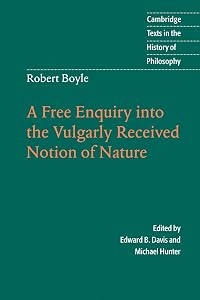
A Free Enquiry into the Vulgarly Received Notion of Nature
by Robert Boyle, Edward B. Davis (Editor), Michael Hunter (Editor)
31 Members (3.00)
On This Page
Description
In this book, published in 1686, the scientist Robert Boyle (1627-91) attacked prevailing notions of the natural world which depicted 'Nature' as a wise, benevolent and purposeful being. Boyle, one of the leading mechanical philosophers of his day, believed that the world was best understood as a vast, impersonal machine, fashioned by an infinite, personal God. In this cogent treatise, he drew on his scientific findings, his knowledge of contemporary medicine and his deep reflection on show more theological and philosophical issues, arguing that it was inappropriate both theologically and scientifically to speak of Nature as if it had a mind of its own: instead, the only true efficient causes of things were the properties and powers given to matter by God. As such, A Free Enquiry into the Vulgarly Received Notion of Nature represents one of the subtlest statements concerning the philosophical issues raised by the mechanical philosophy to emerge from the period of the scientific revolution. show lessTags
Recommendations




Member Reviews
Members
- Recently Added By
Lists

In Our Time books
4,934 works; 2 members
Author Information

74+ Works 329 Members
Born in Munster, Ireland, of English parents, Robert Boyle was among the earliest scientists who studied nature and drew conclusions justified by experiments. A son of a wealthy man, he received a good education. In 1654 he set up a laboratory in Oxford, England, and hired Robert Hooke (1634-1703) as his laboratory assistant. Boyle and Hooke show more designed a greatly improved air pump, which enabled them to study the behavior of air by creating a sufficient vacuum. In 1660 Boyle published Spring and Weight of the Air in which he articulated Boyle's Law, describing the inverse relationship between the temperature and the pressure of a gas. In 1661 Boyle published The Sceptical Chymist in which he challenged the alchemists' belief in the four elements of earth, air, fire, and water. He also attacked the three principles of Paracelsus: salt, sulfur, and mercury. Boyle also studied the relationship between air and combustion and the respiration of animals, and reported his findings in Suspicions about Some Hidden Qualities of the Air (1674). However, the discovery of oxygen would wait for Joseph Priestley. Boyle experimented with the calcination of tin in a sealed container, but, because he weighed only the resultant tin oxide, he did not get sufficient data to interpret the results accurately. When the tin oxide weighed more than the original tin, he theorized that a substance had passed into the glass container. Lavoisier later repeated the experiment, weighed the container, and realized that something in the air had combined with the tin. With his discovery of Boyle's Law, Boyle became somewhat of a celebrity and enjoyed the favor of King Charles II. Boyle contributed to the founding of the Royal Society of London for Improving Natural Knowledge in 1662. Boyle died in London in 1691. (Bowker Author Biography) show less
Michael Hunter, FBA, is Emeritus Professor of History at Birkbeck College, University of London. He is the author of numerous books, including Boyle: Between God and Science (2009); Boyle Studies: Aspects of the Life and Thought of Robert Boyle (1627-91) (2015) and he is the principal editor of Boyle's Works and Correspondence (1999-2001). He has show more also edited Printed Images in Early Modern Britain: Essays in Interpretation (2010). Jim Bennett is Keeper Emeritus of the Science Museum, London, and former Director of the Museum of the History of Science, University of Oxford. He is a leading expert on scientific instruments of the period. show less
Series
Belongs to Publisher Series
Common Knowledge
- Canonical title
- A Free Enquiry into the Vulgarly Received Notion of Nature
Classifications
Statistics
- Members
- 31
- Popularity
- 905,300
- Rating
- (3.00)
- Languages
- English
- Media
- Paper, Ebook
- ISBNs
- 3