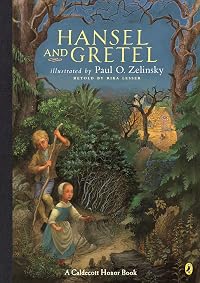
Hansel and Gretel
by Rika Lesser
On This Page
Description
A poor woodcutter's children, lost in the forest, come upon a house made of bread, cakes, and candy, occupied by a wicked witch who likes to have children for dinner.Tags
Recommendations



Member Reviews
This classic retelling of the Grimm's fairy tale is pretty dark for children. A woodsman and his wife live on the edge of the woods with their two children, Hansel and Gretel. Unfortunately, there is not enough food to go around, so the mother convinces the woodsman to take the children out into the woods and leave them there. While he is reluctant to do so, the woodsman agrees. The children overhear the plan and are frightened, but Hansel has a plan. He sneaks out and gathers white pebbles, slipping them into his pocket, and sneaks back to bed. The next day, the woodsman leads the children into the woods and abandons them. But clever Hansel has left a trail of white pebbles, and they find their way home. None too please, the wife again show more convinces her husband to abandon their children in the wilderness, but this time, she locks the door. The woodsmen gives the children bread for the journey, so Hansel leaves a trail of breadcrumbs, but of course, the birds and animals eat them, destroying the trail. Alone and hungry, the children wander through the woods until they happen across a house made of bread, candy, and sweets. Famished, Hansel and Gretel begin gnawing at the house, when an old woman comes out and bids them to come in, where she will feed and take care of them. Well, she throws Hansel in a cage so that she can fatten him up, and makes Gretel her slave. Luckily, the old witch can't see that well, so whenever she goes to check on how juicy and fat Hansel is becoming, he sticks a bone out of the cage door, and in this way, keeps himself and his sister alive for a long time. But finally, the witch gets tired of waiting, so she tells Gretel to prepare the oven. Clever Gretel however, claims she can't do it, and asks the witch to show her how. As soon as the witch climbes in the oven, Gretel slams the door shut, roasting the old witch alive. She frees Hansel, and in the house, they find chests full of gold and jewels. They take what they can and head for home. Their father meets them on the walk and explains that their mother has conveniently dies, and the three of them live happily ever after, presumably after lots and lots of therapy.
This is one of the darkest fairy tales ever written, and that is a crowded field. Between the murderous mother, wet blanket accomplice father, and the cannibalistic witch, this story exemplifies why children should be wary of grownups. This version certainly doesn't shy away from the horror of the original story, although the illustrations, while beautiful, could have been darker and scarier, heightening the tale's essential creepiness. Because of the content, I would steer younger readers away from this story, but older children will enjoy the scariness of what happens to Hansel and Gretel.
For ages 8 - 10. show less
This is one of the darkest fairy tales ever written, and that is a crowded field. Between the murderous mother, wet blanket accomplice father, and the cannibalistic witch, this story exemplifies why children should be wary of grownups. This version certainly doesn't shy away from the horror of the original story, although the illustrations, while beautiful, could have been darker and scarier, heightening the tale's essential creepiness. Because of the content, I would steer younger readers away from this story, but older children will enjoy the scariness of what happens to Hansel and Gretel.
For ages 8 - 10. show less
Hansel and Gretel are a brother and sister who wander in the woods to find strawberries to eat. They eat too many and fall asleep, finally waking to the smell of delicious food cooking in a house where a witch resides. The witch eats children. The children overcome the witch and cook her, and they rescue the other children who are being help captive.
I loved this story. The illustrations are colorful yet not distracting. I enjoyed there is a happy ending to it. The lesson is simple, but still important: Do not wander off into the woods and fall asleep in an unfamiliar territory because you never know what can happen.
I loved this story. The illustrations are colorful yet not distracting. I enjoyed there is a happy ending to it. The lesson is simple, but still important: Do not wander off into the woods and fall asleep in an unfamiliar territory because you never know what can happen.
The story of Hansel and Gretel was always scary to me as a child for obvious reasons. It is a cleverly written story and I like how Rika Lesser changed it up a little bit. The illustrations are absolutely beautiful and accompany the text well. For a child it is hard to think about issues of abandonment, starvation, and cannibalism. These issues can spark conversation between you and your young one and it is a good way to keep the conversation flowing.
This book can be used in class when learning about classic fairy tales. Every child should be exposed to the classics as they are listed as classics for a reason.
This book can be used in class when learning about classic fairy tales. Every child should be exposed to the classics as they are listed as classics for a reason.
The age old story of Hans and Gretel is one of the fairytales wherein the step mother has was too much power over the father of two small children. Food is near non existent and the father simply cannot supply enough for his family.
His wife insists that the solution is to pretend they are walking his two children deep into the woods. They do not return. The first trip, the children manage to return. The second trip they cannot be returned and instead wander throughout the woods. Finding a cottage decorated with a lot of candy, they are lured by a nasty witch who promises to feed them, they follow. They boy child is placed in a cage and daily given a bone to gage if he is fat enough to eat. Every morning the young girl brought food for show more her brother, while she was given none.
Trying to trap the young girl by getting her into the oven, the girl tricked the witch, and the witch was pushed in the oven. Taking every jewel they could find, the children leave the cottage with many treasures. Finding their way back home, they learn their stepmother has died and their father is delighted to see them.
Showing him all the treasures, they live happily ever after. show less
His wife insists that the solution is to pretend they are walking his two children deep into the woods. They do not return. The first trip, the children manage to return. The second trip they cannot be returned and instead wander throughout the woods. Finding a cottage decorated with a lot of candy, they are lured by a nasty witch who promises to feed them, they follow. They boy child is placed in a cage and daily given a bone to gage if he is fat enough to eat. Every morning the young girl brought food for show more her brother, while she was given none.
Trying to trap the young girl by getting her into the oven, the girl tricked the witch, and the witch was pushed in the oven. Taking every jewel they could find, the children leave the cottage with many treasures. Finding their way back home, they learn their stepmother has died and their father is delighted to see them.
Showing him all the treasures, they live happily ever after. show less
Oddly, the starving family doesn’t look very poor in the illustrations. They have a solid looking, well-furnished house in a lovely location near a forest. They could do a reverse mortgage and raise some cash. Apparently feudal Germany was crying out for some financial wizardry. A good loan originator could have saved these children, at least gotten this beleaguered family through a dry patch until the factory was hiring again. Of course, after a number of years, they would have to move out, but they would have needed to do that anyway.
Summary:
This is the story of Hansel and Gretel who are taken out into the woods and left by their parents when there is not enough food for the entire family. While lost in the woods, Hansel and Gretel find a house made of bread and candy that belongs to an old witch. The witch plans to eat Hansel and Gretel, but Gretel pushes the witch into the oven. The two children then gather up the treasures that they find in the house and find their way back home to their father.
Personal Reaction:
I remember hearing different versions of this story as a kid. This version seems to follow the original Grimm versions of 1810 and 1812. And I like it the best. I like that the children are able to find their way back home with treasures for their father show more that never wanted them to go into the forest at all. And that they don't have to worry about food after all that they went through with the witch.
Classroom Extensions:
The students could design their version of what the witch's house looked like. They could also brainstorm and think of ways that would have been better than dropping the bread crumbs to mark the way back home. show less
This is the story of Hansel and Gretel who are taken out into the woods and left by their parents when there is not enough food for the entire family. While lost in the woods, Hansel and Gretel find a house made of bread and candy that belongs to an old witch. The witch plans to eat Hansel and Gretel, but Gretel pushes the witch into the oven. The two children then gather up the treasures that they find in the house and find their way back home to their father.
Personal Reaction:
I remember hearing different versions of this story as a kid. This version seems to follow the original Grimm versions of 1810 and 1812. And I like it the best. I like that the children are able to find their way back home with treasures for their father show more that never wanted them to go into the forest at all. And that they don't have to worry about food after all that they went through with the witch.
Classroom Extensions:
The students could design their version of what the witch's house looked like. They could also brainstorm and think of ways that would have been better than dropping the bread crumbs to mark the way back home. show less
Hansel and Gretel is a traditional fairy tale that has been around for a very long time. I really liked this story due to the variety of characters and the detailed, colorful illustrations. The story begins with the mother forcing her husband to abandon their two children deep in the forest with nothing more than a little piece of bread. The mother is immediately depicted as an evil character without a heart. On the other hand, Hansel is depicted as clever as he lays white pebbles and pieces of bread as they walk, so the children will be able to find their way back home. However, after a few days in the forest, they find a house with a little old woman. Unfortunately, she ends up caging Hansel, so she can fatten him up and eventually show more eat him! She is also depicted as an evil character, despite her kind and inviting appearance. Luckily, Gretel saves the day. After many episodes of being weak and upset, she finally shows her courage as she pushes the evil old woman into the oven and saves both of their lives. This book creates a strong story through the use of protagonist and antagonist characters, immediately drawing the reader to follow the protagonists on their strange and scary journey.
Along with the characters, I also found that the colorful and detailed illustrations truly added to the story. The reader can visually experience the beauty of the bread and candy house, and the excitement and joy it brought the children. And also, experience the fear and surprise both Gretel and Hansel feel through their facial expressions when the old woman is no longer nice and inviting.
Overall, I think the main message is that not all people can be trusted. This message is very important for children to understand, because there are both strangers and people they are close to that could cause them harm. Most children wouldn't believe their own mother or a nice old woman would ever harm them, yet Hansel and Gretel are left in harmful situations by both of them. Although I believe the story has a strong message that all children should learn, this story can be very scary and disturbing for young children. show less
Along with the characters, I also found that the colorful and detailed illustrations truly added to the story. The reader can visually experience the beauty of the bread and candy house, and the excitement and joy it brought the children. And also, experience the fear and surprise both Gretel and Hansel feel through their facial expressions when the old woman is no longer nice and inviting.
Overall, I think the main message is that not all people can be trusted. This message is very important for children to understand, because there are both strangers and people they are close to that could cause them harm. Most children wouldn't believe their own mother or a nice old woman would ever harm them, yet Hansel and Gretel are left in harmful situations by both of them. Although I believe the story has a strong message that all children should learn, this story can be very scary and disturbing for young children. show less
Members
- Recently Added By
Lists

Caldecott Honor Books
296 works; 23 members

Books Read in 2023
5,638 works; 147 members
Author Information

5+ Works 1,243 Members
All Editions
Awards and Honors
Work Relationships
Is a retelling of
Common Knowledge
- Canonical title
- Hansel and Gretel
- Original title
- Hansel and Gretel
- Original publication date
- 1984
- People/Characters
- Hansel; Gretel
- Dedication
- For Grammie and Poppa with love
P. O. Z.
For Elisabeth
R. L.
For Donna Brooks
P. O. Z. & R. L. - First words
- At the edge of a great forest, there once lived a poor woodcutter.
- Last words
- (Click to show. Warning: May contain spoilers.)Now they emptied their pockets of the glittering jewels, and the woodcutter and his children lived happily and prospered to the end of their days.
Classifications
Statistics
- Members
- 1,220
- Popularity
- 20,307
- Reviews
- 76
- Rating
- (3.91)
- Languages
- Chinese, English, French, Spanish
- Media
- Paper, Audiobook, Ebook
- ISBNs
- 39
- ASINs
- 8