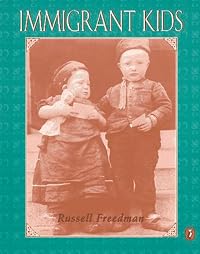
Immigrant Kids
by Russell Freedman
On This Page
Description
Text and contemporary photographs chronicle the life of immigrant children at home, school, work, and play during the late 1800's and early 1900's.Tags
Recommendations








Member Reviews
Filled with photos and first-hand accounts from former "immigrant kids" themselves, this is a quick and informative look at immigrant life in New York during the late 19th and early 20th centuries. This approach offers modern kids a clearer look at life for people new to the US more than 100 years ago than they might get from descriptions alone. Helps children see that, despite differences of time, dress, and experience, kids are kids.
Russell Freedman writes about the immigrant experience in America in the 1800s. It starts by talking about the experience of immigrants coming over and arriving at Ellis Island. Then it goes through their experience of how they lived at home, at school, at work and and for leisure. This book is filled with facts and a reader can learn a lot about the experience...but the pictures really tell the story. Wow! Many of the photos were taken by Jacob A Riis, a NYC newspaper reporter who was originally an immigrant himself. He wanted to follow the real lives of immigrants by taking photos of them in places where pictures hadn't been taken before--like in sweatshops and tenement buildings. He learned to use a detective camera to be able to show more take these pictures, so in this way they are pretty special.
This is a book that has been in my classroom for a couple of years. I have a small group set of these, so now that I have read this book myself, I feel much more comfortable to pull out this set and read it with a small group. This book would be a great way to compare and contrast lives of immigrants then and now. In so many of the descriptions I had to remind myself that Freedman was discussing immigrants from 150 years ago, not immigrants of today. There were so many similarities to today's immigrants. show less
This is a book that has been in my classroom for a couple of years. I have a small group set of these, so now that I have read this book myself, I feel much more comfortable to pull out this set and read it with a small group. This book would be a great way to compare and contrast lives of immigrants then and now. In so many of the descriptions I had to remind myself that Freedman was discussing immigrants from 150 years ago, not immigrants of today. There were so many similarities to today's immigrants. show less
Full of interesting information, and perhaps a good book for a child to use in a traditional report-style assignment, but this book was simply not presented in a stimulating or relatable manner for young kids, at least not in my opinion. I think you would be hard-pressed to find a kid that would ever pick this book up off the shelf just as a pleasurable read.
Summary: Freedom was a watch word for the immigrants migrating to the United States early last century, but the reality that immigrant children faced, was far different then that. Crowded cities and scarcity was a daily occurrence. In order to augment the family budget, children got jobs in whatever profession they could find.
Personal Reaction: I like this book because within its pages are facts and realities that todays children in America know nothing about. This is a great history lesson in and of itself. Good read for any child wanting a bit of knowledge in general.
Classroom Extension: A comprehensive look into the way children lived a long time ago, as opposed to today might open some minds to what hard work really means. I would show more have them make comparison charts to show the work they do to survive compared to what kids did in the past. show less
Personal Reaction: I like this book because within its pages are facts and realities that todays children in America know nothing about. This is a great history lesson in and of itself. Good read for any child wanting a bit of knowledge in general.
Classroom Extension: A comprehensive look into the way children lived a long time ago, as opposed to today might open some minds to what hard work really means. I would show more have them make comparison charts to show the work they do to survive compared to what kids did in the past. show less
This book is about what it was like for Immigrant kids after they came to America and is filled with real pictures taken during the time. It covers the travels here and the life once they arrived. It has sections in which an immigrant shares their own experience as a child during that time. The book can really make a kid greatful for what they have. It is great to be used with a history lesson and is accurate and powerful with its words and pictures. It could also lead into a discuss on child labor laws that followed this time.
Immigrant Kids is a detailed information book about the lives of immigrant children during the second large wave of immigration, the 1890s. The book is honest and offers a realistic view of what children in the new land of 'freedom' had to endure. The promise of America often fell short for immigrants, including immigrant kids. This important part of U.S. history is illustrated with historic photos by Jacob A. Riis and Lewis Hine.
I would use this book in a third grade class when discussing immigration. It is an interesting book because it tells the story of the kids. For students, this is a more interesting perspective. I would use it with older students because of the difficult and challenging experiences many of these kids faced.
Members
- Recently Added By
Author Information

70+ Works 20,504 Members
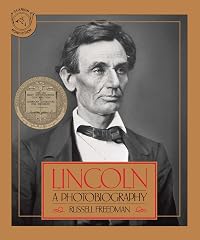
Russell Freedman was born in San Francisco, California on October 11, 1929. He received a bachelor's degree in English from the University of California, Berkeley in 1951. After college, he served in the U.S. Counter Intelligence Corps during the Korean War. After his military service, he became a reporter and editor with the Associated Press. In show more 1956, he took a position at the advertising agency J. Walter Thompson in New York, where he did publicity writing for television. In 1965, he became a full-time writer. His first book, Teenagers Who Made History, was published in 1961. He went on to publish more than 60 nonfiction titles for young readers including Immigrant Kids, Cowboys of the Old West, Indian Chiefs, Martha Graham: A Dancer's Life, Confucius: The Golden Rule, Because They Marched: The People's Campaign for Voting Rights That Changed America, Vietnam: A History of the War, and The Sinking of the Vasa. He received the Newbery Medal for Lincoln: A Photobiography and three Newbery Honors for Eleanor Roosevelt: A Life of Discovery, The Wright Brothers: How They Invented the Airplane, and The Voice That Challenged a Nation: Marian Anderson and the Struggle for Equal Rights. He also received the Regina Medal, the May Hill Arbuthnot Lecture Award, the Orbis Pictus Award, the Sibert Medal, a Sibert Honor, the Laura Ingalls Wilder Medal, and the National Humanities Medal. He died on March 16, 2018 at the age of 88. (Bowker Author Biography) show less
Awards and Honors
Awards
Common Knowledge
- First words
- In the years around the turn of the century, immigration to America reached an all-time high. Between 1880 and 1920, 23 million immigrants arrived in the United States. They came mainly from the countries of Europe, especia... (show all)lly from impoverished towns and villages in southern and eastern Europe.
Classifications
- Genre
- Nonfiction
- DDC/MDS
- 305.230973 — Society, government, & culture Social sciences, sociology & anthropology Social group - Age, Gender, Ethnicity Age groups Young people up to 20
- LCC
- HQ796 .F7635 — Social sciences The family. Marriage, Women and Sexuality The Family. Marriage. Women The family. Marriage. Home Youth. Adolescents. Teenagers
- BISAC
Statistics
- Members
- 1,262
- Popularity
- 19,513
- Reviews
- 18
- Rating
- (4.10)
- Languages
- English
- Media
- Paper, Audiobook, Ebook
- ISBNs
- 12
- ASINs
- 5