
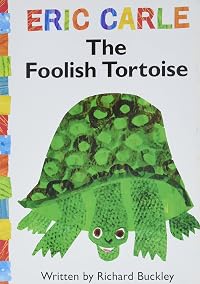
The Foolish Tortoise
by Richard Buckley
On This Page
Description
A tortoise realizes the need for a shell after several scary encounters.Tags
Recommendations









Member Reviews
A tortoise casts aside the safety of his shell to experience the world in a new way only to be beaten down by his fear of the dangers and chaos he finds.
So the awful lesson is never change -- embrace the status quo -- or you'll regret everything. What a foolish tortoise. What a foolish author.
Nice pictures though.
So the awful lesson is never change -- embrace the status quo -- or you'll regret everything. What a foolish tortoise. What a foolish author.
Nice pictures though.
A turtle decides to leave his shell behind one day as it weighs him down, but then discovers all the ways the shell benefits him.
Featuring Eric Carle's distinctive collage work, the illustrations in this book are pure fun. The story itself is captivating enough, and Buckley uses beautiful poetry to tell it. The only downside to this is the possibility that the very young intended audience might not quite understand everything - it's probably confusing for them to hear passages in which nouns and verbs in a sentence are inverted to force a rhyme, especially given that they rarely hear such usage. The vocabulary choices are also sometimes more difficult in order to make passages alliterative (i.e., "A hare, a hound, a horse raced by") or show more to use some other poetic device. Still, I'm one to err on the side of presenting an introduction to something new that will expand young children's minds (and vocabularies), even if it means having to read the book more than once and provide some extra explanations/definitions. Using this method, I found that even my toddler class enjoyed this book and seemed to understand it.
This edition includes an audio CD of the book being read by Keith Nobbs. I did not find his reading to be particularly interesting; it was rather flat and monotone actually. Unlike many other audio CDs accompanying books for young readers, there were no cues for when to turn the page. This is something that tends to be very helpful for beginning readers (or non-readers who are working on pre-literacy skills), so I found that sadly lacking. show less
Featuring Eric Carle's distinctive collage work, the illustrations in this book are pure fun. The story itself is captivating enough, and Buckley uses beautiful poetry to tell it. The only downside to this is the possibility that the very young intended audience might not quite understand everything - it's probably confusing for them to hear passages in which nouns and verbs in a sentence are inverted to force a rhyme, especially given that they rarely hear such usage. The vocabulary choices are also sometimes more difficult in order to make passages alliterative (i.e., "A hare, a hound, a horse raced by") or show more to use some other poetic device. Still, I'm one to err on the side of presenting an introduction to something new that will expand young children's minds (and vocabularies), even if it means having to read the book more than once and provide some extra explanations/definitions. Using this method, I found that even my toddler class enjoyed this book and seemed to understand it.
This edition includes an audio CD of the book being read by Keith Nobbs. I did not find his reading to be particularly interesting; it was rather flat and monotone actually. Unlike many other audio CDs accompanying books for young readers, there were no cues for when to turn the page. This is something that tends to be very helpful for beginning readers (or non-readers who are working on pre-literacy skills), so I found that sadly lacking. show less
There are two reasons why I love this book: the language and the illustrations by Eric Carle.
The language of this book is great because they rhyme. The pattern of the rhyming makes the book enjoyable and interesting. One example of this rhyming is “Took off his large and heavy shell and left it lying where it fell.” I liked that this book rhymes because it makes it fun to read. The language makes sense to the text while also being exciting. The author did a good job at using rhyming while also making the story progress. The language of the story makes it exciting, but it is also organized well.
The second reason I love this book is because of the pictures. The illustrations are detailed and fun. The illustrations are very colorful show more and are large on the pages which makes them exciting. They enhance the story well because each illustration details the text on the page. For example, when the book talks about a large snake creeping on the turtle, the illustration of the snake takes up two pages and is hissing. The style of the illustrations also fits the style of the written text. The text is upbeat and artistic and the pictures are, too. Eric Carle used his artistic style to accommodate the artistic attributes of the language used by the author. The illustrations play a good part in making this story great.
The main idea of this story is to accept who you are. Since the tortoise wants to become something it is not, a tortoise without a shell, it can teach readers to be happy with who they are. Once the tortoise does leave the shell behind, he runs into all different situations that he wishes he had his shell. For example, he was cold in the bad weather and had no protection from the hornet. By the end of the book, the tortoise realizes he is better with his shell and even though he is not fast, his shell has many benefits. This can teach readers to be happy with who they are and not to wish they were different. The tortoise teaches a good lesson about accepting yourself and using your faults as something positive. show less
The language of this book is great because they rhyme. The pattern of the rhyming makes the book enjoyable and interesting. One example of this rhyming is “Took off his large and heavy shell and left it lying where it fell.” I liked that this book rhymes because it makes it fun to read. The language makes sense to the text while also being exciting. The author did a good job at using rhyming while also making the story progress. The language of the story makes it exciting, but it is also organized well.
The second reason I love this book is because of the pictures. The illustrations are detailed and fun. The illustrations are very colorful show more and are large on the pages which makes them exciting. They enhance the story well because each illustration details the text on the page. For example, when the book talks about a large snake creeping on the turtle, the illustration of the snake takes up two pages and is hissing. The style of the illustrations also fits the style of the written text. The text is upbeat and artistic and the pictures are, too. Eric Carle used his artistic style to accommodate the artistic attributes of the language used by the author. The illustrations play a good part in making this story great.
The main idea of this story is to accept who you are. Since the tortoise wants to become something it is not, a tortoise without a shell, it can teach readers to be happy with who they are. Once the tortoise does leave the shell behind, he runs into all different situations that he wishes he had his shell. For example, he was cold in the bad weather and had no protection from the hornet. By the end of the book, the tortoise realizes he is better with his shell and even though he is not fast, his shell has many benefits. This can teach readers to be happy with who they are and not to wish they were different. The tortoise teaches a good lesson about accepting yourself and using your faults as something positive. show less
This story tells the tale of a tortoise who is tired of the limitations of his shell, so he sheds it and attempts to take on the world at a faster pace. Through his journey, however, he starts to understand and appreciate the purpose and protection of his shell, and ultimately returns to it. This is a great lesson in perspective and appreciation in a fun way that engages children, especially with the rhymes, as well as the interesting artwork from Eric Carle.
Eric Carle writes about a Tortoise who decides to ditch its shell because he feels as if it holds him back. He soon realizes that he needs his shell because it keeps him safe, warm, and dry. What I got from reading the book is that every aspect of a person is made with a purpose and you need to always learn to love yourself! Eric Carle, of course, did not disappoint with his unique illustrations throughout this book! The pictures include lots of color, texture, and meaning! The words rhyme and flow very well! The last word of each sentence rhymes with the last word of the next sentence.
I really like this story illustrated by Eric Carle. Eric Carle is known for his collage style art, which is a skill he utilizes in this particular book. The Scholastic Readability Level of this story is PreK-2nd grade. It features the life of a tortoise that abandons his shell because he is tired of being slow. Over time, he realizes that without his shell he is vulnerable to the weather, animals, and other dangers. Additionally, he is not that much faster than before. In the end, he realizes that he misses his shell, which provided him with safety and shelter. I love the moral of the story and it is a fine example of rhyme. I would have students pick out rhyming examples in the story throughout and create rhyming pairs of their own at show more the end. show less
So, the lesson is, don't strive beyond your station or your comfort zone, stay timid? Blech. I guess you could discuss it with your kiddos. The pix are wonderful of course. Be aware that it is told in rhyme, which I know some of you despise.
Members
- Recently Added By
Author Information
All Editions
Common Knowledge
- Canonical title
- The Foolish Tortoise
- Original title
- The Foolish Tortoise
- Original publication date
- 1985
- First words
- A tortoise, tired of being slow,
Impatient to get up and go, - Last words
- (Click to show. Warning: May contain spoilers.)He climbed back in and said, "Goodnight!"
- Original language
- English
Classifications
Statistics
- Members
- 2,536
- Popularity
- 7,523
- Reviews
- 18
- Rating
- (3.88)
- Languages
- Dutch, English, German
- Media
- Paper, Audiobook
- ISBNs
- 33
- UPCs
- 1
- ASINs
- 20
