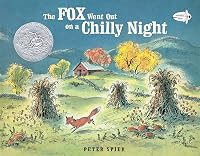
The Fox Went Out on a Chilly Night
by Peter Spier
On This Page
Description
The countryside of New England is depicted in the pictures accompanying this folk song in which a fox travels many miles to get dinner for his wife and ten cubs.Tags
Recommendations













Member Reviews
A vulpine adventurer heads to town in this wonderful picture book presentation of the classic folk song from author/illustrator Peter Spier, winner of a Caldecott Honor in 1962. Traveling many miles, the fox passes a farm where he makes off with a grey goose and duck, and pursued by the farmer, heads home to feed his wife and ten little kits. The book closes with the music and lyrics for the song, and an afterword from Spier describing the Vermont countryside which inspired his illustrations...
Originally published in 1961, in an edition that alternated between color and black and white scenes, The Fox Went Out on a Chilly Night was republished in 2014 in a new edition featuring fully colorized artwork, created by Spier from his original show more illustrations. It is this latter edition that I read, and greatly enjoyed. The song which provides the text here is from England, and dates back to two 15th-century poems in Middle English, The Fox and the Goose and The False Fox. It was recorded as a song in 1810 in Joseph Ritson's Gammer Gurton's Garland, where it was entitled Dame Widdle Waddle. It's interesting to note that the farmer's wife in this modern version is "old mother Giggle-Gaggle." Although originating in England, the visual setting here is classic New England, with the steeple church and the Civil War memorial on the village green. According to Spier, a Dutch-born American author and artist, the setting was inspired by a drive through Vermont one autumn, and he later studied farms around Newfane, VT for specific details, as well as visiting the Farmers' Museum in Cooperstown, New York and Old Sturbridge Village in Massachusetts. All of this preparation certainly paid off, as the visuals here are an absolute delight! I enjoyed everything about this book, from the vulpine hero—foxes are a weakness of mine, and I wrote my masters dissertation on three centuries of Reynard retellings for children—to the autumnal setting (my favorite season), to the artwork in general, with its feeling of old-time authenticity and New England charm. After reading it the first time, I then found a wonderful recording of the song itself on Youtube, performed by Apollo's Fire and accompanied by pages from this book, which I also greatly enjoyed! Highly recommended to anyone who appreciates folk songs turned into picture books, foxy tales (and tails!), and gorgeous picture book art. show less
Originally published in 1961, in an edition that alternated between color and black and white scenes, The Fox Went Out on a Chilly Night was republished in 2014 in a new edition featuring fully colorized artwork, created by Spier from his original show more illustrations. It is this latter edition that I read, and greatly enjoyed. The song which provides the text here is from England, and dates back to two 15th-century poems in Middle English, The Fox and the Goose and The False Fox. It was recorded as a song in 1810 in Joseph Ritson's Gammer Gurton's Garland, where it was entitled Dame Widdle Waddle. It's interesting to note that the farmer's wife in this modern version is "old mother Giggle-Gaggle." Although originating in England, the visual setting here is classic New England, with the steeple church and the Civil War memorial on the village green. According to Spier, a Dutch-born American author and artist, the setting was inspired by a drive through Vermont one autumn, and he later studied farms around Newfane, VT for specific details, as well as visiting the Farmers' Museum in Cooperstown, New York and Old Sturbridge Village in Massachusetts. All of this preparation certainly paid off, as the visuals here are an absolute delight! I enjoyed everything about this book, from the vulpine hero—foxes are a weakness of mine, and I wrote my masters dissertation on three centuries of Reynard retellings for children—to the autumnal setting (my favorite season), to the artwork in general, with its feeling of old-time authenticity and New England charm. After reading it the first time, I then found a wonderful recording of the song itself on Youtube, performed by Apollo's Fire and accompanied by pages from this book, which I also greatly enjoyed! Highly recommended to anyone who appreciates folk songs turned into picture books, foxy tales (and tails!), and gorgeous picture book art. show less
This American folk song about a fox’s raid on a poultry house in town is illustrated in lush detail by Spier based on extensive sketches he made on a field trip to southern New England. The result is a lively mixture of realism and humorous fantasy. The book is filled with details of grinning foxes, startled geese, the autumn countryside in moonlight, shocks of corn drying in the field, a covered bridge, tobacco drying in barns, an old graveyard, the town square with its civil war memorial inscribed with the town’s old family names, names like like Andrews, Jones, Perkins, and Giggle Gaggle. Giggle Gaggle, a name that also appears on a tombstone in the cemetery, because old mother Giggle-Gaggle is the citizen that raise the alarm show more about the raid, causing the fox to get out of town fast, and home to his family feast in a den furnished remarkably like those of the town’s residents. Wonderfully detailed ink sketches in black and white alternate with vivid water-colored ones. All in all, this is a bravo production. show less
The book had an interesting concept, considering illustration, where every other page was in color and the pages in between were drawn in just black and white. There would be beautiful landscapes of the New England Fall landscape, trees with leaves of all shades, from red to orange to yellow. Then there would be entire pages of black and white. This seemed odd when reading about the fox leaving his home and stealing the goose and the duck from the farmer. But as the story progressed to the fox returning home to feed his family with the food, you see the other side to this story. How the fox is simply providing for his family, like any father would. This twist questions the emotions felt about the fox, having him going from a sneaky show more predator to a providing father. The pages in black and white brought on an ominous, sinister tone to the story, which was actually an old song, while the pages in color would seem to pop even more climactically and vividly. The color also added warmth to the fox when he is sitting by the fire, as his children nibbled on the bones after the meal, there stomachs' full from their father's hunt. It was a surprise to myself, personally, when the fox returned home and we saw that he was providing for his family and all of his children and I felt torn on whether or not he was the bad guy. show less
This Caldecott Honor Book has been a favorite in my family for about 30 years and was a frequently requested story for my four boys as they were growing up. It was illustrated in 1961 by Peter Spier and is based on a Burl Ives arrangement from 1945 of an old folk tune called "The Fox." The lyrics make up the lively text. Spier's wonderful line drawings are filled with details, plenty of action and a folksy, down-home world of a bygone era from the turn of the last century. Every other page is in full color with the rest in black and white. The drawings are so chock full of details that you will enjoy the black and white ones nearly as much as the colored ones. Small town life and a rustic farm homestead come to life in these pages as show more the fox goes out on a chilly night to find supper for his hungry children. The pictures are informative and interesting and funny. There is so much flavor in this book that you'll want to share it with the kids again and again. There is music at the back of the book for voice, piano and guitar so that you can sing along and teach the kids to join in. All seven verses are included. I still sing this song on road trips and every one of my grown children remembers the words. It's a treasure. show less
A fox goes into "town" to snag some farm animals to bring home as dinner for his family.
I love the song "The Fox," and although I've heard a couple of different versions before, the text Spier presents here varies ever so slightly. But it retains the overall fun and upbeat cadence of the song with its repeating lines and rhymes. My 4-year-old niece and I read the book together, then listened to a version of the song while following along in the book, matching the lyrics to the pictures.
The illustrations are beautifully delicately and finely executed. There are lots of details in each picture and the colors are rich in shade and hues. However, only every other spread is colored with the others being black and white sketches. I found show more this a very odd choice and didn't care for it much. show less
I love the song "The Fox," and although I've heard a couple of different versions before, the text Spier presents here varies ever so slightly. But it retains the overall fun and upbeat cadence of the song with its repeating lines and rhymes. My 4-year-old niece and I read the book together, then listened to a version of the song while following along in the book, matching the lyrics to the pictures.
The illustrations are beautifully delicately and finely executed. There are lots of details in each picture and the colors are rich in shade and hues. However, only every other spread is colored with the others being black and white sketches. I found show more this a very odd choice and didn't care for it much. show less
Not a quick read! First I recommend you read the music in the back, if you know how, or at least find a video on youtube, so you know how to read the text. Then I recommend you read the text aloud, in that rhythm, singing if you can, or at least chanting.
Meanwhile, there's *lots* of detail in the pictures. Looks like someone's going to get a cutter for Christmas - see the page from the catalog on the second 'grease my chin' page, and note all the details that signify this is Autumn. Note the text on the Statue in the Town Square, and that the memorial is specifically for Civil War dead, not a generic statue. Note that the Giggle-Gaggles and all their poultry live in town (at least on the edge) - they're not actual farmers.
What is show more *your* favorite detail?
I do wonder about one image - I see syrup buckets hanging from some trees on an early page. But syrup is drawn in early spring, generally March. And it wouldn't be wise, I would think, to leave the buckets exposed in all weather. Do any of you know more about syruping??
I highly recommend the book. Maybe not to buy, but even if you have to beg permission to read it at the library instead of taking it home, do so. Imo, it deserved the Caldecott honor. 1962 was a very good year. show less
Meanwhile, there's *lots* of detail in the pictures. Looks like someone's going to get a cutter for Christmas - see the page from the catalog on the second 'grease my chin' page, and note all the details that signify this is Autumn. Note the text on the Statue in the Town Square, and that the memorial is specifically for Civil War dead, not a generic statue. Note that the Giggle-Gaggles and all their poultry live in town (at least on the edge) - they're not actual farmers.
What is show more *your* favorite detail?
I do wonder about one image - I see syrup buckets hanging from some trees on an early page. But syrup is drawn in early spring, generally March. And it wouldn't be wise, I would think, to leave the buckets exposed in all weather. Do any of you know more about syruping??
I highly recommend the book. Maybe not to buy, but even if you have to beg permission to read it at the library instead of taking it home, do so. Imo, it deserved the Caldecott honor. 1962 was a very good year. show less
This Caldecott Honor Book is amazing musical tale about how a fox who goes out on a chilly night and visits the hen house of a local farmer in or near a village. The fox must do this in order to feed his children/family. The book is the picture and word story of his journey there and back with the meal for his family. He has a family of 10 little foxes and a wife. What I love the most about this picture book is that the lyrics fit so well with the pictures. Spier's drawings are filled with wonderful details. Most pages are in full color with the rest in black and white. All the colors are wonderfully blended. I can’t even pick a favorite page because they are all so beautifully drawn whether it is a black and white page or a colored show more one. I would highly recommend this book for children! show less
Members
- Recently Added By
Lists

Caldecott Honor Books
296 works; 23 members

Rabbit and Fox Story Books For Children
139 works; 7 members

Reading Rainbow
193 works; 10 members

Books Read in 2023
5,638 works; 147 members

Early Picture Books
467 works; 9 members
Author Information

66+ Works 12,664 Members
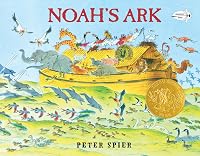
Peter Edward Spier was born in Amsterdam on June 6, 1927. His formal education ended in his early teens, about a year after the Nazis invaded the Netherlands in 1940. His father was imprisoned by the Nazis for an illustration of Hitler that speculated about what would have happened had he stayed a painter. Since the family was Jewish, they were show more all sent to the Theresienstadt concentration camp in Czechoslovakia. They were liberated by the Soviet Red Army in May 1945. Spier returned to the Netherlands after the war and served in the Royal Netherlands Navy for four years before immigrating to the United States in 1951. He worked in advertising before he began to write and illustrate children's books. His books included The Cow Who Fell in the Canal by Phyllis Krasilovsky, The Fox Went Out on a Chilly Night, Of Dikes and Windmills, and Circus! He received the Caldecott Medal for Noah's Ark. He died of congestive heart failure on April 27, 2017 at the age of 89. (Bowker Author Biography) show less
Awards and Honors
Work Relationships
Is contained in
Common Knowledge
- Canonical title
- The Fox Went Out on a Chilly Night
Classifications
- Genres
- Children's Books, Picture Books, Poetry
- DDC/MDS
- 782.42162 — Arts & recreation Music Vocal music Secular forms of vocal music Songs General principles and musical forms Traditions of secular songs {genres} Folk songs
- LCC
- PZ8.3 .F825 — Language and Literature Fiction and juvenile belles lettres Fiction and juvenile belles lettres Juvenile belles lettres
- BISAC
Statistics
- Members
- 1,255
- Popularity
- 19,601
- Reviews
- 18
- Rating
- (3.96)
- Languages
- Chinese, English
- Media
- Paper, Audiobook, Ebook
- ISBNs
- 31
- ASINs
- 11