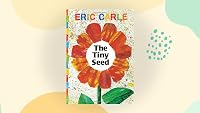
The Tiny Seed
by Eric Carle
On This Page
Description
A simple description of a flowering plant's life cycle through the seasons.Tags
Recommendations






Member Reviews
I have always loved Eric Carle's books. I really liked this particular book for a number of reasons. First, it is educational, but still engaging. It shows what can happen to seeds as they are carried by the wind before they are able to land safely and grow into a plant. Two examples of those things are landing in a place where a seed cannot grow, such as a snowy mountain top, or being eaten by an animal, like a bird or mouse. The way it is illustrated is absolutely beautiful to me and I enjoyed going through this book as a college student, so I think they are colorful enough for a child to enjoy, as well. It is also engaging because the narrator asks questions for the reader to consider: "Will it [the seed] be able to keep up with the show more others [other seeds]? And where are they all going?" It keeps you thinking as the tiny seed embarks on its journey, and I think it is an excellent touch. I also like that the entire story is a metaphor. The tiny seed follows the other, larger seeds as the wind carries them to their resting place to grow. Bad things happen to the larger seeds because they are noticed more quickly, and the tiny seed stays off to the side, and is the last seed to begin sprouting. In the end, the tiny seed is the only one to survive and grows into the biggest, most beautiful flower anyone had ever seen. This illustrates the big idea, which is even though you may be small, you can grow to accomplish big things. show less
Summary: "The Tiny Seed" is a colorful picture book about the life of a seed. As the seasons pass by, a seed follows a cycle of life. These seeds are susceptible to many obstacles, such as being picked or damaged. The seeds that do survive blossom into beautiful flowers. These flowers will release more seeds and the entire cycle will restart.
Review: Eric Carle's love of a nature is found in "The Tiny Seed". Aside from the beautifully crafted illustrations, the story is one of my favorites to this point. I took away from this book that no matter how beautiful and perfect something may be (a flower), there are still hardships that can get in the way. This would be a great lesson for young children about the cycle of life and the product show more that can be created. show less
Review: Eric Carle's love of a nature is found in "The Tiny Seed". Aside from the beautifully crafted illustrations, the story is one of my favorites to this point. I took away from this book that no matter how beautiful and perfect something may be (a flower), there are still hardships that can get in the way. This would be a great lesson for young children about the cycle of life and the product show more that can be created. show less
I like the middle part of the book that shows the many ways seeds can miss the opportunity to sprout and become full-grown plants, but I dislike that the beginning and end have bad information about things in our atmosphere catching fire from the sun and a flower that grows taller than trees and houses. That nonsense spoils it for me.
A tiny seed is following all the other seeds from the same flower as they blow through the sky with the wind, but the tiny seed has a hard time keeping up. It narrowly escapes many different dangers that some of the other seeds weren't so lucky to avoid. The tiny seed finally begins to grow, slowly at first, but then it keeps growing taller and taller. It grows to be the biggest flower people have ever seen! Fall comes again, and along with the petals, all of the seeds begin to blow off of the giant flower, starting the cycle over again.
This book is really cute, and it touches on the cyclical nature of life, which is a good concept to introduce to children at a young age. Readers can assume that the seeds from the giant flower will go show more through similar things as the tiny seed and their inferencing that builds critical thinking skills. I also liked that you can draw the message that you can grow up to be anything you want to be from this story. The seed was tiny, but it still grew up to be the biggest flower anyone has seen. Plus, the seed's tiny size helped it avoid danger a few times, which teaches that sometimes what we see as our flaws are really advantages. I absolutely loved the illustrations, as it is in Carle's typical collage style with vivid colors and abstract images. Young readers would really enjoy looking at the pictures and hearing this story. show less
This book is really cute, and it touches on the cyclical nature of life, which is a good concept to introduce to children at a young age. Readers can assume that the seeds from the giant flower will go show more through similar things as the tiny seed and their inferencing that builds critical thinking skills. I also liked that you can draw the message that you can grow up to be anything you want to be from this story. The seed was tiny, but it still grew up to be the biggest flower anyone has seen. Plus, the seed's tiny size helped it avoid danger a few times, which teaches that sometimes what we see as our flaws are really advantages. I absolutely loved the illustrations, as it is in Carle's typical collage style with vivid colors and abstract images. Young readers would really enjoy looking at the pictures and hearing this story. show less
Very bold and cute, there's a reason why this author is well-regarded as a children's book author. Also thought-provoking when you realize how many seeds never actually make it.
I greatly enjoyed “The Tiny Seed”, the central message of which was that even the tiniest seed has the potential to become the biggest flower. I loved the story’s plot, which was the story of a tiny seed who sailed across the world until landing in the earth, and eventually becoming the largest flower anyone had ever seen. This book made the process by which a seed travels, is planted, and is grown accessible to young readers. I also liked the book for its clear, patterned language, e.g., “One of the seeds flies higher than the others. Up, up it goes! It flies too high and the sun’s hot rays burn it up. But the tiny seed sails on with the others.” I felt that the well-paced way in which the story was written made it easy for show more the reader to follow along with the story. Finally, I loved the story’s illustrations, which I felt enhanced the story by so accurately and beautifully depicting the tiny seed’s journey to becoming the largest flower of the bunch. This book is definitely one which I would like to have my in future classroom library, for it makes information about the process by which a seed travels and grows accessible and enjoyable to young readers. show less
This book has a great combination of narrative and nonfiction elements to it. The way it informs the readers and listeners about the way thats seeds travel through nature from plant to plant is just fantastic and great for science lessons. The illustrations are also vivid and colorful. If the words lose the readers its okay because their focus can remain on the bright pictures. The author makes sure that it is just as interesting as it is informative making sure by the end of the book you understand the plant cycles through the seasons.
Members
- Recently Added By
Lists

Garden
23 works; 2 members

Early Picture Books
467 works; 9 members

Little Library finds
87 works; 2 members

1970 Club
85 works; 2 members

Written and Illustrated By
805 works; 1 member
Author Information

585+ Works 195,005 Members
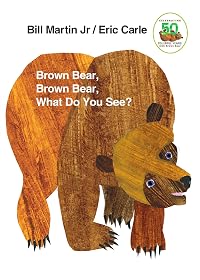
Eric Carle is an award-winning, children's picture book author and illustrator whose most recognized work is The Very Hungry Caterpillar Board Book. Carle was born to German parents in 1929 in Syracuse, New York. The family returned to Germany in 1935, moving to a suburb of Stuttgart. Carle disliked high school, quitting at the age of 16 before show more graduation. He was admitted as the youngest student to the Akademie der bildenden Kunste, an art school. After finishing at the Akademie, he worked as a poster designer for the U.S. Information Center in Germany until 1952, when he moved back to New York City. He was a graphic designer at the New York Times and later worked as an art director at L.W. Frohlich & Co. In 1963, Bill Martin, Jr. saw a poster of a red lobster that Carle had designed and asked him to illustrate Brown Bear, Brown Bear, What Do You See?, thus launching his freelance career. Among his many children's books are Dream Snow, Hello, Red Fox, The Very Clumsy Click Beetle, and Pancakes, Pancakes! His title The Artist Who Painted a Blue Horse made Publisher's Weekly Best Seller List for 2011. His title Brown Bear Brown Bear What to You See? made The New York Times Best Seller List for 2012. In 2015 he made The New Zealand Best Seller List with Love from the Very Hungry Caterpillar. Eric Carle, beloved children's book author and illustrator, died on May 23, 2021. He was 91. (Bowker Author Biography) show less
Some Editions
Awards and Honors
Awards
Notable Lists
Work Relationships
Common Knowledge
- Canonical title
- The Tiny Seed
- Original title
- The tiny seed
- Original publication date
- 1987
- First words
- It is Autumn.
- Last words
- (Click to show. Warning: May contain spoilers.)Out came many tiny seeds that quickly sail far away on the wind.
- Original language
- English
Classifications
Statistics
- Members
- 8,274
- Popularity
- 1,340
- Reviews
- 179
- Rating
- (4.12)
- Languages
- 13 — Chinese, Dutch, English, French, German, Greek, Hindi, Italian, Japanese, Norwegian, Portuguese, Spanish, Turkish
- Media
- Paper, Audiobook, Ebook
- ISBNs
- 88
- ASINs
- 24