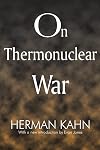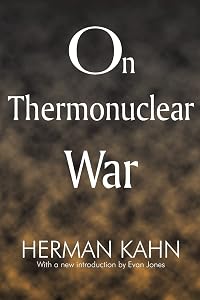
On Thermonuclear War
by Herman Kahn
On This Page
Description
On Thermonuclear War was controversial when originally published and remains so today. It is iconoclastic, crosses disciplinary boundaries, and finally it is calm and compellingly reasonable. The book was widely read on both sides of the Iron Curtain and the result was serious revision in both Western and Soviet strategy and doctrine. As a result, both sides were better able to avoid disaster during the Cold War. The strategic concepts still apply: defense, local animosities, and the usual show more balance-of-power issues are still very much with us. Kahn's stated purpose in writing this book was simply: "avoiding disaster and buying time, without specifying the use of this time." By the late 1950s, with both sides H-bomb-armed, reason and time were in short supply. Kahn, a military analyst at Rand since 1948, understood that a defense based only on thermonuclear arnaments was inconceivable, morally questionable, and not credible.The book was the first to make sense of nuclear weapons. Originally created from a series of lectures, it provides insight into how policymakers consider such issues. One may agree with Kahn or disagree with him on specific issues, but he clearly defined the terrain of the argument. He also looks at other weapons of mass destruction such as biological and chemical, and the history of their use. The Cold War is over, but the nuclear genie is out of the bottle, and the lessons and principles developed in On Thermonuclear War apply as much to today's China, Russia, Iran, and North Korea as they did to the Soviets. show lessTags
Recommendations




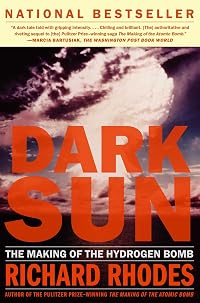
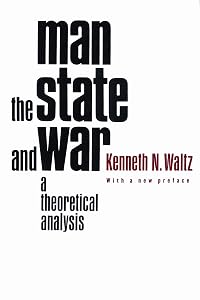
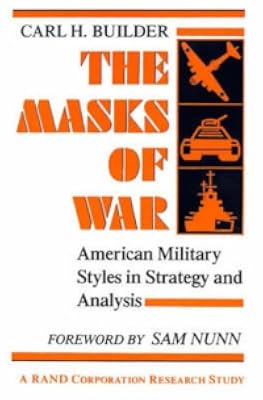
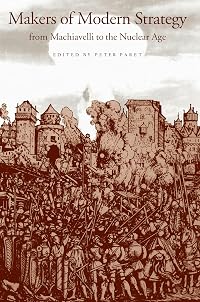






Member Reviews
Kahn's seminal 1960 work on nuclear strategy. This is a dense and weighty book that examines its subject in great detail. Kahn is remembered for his assertions that a nuclear war would mean neither the end of civilization nor of humanity, that even a modest civil defense program could make a substantial difference in the time that a first-world nation needed to recover from such a war, and that a nuclear war was therefore "winnable," at least as of the 1960's, and in the sense of one combatant emerging less damaged than the other. He has sometimes been reviled as a warmonger for his unsentimental appraisal of the prospect of the deaths of millions - but what I took from his arguments early in this book is that he simply felt that when show more formulating policy regarding a war on such a scale, it would be irresponsible to be less than completely honest and completely objective. Thus, he argued for quantitative rather than emotional assessments, and had little use for analyses that were driven by a need to justify pre-conceived notions.
Beyond these ideas, he also develops a kind of taxonomy of the different kinds of deterrence, and elaborates the implications of each at great length. One can recognize the approaches to deterrence by the various different modern nuclear states quite easily in Kahn's treatment of the subject.
Kahn did recognize that, with more powerful thermonuclear devices, more sophisticated delivery systems, and more nuclear-capable nations being likely, the world would become a much more dangerous place in the decades after the 1960's. It would be fascinating to see what he would make of the current nuclear landscape. He does not, for example, address the concept of nuclear winter, which did not become a major subject of inquiry until the early 1980's. Given that even today one can find papers asserting that the dangers of nuclear winter are overstated and other papers predicting that even a relatively modest nuclear war would ultimately lead to the deaths of 90 percent of the human race, a Kahn-style examination of the risks would be highly instructive. show less
Beyond these ideas, he also develops a kind of taxonomy of the different kinds of deterrence, and elaborates the implications of each at great length. One can recognize the approaches to deterrence by the various different modern nuclear states quite easily in Kahn's treatment of the subject.
Kahn did recognize that, with more powerful thermonuclear devices, more sophisticated delivery systems, and more nuclear-capable nations being likely, the world would become a much more dangerous place in the decades after the 1960's. It would be fascinating to see what he would make of the current nuclear landscape. He does not, for example, address the concept of nuclear winter, which did not become a major subject of inquiry until the early 1980's. Given that even today one can find papers asserting that the dangers of nuclear winter are overstated and other papers predicting that even a relatively modest nuclear war would ultimately lead to the deaths of 90 percent of the human race, a Kahn-style examination of the risks would be highly instructive. show less
Ratings
Members
- Recently Added By
Author Information

30+ Works 687 Members
Herman Kahn (1922-1983) was a renowned political scientist, economist, historian, geostrategist, and considered by many to be the founder of futurology as a serious field of study. Associated for many years with the RAND Corporation, he was the founding director of the first independent "think tank," the Hudson Institute. Among his many books are show more Thinking About the Unthinkable, The Year 2000, The Next 200 Years, The Coming Boom, The Resourceful Earth, and On Thermonuclear War. Thomas C. Schelling is Distinguished University Professor at the School of Public Policy, University of Maryland. In addition to being the 2005 Nobel Prize Laureate in Economics, he is the author of numerous works, including Choice and Consequence, The Strategy of Conflict, and Micromotives and Macrobehavior. show less
Awards and Honors
Distinctions
Classifications
- Genres
- Nonfiction, General Nonfiction, History, Politics and Government
- DDC/MDS
- 358.39 — Society, government, & culture Public administration & military science Air and other specialized forces and warfare; engineering and related services Other technical services
- LCC
- UF767 .K25 — Military Science Artillery Artillery Ordnance material (Ordnance proper)
- BISAC
Statistics
- Members
- 175
- Popularity
- 187,543
- Reviews
- 1
- Rating
- (3.00)
- Languages
- English
- Media
- Paper, Ebook
- ISBNs
- 7
- ASINs
- 8