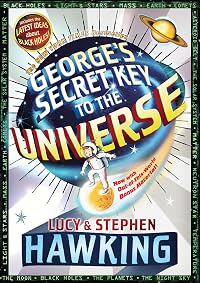
George's Secret Key to the Universe
by Lucy Hawking (Author), Stephen Hawking (Author)
George and Cosmos (1)
On This Page
Description
Follows the adventures of a young boy and his neighbor friend as they travel through a computer portal into outer space, where they explore such mysteries as black holes and the origins of the universe, while trying to evade an evil scientist.Tags
Recommendations

Member Reviews
I bought this for my 6 year old son who has a terrific imagination and loves science. I read a chapter a night to him over the course of a month. He loved the story and the quality time we spent together.
The basic idea of the book is a boy, George, makes friends with a girl, Annie, and her scientist father Eric. Eric has created the smartest computer in the world, Cosmos. Cosmos is able to open windows to galaxy where Annie, Eric, and George can explore. During the story they run into the books villian, Dr. Reaper, who steals Cosmos to use it for his own personal gain instead of scientific advancement.
I really like how the book incorporates current scientific theories in a manner a young child can be interested in. There were a few show more points that I wasn't thrilled about, for example, the idea that the villian was a teacher or that Erics parents were anti-technology.
However, the book has sparked a tremendous interest in space and science in my son and that alone makes the book worth it. show less
The basic idea of the book is a boy, George, makes friends with a girl, Annie, and her scientist father Eric. Eric has created the smartest computer in the world, Cosmos. Cosmos is able to open windows to galaxy where Annie, Eric, and George can explore. During the story they run into the books villian, Dr. Reaper, who steals Cosmos to use it for his own personal gain instead of scientific advancement.
I really like how the book incorporates current scientific theories in a manner a young child can be interested in. There were a few show more points that I wasn't thrilled about, for example, the idea that the villian was a teacher or that Erics parents were anti-technology.
However, the book has sparked a tremendous interest in space and science in my son and that alone makes the book worth it. show less
My first take is that this is an excellent exposure to science--and especially astrophysical science--and that it should be read by all children as early as possible. But I intend to give it to a special young friend of mine and see how she likes it. The plot is that a boy, whose parents are pretty close to being Luddites, stumbles into a family of scientists. Meanwhile he's harrowed by a teacher, and some bullies, at school and finds himself drawn into a conflict he can't quite understand....all the while he's learning about stars and planets and comets and black holes...and how dangerous outer space can be to the unprepared. And, by paying attention, he learns enough physics to save the good scientist from the machinations of the bad show more scientist. Combining action and information in the same story is a challenge; I enjoyed it, but will a child? I'll save my rating until I learn the answer to that question. show less
I really thought this one was terrible. The science was interesting, but too much like science fiction, so that it seemed like fantasy. The writing was good enough, but some of the themes were disturbing. I think the ending was supposed to be a coming-together of all the different factions, but it message of the book seemed to be that environmentalists are against all technology and innovation, and that it’s okay if we destroy this planet because science can find us a new one.
I would love someone to explain to me the visual references to [b: The Little Prince|157993|The Little Prince|Antoine de Saint-Exupéry|http://images.gr-assets.com/books/1367545443s/157993.jpg|2180358]. They were far too obvious to be accidental, and yet nothing show more was really made of them. I just can’t see George as a modern-day Little Prince.
The book design was atrocious. My reading was often disrupted mid-sentence by sidebars and pages of photographs. I enjoyed the sidebars- they were better than the story, but the placement of them was problematic. Likewise, the photos were cool, but they weren’t placed near the relevant content in the book, and often came in the middle of the chapter. When I reached the end of the photos, I had to go back and reread the last page of text to get back into the story. We’ve made such strides in design recently, that there’s really no excuse for this.
It always makes me sad when books like this get so much press because of their authors when so many wonderful books are ignored. show less
I would love someone to explain to me the visual references to [b: The Little Prince|157993|The Little Prince|Antoine de Saint-Exupéry|http://images.gr-assets.com/books/1367545443s/157993.jpg|2180358]. They were far too obvious to be accidental, and yet nothing show more was really made of them. I just can’t see George as a modern-day Little Prince.
The book design was atrocious. My reading was often disrupted mid-sentence by sidebars and pages of photographs. I enjoyed the sidebars- they were better than the story, but the placement of them was problematic. Likewise, the photos were cool, but they weren’t placed near the relevant content in the book, and often came in the middle of the chapter. When I reached the end of the photos, I had to go back and reread the last page of text to get back into the story. We’ve made such strides in design recently, that there’s really no excuse for this.
It always makes me sad when books like this get so much press because of their authors when so many wonderful books are ignored. show less
Z called it an "amazing book." I found much of the writing pretty clunky, but it's a great adventure to introduce some pretty cool physics as science fact to kids.
This book will teach the budding elementary school aged geek some of the newest theories about black holes. It will teach adults about Stephen Hawking's playful mind and sense of humor.
This book was written for those pre-geek second and third graders who read all the astronomy books in the j520 section of the library and then pester their parents, teachers and school librarians about the big bang, black holes, comets and life on other planets. I've done stints in elementary school libraries and there are plenty of these kids.
Perhaps some adults may think the story is too young for the science presented -- but I bet these adults haven't worked in school libraries. They don't know about the one "weird kid" who seems to be in almost show more every second and third grade class in every school in the nation who craves to know the inner workings of the universe and is frustrated that most adults they encounter don't seem to know or care about the questions they have.
My cousin and I were those "weird kids" in our classes. We were mad about science and played "Let's Pretend" long after the other kids our age quit. I can totally imagine him and I pretending that we had an amazing computer that zoomed us out into space and allowed us to ride a comet around the solar system. And in reality, I remember us pretending that we were falling into a black hole at some point.
When I read this book, I felt as if I were eight years old again. I would have LOVED this book. It would have been next to the "Brown Paper School Book" series that I treasured. I felt like I was snooping in on someone else's "Let's Pretend" game. show less
This book was written for those pre-geek second and third graders who read all the astronomy books in the j520 section of the library and then pester their parents, teachers and school librarians about the big bang, black holes, comets and life on other planets. I've done stints in elementary school libraries and there are plenty of these kids.
Perhaps some adults may think the story is too young for the science presented -- but I bet these adults haven't worked in school libraries. They don't know about the one "weird kid" who seems to be in almost show more every second and third grade class in every school in the nation who craves to know the inner workings of the universe and is frustrated that most adults they encounter don't seem to know or care about the questions they have.
My cousin and I were those "weird kids" in our classes. We were mad about science and played "Let's Pretend" long after the other kids our age quit. I can totally imagine him and I pretending that we had an amazing computer that zoomed us out into space and allowed us to ride a comet around the solar system. And in reality, I remember us pretending that we were falling into a black hole at some point.
When I read this book, I felt as if I were eight years old again. I would have LOVED this book. It would have been next to the "Brown Paper School Book" series that I treasured. I felt like I was snooping in on someone else's "Let's Pretend" game. show less
George's Secret Key to the Universe is a kids book that explains astrophysics to kids and gets them excited about science. George lives with his eco-friendly parents who hate science because technology is destroying the earth. To George's great excitement, a new neighbor, Eric, moves in with his daughter, Annie. Eric is a scientist and he owns Cosmos, the world's smartest computer. Cosmos takes George and Annie on journeys through outer space and the reader learns all about the vast reaches of the galaxy. Meanwhile, the evil science teacher at George's school aligns himself with the school bullies to steal Cosmos.
The story was average, the illustrations were nice, and I like reading about astrophysics, but I am not smart enough to show more understand it unless it is written for kids, so that was nice.
I think there should be a sequel where Cosmos takes George and Annie on a journey into the mysteries of the soil and plant growth, so we can all learn about the amazing discoveries in biology. I know it isn't as glamorous as outer space, but it bothered me how earth science was portrayed. George's parents were eco-friendly hippies who wouldn't use any technology and grew their own food. The book made them seem somewhat ignorant and unintelligent because all they knew how to do was grow their own food. Why do astrophysicists get all the glory? show less
The story was average, the illustrations were nice, and I like reading about astrophysics, but I am not smart enough to show more understand it unless it is written for kids, so that was nice.
I think there should be a sequel where Cosmos takes George and Annie on a journey into the mysteries of the soil and plant growth, so we can all learn about the amazing discoveries in biology. I know it isn't as glamorous as outer space, but it bothered me how earth science was portrayed. George's parents were eco-friendly hippies who wouldn't use any technology and grew their own food. The book made them seem somewhat ignorant and unintelligent because all they knew how to do was grow their own food. Why do astrophysicists get all the glory? show less
(Read as research for a book project I'm working on - spoilers follow)
This first book by Lucy and Stephen Hawking occupies a small niche of children's fiction, which also teaches about science. Here the focus is purely on cosmology.
George, a boy of about 9, lives with hippy parents, living something like The Good life, who bar all technology from the house. He wishes there was a least a computer to play with, and seems to be jealous of every other kid around. The next door is a banned place, but he has no choice but to explore when his pet pig goes right into the neighbours house and needs fetching. There he meets Annie, a girl about his age, along with her dad, Eric, who is the usual excitable professor. Before long, he gets initiated show more into their scientific group by signing an oath about using any scientific knowledge he gains only for the good of others and of humanity, and this allows him to play with Cosmos, the most powerful computer in the world, which is capable of opening doors to any part of the universe, and can also speed up time dramatically for that section of the universe. George's first viewing is through one of these doors, as a star is born, lives and then explodes in a supernova. He's hooked, and it's not long before he's back hoping for another experience. This time Annie takes him for a ride on a comet - literally. But it's a dangerous ride, and Eric saves them in the nick of time, before being angry at them both for being so wreckless. His encounters with his exciting neighbours are curtailed, and instead his energies centre on a group of bullies, intent on picking on him, and a creepy, very strict teacher, who seems excessively interested in Eric and Cosmos.
This teacher used to work with Eric and now wants revenge and power. So he tricks Eric into believing there is a habitable planet at a certain coordinate - something Eric has been searching for in vain for many years, as a potential way of saving humanity from global warming catastrophe. There is no planet - only a black hole. George tries to warn Eric, but it's too late. Eric saves George, but is himself sucked into the black hole. George may be able to use Cosmos to save Eric, but Cosmos has been stolen by the bullies, who are now working for the evil teacher. So George has to learn about black holes and that the information that goes in it (including about a human) does eventually come out (Hawking Radiation), so perhaps Eric can be saved. Then George has to devise a plan to get back Cosmos, by drawing the teacher away from his house. Then George has to get Cosmos to understand about black holes, and save Eric, by speeding up the black hole's lifespan significantly and trying to read all the information that comes out. He manages to do all this, saves the day, and there is just enough time to go to the school and give a talk in a competition. He talks about cosmology and all the wondrous things he's learnt, winning a computer with the best talk, and softening his parent's hatred of technology.
Peppered throughout the book are little boxes of non-fiction, which teach you about various topics, such as details about Saturn, or atoms.
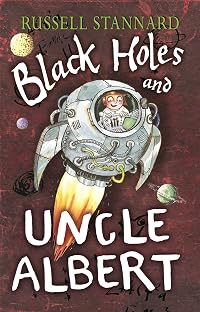
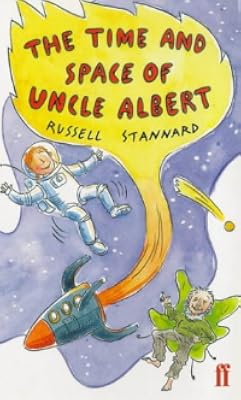
Unlike the Uncle Albert series, which it perhaps owes a little debt to, on the whole you are not shown results, or how they are derived, you are just told facts. The facts, of course, are profound and exciting, being about what makes up the universe, how stars and planets are born, live and die and so on, but you don't necessarily get a sense of the scientific process from this book. And you do get a sense of the wonder and excitement of physics and cosmology from this. But I would have liked a little more showing and less telling of the facts.
There are also other issues. I feel squeamish about bits in a so-called science book which are distinctly fantastical, such as these doors opening up, and time being radically speeded up for large swathes of the universe. I was unsurprised that black holes figure so prominently, given that Stephen Hawking is one of the authors, but is Hawking radiation at the level of fact? I don't think so, and I definitely don't think there is any fact to the idea that you can suck out a person from the black hole radiation. Perhaps I am too much of a purist, but surely you could have built another plot which didn't have these flaws?
In some ways the strengths and weaknesses of the Uncle Albert books are opposed in this one. Stannard's Uncle Albert books were weak on plot, but brilliant at explanations. Here, the plot is actually reasonably good - it makes you want to know what happens next - and there is a clear storyline to latch onto. The characters may at times be a little flat, but the evil teacher is actually quite a decent, weird baddie. On the other hand, it would be great if the science in this book was more about the big picture, and about critical curiosity, than a load of facts.
Given that there are so few of these books around, and I think they serve an extremely important purpose, I would still not hesitate to recommend them to every child with any curiosity - but I would go for the Uncle Albert books first, even if this was a more fun and gripping read. show less
This first book by Lucy and Stephen Hawking occupies a small niche of children's fiction, which also teaches about science. Here the focus is purely on cosmology.
George, a boy of about 9, lives with hippy parents, living something like The Good life, who bar all technology from the house. He wishes there was a least a computer to play with, and seems to be jealous of every other kid around. The next door is a banned place, but he has no choice but to explore when his pet pig goes right into the neighbours house and needs fetching. There he meets Annie, a girl about his age, along with her dad, Eric, who is the usual excitable professor. Before long, he gets initiated show more into their scientific group by signing an oath about using any scientific knowledge he gains only for the good of others and of humanity, and this allows him to play with Cosmos, the most powerful computer in the world, which is capable of opening doors to any part of the universe, and can also speed up time dramatically for that section of the universe. George's first viewing is through one of these doors, as a star is born, lives and then explodes in a supernova. He's hooked, and it's not long before he's back hoping for another experience. This time Annie takes him for a ride on a comet - literally. But it's a dangerous ride, and Eric saves them in the nick of time, before being angry at them both for being so wreckless. His encounters with his exciting neighbours are curtailed, and instead his energies centre on a group of bullies, intent on picking on him, and a creepy, very strict teacher, who seems excessively interested in Eric and Cosmos.
This teacher used to work with Eric and now wants revenge and power. So he tricks Eric into believing there is a habitable planet at a certain coordinate - something Eric has been searching for in vain for many years, as a potential way of saving humanity from global warming catastrophe. There is no planet - only a black hole. George tries to warn Eric, but it's too late. Eric saves George, but is himself sucked into the black hole. George may be able to use Cosmos to save Eric, but Cosmos has been stolen by the bullies, who are now working for the evil teacher. So George has to learn about black holes and that the information that goes in it (including about a human) does eventually come out (Hawking Radiation), so perhaps Eric can be saved. Then George has to devise a plan to get back Cosmos, by drawing the teacher away from his house. Then George has to get Cosmos to understand about black holes, and save Eric, by speeding up the black hole's lifespan significantly and trying to read all the information that comes out. He manages to do all this, saves the day, and there is just enough time to go to the school and give a talk in a competition. He talks about cosmology and all the wondrous things he's learnt, winning a computer with the best talk, and softening his parent's hatred of technology.
Peppered throughout the book are little boxes of non-fiction, which teach you about various topics, such as details about Saturn, or atoms.
Unlike the Uncle Albert series, which it perhaps owes a little debt to, on the whole you are not shown results, or how they are derived, you are just told facts. The facts, of course, are profound and exciting, being about what makes up the universe, how stars and planets are born, live and die and so on, but you don't necessarily get a sense of the scientific process from this book. And you do get a sense of the wonder and excitement of physics and cosmology from this. But I would have liked a little more showing and less telling of the facts.
There are also other issues. I feel squeamish about bits in a so-called science book which are distinctly fantastical, such as these doors opening up, and time being radically speeded up for large swathes of the universe. I was unsurprised that black holes figure so prominently, given that Stephen Hawking is one of the authors, but is Hawking radiation at the level of fact? I don't think so, and I definitely don't think there is any fact to the idea that you can suck out a person from the black hole radiation. Perhaps I am too much of a purist, but surely you could have built another plot which didn't have these flaws?
In some ways the strengths and weaknesses of the Uncle Albert books are opposed in this one. Stannard's Uncle Albert books were weak on plot, but brilliant at explanations. Here, the plot is actually reasonably good - it makes you want to know what happens next - and there is a clear storyline to latch onto. The characters may at times be a little flat, but the evil teacher is actually quite a decent, weird baddie. On the other hand, it would be great if the science in this book was more about the big picture, and about critical curiosity, than a load of facts.
Given that there are so few of these books around, and I think they serve an extremely important purpose, I would still not hesitate to recommend them to every child with any curiosity - but I would go for the Uncle Albert books first, even if this was a more fun and gripping read. show less
Members
- Recently Added By
Lists

Satori Smiles Children's Book List
262 works; 7 members

Books Read in 2021
5,361 works; 114 members

Torchlight Level 3
20 works; 1 member
Author Information

Lucy Hawking was born in England in 1970. After reading French and Russian at Oxford University, Lucy Hawking became a journalist. She has worked for New York Magazine and has written for the Daily Mail, The Telegraph, The Times, and the London Evening Standard. She has also worked as a radio journalist. She has written two novels: Jaded (2004) show more and Run for Your Life (2005), which was also published as The Accidental Marathon. She and her father, Stephen Hawking, are the authors of the George series. The children's book series includes, George's Secret Key to the Universe, George's Cosmic Treasure Hunt, George and the Big Bang, George and the Unbreakable Code, George and the Blue Moon, and George and the Ship of Time. She is an administrative staff member of the Autism Research Centre (ARC) at the University of Cambridge. She is the daughter of theoretical physicist, Stephen Hawking. She lives in London. (Bowker Author Biography) show less

Stephen William Hawking was born in Oxford, England on January 8, 1942. He received a first class honors degree in natural science from Oxford University and a Ph.D. from Cambridge University. He was a theoretical physicist and has held the post of Lucasian Professor of Mathematics at Cambridge University from 1982 until his death. In 1974, he was show more elected a Fellow of the Royal Society, the world's oldest scientific organization. In 1963, he learned he had amyotrophic lateral sclerosis, a neuromuscular wasting disease also known as Lou Gehrig's disease. The disease confined him to a wheelchair and reduced his bodily control to the flexing of a finger and voluntary eye movements, but left his mental faculties untouched. He became a leader in exploring gravity and the properties of black holes. He wrote numerous books including A Brief History of Time: From the Big Bang to Black Holes, Black Holes and Baby Universes, On the Shoulders of Giants, A Briefer History of Time, The Universe in a Nutshell, The Grand Design, and Brief Answers to the Big Questions. In 1982, he was named a commander of the British Empire. A film about his life, The Theory of Everything, was released in 2014 and was based on his first wife Jane Hawking's book Traveling to Infinity: My Life with Stephen. He died on March 14, 2018 at the age of 76. (Bowker Author Biography) show less
Awards and Honors
Awards
Notable Lists
Series

Work Relationships
Common Knowledge
- Canonical title
- George's Secret Key to the Universe
- Original publication date
- 2007
- People/Characters
- George Greenby; Eric Bellis (Annie's father); Annie Bellis (Eric's daughter); Cosmos (computer)
- Important places
- England, UK
- Dedication
- For William and George, with love
- First words
- Pigs don't just vanish, thought George to himself as he stood staring into the depths of the very obviously empty pigsty.
- Last words
- (Click to show. Warning: May contain spoilers.)As a comet passes the Sun, it warms up and the ice on it starts to melt. . .
- Original language
- English
Classifications
Statistics
- Members
- 1,556
- Popularity
- 14,789
- Reviews
- 44
- Rating
- (3.71)
- Languages
- 23 — Catalan, Chinese, Czech, Danish, Dutch, English, Estonian, Finnish, French, German, Greek, Hebrew, Hungarian, Italian, Lithuanian, Polish, Portuguese, Romanian, Russian, Slovak, Spanish, Swedish, Ukrainian
- Media
- Paper, Audiobook, Ebook
- ISBNs
- 73
- ASINs
- 13