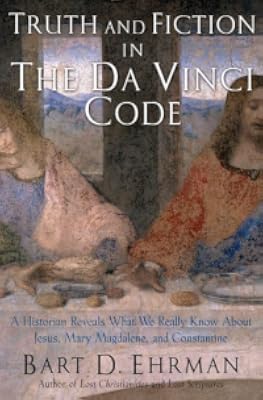
Truth and Fiction in The Da Vinci Code: A Historian Reveals What We Really Know about Jesus, Mary Magdalene, and Constantine
by Bart D. Ehrman
On This Page
Description
Dan Brown's fiction 'The Da Vinci Code' has made a big impact, but how much truth lies behind his claims? Bart Ehrman examines the historical figures that appear in the novel and sets out to separate the literal truth from the flights of fancy.Tags
Recommendations




Member Recommendations
Member Reviews
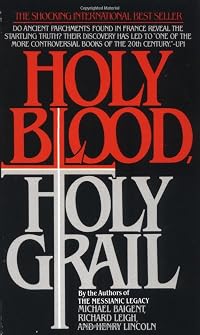
In his usual somewhat repetitive but detailed fashion, Ehrman goes about demolishing Dan Brown's claim of the truth of all the documents he based The Da Vinci Code on. It turns out Brown had no understanding of the documents his "experts" in the novel talk about, totally misrepresenting their content and meaning. For example, he claims that the Dead Sea Scrolls contains gospels, which they do not. The contents are all Jewish documents. He claims the word "companion" used to describe Mary Magdalene's relationship to Jesus meant spouse in Aramaic, again showing his ignorance of the non-canonical gospel he was using as his source, which only survives in a Coptic translation from Greek--not Aramaic. And the Coptic translation borrows the show more Greek word, which is quite common and quite clearly does not mean "spouse". The truth, of course, is that Brown stole the whole idea for his book from one published a few years earlier: The Holy Blood and the Holy Grail. Still, Ehrman's explanation is interesting and he does a good job as his own narrator in the audiobook version. show less
Having read a lot of ancient history, particularly early Christian history, most friends and family, after reading The Da Vinci Code, inevitably ask me how much of it is true. I always refer them to this book. Ehrman is eminently rational and respectful in his critique. He doesn't slam Dan Brown, he simply points out where his claims are historically accurate and where they are way off base.
Not only is this an excellent assessment of the book, it is an amazingly accessible and interesting distillation of New Testament scholarship. Ehrman offers a brief history of Charlemagne and the Council of Nicea, discussions of many non-canonical gospels, and most importantly insight into how professional historians view and assess ancient texts as show more historical documents. This is the kind of information that EVERY member of the Christian religion should know, but most don't. show less
Not only is this an excellent assessment of the book, it is an amazingly accessible and interesting distillation of New Testament scholarship. Ehrman offers a brief history of Charlemagne and the Council of Nicea, discussions of many non-canonical gospels, and most importantly insight into how professional historians view and assess ancient texts as show more historical documents. This is the kind of information that EVERY member of the Christian religion should know, but most don't. show less
I read the Da Vinci COde and thoroughly enjoyed it as did the author however this short book taught me far more about early Christianity then did Brown's best seller. The author managed to do this without disparaging Dan Brown's novel (which is a great read). He explains some fascinating facts about Jesus, ary Magdalene and Constantine and their roles in the formation of modern Christianity. This book is a must read for anyone who has read Dan Brown's book (and who hasn't)
A really great answer to The DaVinci Code - not a religiously based answer, but one based on historical evidence. If the author is Christian or nonChristian, it is never revealed, but he does enlighten his readers on specifically the questions posed and the claimed "truths" in the popular fiction book. In short, I would take anything Dan Brown writes with a huge bag of salt, and despite his disclaimer that all the works of art, architechture, documents, etc are real and as he describes them, I would not trust one letter of it unless it was indpendantly verified. I would not believe his description of The Mona Lisa unless it jived with another independant source.
The book also serves as a great introduction to early Christianity during show more Jesus's time through Constantine. show less
The book also serves as a great introduction to early Christianity during show more Jesus's time through Constantine. show less
Substance: Ably confronts Brown's claims and debunks almost all of them. Brown is correct in only a few instances, mostly where non-specialist scholarship is irrelevant. Ehrman's point-by-point deconstruction (not quite a fisking) is illuminating. From a "practicing Christian" viewpoint, he falls into the camp of the symbologists rather than the literalists.
Style: Not as straight-forward as I prefer, but covers the territory.
Original LCC derived from Brown; refiled with LCC for works on the New Testament in re Jesus per se.
Style: Not as straight-forward as I prefer, but covers the territory.
Original LCC derived from Brown; refiled with LCC for works on the New Testament in re Jesus per se.
Like other works of Ehrman's I've looked into, places undue authority in the canonical Gospels as historical sources in the modern sense. In addition, here he dismisses arguments from silence vs Jewish social norm with reference to the absolute apocalypticism, cf Essenes [155-7]. Cit. Paul 157-8.Likewise, he dismisses the feminist view of Jesus’ subversion of social structure, and Schussler-Fiorenza specifically, with the absoluteness of Jesus’ apocalypticism. [151] But just a little farther on, Ehrman acknowledges that, while "the leaders of the original Christian community in Jerusalem appear to have been the core members of [Jesus'] (male) apostolic band. [165],” "[t]he apostolic band was evidently larger and more inclusive show more than the list of twelve men most people know about.” 1Cor. 11:4–6; Phil. 4:2. [167] Gal. 3:28 [168] contra 1Cor. 11:2–16 [169] Not that I was ready to believe Dan Brown, but neither do I just roll over for Ehrman's assertions. show less
interesting background info on the DA VINCI CODE, but too much repetition.
Members
- Recently Added By
Author Information

139+ Works 22,232 Members
New Testament scholar Bart D. Ehrman grew up in Lawrence, Kansas and graduated from Wheaton College in 1978. He earned his Masters of Divinity and PhD from Princeton Theological Seminary and has taught at Rutgers University and the University of North Carolina at Chapel Hill, where he is the James A. Gray Distinguished Professor. He has published show more more than 20 scholarly and popular books, including three New York Times bestsellers, plus numerous articles and book reviews. (Bowker Author Biography) show less
Series
Belongs to Publisher Series
Work Relationships
Is a reply to
Common Knowledge
- Original title
- Truth and fiction in The Da Vinci code: a historian reveals what we really know about Jesus, Mary Magdalene, and Constantine
- Original publication date
- 2004
- People/Characters
- Mary Magdalene
- Original language
- English
Classifications
- Genres
- Religion & Spirituality, Nonfiction, Fiction and Literature
- DDC/MDS
- 813.54 — Literature & rhetoric American literature in English American fiction in English 1900-1999 1945-1999
- LCC
- PS3552 .R685434 .D3335 — Language and Literature American literature American literature Individual authors 1961-
- BISAC
Statistics
- Members
- 632
- Popularity
- 46,265
- Reviews
- 13
- Rating
- (3.84)
- Languages
- 6 — Czech, English, Hungarian, Italian, Portuguese, Spanish
- Media
- Paper, Audiobook, Ebook
- ISBNs
- 24
- ASINs
- 5