On This Page
Description
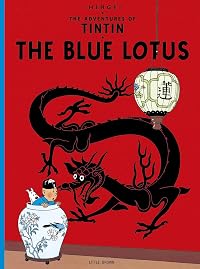
The world's most famous travelling reporter is on the trail of the Blue Lotus. In India, Tintin gets drawn into a dangerous mystery revolving around a madness-inducing poison. He traces its origins to Shanghai and a nefarious web of opium traffickers. But can he outwit the crooks?Tags
Recommendations














Member Reviews
The best of the Tintin stories so far (I'm reading and rating them in order of publication): Hergé has really hit his stride with The Blue Lotus.
Nicely plotted with lots of intrigue to which we, the reader, are more privy than Tintin. An interesting device to increase narrative tension: "No, Tintin - don't trust him!"
Hergé, it seems, seeks to atone for his previously less than flattering representation of non-European cultures by rather heavy-handedly debunking some then-prevalent stereotypes of Chinese culture. However, it's well-intentioned and forgiveable. The depiction of his Chinese characters is sympathetic, and they are contrasted most favourably against the corrupt Western Chief-of-Police and the brutally racist and vindictive show more American businessman. However, there's still a touch of "demonising" in his treatment of his Japanese characters.
The Blue Lotus is more firmly rooted in the real world than the previous stories, drawing upon actual events and the political situation between China and Japan in the early 1930s, adding depth to what is, after all, a children's story (but an increasingly intelligent one).
The prat-falling Thomson and Thompson are again the main comic relief. show less
Nicely plotted with lots of intrigue to which we, the reader, are more privy than Tintin. An interesting device to increase narrative tension: "No, Tintin - don't trust him!"
Hergé, it seems, seeks to atone for his previously less than flattering representation of non-European cultures by rather heavy-handedly debunking some then-prevalent stereotypes of Chinese culture. However, it's well-intentioned and forgiveable. The depiction of his Chinese characters is sympathetic, and they are contrasted most favourably against the corrupt Western Chief-of-Police and the brutally racist and vindictive show more American businessman. However, there's still a touch of "demonising" in his treatment of his Japanese characters.
The Blue Lotus is more firmly rooted in the real world than the previous stories, drawing upon actual events and the political situation between China and Japan in the early 1930s, adding depth to what is, after all, a children's story (but an increasingly intelligent one).
The prat-falling Thomson and Thompson are again the main comic relief. show less
http://nwhyte.livejournal.com/2194952.html
The Blue Lotus really is the first proper Tintin book - a huge step up from Cigars of the Pharaoh. Hergé takes Tintin to the real 1931 Japanese invasion of China, and is firmly and passionately on the side of the Chinese, both versus the Japanese and the Europeans in the Shanghai concession (one of whom in real life would have bee a very young J.G. Ballard). Apparently this came about because a priest who worked with Chinese students at Leuven contacted Hergé out of concern that the promised adventure in China would be as stereotypical as the previous volumes; and through him, Hergé met Zhang Chongren, who was effectively Hergé's co-artist for the Chinese parts of the book, and is also the show more basis for the character of Chang here and in Tintin in Tibet. Suddenly the political orientation of Tintin has veered very sharply to the left.
But there's also a step change in quality of plotting and of art. There's one rather silly scene where Tintin hospitalises three burly guards, and Thomson and Thompson provide some slapstick comic relief, but otherwise this is a book that takes story-telling seriously and uses the right tools to do it in the right way. It's unfortunate in a way that it ties up some dangling plot strands from Cigars of the Pharaoh, because it is so much better.
I think I actually had not read it before - none of the incidents rang any bells for me, and I see that it was not translated into English until 1983 precisely because it was thought to be too firmly rooted in events of 1931 which would be unknown to today's younger readers. But in fact the themes of military domination and corrupt occupation are, unfortunately, pretty timeless. show less
The Blue Lotus really is the first proper Tintin book - a huge step up from Cigars of the Pharaoh. Hergé takes Tintin to the real 1931 Japanese invasion of China, and is firmly and passionately on the side of the Chinese, both versus the Japanese and the Europeans in the Shanghai concession (one of whom in real life would have bee a very young J.G. Ballard). Apparently this came about because a priest who worked with Chinese students at Leuven contacted Hergé out of concern that the promised adventure in China would be as stereotypical as the previous volumes; and through him, Hergé met Zhang Chongren, who was effectively Hergé's co-artist for the Chinese parts of the book, and is also the show more basis for the character of Chang here and in Tintin in Tibet. Suddenly the political orientation of Tintin has veered very sharply to the left.
But there's also a step change in quality of plotting and of art. There's one rather silly scene where Tintin hospitalises three burly guards, and Thomson and Thompson provide some slapstick comic relief, but otherwise this is a book that takes story-telling seriously and uses the right tools to do it in the right way. It's unfortunate in a way that it ties up some dangling plot strands from Cigars of the Pharaoh, because it is so much better.
I think I actually had not read it before - none of the incidents rang any bells for me, and I see that it was not translated into English until 1983 precisely because it was thought to be too firmly rooted in events of 1931 which would be unknown to today's younger readers. But in fact the themes of military domination and corrupt occupation are, unfortunately, pretty timeless. show less
In this Tintin adventure, Tintin is embroiled in a conflict between the Chinese and the Japanese occupying China in the late 1930s. There are several close shaves with death, lots of masquerading, car chases and dramatic declamations. Oh yes and a cameo by Dupont and Dupond. No Captain Haddock, alas!
I borrowed this because it was mentioned in Agent Sonya, by Ben Macintyre, and Hergé’s portrayal of the Chinese in this volume was supposed to be more nuanced and less racist than his portrayals of cultures in other volumes (e.g., the Congolese, Native Americans). It is true that Chang, a young boy Tintin meets while heading from Shanghai to Hou Kou, gets a fair bit of screen time, and Tintin sticks up for a rickshaw driver who is being show more bullied by an asshole white guy, but I couldn’t help wincing at the drawings of the Japanese bad guys (the buck teeth veered into caricature).
In terms of the drawings, I found the dialogue hard to read, because the characters’ heads kept blocking the speech bubbles, requiring some weird hyphen placement, and the writing itself was a bit thin and spidery.
I may read another Tintin, but I will probably skip to one featuring Captain Haddock, because he is my favourite. show less
I borrowed this because it was mentioned in Agent Sonya, by Ben Macintyre, and Hergé’s portrayal of the Chinese in this volume was supposed to be more nuanced and less racist than his portrayals of cultures in other volumes (e.g., the Congolese, Native Americans). It is true that Chang, a young boy Tintin meets while heading from Shanghai to Hou Kou, gets a fair bit of screen time, and Tintin sticks up for a rickshaw driver who is being show more bullied by an asshole white guy, but I couldn’t help wincing at the drawings of the Japanese bad guys (the buck teeth veered into caricature).
In terms of the drawings, I found the dialogue hard to read, because the characters’ heads kept blocking the speech bubbles, requiring some weird hyphen placement, and the writing itself was a bit thin and spidery.
I may read another Tintin, but I will probably skip to one featuring Captain Haddock, because he is my favourite. show less
The Blue Lotus is the third of the main sequence of Tintin books, and follows directly on the heels of Cigars of the Pharaoh. The book picks up the story of Tintin's struggle with the mysterious opium smuggling ring that decided to frame him out of the blue at the beginning of Cigars and tried to kill him several times so that he would not reveal the information he didn't know about their operations. At the end of Cigars the smuggling ring had been handed a setback, but there were a couple of loose ends left hanging - the people afflicted by the "poison of madness", the destination of the opium-filled cigars, and the mysterious masked criminal who supposedly fell to his death - and if you didn't know about them, there is a convenient show more sidebar on the first page to fill you in. The last is more or less important, because in Cigars, when the masked villain fell off the cliff it looked like it should have been fatal, so letting the reader know he's still alive seems to be relatively critical.
The most important thing about The Blue Lotus is that after the fitful start of the previous two books, Hergé really began to hit his stride in this one. Not only does this volume have a single unifying story, that story begins to touch on issues such as racial prejudice and oppression. In addition, after Tintin merely stumbled into solving the "mysteries" of the previous two books, in The Blue Lotus the story presents him with actual clues to figure out and follow, placing our hero in the role of an active participant in the story, rather than having him merely react to the villains' evil plans. This makes the story much more satisfying, as it makes Tintin an actual protagonist rather than just a lucky guy carried along by circumstance to the secret hideout of the bad guys.
At the outset of the book, Tintin is busy intercepting radio signals that seem to make no sense when he is asked to join his Maharajah host in viewing a fakir demonstrating his powers. (The inclusion of individuals like the fakir, with apparent supernatural powers, is why I disagree with some people who assert that Tintin is "realistic fiction". Hergé consistently included mystical powers and objects in his stories, as well as throwing in some science fictional elements here and there. Though not all of the Adventures of Tintin include these elements, Tintin clearly inhabits a world in which magic and superscience are real and aliens visit the Earth). After a mysterious interlude with the fakir, Tintin gets a visit from a man from Shanghai who is immediately poisoned by the Rajaijah juice "poison of madness" and is only able to mention the name Mitsurhirato before going insane. This spurs Tintin to head to Shanghai to investigate further, and after some comedy involving Snowy and a trunk, the story moves along to China.
And China is where The Blue Lotus starts to show an uptick in the quality of story telling. China was an occupied country, forced by foreign powers to allow detachments of troops and enclaves beyond Chinese control on its territory while the Chinese inhabitants were treated as second-class citizens in their own country, and Hergé uses the story of The Blue Lotus to highlight the unfairness of this and criticize the treatment of the Chinese - which seems to be a fairly bold statement to be making in the 1930s. Tintin had already been established in previous volumes as being the sort of person to stand up for the "little guy", but now his efforts take on more significance as he stands against Imperialism in support of its victims. On the other hand, he uses a fair portion of the story to bash the Japanese presence in China at a time when the Japanese were being roundly condemned for their interventions there, so maybe Hergé wan't being all that forward thinking after all. He did write unscrupulous and loudmouthed Europeans conspiring with the Japanese in order to get petty revenge against Tintin into the story, so all of the Westerners other than Tintin (due to his basic goodness), and Thompson and Thomson (who evade being obnoxious and evil as a result of their bumbling cluelessness) come off poorly.
Tintin moves about Shanghai, meets Mitsurhirato, is arrested, released, tries to return to India, gets kidnapped, has his life threatened and saved a couple times, and finally joins up with Wang-Chen Yee and the Sons of the Dragon to fight the opium trade in China. As an aside, when he is arrested, to punish him for what he perceives as previous insolence, the corrupt chief of police for the International Settlement tries to have Tintin roughed up by three burly looking Indian policemen. The result - Tintin sending the three of them to the hospital - makes me think that Tintin is, pound for pound, the toughest fighter alive in his fictional world because despite his relatively slight build he is consistently able to knock out much larger and beefier opponents, usually with a single punch. Aside from his fighting skills, Tintin is apparently a crack cryptologist, unraveling the code that stumped him at the opening of the book, although he does the unraveling off-camera and how he hits upon the solution he tries that cracks the code is left entirely unexplained. These skills might explain why a secret Chinese society might consider Tintin's assistance to be critical to their plans, because I guess no Chinese native has impressive fighting skills, the ability to solve modestly difficult puzzles, or the ability to stumble about until the villains reveal their plans. Those tasks, I suppose, require European assistance. Well, European assistance from someone who needs to have his bacon pulled out of the fire numerous times by the secret society to get out of the life-threatening situations he unwittingly puts himself in.
One interesting element in the story is that Hergé wrote in a fairly accurate depiction of the Mukden Incident (with the bombing moved to a location near Shanghai) and the resulting Japanese invasion of Manchuria and diplomatic fallout that led to the Japanese withdrawal from the League of Nations. Hergé also ties the Japanese perfidy into the opium smuggling ring, which links it with the larger story and may be historically accurate as well (although in reality pretty much representatives from every nation seemed to have their fingers in the opium trade in China), and give the book its name, as the Blue Lotus of the story The Blue Lotus is a notorious opium den. Hergé also included the contemporaneous flooding of the Yangtze River in the story, making that another plot element drawn from actual history.
After being condemned to being executed as a spy by the Japanese forces, Tintin proves his idealistic bona fides by refusing an offer to release him in exchange for becoming a Japanese agent. of course, because his the protagonist of the story he is rescued and makes his way to Hukow, encountering the flooded Yangtze on the way. Proving himself a hero again, Tintin jumps into the swollen river and rescues a drowning kid named Chang Chong-chen, a character based upon a real life friend of Hergé's named Zhang Chongren. Hergé's friendship with Chongren is cited as one of the reasons that the Adventures of Tintin began to improve noticeably starting with this volume. Chongren provided Hergé with background information including descriptions of life in 1930's China that were incorporated into the book. It is likely that Chongren's influence served to transform Hergé's attitudes towards imperialism from the patronizing treatment of the native population seen in Tintin and the Congo to the much more sympathetic attitude found in this book and later ones in the series. Tintin and Chang have a brief discussion, probably very similar in summary form to some discussions between Hergé and Chongren concerning common misconceptions about Chinese culture, setting the tone for the Tintin series in the future.
But back in the story, Tintin finds his way to Hukow in search of the one man he thinks can come up with a cure for the "poison of madness", now with the orphaned Chang in tow. Which turns out to be lucky for both him and Chang, as Chang proves instrumental in Tintin's efforts to avoid arrest and death, and Chang ends up being taken in by Wang Chen-Yee as an adoptive son. In the end, after some intrigue and the tables being turned a couple of times, Tintin foils the opium smuggling ring and unmasks the mysterious leader. Or rather the mysterious leader goes out of his way to unmask himself, which is a little bit odd. Having foiled the criminals, Tintin is feted in the streets of Shanghai but doesn't seem to actually write a newspaper story about his exploits, instead being interviewed by another reporter. This continues Tintin's streak of never actually doing any reporting despite holding the job of "journalist".
Unsurprisingly, things turn out well for Tintin and his friends, and badly for his enemies. The opium smugglers are put in jail, the Japanese officials are disgraced, the corrupt European interlopers in China are left to sit in sullen resentment. Tintin, on the other hand, is a hero. His efforts result in a cure for the "poison of madness" and a home for Chang. In addition to the storytelling and background research getting better in this volume, so does the artwork, as Hergé is able to include some larger panels showing bigger vistas into the book. With all of these elements coming together in its pages The Blue Lotus is a real turning point for the series. Although we do not yet have the full cast of characters who will make the series truly memorable - Captain Haddock, Professor Calculus, Nestor, and so on - the essential story elements that make Tintin such a great series have finally come together making The Blue Lotus both a good read in itself, and an important book for the series as a whole.
This review has also been posted to my blog Dreaming About Other Worlds. show less
The most important thing about The Blue Lotus is that after the fitful start of the previous two books, Hergé really began to hit his stride in this one. Not only does this volume have a single unifying story, that story begins to touch on issues such as racial prejudice and oppression. In addition, after Tintin merely stumbled into solving the "mysteries" of the previous two books, in The Blue Lotus the story presents him with actual clues to figure out and follow, placing our hero in the role of an active participant in the story, rather than having him merely react to the villains' evil plans. This makes the story much more satisfying, as it makes Tintin an actual protagonist rather than just a lucky guy carried along by circumstance to the secret hideout of the bad guys.
At the outset of the book, Tintin is busy intercepting radio signals that seem to make no sense when he is asked to join his Maharajah host in viewing a fakir demonstrating his powers. (The inclusion of individuals like the fakir, with apparent supernatural powers, is why I disagree with some people who assert that Tintin is "realistic fiction". Hergé consistently included mystical powers and objects in his stories, as well as throwing in some science fictional elements here and there. Though not all of the Adventures of Tintin include these elements, Tintin clearly inhabits a world in which magic and superscience are real and aliens visit the Earth). After a mysterious interlude with the fakir, Tintin gets a visit from a man from Shanghai who is immediately poisoned by the Rajaijah juice "poison of madness" and is only able to mention the name Mitsurhirato before going insane. This spurs Tintin to head to Shanghai to investigate further, and after some comedy involving Snowy and a trunk, the story moves along to China.
And China is where The Blue Lotus starts to show an uptick in the quality of story telling. China was an occupied country, forced by foreign powers to allow detachments of troops and enclaves beyond Chinese control on its territory while the Chinese inhabitants were treated as second-class citizens in their own country, and Hergé uses the story of The Blue Lotus to highlight the unfairness of this and criticize the treatment of the Chinese - which seems to be a fairly bold statement to be making in the 1930s. Tintin had already been established in previous volumes as being the sort of person to stand up for the "little guy", but now his efforts take on more significance as he stands against Imperialism in support of its victims. On the other hand, he uses a fair portion of the story to bash the Japanese presence in China at a time when the Japanese were being roundly condemned for their interventions there, so maybe Hergé wan't being all that forward thinking after all. He did write unscrupulous and loudmouthed Europeans conspiring with the Japanese in order to get petty revenge against Tintin into the story, so all of the Westerners other than Tintin (due to his basic goodness), and Thompson and Thomson (who evade being obnoxious and evil as a result of their bumbling cluelessness) come off poorly.
Tintin moves about Shanghai, meets Mitsurhirato, is arrested, released, tries to return to India, gets kidnapped, has his life threatened and saved a couple times, and finally joins up with Wang-Chen Yee and the Sons of the Dragon to fight the opium trade in China. As an aside, when he is arrested, to punish him for what he perceives as previous insolence, the corrupt chief of police for the International Settlement tries to have Tintin roughed up by three burly looking Indian policemen. The result - Tintin sending the three of them to the hospital - makes me think that Tintin is, pound for pound, the toughest fighter alive in his fictional world because despite his relatively slight build he is consistently able to knock out much larger and beefier opponents, usually with a single punch. Aside from his fighting skills, Tintin is apparently a crack cryptologist, unraveling the code that stumped him at the opening of the book, although he does the unraveling off-camera and how he hits upon the solution he tries that cracks the code is left entirely unexplained. These skills might explain why a secret Chinese society might consider Tintin's assistance to be critical to their plans, because I guess no Chinese native has impressive fighting skills, the ability to solve modestly difficult puzzles, or the ability to stumble about until the villains reveal their plans. Those tasks, I suppose, require European assistance. Well, European assistance from someone who needs to have his bacon pulled out of the fire numerous times by the secret society to get out of the life-threatening situations he unwittingly puts himself in.
One interesting element in the story is that Hergé wrote in a fairly accurate depiction of the Mukden Incident (with the bombing moved to a location near Shanghai) and the resulting Japanese invasion of Manchuria and diplomatic fallout that led to the Japanese withdrawal from the League of Nations. Hergé also ties the Japanese perfidy into the opium smuggling ring, which links it with the larger story and may be historically accurate as well (although in reality pretty much representatives from every nation seemed to have their fingers in the opium trade in China), and give the book its name, as the Blue Lotus of the story The Blue Lotus is a notorious opium den. Hergé also included the contemporaneous flooding of the Yangtze River in the story, making that another plot element drawn from actual history.
After being condemned to being executed as a spy by the Japanese forces, Tintin proves his idealistic bona fides by refusing an offer to release him in exchange for becoming a Japanese agent. of course, because his the protagonist of the story he is rescued and makes his way to Hukow, encountering the flooded Yangtze on the way. Proving himself a hero again, Tintin jumps into the swollen river and rescues a drowning kid named Chang Chong-chen, a character based upon a real life friend of Hergé's named Zhang Chongren. Hergé's friendship with Chongren is cited as one of the reasons that the Adventures of Tintin began to improve noticeably starting with this volume. Chongren provided Hergé with background information including descriptions of life in 1930's China that were incorporated into the book. It is likely that Chongren's influence served to transform Hergé's attitudes towards imperialism from the patronizing treatment of the native population seen in Tintin and the Congo to the much more sympathetic attitude found in this book and later ones in the series. Tintin and Chang have a brief discussion, probably very similar in summary form to some discussions between Hergé and Chongren concerning common misconceptions about Chinese culture, setting the tone for the Tintin series in the future.
But back in the story, Tintin finds his way to Hukow in search of the one man he thinks can come up with a cure for the "poison of madness", now with the orphaned Chang in tow. Which turns out to be lucky for both him and Chang, as Chang proves instrumental in Tintin's efforts to avoid arrest and death, and Chang ends up being taken in by Wang Chen-Yee as an adoptive son. In the end, after some intrigue and the tables being turned a couple of times, Tintin foils the opium smuggling ring and unmasks the mysterious leader. Or rather the mysterious leader goes out of his way to unmask himself, which is a little bit odd. Having foiled the criminals, Tintin is feted in the streets of Shanghai but doesn't seem to actually write a newspaper story about his exploits, instead being interviewed by another reporter. This continues Tintin's streak of never actually doing any reporting despite holding the job of "journalist".
Unsurprisingly, things turn out well for Tintin and his friends, and badly for his enemies. The opium smugglers are put in jail, the Japanese officials are disgraced, the corrupt European interlopers in China are left to sit in sullen resentment. Tintin, on the other hand, is a hero. His efforts result in a cure for the "poison of madness" and a home for Chang. In addition to the storytelling and background research getting better in this volume, so does the artwork, as Hergé is able to include some larger panels showing bigger vistas into the book. With all of these elements coming together in its pages The Blue Lotus is a real turning point for the series. Although we do not yet have the full cast of characters who will make the series truly memorable - Captain Haddock, Professor Calculus, Nestor, and so on - the essential story elements that make Tintin such a great series have finally come together making The Blue Lotus both a good read in itself, and an important book for the series as a whole.
This review has also been posted to my blog Dreaming About Other Worlds. show less
This is the sequel to Cigars of the Pharaoh, and while Cigars can probably be read on its own, it is much better to read this one after one has read Cigars since it can be a little difficult picking it up where Herge left off. Obviously this album was also serialised, but in this one the criticism that has been levelled against Herge for depicting foreign cultures from Euro-centric point of view has levelled off, particularly since at this time he had befriended a young Chinese boy, who appears in this story of Chang.
The story begins with Tintin relaxing in Gaipajama when he is introduced to another fakir (who has no problem sitting on sharp objects, but when he sits on a pillow he screams in pain - boy did Herge develop a pretty show more twisted sense of humour) who predicts that not only is Tintin's adventure not over, but warns him to beware of a man with dark hair and glasses. Immediately a Chinese man arrives, but before he can pass on his message he is struck by Raja juice and goes mad.
When we come into this book we discover that there are a number of unanswered questions, namely that the mystery of the Raja juice had not been solved and the body of the mastermind was never recovered after he fell off the cliff. As such Tintin decides to make his way to Shanghai, but when he arrives he is told by the Japanese that the Raj's life is in danger and he must return to India to protect him. Tintin is obviously a little suspicious and begins snooping around.
This story is set during a very tumultuous time in Asia as the Japanese Empire had pretty much industrialised (and had become the first non-European nation to do so). While China was still under defacto control of the Europeans the Japanese had made it very clear that despite the US gunboat diplomacy that they were still a force to be reckoned with. After defeating the Russians in the Russo-Japanese war it became clear that Japan was not going to be the standard push-over non-European nation, and they had joined the alliance during World War I. However, like many other countries (such as Italy) they had been shafted by the English, the French, and the Americans, so they decided to create an empire of their own (the Co-prosperity Sphere).
While this story is fictional, the destruction of the Nanking to Shanghai railway is reflective of a similar incident which resulted in the Japanese invasion of Manchuria. In this story a simple act of sabotage is misreported and blown out of proportion. What started off as a simple railway attack, turned into a whole train full of Japanese citizens being killed (very, very clever Herge), which resulted in the Japanese occupation of China to install peace and order. It has been suggested that similar stories were misreported by the US media to enable them to enter various wars (such as the sinking of the Lusitania, the Gulf of Tonkin incident, and a raid by Mexican bandits that triggered the Mexican-American War).
This is actually quite a good book and it is interesting that Herge actually tries to challenge the European beliefs about Chinese culture. We have some scenes where it is being explained that there is a common misconception that the Chinese throw female babies into the river, and break their feet so that they will not grow. As is explained, it is simply not true and it seems that Herge is now trying to open our eyes to some of the atrocities that were occurring in the colonies. This is coming a very long way from the propaganda of Tintin in the Congo (which I seriously have to get my hands on now). show less
The story begins with Tintin relaxing in Gaipajama when he is introduced to another fakir (who has no problem sitting on sharp objects, but when he sits on a pillow he screams in pain - boy did Herge develop a pretty show more twisted sense of humour) who predicts that not only is Tintin's adventure not over, but warns him to beware of a man with dark hair and glasses. Immediately a Chinese man arrives, but before he can pass on his message he is struck by Raja juice and goes mad.
When we come into this book we discover that there are a number of unanswered questions, namely that the mystery of the Raja juice had not been solved and the body of the mastermind was never recovered after he fell off the cliff. As such Tintin decides to make his way to Shanghai, but when he arrives he is told by the Japanese that the Raj's life is in danger and he must return to India to protect him. Tintin is obviously a little suspicious and begins snooping around.
This story is set during a very tumultuous time in Asia as the Japanese Empire had pretty much industrialised (and had become the first non-European nation to do so). While China was still under defacto control of the Europeans the Japanese had made it very clear that despite the US gunboat diplomacy that they were still a force to be reckoned with. After defeating the Russians in the Russo-Japanese war it became clear that Japan was not going to be the standard push-over non-European nation, and they had joined the alliance during World War I. However, like many other countries (such as Italy) they had been shafted by the English, the French, and the Americans, so they decided to create an empire of their own (the Co-prosperity Sphere).
While this story is fictional, the destruction of the Nanking to Shanghai railway is reflective of a similar incident which resulted in the Japanese invasion of Manchuria. In this story a simple act of sabotage is misreported and blown out of proportion. What started off as a simple railway attack, turned into a whole train full of Japanese citizens being killed (very, very clever Herge), which resulted in the Japanese occupation of China to install peace and order. It has been suggested that similar stories were misreported by the US media to enable them to enter various wars (such as the sinking of the Lusitania, the Gulf of Tonkin incident, and a raid by Mexican bandits that triggered the Mexican-American War).
This is actually quite a good book and it is interesting that Herge actually tries to challenge the European beliefs about Chinese culture. We have some scenes where it is being explained that there is a common misconception that the Chinese throw female babies into the river, and break their feet so that they will not grow. As is explained, it is simply not true and it seems that Herge is now trying to open our eyes to some of the atrocities that were occurring in the colonies. This is coming a very long way from the propaganda of Tintin in the Congo (which I seriously have to get my hands on now). show less
My review, as posted in Tintin Books
After a polite request was made that Hergé be sensitive in his portrayal of the Chinese, the artist went to great pains to accurately render the culture of China (although his portrayal of the Japanese may still have warranted some chastisement). This cultural investigation led the author to a personal ideology of freedom and cultural acceptance which would inform his later works.
China's leader ended up inviting Herge to a state visit due to his pleasure with the album, and the public were also captivated. "The Blue Lotus" was crucial in ushering in a Golden Age for Herge, and for "Tintin". Herge's perfected artistic style, and the open-minded attitudes of both his comics and their leading character, show more combined of course with the carefree globetrotting atmosphere, meant that the albums were fascinating to young and old alike. Already, Herge was writing far above the standard required for children's works. He was creating a legacy that would be alive and thriving eighty years later.
All in all, this is a beautiful album which clearly paves the way for Tintin's future adventures. It probably only deserves three-and-a-half stars, but I'm bumping it up to four due to the clear indication of what was to come. show less
After a polite request was made that Hergé be sensitive in his portrayal of the Chinese, the artist went to great pains to accurately render the culture of China (although his portrayal of the Japanese may still have warranted some chastisement). This cultural investigation led the author to a personal ideology of freedom and cultural acceptance which would inform his later works.
China's leader ended up inviting Herge to a state visit due to his pleasure with the album, and the public were also captivated. "The Blue Lotus" was crucial in ushering in a Golden Age for Herge, and for "Tintin". Herge's perfected artistic style, and the open-minded attitudes of both his comics and their leading character, show more combined of course with the carefree globetrotting atmosphere, meant that the albums were fascinating to young and old alike. Already, Herge was writing far above the standard required for children's works. He was creating a legacy that would be alive and thriving eighty years later.
All in all, this is a beautiful album which clearly paves the way for Tintin's future adventures. It probably only deserves three-and-a-half stars, but I'm bumping it up to four due to the clear indication of what was to come. show less
This Tintin adventure is the first to follow a continous story line. Cigars of the Pharaoh is alluded to in the beginning and the opium ring is still a central antagonist throughout. For a 1930's Belgium comic, The Blue Lotus is fairly open minded, especially compared to Tintin in the Congo. There is still much to get peeved about if you easily get hung up on the colonialist mindset. If you can put that aside there is much to enjoy historically including the Boxer Rebellion and the Shanghai International District (Bund). Bullets fly, daring escapes are made, and poison darts pierce the necks of secret agents. High adventure awaits in The Blue Lotus!
Members
- Recently Added By
Lists

Recommended Comics / Graphic Novels
595 works; 122 members

Evan's Reading List 2021
16 works; 1 member

Le Monde - Les 100 livres du siècle
121 works; 25 members

Books Read in 2024
4,727 works; 128 members
Author Information

'Hergé' was born Georges Remi on 22 May, 1907 in Etterbeek, a suburb of Brussels, in Belgium. After leaving school, he worked for the daily newspaper, Le XXe Siècle (The 20th Century). He was responsibe the for the section of the newspaper designed for children. Tintin, the main character in his works, was introduced on January 10, 1929 in a show more story entitled 'Tintin in the Land of the Soviets.' Each story ran as a comic strip in the newspaper and then was published as a book. Some of these books were adapted for the small screen including The Crab With The Golden Claws, Star of Mystery, Red Rakham's Treasure, Black Island, Objective Moon and The Calculus Affair. French TV produced longer versions of twenty of the books in 1992, which have been broadcast in over fifty countries. On 3 March, 1983, he died in Brussels. At the time of his death, he was working on Tintin and the Alpha-Art, which was published in an unfinished form. (Bowker Author Biography) show less
Some Editions
Awards and Honors
Notable Lists
Series

Work Relationships
Is contained in
Is a retelling of
Has the adaptation
Common Knowledge
- Canonical title
- The Blue Lotus
- Original title
- Le Lotus bleu
- Alternate titles*
- Tintin : Le Lotus bleu
- Original publication date
- 1946 (Color) (Color)
- People/Characters
- Tintin; Milou; Chang Chong-Chen; Mitsuhirato; Roberto Rastapopoulos; Snowy (show all 12); Wang Chen-yee; Charles Yokohama; Professor Fang Hsi-ying; Liu Ju Lin; The Thompson Twins; Yamato
- Important places
- China; Shanghai, China; India; Gaipajama; The Street of Infinite Wisdom; Hukow (show all 7); The Blue Lotus
- First words*
- On se souvient de la lutte sans merci que le jeune reporter Tintin avait engagée contre une puissante bande internationale de trafiquants de stupéfiants.
- Last words*
- (Click to show. Warning: May contain spoilers.)TOOOOT
- Original language
- French
- Disambiguation notice
- This is the 1946 redrawn and colourised version of "The Blue Lotus" (Le Lotus bleu). Please, do not combine it with the 1936 original black and white version. Many scenes that appeared in the original 1936 version were left o... (show all)ut in 1946.
This entry has mismatched title and ISBN.
*Some information comes from Common Knowledge in other languages. Click "Edit" for more information.
Classifications
- Genre
- Graphic Novels & Comics
- DDC/MDS
- 741.59493 — Arts & recreation Drawing & decorative arts Drawing Comic books, graphic novels, fotonovelas, cartoons, caricatures, comic strips History, geographic treatment, biography European Other European Belgium & Luxembourg
- LCC
- PN6790 .B44 .T5613 — Language and Literature Literature (General) Literature (General) Collections of general literature Comic books, strips, etc.
- BISAC
Statistics
- Members
- 2,411
- Popularity
- 8,129
- Reviews
- 27
- Rating
- (3.97)
- Languages
- 31 — Afrikaans, Arabic, Armenian, Bengali, Catalan, Chinese, Czech, Danish, Dutch, English, Estonian, Finnish, French, German, Greek, Hindi, Indonesian, Italian, Japanese, Korean, Multiple languages, Norwegian (Bokmål), Polish, Portuguese, Romanian, Russian, Serbian, Croatian, Spanish, Swedish, Turkish
- Media
- Paper, Ebook
- ISBNs
- 110
- ASINs
- 22