The Soccer War
by Ryszard Kapuściński
On This Page
Description
The author chronicles his experiences as a foreign correspondent in Africa, Latin America, and the Middle East between 1958 and 1980.Tags
Recommendations







Member Reviews
Exceptional writing/war reporting as expected from RK; but since I've found out he 'fictionalised' a lot of his accounts; rather gone off him to a degree.
A pre-HST Gonzo approach taken to it's extreme maybe ? If close to being true though - there's a couple of 'I'm here thanks to the grace of God' moments due to to two very touch and go incidents, which could have been life ending.
Recommended - as most of his writing is, but with the caveats mentioned.
A pre-HST Gonzo approach taken to it's extreme maybe ? If close to being true though - there's a couple of 'I'm here thanks to the grace of God' moments due to to two very touch and go incidents, which could have been life ending.
Recommended - as most of his writing is, but with the caveats mentioned.
Great Prose But Unclear Lines Between Fact and Fiction
Not having read Ryszard Kapuściński before, I picked this book up because I was interested in learning more about "The Soccer War" after I heard a BBC podcast about it. Knowing the book only had a single article about the Soccer War, I decided to read it anyway because the other topics seemed interesting.
While other reviewers have said that about half the book deals with Africa, I think it is more like three-fourths of the book. Some of tales about about Kapuściński's bravery and nerve are a little egotistical (although I don't doubt they happened). He seems to enjoy talking about his hardships in an Ernest Hemmingway-like prose. The essays about Ben Bella in Algeria are show more fascinating. They offer a lot of assumptions that ring true, even though the essays are somewhat scant on details.
After reading "The Soccer War," I read that Kapuściński is something of a folk-hero among the literati, even though his critics say he mixes fiction with fact. Many of his stories do not seem true, such as his description of driving alone between two sides of a civil war, getting doused in benzyne and then let free after someone at a checkpoint laughs maniacally, ramming through the next checkpoint in his Peugeot, and then being sprayed with bullets and having Molotov cocktails hurled at him.
I also do not like the way he refers to Africans as having one mentality, calling them collectively "the black," is in "the black believes..." I don't know if this was acceptable when he was writing in the '60s, but describing all Africans in that same breath is certainly bad sociology and bad journalism if it isn't outright racist.
Kapuściński's article about the titular war glosses over the real context of it, focusing instead on the soccer games between Honduras and El Salvador, rather than focusing on the socioeconomic causes. Kapuściński claims that he was caught in a bombing raid in Tegucigalpa, although there was only one recorded in the war and it was at the airport, not the civilian neighborhood Kapuściński described. When he arrives at the front, he is one of the only reporters to witness firefights because the others had "weak hearts." Amazingly, a Honduran soldier hands Kapuściński his rifle while the soldier collects boots from corpses. He also greatly exaggerates the number of combat deaths, claiming there were more than 6,000 Honduran deaths when there were really only 3,000 combined deaths according to the most "generous" estimates.
It is clear, as his biographers state, that Kapuściński fictionalizes a lot of the work in his books. Perhaps his dispatches were more factual. Still, Kapuściński's book is interesting. It's easy to read because he jumps quickly from one essay to the next. show less
Not having read Ryszard Kapuściński before, I picked this book up because I was interested in learning more about "The Soccer War" after I heard a BBC podcast about it. Knowing the book only had a single article about the Soccer War, I decided to read it anyway because the other topics seemed interesting.
While other reviewers have said that about half the book deals with Africa, I think it is more like three-fourths of the book. Some of tales about about Kapuściński's bravery and nerve are a little egotistical (although I don't doubt they happened). He seems to enjoy talking about his hardships in an Ernest Hemmingway-like prose. The essays about Ben Bella in Algeria are show more fascinating. They offer a lot of assumptions that ring true, even though the essays are somewhat scant on details.
After reading "The Soccer War," I read that Kapuściński is something of a folk-hero among the literati, even though his critics say he mixes fiction with fact. Many of his stories do not seem true, such as his description of driving alone between two sides of a civil war, getting doused in benzyne and then let free after someone at a checkpoint laughs maniacally, ramming through the next checkpoint in his Peugeot, and then being sprayed with bullets and having Molotov cocktails hurled at him.
I also do not like the way he refers to Africans as having one mentality, calling them collectively "the black," is in "the black believes..." I don't know if this was acceptable when he was writing in the '60s, but describing all Africans in that same breath is certainly bad sociology and bad journalism if it isn't outright racist.
Kapuściński's article about the titular war glosses over the real context of it, focusing instead on the soccer games between Honduras and El Salvador, rather than focusing on the socioeconomic causes. Kapuściński claims that he was caught in a bombing raid in Tegucigalpa, although there was only one recorded in the war and it was at the airport, not the civilian neighborhood Kapuściński described. When he arrives at the front, he is one of the only reporters to witness firefights because the others had "weak hearts." Amazingly, a Honduran soldier hands Kapuściński his rifle while the soldier collects boots from corpses. He also greatly exaggerates the number of combat deaths, claiming there were more than 6,000 Honduran deaths when there were really only 3,000 combined deaths according to the most "generous" estimates.
It is clear, as his biographers state, that Kapuściński fictionalizes a lot of the work in his books. Perhaps his dispatches were more factual. Still, Kapuściński's book is interesting. It's easy to read because he jumps quickly from one essay to the next. show less
This intriguing collection of essays chronicles the author's experiences as a foreign correspondent covering war and revolution between 1958 and 1980. The titular piece refers to a brief war between Honduras and El Salvador, but the collection mostly deals with Africa, especially the Congo, Ghana, and Algeria. Some of the essays are, inevitably, not as strong as others; nevertheless, Kapuscinski, an internationally acclaimed journalist, communicates with immediacy and heart in an engaging, readable style. Speaking of his childhood in Poland during World War II, he writes, "In my country, the war did not pass anyone by; it went through every home, it smashed its rifle butt against every door, it burned dozens of cities and thousands of show more villages. The war wounded everyone, and those who survived cannot cure themselves of it. A person who has lived through a great war is different from someone who never lived through any war. They are two different human beings. They will never find a common language, because you cannot really describe the war, you cannot share it, you cannot tell someone: Here, take a little bit of my war. Everyone has to live out his own war to the end." show less
Kapuscinski’s second book, “The Soccer War” (Wojna futbolowa), written in 1978 is not the Polish writer’s best book but it certainly fulfills the expectations.
Again Kapuscinski, who as a war - correspondent visits the different third world countries during their bloody struggle towards independence, finds himself in the most dangerous situations. Ryszard is stung by scorpions, dodges bullets, escapes fire squads, hides from enraged lynching mobs and, even in a moment of extreme horror, is doused in petrol, ready to set alight.
The revolutionary theatres he is visiting follow each other: Congo, Algeria, Mozambique, Ethiopia and Somalia. The book takes it enigmatic title from one of these “revolutions”, the 100-hour war show more between El Salvador and Honduras in ’69. Ignited by the riots following the qualifying rounds of the 1970 World Cup, this Central - American hysteria leads to some 300,000 Salvadorans displaced from their homes, 900 troops and civilians killed on El Salvadorian side, 2,000 civilians killed on the Honduras side and thousands of homeless farmers, who have not a clue of what happened to them.
All this in less than four days of fighting!
Kapuscinski’s reputation as a hard boiled war-correspondent and witness of his time has slightly been debunked by a recent biography written by his fellow countryman Artur Domoslawski. Kapuscinski seems not to have been the witness to all of what he claimed. Still Kapuscinski enjoys a quasi mythical status in Poland and the new biography was viciously attacked when published.
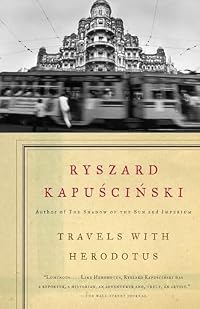
So what to think about this book? Personally, I think that none of Kapuscinski’s earlier books can beat the universal and time-less attraction of his last novel “Travels with Herodotus”. All his previous books, original and gripping reads on their own account, still lead to his final book which is also his testament.
Apart from some sensational incidents, Kapuscinski’s books have dated a bit. The great events he describes have turned into historical footnotes; most mysteries he discusses have been elucidated or at least been put into another perspective.
But some chapters are essential in their depiction of what is wrong with the countries he loved so much.
Take for instance the short chapter in which Kapuscinski narrates how a Tanzanian woman, Member of Parliament, tries unsuccessfully to pass a bill which would greatly improve the financial support and the living conditions of the numerous illegitimate children by passing a part of the responsibility to their known biological fathers.
The ludicrous arguments, which her male colleagues use against this praise-worthy bill, announce, already then, the scandalous attitudes and blatant irresponsibility which many African governments will show towards the Aids problem and explains why the different African Leaders failed to set up an effective prevention program.
So, as a conclusion, any book of Kapuscinski is still a gripping read, but as to the understanding you get out of it depends on your proper insight and your receptivity. show less
Again Kapuscinski, who as a war - correspondent visits the different third world countries during their bloody struggle towards independence, finds himself in the most dangerous situations. Ryszard is stung by scorpions, dodges bullets, escapes fire squads, hides from enraged lynching mobs and, even in a moment of extreme horror, is doused in petrol, ready to set alight.
The revolutionary theatres he is visiting follow each other: Congo, Algeria, Mozambique, Ethiopia and Somalia. The book takes it enigmatic title from one of these “revolutions”, the 100-hour war show more between El Salvador and Honduras in ’69. Ignited by the riots following the qualifying rounds of the 1970 World Cup, this Central - American hysteria leads to some 300,000 Salvadorans displaced from their homes, 900 troops and civilians killed on El Salvadorian side, 2,000 civilians killed on the Honduras side and thousands of homeless farmers, who have not a clue of what happened to them.
All this in less than four days of fighting!
Kapuscinski’s reputation as a hard boiled war-correspondent and witness of his time has slightly been debunked by a recent biography written by his fellow countryman Artur Domoslawski. Kapuscinski seems not to have been the witness to all of what he claimed. Still Kapuscinski enjoys a quasi mythical status in Poland and the new biography was viciously attacked when published.
So what to think about this book? Personally, I think that none of Kapuscinski’s earlier books can beat the universal and time-less attraction of his last novel “Travels with Herodotus”. All his previous books, original and gripping reads on their own account, still lead to his final book which is also his testament.
Apart from some sensational incidents, Kapuscinski’s books have dated a bit. The great events he describes have turned into historical footnotes; most mysteries he discusses have been elucidated or at least been put into another perspective.
But some chapters are essential in their depiction of what is wrong with the countries he loved so much.
Take for instance the short chapter in which Kapuscinski narrates how a Tanzanian woman, Member of Parliament, tries unsuccessfully to pass a bill which would greatly improve the financial support and the living conditions of the numerous illegitimate children by passing a part of the responsibility to their known biological fathers.
The ludicrous arguments, which her male colleagues use against this praise-worthy bill, announce, already then, the scandalous attitudes and blatant irresponsibility which many African governments will show towards the Aids problem and explains why the different African Leaders failed to set up an effective prevention program.
So, as a conclusion, any book of Kapuscinski is still a gripping read, but as to the understanding you get out of it depends on your proper insight and your receptivity. show less
A collection of personal reportage by a guy addicted to throwing himself into life-threatening situations. The access he gets is amazing, but it is difficult to imagine the personal cost is worth it.
Mixed with pathos and humor a vivid trip through some of the world's hot spots.
A collection of travel reportage from Africa and South America, including the titular war which legitimately did break out because of a football match.
Members
- Recently Added By
Published Reviews
ThingScore 100
Lists

Non-Fiction Worth Reading
1,015 works; 254 members

Central America
14 works; 1 member
Author Information

86+ Works 10,439 Members
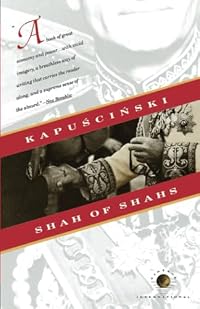
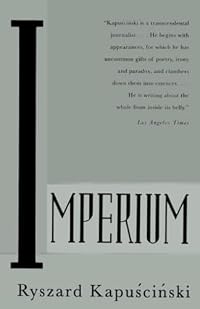
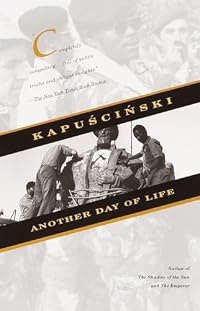
Ryszard Kapuscinski was born in Pinsk, a city now in Belarus on March 4, 1932. He received a master's degree in history from the University of Warsaw. He worked for the Communist journal Sztandar Mlodych, The Flag of Youth. He wrote an article describing the misery and despair of steel workers at a new steel plant outside of Krakow that the party show more bosses had extolled as a showpiece of proletarian culture. He was fired and forced into hiding. Later his findings were confirmed by a blue-ribbon task force and he was awarded Poland's Golden Cross of Merit. In 1962, PAP, the Polish news agency, appointed him its only correspondent in the third world. His articles about third world conflicts eventually appeared in a series of books including The Emperor: Downfall of an Autocrat, about the lapsed life of Haile Selassie's imperial court; The Soccer War, which dealt with Latin American conflicts; Another Day of Life, about Angola's civil war; Shah of Shahs, about the rise and fall of Iran's last monarch; and Imperium, an account of his travels through Russia and its neighbors after the collapse of the Soviet Union. He also wrote for The New Yorker, The New York Times Magazine, and Granta. In 1981, the government of General Wojciech Jaruzelski stripped him of his journalistic credentials after he committed himself to the Solidarity trade union movement. He then began working with underground publishers, contributing poems, and supporting the dissident culture. He died January 23, 2007 at the age of 74. (Bowker Author Biography) show less
Some Editions
Series
Belongs to Publisher Series
Work Relationships
Common Knowledge
- Canonical title
- The Soccer War
- Original title
- Wojna futbolowa
- Alternate titles*
- The Soccer War
- Original publication date
- 1978
- People/Characters
- Ryszard Kapuściński; Patrice Lumumba
- Important places
- Algeria; Tanganyika, East Africa; Accra, Ghana; El Salvador; Leopoldville
- First words
- "I am living on a raft in a side-street in the merchant district of Accra."
- Last words
- (Click to show. Warning: May contain spoilers.)"They cannot see it. You cannot see it, anything, the night, Mpango, the thick bush, Ghana, the fire dying out, the elders going off to sleep, the Nana dozing, and snow falling somewhere, and woman like blacks, thoughts, 'Thaey are learning to read, he said something like that,' thoughts, 'They had a war, ach, a war, he said, yes, no colonies, that country, Poland, white and they have no colonies,' thoughts, the bush screams, this strange world."
- Blurbers
- le Carre, John
*Some information comes from Common Knowledge in other languages. Click "Edit" for more information.
Classifications
Statistics
- Members
- 808
- Popularity
- 34,077
- Reviews
- 10
- Rating
- (4.00)
- Languages
- 12 — Dutch, English, French, German, Hungarian, Italian, Japanese, Norwegian (Bokmål), Polish, Portuguese, Spanish, Swedish
- Media
- Paper, Ebook
- ISBNs
- 43
- ASINs
- 7