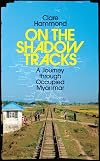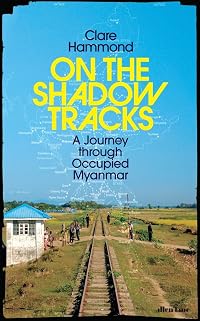
On the Shadow Tracks: A Journey Through Occupied Myanmar
by Clare Hammond
On This Page
Description
"In 2016, while working as a journalist in Yangon, Clare Hammond discovered an obscure map that showed a web of new railways spanning the length and breadth of the country - railways not shown on any other publicly available maps. She was determined to uncover the railways' origins, purpose, and most of all, the silence that surrounded them. She would spend three months travelling on these mysterious railways, and the next five years piecing their story together. Her journey would take her show more from Myanmar's tropical south to the embattled mountain towns that border India and China. In dilapidated carriages, along tracks in disrepair, through contested ethnic states and former sites of forced labour, visiting temples, tea shops and festivals, Clare encountered a colourful and contradictory Myanmar through the stories of its people. Simultaneously a lush and evocative travelogue, an unsparing account of Myanmar's recent history, and an astonishing, conversation-shifting engagement with Britain's colonial legacy, On the Shadow Tracks is that rare and necessary thing: a book that finds and tells the truth"-- show lessTags
Recommendations
























Member Reviews
In 2015 and 2016, Clare Hammond, a business journalist based in Yangon, the old capital of Burma, went on a trip through what is now Myanmar, using the country's dilapidated, abandoned, illusory, and in some cases totally imaginary, railway system as her conduit into parts of the country few outsiders visit. Now a book researched 10 years ago, but only published now, might imply that her observations are out of date. Sadly, they are not. This book could have been written at any time in the last 25 years.
In 2015 and 2016 there was hope that the election of the Aung San Suu Kyi government would be a new beginning for Myanmar; sadly we now know that, well intentioned as her party was, the Army never really gave up much power, and the show more refusal to do anything to curb the Army's brutal pograms against the Rohingya, and the global shrugging of the shoulders of countries and investors more interested in profits to be made from Myanmar's natural resources convinced the generals that a veneer of democracy wasn't needed to allow them to enrich themselves. They officially took back control in 2021; they have it now. No one outside Myanmar cares.
The creation of firstly Burma, and then Myanmar, was always a mess. In its hurry to abandon colonies it could no longer afford, the British handed the whole territory to Burmese, including territories that had only rarely, or never, been subjects of the Burmese kingdoms. Peoples such as the Karen and the Shan had distinct territories, languages and religions and expected autonomy after the British withdrew; of course they didn't get it. Perhaps some sort of federal system might have been possible, but it would have laborious and time consuming to set up and, the British had to go.
Railways were always a form of control for colonisers. A railway allows you to move soldiers around the country quickly, especially important in a mountainous, jungly, difficult to navigate area like Myanmar. And of course, railways symbolise progress, and can actually help to provide it, by moving goods and services around more efficiently too.
Myanmar's railways never really worked. Conditions were too difficult, the rainfall too extreme, the quipment not up to task, the expertise to run and maintain them not available, the costs too high. That didn't stop the military government from building them though, or at least attempting to do so. And as Hammond explains, lacking the labour to do so, it hit on a simple solution; the slave and enforced labour of the local farmers. Throughout her journey be it in Rakhine, Shan, Karen or other non Burmese parts of the country, the story is the same. Forced labour, for no wages or food or shelter, in malarial jungles, enduring beatings by the Army, farmers male and female, young and old, built railways. Land casually confiscated, without recompense, or legal ruling. People made homeless and expelled from where they had lived for generations. The land laid waste.
Even more depressing, if possible, is that most of these projects were utterly pointless. Noone wanted to take the trains, they don't want to now. Buses and minivans are much more efficient. And its difficult to tame nature in Myanmar; everywhere Hammond goes she finds abandoned, overgrown stations and tracks, bridges that have collapsed, tunnels it just isn't safe to go through.
So what was and is the point of all this? Of course, the railways are primarily for military use, not nation building. But they played a very important role in the subjugation of non Burmese people as well.
Clare Hammond was smart to use the railways as her symbol of all that is broken, corrupt and illusory in Myanmar. Also - they gave her the perfect cover. Everyone knows that some British people have a strange obsession with trains and railways. Goodness knows what train officials, government officials, police and everyday people made of this slight, small, but obviously tough as nails, British woman, with her questions about railways, how they were built and why they were built. In the end, they seem to have concluded that the easiest course of action was to talk to her. Although she has some hairy moments in Shan state, in general, officialdom leaves her be, the bemused Railway Police protect her (sample exchange. Policeman "Aren't you scared"? Hammond "Why, should I be?") and people everywhere house her, feed her, share their stories, festivals and booze with her.
Its a thrilling narrative. Hammond is understandably unforthcoming about the tremendous feats of organisation, and perhaps in some cases, bribery this must have taken. But its an excellent piece of reportage, and I don't think I've read anything quite like it. Highly recommended show less
In 2015 and 2016 there was hope that the election of the Aung San Suu Kyi government would be a new beginning for Myanmar; sadly we now know that, well intentioned as her party was, the Army never really gave up much power, and the show more refusal to do anything to curb the Army's brutal pograms against the Rohingya, and the global shrugging of the shoulders of countries and investors more interested in profits to be made from Myanmar's natural resources convinced the generals that a veneer of democracy wasn't needed to allow them to enrich themselves. They officially took back control in 2021; they have it now. No one outside Myanmar cares.
The creation of firstly Burma, and then Myanmar, was always a mess. In its hurry to abandon colonies it could no longer afford, the British handed the whole territory to Burmese, including territories that had only rarely, or never, been subjects of the Burmese kingdoms. Peoples such as the Karen and the Shan had distinct territories, languages and religions and expected autonomy after the British withdrew; of course they didn't get it. Perhaps some sort of federal system might have been possible, but it would have laborious and time consuming to set up and, the British had to go.
Railways were always a form of control for colonisers. A railway allows you to move soldiers around the country quickly, especially important in a mountainous, jungly, difficult to navigate area like Myanmar. And of course, railways symbolise progress, and can actually help to provide it, by moving goods and services around more efficiently too.
Myanmar's railways never really worked. Conditions were too difficult, the rainfall too extreme, the quipment not up to task, the expertise to run and maintain them not available, the costs too high. That didn't stop the military government from building them though, or at least attempting to do so. And as Hammond explains, lacking the labour to do so, it hit on a simple solution; the slave and enforced labour of the local farmers. Throughout her journey be it in Rakhine, Shan, Karen or other non Burmese parts of the country, the story is the same. Forced labour, for no wages or food or shelter, in malarial jungles, enduring beatings by the Army, farmers male and female, young and old, built railways. Land casually confiscated, without recompense, or legal ruling. People made homeless and expelled from where they had lived for generations. The land laid waste.
Even more depressing, if possible, is that most of these projects were utterly pointless. Noone wanted to take the trains, they don't want to now. Buses and minivans are much more efficient. And its difficult to tame nature in Myanmar; everywhere Hammond goes she finds abandoned, overgrown stations and tracks, bridges that have collapsed, tunnels it just isn't safe to go through.
So what was and is the point of all this? Of course, the railways are primarily for military use, not nation building. But they played a very important role in the subjugation of non Burmese people as well.
Clare Hammond was smart to use the railways as her symbol of all that is broken, corrupt and illusory in Myanmar. Also - they gave her the perfect cover. Everyone knows that some British people have a strange obsession with trains and railways. Goodness knows what train officials, government officials, police and everyday people made of this slight, small, but obviously tough as nails, British woman, with her questions about railways, how they were built and why they were built. In the end, they seem to have concluded that the easiest course of action was to talk to her. Although she has some hairy moments in Shan state, in general, officialdom leaves her be, the bemused Railway Police protect her (sample exchange. Policeman "Aren't you scared"? Hammond "Why, should I be?") and people everywhere house her, feed her, share their stories, festivals and booze with her.
Its a thrilling narrative. Hammond is understandably unforthcoming about the tremendous feats of organisation, and perhaps in some cases, bribery this must have taken. But its an excellent piece of reportage, and I don't think I've read anything quite like it. Highly recommended show less
Ratings
Members
- Recently Added By
Lists

Non-Fiction Worth Reading
1,016 works; 262 members

Best Travel Writing - Non-Fiction
110 works; 6 members

Top Five Books of 2025
954 works; 303 members

Books Read in 2025
4,128 works; 98 members
Author Information
1 Work 25 Members
Awards and Honors
Common Knowledge
- Important places
- Myanmar
- Blurbers
- Lumley, Joanna; Roberts, Sophy
Classifications
- Genres
- Travel, Nonfiction, History, General Nonfiction, Biography & Memoir
- DDC/MDS
- 959.1 — History & geography History of Asia Southeast Asia: Myanmar, Thailand, Laos, Cambodia, Vietnam Burma (Myanmar)
- LCC
- DS530.65 .H36 — History of Europe, Asia, Africa and Oceania Asia History of Asia Southeast Asia
- BISAC
Statistics
- Members
- 25
- Popularity
- 1,076,961
- Reviews
- 1
- Rating
- (4.00)
- Languages
- English
- Media
- Paper, Audiobook, Ebook
- ISBNs
- 2
- ASINs
- 2