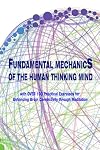
Fundamental Mechanics of the Human Thinking Mind
by VB
On This Page
Tags
Member Reviews
I wasn't really sure what to make of this book. Either it was just a bunch of mumbo jumbo or it was a work of genius. I probably fell somewhere in the middle after giving it some studied thought. It is a book with the subject of meditation but most of us have a preconceived or experienced notion of what meditation is about. This author stirs things up a bit and adds some offbeat and insightful looks into what it may really be about.
He spends a lot of time making his case about what mediation is trying to be and not so much on technique. He talks a lot about our talking mind which he claims is not really us but a voice that often leads us astray in analyzing the past or contemplating the future. He makes it clear that the here and now is show more all that really mattters. He opens the door to his here and now with his concept of LFL for look, feel, listen. And it is pretty persuasive. He also debunks the value of the closed eye empty mind approach to traditional meditation.
On balance the concepets he brings forth I did feel had merit and opened up a whole new way to look at the process of meditation and what it can and cannot do for us. One approach that leads us down a different path. show less
He spends a lot of time making his case about what mediation is trying to be and not so much on technique. He talks a lot about our talking mind which he claims is not really us but a voice that often leads us astray in analyzing the past or contemplating the future. He makes it clear that the here and now is show more all that really mattters. He opens the door to his here and now with his concept of LFL for look, feel, listen. And it is pretty persuasive. He also debunks the value of the closed eye empty mind approach to traditional meditation.
On balance the concepets he brings forth I did feel had merit and opened up a whole new way to look at the process of meditation and what it can and cannot do for us. One approach that leads us down a different path. show less
 This review was written for LibraryThing Early Reviewers.
While the author has done some good research and has referenced good sources, I found some of the author's claims that mental illness and wars are attributed to the default mode network (or automatic negative thoughts) to be outlandish/bridge too far. The author has pages of quotes from reputable authors/philosophers such as Eckhart Tolle, Mo Gawdat but purports the DMN practices address a good many societal ills, a bridge too far. I would stick with the original authors rather than this volume.
I found the fact that author uses the concepts of "mindfulness" and "meditation" interchangeably, confusing. Furthermore, the author has a tendency to treat the reader with condescension throughout the book (using different fonts/text show more formatting etc. to highlight concepts already introduced). show less
This review was written for LibraryThing Early Reviewers.This book is a big read and a lot to get through, so I haven't completed it yet, but I am learning SO much about the human mind and the function of the brain that I didn't know before.
The best part is that the author really breaks down the mechanics in easy-to-digest language and visuals. I am not left looking for definitions of highly academic words that nobody knows; instead, I can read and ingest the information easily.
I highly recommend this book to anyone who wants to learn more about the function of the human brain!
The best part is that the author really breaks down the mechanics in easy-to-digest language and visuals. I am not left looking for definitions of highly academic words that nobody knows; instead, I can read and ingest the information easily.
I highly recommend this book to anyone who wants to learn more about the function of the human brain!
This review was written for LibraryThing Early Reviewers.Lots of good recourses and links some good points as well. I had a lot of what i felt were filler pages of full sized quotes but they were there to reflect on so its likely easier without distraction of other text.
While i know he said he was essentially playing hard ball with hard hitting facts it did come off a bit as talking down on the reader or taunting a kid with a 'dangerous item' and honestly felt a lot like a research guide book. Which isn't a bad thing and honestly likely intended with how its set up.
It does provide links to alternate sources and videos which may be hard to type from a physical book it does make it easier as a digital book. I did not go through a majority of the links only a few and they do make up a large show more portion of the end of the book . Was expecting more of a collection of practices that is more reader friendly ( and by that i mean doesn't require a ton of outside other author sources which is heavily leaned on to give us background for what is being talked about) I may revisit in the future to dive deeper into the various resources
TLDR
Not bad just not what i expected. Its an interesting reading topic to be sure but i wasn't expecting to have to read it like I'm formulating a college final paper. Great Guide on the subject and a good place for resources on the mater. show less
While i know he said he was essentially playing hard ball with hard hitting facts it did come off a bit as talking down on the reader or taunting a kid with a 'dangerous item' and honestly felt a lot like a research guide book. Which isn't a bad thing and honestly likely intended with how its set up.
It does provide links to alternate sources and videos which may be hard to type from a physical book it does make it easier as a digital book. I did not go through a majority of the links only a few and they do make up a large show more portion of the end of the book . Was expecting more of a collection of practices that is more reader friendly ( and by that i mean doesn't require a ton of outside other author sources which is heavily leaned on to give us background for what is being talked about) I may revisit in the future to dive deeper into the various resources
TLDR
Not bad just not what i expected. Its an interesting reading topic to be sure but i wasn't expecting to have to read it like I'm formulating a college final paper. Great Guide on the subject and a good place for resources on the mater. show less
This review was written for LibraryThing Early Reviewers.I will start off by saying that I just could not get through this book. The author kept stating why the book should be read and I couldn't get past being told why instead of getting to the point.
This review was written for LibraryThing Early Reviewers.I am very grateful to had the opportunity to be able to read this book as it is extremely interesting to read in my opinion.
This book has opened my mind and eyes alot and has kept me on my feet till the very end.
This book has opened my mind and eyes alot and has kept me on my feet till the very end.
This review was written for LibraryThing Early Reviewers.The author, VB, at page 10 of his e-book, Fundamental Mechanics of the Human Thinking Mind (FMHTM), presents its objective:
This book is about the PROFOUND CONSEQUENCES that arise from the UNAWARE,
self-conversations that transpire inside your mind throughout most of your “awake” hours;
WHICH YOU INNOCENTLY BELIEVE IS YOURSELF TALKING TO YOURSELF
This reviewer is reading FMHTM in its Portable Document Format (PDF) version. A list of the book's 13 sections follows:
1. Introduction -- p. 24
2. Why Should Everyone Care About Meditation (Awareness) And Brain Connectivity? -- p. 51
3. The Reality Is, At This Very Moment, You Are Confused About Who You Are -- p. 69
4. Case Study, Interviews, Books, and Podcast Excerpts For Validation -- p. 77 show more
5. Meditation Is Not What You Think -- p. 91
6. The Bandwidth Model -- p. 106
7. Awareness and Unconscious Thinking in Our Daily Lives -- p. 128
8. Unconsciousness Thinking Characteristics and [Their] Far Reaching Negative Effects -- p. 178
9. Confusion Regarding Traditional Meditation Methods and Buddhism -- p. 199
10. In Conclusion -- p. 209
11. Practical Exercises, Guides, and Notes -- p. 216
12. Brief Explorations in Meditation Science -- p. 273
13. Appendices -- p. 285
Pages 11 thru 23 provide the reader with definitions of meditation : "experiencing the present moment" and "the tried and true course for understanding your thinking mind" (p. 12) The author then reviews myriad examples of human distraction and disconnectedness, especially since the outbreak of the COVID-19 pandemic, that have occurred despite the several modes of communication and entertainment available to most individuals. Our author then informs us of his discovery of meditation by reading Eckhart Tolle's book 'The Power of Now' (first published 1997 in Canada) and then reveals some biographical perspective:
"My relentless pursuit of understanding originated from the mental and
emotional anguish I endured. Years in and out of therapy and various
antidepressants for chronic anxiety, depression, ADHD, and borderline bipolar
disorder marked my life. Despite a successful career as an architect, my life
teetered between sanity and chaos. A loving and disciplined family provided
crucial support. Proper education, discipline, morality, and ethics helped me
survive powerful inner narratives that regulated most of my behaviors and
actions with little conscious control. Without this support, I could have ended
up in jail or dead, a sad fate that befalls too many." (p. 17)
The author, VB, continues with a Disclaimer (p. 19) that reading further may challenge one's sense of identity and perception of reality and then presents an image from the 1999 motion picture film, The Matrix, and compares it to one of an individual seated with legs crossed in the meditative lotus position. The reader is then presented with the option of taking a "Blue Pill" (stop now) or a "Red Pill" (continue at your own risk) -- (pp. 20-23). This reader has not viewed the film and is not familiar with the blue pill/red pill choice or option.
With 'Part 1 -- Introduction' (pp. 24-50) the author lays out his approach to present-moment awareness meditation. The human brain's "Default Mode Network" is discussed in detail with reference to Wikipedia's entry on the subject. And VB reminds the reader that "I prepared this work using the scientific method. Observation, research, hypothesis, test with experiment, analyze data and report conclusions culminating with this book." (p.32) At this point, the reader is asked to become "interactive" with the text by clicking on the hyperlinks therein.
---
MTF
=== show less
This book is about the PROFOUND CONSEQUENCES that arise from the UNAWARE,
self-conversations that transpire inside your mind throughout most of your “awake” hours;
WHICH YOU INNOCENTLY BELIEVE IS YOURSELF TALKING TO YOURSELF
This reviewer is reading FMHTM in its Portable Document Format (PDF) version. A list of the book's 13 sections follows:
1. Introduction -- p. 24
2. Why Should Everyone Care About Meditation (Awareness) And Brain Connectivity? -- p. 51
3. The Reality Is, At This Very Moment, You Are Confused About Who You Are -- p. 69
4. Case Study, Interviews, Books, and Podcast Excerpts For Validation -- p. 77 show more
5. Meditation Is Not What You Think -- p. 91
6. The Bandwidth Model -- p. 106
7. Awareness and Unconscious Thinking in Our Daily Lives -- p. 128
8. Unconsciousness Thinking Characteristics and [Their] Far Reaching Negative Effects -- p. 178
9. Confusion Regarding Traditional Meditation Methods and Buddhism -- p. 199
10. In Conclusion -- p. 209
11. Practical Exercises, Guides, and Notes -- p. 216
12. Brief Explorations in Meditation Science -- p. 273
13. Appendices -- p. 285
Pages 11 thru 23 provide the reader with definitions of meditation : "experiencing the present moment" and "the tried and true course for understanding your thinking mind" (p. 12) The author then reviews myriad examples of human distraction and disconnectedness, especially since the outbreak of the COVID-19 pandemic, that have occurred despite the several modes of communication and entertainment available to most individuals. Our author then informs us of his discovery of meditation by reading Eckhart Tolle's book 'The Power of Now' (first published 1997 in Canada) and then reveals some biographical perspective:
"My relentless pursuit of understanding originated from the mental and
emotional anguish I endured. Years in and out of therapy and various
antidepressants for chronic anxiety, depression, ADHD, and borderline bipolar
disorder marked my life. Despite a successful career as an architect, my life
teetered between sanity and chaos. A loving and disciplined family provided
crucial support. Proper education, discipline, morality, and ethics helped me
survive powerful inner narratives that regulated most of my behaviors and
actions with little conscious control. Without this support, I could have ended
up in jail or dead, a sad fate that befalls too many." (p. 17)
The author, VB, continues with a Disclaimer (p. 19) that reading further may challenge one's sense of identity and perception of reality and then presents an image from the 1999 motion picture film, The Matrix, and compares it to one of an individual seated with legs crossed in the meditative lotus position. The reader is then presented with the option of taking a "Blue Pill" (stop now) or a "Red Pill" (continue at your own risk) -- (pp. 20-23). This reader has not viewed the film and is not familiar with the blue pill/red pill choice or option.
With 'Part 1 -- Introduction' (pp. 24-50) the author lays out his approach to present-moment awareness meditation. The human brain's "Default Mode Network" is discussed in detail with reference to Wikipedia's entry on the subject. And VB reminds the reader that "I prepared this work using the scientific method. Observation, research, hypothesis, test with experiment, analyze data and report conclusions culminating with this book." (p.32) At this point, the reader is asked to become "interactive" with the text by clicking on the hyperlinks therein.
---
MTF
=== show less
This review was written for LibraryThing Early Reviewers.Members
- Recently Added By
Author Information
3 Works 12 Members
Common Knowledge
- Canonical title
- Fundamental Mechanics of the Human Thinking Mind
Statistics
- Members
- 10
- Popularity
- 2,129,660
- Reviews
- 7
- Rating
- (3.50)
- Languages
- English
- Media
- Paper
- ISBNs
- 1
- ASINs
- 1