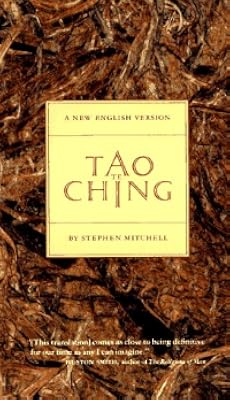
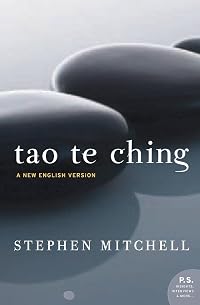
Tao Te Ching: A New English Version
by Stephen Mitchell
On This Page
Description
Lao-tzu's Tao Te Ching, or Book of the Way, is the classic manual on the art of living and one of the wonders of the world. In eighty-one brief chapters, the Tao Te Ching llods at the basic predicament of being alive and gives advice that imparts balance and perspective, a serene and generous spirit. This book is about wisdom in action. It teaches how wo work for the good with the effortless skill that comes from being in accord with the Tao (the basic principle of the universe) and applies show more equally to good government and sexual love, to childrearing, business, and ecology. The Tao Te Ching is the most widely translated book in world literature, after the Bible. Yet the gemlike lucidity of the original has eluded most previous translations, and they have obscured some of its central ideas. Now the Tao Te ching has been rendered into English by the eminent scholar and translator Stephen Mitchell. Mr. Mitchell's Dropping Ashes on the Buddha is a modern Zen classic, and his translations of Rilke and of the Book of Job have already been called definitive for our time. show lessTags
Recommendations


Member Reviews
I actually listened to the audio book version of Tao Te Ching after hearing it mentioned on the Sword and Laser podcast. With an hour drive into work, an audio book can have a crucial impact on my commute. At first the delivery is a little hard to adapt to in that it flows much like the Tao principle. Letting your mind wander for a moment tends to lose the momentum. While read in a leisurely pace, the concepts of Tao Te Ching all tended to make me drift into introspection. There was quite a bit of turning off my radio so that I could let myself catch up.
I really enjoyed the Tao Te Ching; however, I think that this would be best enjoyed in written form. I plan to put it into my list of books that I read over and over again. There is so show more much to digest in the wisdom of this translation, and I think that each reading will provide more insight. show less
I really enjoyed the Tao Te Ching; however, I think that this would be best enjoyed in written form. I plan to put it into my list of books that I read over and over again. There is so show more much to digest in the wisdom of this translation, and I think that each reading will provide more insight. show less
After many readings, and after reading many other translations of the Tao Te Ching, this is still my favorite. I return to read it again every few years, and find that it serves as an excellent recentering of my perspective. The translation presented by Stephen Mitchell does a remarkable job of capturing the essence of what I love about this philosophical classic, and those two whom I recommend it who take the time to read it always have good things to say about it. One notable reaction to it was from a barista at what is, at the time of this writing, my favorite coffee shop: she told me she found the message of the Tao Te Ching to describe "a beautiful way to think about life" (paraphrased from memory), which put a smile on my face. It show more truly is exactly that, though of course no words can adequately capture the entirety of it so succinctly. "The tao that can be told is not the eternal tao," of course.
There are instances here and there where some bit of phrasing is not quite as perfect as its counterpart in another translation, of course -- including what I quoted above, where I find myself drawn more to a common translation of the statement as "The way that can be spoken is not the true Way." The most particularly jarring phrasing in Mitchell's translation is deep into it where he "updates" things for modern technology: "When a country is in harmony with the Tao, the factories make trucks and tractors. When a country goes counter to the Tao, warheads are stockpiled outside the cities." I find such attempts to update things within an ancient classic ill-advised, in part because the implications of the statement may be subtly altered by the differing relationships between tools of life and war in the distant past and those in the present age, but more importantly the updated imagery strikes a discordant note of anachronism within the otherwise elegant representation of the book's themes. Taken as a whole, though, the effort of Mitchell's translation is obviously focused on the essential wisdom of the Tao Te Ching distinct from individual modern political biases, attempts to leverage modern cultural connotation in ways that skew the intrinsic meaning of the work, and other problems that litter many other translations.
The wisdom within the work can be detected in any of the many translations I have read, but the work of doing so is quite effortless in Mitchell's translation relative to others, and for that more than anything else it has long been, and continues to be, my favorite.
(review updated 2015-07-05)
I read the pocket edition of the Stephen Mitchell translation, including all the author's notes in the back, and found them rather illuminating. The brief moments where something did not come of quite right for me in the translation, as a part of the larger whole, turned out to all be in "chapters" where Mitchell's notes indicate he "took liberties" with the translations. While those sections might have benefited from a little bit of poetic license, I felt he took it just a smidgen farther than would be ideal in a couple of cases.
The process of re-reading, then going through again with the notes (effectively reading the book itself twice this time and the notes once during the second read-through), gave me more to think about than in previous readings of the book, and I loved it. Even the imperfection of human filters in the form of translators offers some insight into the deeper meanings of the text, and the translation notes included in the pocket edition increases the transparency of the translation.
(above section 2017-11-10) show less
There are instances here and there where some bit of phrasing is not quite as perfect as its counterpart in another translation, of course -- including what I quoted above, where I find myself drawn more to a common translation of the statement as "The way that can be spoken is not the true Way." The most particularly jarring phrasing in Mitchell's translation is deep into it where he "updates" things for modern technology: "When a country is in harmony with the Tao, the factories make trucks and tractors. When a country goes counter to the Tao, warheads are stockpiled outside the cities." I find such attempts to update things within an ancient classic ill-advised, in part because the implications of the statement may be subtly altered by the differing relationships between tools of life and war in the distant past and those in the present age, but more importantly the updated imagery strikes a discordant note of anachronism within the otherwise elegant representation of the book's themes. Taken as a whole, though, the effort of Mitchell's translation is obviously focused on the essential wisdom of the Tao Te Ching distinct from individual modern political biases, attempts to leverage modern cultural connotation in ways that skew the intrinsic meaning of the work, and other problems that litter many other translations.
The wisdom within the work can be detected in any of the many translations I have read, but the work of doing so is quite effortless in Mitchell's translation relative to others, and for that more than anything else it has long been, and continues to be, my favorite.
(review updated 2015-07-05)
I read the pocket edition of the Stephen Mitchell translation, including all the author's notes in the back, and found them rather illuminating. The brief moments where something did not come of quite right for me in the translation, as a part of the larger whole, turned out to all be in "chapters" where Mitchell's notes indicate he "took liberties" with the translations. While those sections might have benefited from a little bit of poetic license, I felt he took it just a smidgen farther than would be ideal in a couple of cases.
The process of re-reading, then going through again with the notes (effectively reading the book itself twice this time and the notes once during the second read-through), gave me more to think about than in previous readings of the book, and I loved it. Even the imperfection of human filters in the form of translators offers some insight into the deeper meanings of the text, and the translation notes included in the pocket edition increases the transparency of the translation.
(above section 2017-11-10) show less
Philosophic fluff. Most of the good lines quoted something - from Shakespeare to Star Wars (not quotes exactly - evoke, more like). The glosses were interesting (why did Mitchell say it that way?) and amusing ("One gives birth to Two: Oy!"
I am taken with this idea that a translation can be a paraphrase. The Message by Eugene Peterson does this with the Bible, and I appreciate reading it for a richer perspective. I am only passingly familiar with this particular text and, of course, only in translation, but the afterword by Stephen Mitchell has inspired me to read more of his work and to think about rewriting other texts as a way of meditating on them.
It's awkward to rate books upon which religions are founded, and so I won't be giving this any rating. This is an instructional book, a wise one too, I think so at least, and one that appeals to me as it preaches coexistence and harmony. The three major principles here being: simplicity, patience, and compassion. This translation was smooth, as was the audiobook. I got a different translation from the library I'll read later, just because it's a short and fast read I want to read again, and also because I want to compare translations
I liked this version a lot. I am likely paraphrasing other reviewers when I say it is accessible, sensible, stylistic, and modern. Modern meaning it's been sanitized a bit more than most, for example "The Master doesn't seek fulfillment; Not seeking, not expecting; she is present, and can welcome all things. So use of the female and male 'tense'. Also missing some of the more abstract or even abstruse general metaphysical terms found in some translations. A good starter Tao for the first timer.
There’s a line about an ordinary person not being ready for the dao compared to the superior man. Perhaps that’s why I oughta reread this later
Great translation though, do reccomend.
Great translation though, do reccomend.
Members
- Recently Added By
Author Information

33+ Works 9,176 Members
Poet and writer Stephen Mitchell attended Amherst College, the Sorbonne, and Yale University. He has been training in Zen mediation for more than 25 years. His book, Real Power, uses ancient wisdom to study power, the key to business. Mitchell also translated the Tao Te Ching. (Bowker Author Biography)
Classifications
- Genres
- Religion & Spirituality, Nonfiction, Philosophy
- DDC/MDS
- 299.51482 — Religion Other religions Shintoism/Taoism/Other Mythologies Of Asian Origin Religions of Chinese Origin Taoism Scriptures
- LCC
- BL1900 .L26 .E5 — Philosophy, Psychology and Religion Religions. Mythology. Rationalism Religions. Mythology. Rationalism History and principles of religions Asian. Oriental By region or country China Taoism
- BISAC
Statistics
- Members
- 1,199
- Popularity
- 20,764
- Reviews
- 19
- Rating
- (4.34)
- Languages
- Chinese, English, Italian
- Media
- Paper, Audiobook, Ebook
- ISBNs
- 8
- ASINs
- 11