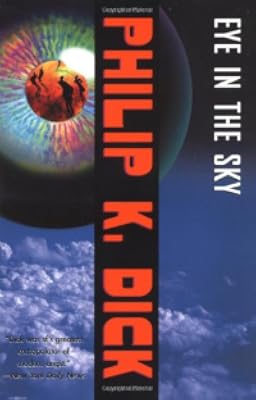
Eye in the Sky
by Philip K. Dick
On This Page
Description
Fiction. Literature. Science Fiction. HTML:"I have never seen [its] theme handled with greater technical dexterity or given more psychological meaning."—Fantasy and Science FictionWhen a routine tour of a particle accelerator goes awry, Jack Hamilton and the rest of his tour group find themselves in a world ruled by Old Testament morality, where the smallest infraction can bring about a plague of locusts. Escape from that world is not the end, though, as they plunge into a Communist show more dystopia and a world where everything is an enemy.
Philip K. Dick was aggressively individualistic and no worldview is safe from his acerbic and hilarious take downs. Eye in the Sky blends the thrills and the jokes to craft a startling morality lesson hidden inside a comedy. show less
Tags
Recommendations


























Member Reviews
For liberal, open-minded men and women, dealing with religious fundamentalists can be most unpleasant. From my own experience, I recall several nasty cases: my Sunday school teacher giving us kids a pep talk on the virtues of racism and segregation; whilst accompanying a college buddy to his church, listening to the minister browbeat the congregation with threats of hellfire; aggressive bible thumpers on my doorstep; a loudmouth bully manager using the Bible as a billy club to manipulate his subordinates. In a way, looking back on my boyhood, I got off easy. There are many young boys and girls who have been emotionally traumatized and even physically abused and beaten in the name of fundamentalist-style religion.
Although PKD had a show more liberally inclined upbringing (his mother sent young Philip to a Quaker school), I’m quite certain he had his own brushings with fundamentals in one form or another. Anyway, unlike a book attempting to counter narrow-mindedness with well-reasoned, heartfelt advice on tolerance, compassion, awareness or presence, written by, say, the Dali Lama or Eckhart Tolle, PKD’s ‘Eye in the Sky’ is a searing, no-nonsense, tell-it-like-it-is novel addressing fundamentalist religion with all its rigidity, brutality, suffocation and kitschy ugliness. Indeed, one of the most entertaining, inventive works of science fiction you will ever read. Did Christopher Hitchens read ‘Eye in the Sky’? If so, undoubtedly many a time Hitch chuckled and nodded his head in approval.
But the novel’s pointed black-as-midnight humor and blistering satire has a wider target than religion; after fundamentalism, PDK shifts his focus to a frumpy woman who holds an antiquated vision of life that is saccharine, shallow and out-and-out dishonest. Then, more swings and moves!
And, when each character’s distorted, cartoonish view of life becomes the reality of the external world, the story clicks from one universe to another, and with each click, PDK vividly portrays how intolerance and mean-spiritedness of any stripe or flavor is a nightmarish reality. Thus, on one level, ‘Eye in the Sky’ can be read as a philosophical meditation on how human perception shrinks the world into its own stultifying vision. And, on another level, the implications of solipsism, that is, a view of the world having no extension or externality; rather, the entire universe living in the head of the solipsist. All in all, a book that’s vintage PKD, a book that, in my modest view of the universe, should be required high school reading. show less
“Anti-cat is one jump away from anti-Semitism.”
― Philip K. Dick, Eye in the Sky
For liberal, open-minded men and women, dealing with religious fundamentalists can be most unpleasant. From my own experience, I recall several nasty cases: a Sunday school teacher giving us kids a pep talk on the virtues of racism and segregation; accompanying a college buddy to his church, listening to the minister browbeat the congregation with threats of hellfire; having to deal with aggressive bible thumpers at my front door; a loudmouth bully manager using the Bible as a billy club to manipulate subordinates.
In a way, looking back on my boyhood, I got off easy. There are many young boys and girls who have been emotionally traumatized and even show more physically abused and beaten in the name of fundamentalist-style religion.
Although PKD had a liberally inclined upbringing (his mother sent young Philip to a Quaker school), I’m quite certain he had his own brushings with fundamentals in one form or another. Anyway, unlike a book attempting to counter narrow-mindedness with well-reasoned, heartfelt advice on tolerance, compassion, awareness or presence, written by, say, the Dali Lama or Eckhart Tolle, PKD’s Eye in the Sky is a searing, no-nonsense, tell it like it is novel addressing fundamentalist religion with all its rigidity, brutality, suffocation and kitschy ugliness.
Indeed, one of the most entertaining, inventive works of science fiction you will ever read. Did Christopher Hitchens read Eye in the Sky? If so, undoubtedly many a time Hitch chuckled and nodded his head in approval.
But the novel’s pointed black as midnight humor and blistering satire has a wider target than religion; after fundamentalism, PDK shifts his focus to a frumpy woman who holds an antiquated vision of life that is saccharine, shallow and out-and-out dishonest. Then, more swings and moves!
And, when each character’s distorted, cartoonish view of life becomes the reality of the external world, the story clicks from one universe to another, and with each click, PDK vividly portrays how intolerance and mean-spiritedness of any stripe or flavor is a nightmarish reality.
Thus, on one level, Eye in the Sky can be read as a philosophical meditation on how human perception shrinks the world into its own stultifying vision. And, on another level, the implications of solipsism, that is, a view of the world having no extension or externality; rather, the entire universe living in the head of the solipsist. All in all, a book that’s vintage PKD, a book that, in my modest view of the universe, should be required high school reading. show less
An accident at the Bevatron—the perfect Space-Age, Cold War B-movie prop—sets up PKD’s 1957 exploration of the multiverse (more a psychological-philosophical concept than scientific). A group of injured, unconscious visitors to the Berkeley Lawrence lab ends up sharing, in befuddling succession, the mindspace of a religious fanatic, a priggish matron and a vengeful paranoiac. The early scene with two men dangling from an umbrella as they ascend through the Ptolemaic universe, above an absurdly swollen earth past a pea-sized moon and tiny stars to a heaven of fog and the titular Eye, justifies the $1.25 I spent on this at the Paperback Exchange in Show Low, Arizona (according to a stamp inside the front cover) sometime in the show more mid-1980s. In the fourth and final world, the castaways survive the mind of a closeted Communist, once the bad guys are vanquished by flaming slogans falling from the sky. Dick’s work got weirder, druggier and deeper in the 60s and 70s, but may never again have been so loose and funny. show less
My reactions to this novel upon reading it in 1989 -- with spoilers.
Like most Philip K. Dick novels, this one was weird, humorous, and sometimes horrifying.
The premise -- a Bevatron accident releasing enough energy for individual neurotic world views to be materially realized -- is absurd and quite compelling and fascinating. As usual in Dick's works, there is much black humor here and just plain humor: horses with trousers, magical vending machine, scientists consulting prayer wheels. And, as usual, the dialogue is real, and the characters well-done (though definately less well-developed than in latter novels -- this was the fourth novel Dick published).
Dick's concern, as usual, is for the individual. Here, as in Dr. Bloodmoney, is an show more early black character in sf -- not, as Dick said in an interview, a saint or martyr but a real, if put upon, character with flaws, neuroses, and a need for security. McFeyffe tries to destroy Marsha (and, indirectly, Jack) Hamilton because she is a member of the "cult of individualism" unwilling to go along with communism or the status quo in toto. Hence, both sides see her as a threat. Clearly, though, she is a character Dick felt laudable and much like him.
The novel is clearly about political orders imposing, like the three neurotics' worlds, their order on reality even to the point of altering behavior of individuals and their appearance (a genuinely scary part of the book). However, the book's most vicious attack is reserved for communism. A great scene is the flaming slogans wrecking destruction on the earth after falling from the sky. Jack Hamilton refers to it as insane, prudish, and father-worshipping belief -- the worst features of the other three fantasy worlds. However, it is not as scary as Miss Reiss' paranoid world
In the last analysis, though, it is the central ideal of this book that makes it so memorable: that we may impose our neuroses on reality to the detriment of others and, like Reiss, ourselves. And, of course, the corollary, that our bodies and minds molded by others views of reality and, like Silke, we may not realize it. Dick gives us a frightening, thought-provoking metaphor for politics and society. show less
Like most Philip K. Dick novels, this one was weird, humorous, and sometimes horrifying.
The premise -- a Bevatron accident releasing enough energy for individual neurotic world views to be materially realized -- is absurd and quite compelling and fascinating. As usual in Dick's works, there is much black humor here and just plain humor: horses with trousers, magical vending machine, scientists consulting prayer wheels. And, as usual, the dialogue is real, and the characters well-done (though definately less well-developed than in latter novels -- this was the fourth novel Dick published).
Dick's concern, as usual, is for the individual. Here, as in Dr. Bloodmoney, is an show more early black character in sf -- not, as Dick said in an interview, a saint or martyr but a real, if put upon, character with flaws, neuroses, and a need for security. McFeyffe tries to destroy Marsha (and, indirectly, Jack) Hamilton because she is a member of the "cult of individualism" unwilling to go along with communism or the status quo in toto. Hence, both sides see her as a threat. Clearly, though, she is a character Dick felt laudable and much like him.
The novel is clearly about political orders imposing, like the three neurotics' worlds, their order on reality even to the point of altering behavior of individuals and their appearance (a genuinely scary part of the book). However, the book's most vicious attack is reserved for communism. A great scene is the flaming slogans wrecking destruction on the earth after falling from the sky. Jack Hamilton refers to it as insane, prudish, and father-worshipping belief -- the worst features of the other three fantasy worlds. However, it is not as scary as Miss Reiss' paranoid world
In the last analysis, though, it is the central ideal of this book that makes it so memorable: that we may impose our neuroses on reality to the detriment of others and, like Reiss, ourselves. And, of course, the corollary, that our bodies and minds molded by others views of reality and, like Silke, we may not realize it. Dick gives us a frightening, thought-provoking metaphor for politics and society. show less
Eye in the Sky is one of Dick's earliest science fiction novels but remains one of my favourites. It illustrates already some of Dick's recurring themes, such as deep distrust of authority and the problem of distinguishing between illusion and reality. It was first published in 1957, so Dick wrote it during the McCarthy era of Cold War paranoia.
The book opens with a report of an accident at the Bevatron in 1959, which injured seven visitors and their guide, but Dick quickly gives a bit a back story for some introduction to the characters. Jack Hamilton is an electronics engineer who worked for a company which does missile research for the government. He has just been told that his wife, Marsha, is a security risk. According to her FBI show more file, based in part on information supplied by Hamilton's supposed friend McFeyffe, a security guard for the company, she has shown interest in organisations thought to be sympathetic to Communism and supported causes also supported by Communists. Among many other errors, she objected to Charlie Chaplin being barred, she contributed $48.55 to the Society for the Advancement of Colored People, she has claimed to be in favour of peace, "she still turns up when some Commie group organizes to protest a lynching in the South". (I find it surprising that apparently all that the FBI claims is true: is that realistic?) His choice was, get rid of his wife or lose his job.
Hamilton and Marsha had planned to visit the Bevatron that afternoon and they stick with that. McFeyffe decides to go too and gives them a lift. They join a group under the charge of a young negro guide: he has an advanced degree from MIT, but it's not easy for a negro to get a better position here than tourist guide. There's a bit of conversation among the group which gives some hints of the kind of people some of them are — this is relevant later. There's the elderly gentleman who is more impressed by God's hurricanes than scientific marvels, the vaguely well-meaning middle-aged woman, the precise, fussy young woman. Then the accident happens: a beam of highly energetic particles escapes from the Bevatron and slices through the supports of their observation platform and they fall through the radiation and equipment to the concrete floor below. "Conscious of the grotesque brokenness of his body, he lay in an inert heap, trying aimlessly, reflexively, to get up. And realizing at the same time, that there would be no getting up for any of them. Not for a while."
Nonetheless, Hamilton wakes up that same afternoon in a hospital bed and is not much hurt after all. His wife is even less hurt and is in the room waiting for him. They go home, but begin to suspect that something is seriously wrong, and his experiences the next day when he applies for a job with an electronics company run by a friend of his father's amply confirm his suspicions. In fact, the victims of the accident are trapped in the delusional world of the religious member of the group, the elderly gentleman Arthur Silvester, and the development of this world and their adventures in it take up more than half of the book. After some time in this world, the people begin to take on the characteristics of stereotypical members of the groups Silvester sees them as belonging too. Their escape from this world comes when Silvester is knocked unconscious during a fight between the others and some vengeful angels.
Relief at escape from illusion is short lived: they are now subject to the beliefs of the prudish middle-aged woman. Luckily she will abolish from her world anything she finds distasteful when it is pointed out to her. Since the processes of life are rather messy, she can be manoeuvred into rendering life impossible, thus killing herself and everybody else, which gets them out of that world, but into a yet worse one of paranoid fantasy, which is however also self destructive. The next illusory world is someone's communist vision of capitalist America, complete with bloated plutocrats and heroic labour leaders. The pain and struggle of the dissolution of this final fantasy merge into the pain of real life and the efforts to rescue and treat the accident victims.
After their real recovery, most of the accident victims, wiser, we hope, for their experiences, pool their talents and resources to set up a factory to make high-end sound reproduction equipment: the final, hopeful words are, "What are we waiting for? Let's get to work!"
On one level, Dick is crudely warning us of the dangers posed by extreme irrational political or religious ideologies — warnings which are as relevant today as they were during the Cold War. That covers, however, just the framing story and two of the fantasy worlds. More generally, he is urging us to consider whether our beliefs and fears are well grounded, because they too may endanger our welfare and happiness even while external influences do not. show less
The book opens with a report of an accident at the Bevatron in 1959, which injured seven visitors and their guide, but Dick quickly gives a bit a back story for some introduction to the characters. Jack Hamilton is an electronics engineer who worked for a company which does missile research for the government. He has just been told that his wife, Marsha, is a security risk. According to her FBI show more file, based in part on information supplied by Hamilton's supposed friend McFeyffe, a security guard for the company, she has shown interest in organisations thought to be sympathetic to Communism and supported causes also supported by Communists. Among many other errors, she objected to Charlie Chaplin being barred, she contributed $48.55 to the Society for the Advancement of Colored People, she has claimed to be in favour of peace, "she still turns up when some Commie group organizes to protest a lynching in the South". (I find it surprising that apparently all that the FBI claims is true: is that realistic?) His choice was, get rid of his wife or lose his job.
Hamilton and Marsha had planned to visit the Bevatron that afternoon and they stick with that. McFeyffe decides to go too and gives them a lift. They join a group under the charge of a young negro guide: he has an advanced degree from MIT, but it's not easy for a negro to get a better position here than tourist guide. There's a bit of conversation among the group which gives some hints of the kind of people some of them are — this is relevant later. There's the elderly gentleman who is more impressed by God's hurricanes than scientific marvels, the vaguely well-meaning middle-aged woman, the precise, fussy young woman. Then the accident happens: a beam of highly energetic particles escapes from the Bevatron and slices through the supports of their observation platform and they fall through the radiation and equipment to the concrete floor below. "Conscious of the grotesque brokenness of his body, he lay in an inert heap, trying aimlessly, reflexively, to get up. And realizing at the same time, that there would be no getting up for any of them. Not for a while."
Nonetheless, Hamilton wakes up that same afternoon in a hospital bed and is not much hurt after all. His wife is even less hurt and is in the room waiting for him. They go home, but begin to suspect that something is seriously wrong, and his experiences the next day when he applies for a job with an electronics company run by a friend of his father's amply confirm his suspicions. In fact, the victims of the accident are trapped in the delusional world of the religious member of the group, the elderly gentleman Arthur Silvester, and the development of this world and their adventures in it take up more than half of the book. After some time in this world, the people begin to take on the characteristics of stereotypical members of the groups Silvester sees them as belonging too. Their escape from this world comes when Silvester is knocked unconscious during a fight between the others and some vengeful angels.
Relief at escape from illusion is short lived: they are now subject to the beliefs of the prudish middle-aged woman. Luckily she will abolish from her world anything she finds distasteful when it is pointed out to her. Since the processes of life are rather messy, she can be manoeuvred into rendering life impossible, thus killing herself and everybody else, which gets them out of that world, but into a yet worse one of paranoid fantasy, which is however also self destructive. The next illusory world is someone's communist vision of capitalist America, complete with bloated plutocrats and heroic labour leaders. The pain and struggle of the dissolution of this final fantasy merge into the pain of real life and the efforts to rescue and treat the accident victims.
After their real recovery, most of the accident victims, wiser, we hope, for their experiences, pool their talents and resources to set up a factory to make high-end sound reproduction equipment: the final, hopeful words are, "What are we waiting for? Let's get to work!"
On one level, Dick is crudely warning us of the dangers posed by extreme irrational political or religious ideologies — warnings which are as relevant today as they were during the Cold War. That covers, however, just the framing story and two of the fantasy worlds. More generally, he is urging us to consider whether our beliefs and fears are well grounded, because they too may endanger our welfare and happiness even while external influences do not. show less
Fun book set firmly in Dick's favorite genre - alternate realities. This one shows it's age (1957) in a few places, most noticeably with the women's roles as well as the Cold War paranoia. But overall, a crazy book and a lot of fun to read.
Weird, to the say the least. An interesting depiction of how normal seeming people can actually hold all sorts of terrifying viewpoints, some worse than others. It’s a bit dated in its political and social views, but still entertaining.
Members
- Recently Added By
Lists

Simulated Reality in Fiction
124 works; 7 members

Books Read in 2023
5,547 works; 145 members

Les 100 principaux titres de la science-fiction (1981)
126 works; 3 members
Talk Discussions
Past Discussions
P. K. Dick's Eye in the Sky, rev. jimroberts in Reviews reviewed (September 2009)
Author Information

671+ Works 146,980 Members
Phillip Kindred Dick was an American science fiction writer best known for his psychological portrayals of characters trapped in illusory environments. Born in Chicago, Illinois, on December 16, 1928, Dick worked in radio and studied briefly at the University of California at Berkeley before embarking on his writing career. His first novel, Solar show more Lottery, was published in 1955. In 1963, Dick won the Hugo Award for his novel, The Man in the High Castle. He also wrote a series of futuristic tales about artificial creatures on the loose; notable of these was Do Androids Dream of Electric Sheep?, which was later adapted into film as Blade Runner. Dick also published several collections of short stories. He died of a stroke in Santa Ana, California, in 1982. (Bowker Author Biography) show less
Some Editions
Series
Belongs to Publisher Series
Work Relationships
Common Knowledge
- Canonical title
- Eye in the Sky
- Original title
- Eye in the Sky
- Original publication date
- 1957
- People/Characters
- Jack Hamilton; Marsha Hamilton; T. E. Edwards (Colonel); Charley McFeyffe; Joan Reiss; Guy Tillingford (show all 12); Bob Brady; Bill Laws; David Pritchet; Arthur Silvester; Edith Pritchet; Silky
- Important places
- Belmont Bevatron
- First words
- The proton beam deflector of the Belmont Bevatron betrayed its inventors at four o'clock in the afternoon of October 2, 1959.
- Quotations
- As he seated himself, the thick, opaque presence of middle-aged businessmen billowed up around him
Was all Heaven just this titanic lake? As far as he could see, there was nothing but lake.
It wasn't a lake. It was an eye. And the eye was looking at him and McFeyffe!
He didn't have to be told Whose eye it was. - Last words
- (Click to show. Warning: May contain spoilers.)Heading eagerly toward the corrugated-iron shed, Bill Laws yelled, "What are we waiting for? Let's get to work!"
- Blurbers
- Le Guin, Ursula K.
- Original language
- English
Classifications
Statistics
- Members
- 1,688
- Popularity
- 13,201
- Reviews
- 30
- Rating
- (3.60)
- Languages
- 13 — Czech, Dutch, English, Finnish, French, German, Hungarian, Italian, Japanese, Polish, Portuguese, Spanish, Turkish
- Media
- Paper, Audiobook, Ebook
- ISBNs
- 51
- ASINs
- 29