That Dog Just Don't Hunt: Create a powerful and purposeful workforce by selecting and keeping the right employees
by Charles N. Acker
On This Page
Description
That Dog Just Don't Hunt explores the author's on-going search to identify employee deficiencies, develop productive recruiting methods and energize the workforce. He shares some of his surprising results in this thoughtful and whimsical narrative. If you think that good employees are hard to find; that they often don't measure up to your expectations, and that managing employees is akin to herding cats, then this book is a must read!Tags
Member Reviews
As a manager beleaguered with tasks, who hasn’t thought that if the employees were only more industrious/dedicated/loyal that business would be better than usual? As an employee coming off an exhausting shift, who hasn’t heard the management complain that if they weren’t such lazy bums, business would be better than usual? Charles N. Acker, in his slim guide to better business, answers these employee problems, which, he says, more often than not, are management problems.
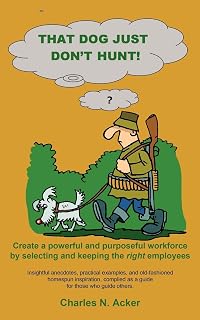
The title for the book, That Dog Just Don’t Hunt, comes from the old hunter gripe that blaims the servant for the master’s woes. Just like the hapless employees, Acker says, that suffer the failures of their bosses. So, how does this happen? More than likely, show more the problem begins in muddle. Business owners don’t clarify what they want—besides making money—so managers don’t know what to expect of their employees. “In general, employees need to feel useful and that their efforts contribute to the organization. That, of course, means that the company must also have clearly defined goals, a plan to improve, and ways to measure that improvement…. This calls first for the business to be clear on where they want to go and what they’d like to achieve…”
Acker began putting his book together on a plane to Fairbanks, on the way to the firing a middle manager. He began to ask questions about not only what the manager did wrong, but what the manager’s boss did wrong. The result is productive techniques, anecdotes, cartoons, graphs, specific examples that lead the reader through six different Big Ideas discovered on that plane ride. Acker believes that the way to help employees and business succeed is by adapting a manager/employee growth relationship.
In this time of top-heavy corporate growth, when the CEOs and the shareholders take home the lion’s share and the employees are left with crumbs, Acker maintains that “[t]he company has to continue growing its human resource as it grows itself. Otherwise, the sustainability of corporate growth will fail because the employees do not keep up with the growth trend, resulting in turnover and dissatisfaction among the ranks.”
Big Idea #1, then, is titled Natural Ability, and includes information about how to align natural talent with the right job. It also gives directions on how to find that talent: how to write an ad; recruitment; and some telling interview questions.
In the first of many great segues between chapters, Big Idea #1 leads naturally to Big Idea #2: Training and Education. Big Idea #3 uses a “smelly dog theory” to talk about supervision, and it brings up the enormous question of employee loyalty. “I often find that money doesn’t dictate a greener pasture for the employee. It’s more frequently a negative work environment that prompts them to look elsewhere…. Donuts and soda can only do so much to entice an employee’s loyalty.”
The challenge of management, says Acker, is to carefully select people for their natural talents, then mold them into employees who meet expectations. This little book is full of big ideas on how to do just that. A must for every business, large and small.
ForeWord Clarion Reviews show less
The title for the book, That Dog Just Don’t Hunt, comes from the old hunter gripe that blaims the servant for the master’s woes. Just like the hapless employees, Acker says, that suffer the failures of their bosses. So, how does this happen? More than likely, show more the problem begins in muddle. Business owners don’t clarify what they want—besides making money—so managers don’t know what to expect of their employees. “In general, employees need to feel useful and that their efforts contribute to the organization. That, of course, means that the company must also have clearly defined goals, a plan to improve, and ways to measure that improvement…. This calls first for the business to be clear on where they want to go and what they’d like to achieve…”
Acker began putting his book together on a plane to Fairbanks, on the way to the firing a middle manager. He began to ask questions about not only what the manager did wrong, but what the manager’s boss did wrong. The result is productive techniques, anecdotes, cartoons, graphs, specific examples that lead the reader through six different Big Ideas discovered on that plane ride. Acker believes that the way to help employees and business succeed is by adapting a manager/employee growth relationship.
In this time of top-heavy corporate growth, when the CEOs and the shareholders take home the lion’s share and the employees are left with crumbs, Acker maintains that “[t]he company has to continue growing its human resource as it grows itself. Otherwise, the sustainability of corporate growth will fail because the employees do not keep up with the growth trend, resulting in turnover and dissatisfaction among the ranks.”
Big Idea #1, then, is titled Natural Ability, and includes information about how to align natural talent with the right job. It also gives directions on how to find that talent: how to write an ad; recruitment; and some telling interview questions.
In the first of many great segues between chapters, Big Idea #1 leads naturally to Big Idea #2: Training and Education. Big Idea #3 uses a “smelly dog theory” to talk about supervision, and it brings up the enormous question of employee loyalty. “I often find that money doesn’t dictate a greener pasture for the employee. It’s more frequently a negative work environment that prompts them to look elsewhere…. Donuts and soda can only do so much to entice an employee’s loyalty.”
The challenge of management, says Acker, is to carefully select people for their natural talents, then mold them into employees who meet expectations. This little book is full of big ideas on how to do just that. A must for every business, large and small.
ForeWord Clarion Reviews show less
Members
- Recently Added By
Author Information
1 Work 1 Member
Classifications
- Genres
- Business, Nonfiction
- BISAC
Statistics
- Members
- 1
- Popularity
- 8,853,149
- Reviews
- 1
- Rating
- (4.00)
- Languages
- English
- Media
- Paper
- ISBNs
- 1