Djuna: The Extraordinary Life of Djuna Barnes
by Jon Macy
On This Page
Description
"Djuna Barnes lived in a dazzling world filled with literary salons, innovative writing, and daring new art styles. But it didn't come easily. She managed to work her way out of an abusive childhood growing up in a polygamous rural utopian community on Long Island. She was determined to live an extraordinary life, and found herself socializing with the likes of James Joyce, Natalie Barney, Peggy Guggenheim, and T.S. Eliot in 1920s literary Paris. Called the most famous unknown of the show more century, Djuna Barnes stood out for her brilliant writing, her biting wit, and her unique style. Her novel, Nightwood is considered by some to be one of the greatest lesbian love stories ever written. But as the stock market crashed and the Lost Generation left Paris, her life began to unwind. A fascinating window into the life of a woman whose enormous literary talent and provocative attitude were both celebrated and disdained by the world."--Amazon.com. show lessTags
Member Reviews
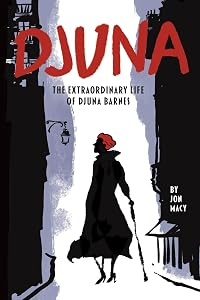
Lovingly drawn, in a broad style reminiscent of Persepolis and other self-serious histories, with only splashes of maroon across Djuna's hair to break up the grayscale. The landscapes and backgrounds are meticulously drawn, while the people are often splashes of white and black suggesting their profile and emotion more than their features.
Macy's biography is too relentlessly chronological for its own good. And while he throws around the word genius, he never offers an explanation. A biography of Joyce would dwell on his human and humorous characters, the astounding command he demonstrated of the Western canon. Hemingway's biography would dwell on terse prose and doomed, fighting men. What exactly did Djuna Barnes offer the world that show more no one else could?
I've spent days laboring through 310 pages, and I still don't know. show less
Macy's biography is too relentlessly chronological for its own good. And while he throws around the word genius, he never offers an explanation. A biography of Joyce would dwell on his human and humorous characters, the astounding command he demonstrated of the Western canon. Hemingway's biography would dwell on terse prose and doomed, fighting men. What exactly did Djuna Barnes offer the world that show more no one else could?
I've spent days laboring through 310 pages, and I still don't know. show less
I'm a little torn by my rating because I do feel that Djuna Barnes is someone worth learning about, but the execution of the book just had a few too many stumbles for her charisma to overcome.
Barnes is an LGBTQIA+ icon who knew most everyone in the Modernist movement and the "Lost Generation" social scene of the 1920s and 1930s. She broke into writing as a journalist, became known for her illustrations, short stories, and novels, but ultimately evolved into a prickly and reclusive cult celebrity.
The first third of the book has some energy as Barnes uses her talents to climb out of anonymity and a messed up family situation, but the parade of celebrity cameos, the sidelining of her career by a toxic relationship, her growing bitterness show more and some mental health issues, make the back end of the book -- and her very long life -- a bit of a trudge.
Unfortunately, the chronology of the book gets a little squishy at times with flashbacks and the vague passage of decades, and this dramatization is a little careless with historical figures and facts.
The narration gives the impression of a nonfiction work, but the author breaks out of the objective tone a few times to interject some personal asides, including the fact that he is completely making up one celebrity encounter just because he wanted it to happen. In another scene, John Steinbeck shows up in Paris in the 1920s yelling how he is the author of The Grapes of Wrath -- which wasn't published until 1939 -- even though my brief research indicates he was attending Stanford and living in either California or New York at the time, not going to Paris until the 1940s.
Creator Jon Macy is a bit too obsessed with all of Barnes' famous acquaintances, shoehorning in around fifty of them. Usually, they are fully named, but a few are left to be worked out by only their first name or nickname, including Rudolph "Silas" Glossop, Ernst "Putzi" Hanfstaengl, Isadora Duncan, Harry Macelhone, and Dan Mahoney (inspiration for Dr. Matthew O'Connor in Barnes' Nightwood). And for some reason John Ferrar Holms is called John Holmes.
Macy seems like a genuine fan of Barnes, and his enthusiasm is almost contagious, but the book is just a bit too long and too willing to "print the legend." show less
Barnes is an LGBTQIA+ icon who knew most everyone in the Modernist movement and the "Lost Generation" social scene of the 1920s and 1930s. She broke into writing as a journalist, became known for her illustrations, short stories, and novels, but ultimately evolved into a prickly and reclusive cult celebrity.
The first third of the book has some energy as Barnes uses her talents to climb out of anonymity and a messed up family situation, but the parade of celebrity cameos, the sidelining of her career by a toxic relationship, her growing bitterness show more and some mental health issues, make the back end of the book -- and her very long life -- a bit of a trudge.
Unfortunately, the chronology of the book gets a little squishy at times with flashbacks and the vague passage of decades, and this dramatization is a little careless with historical figures and facts.
The narration gives the impression of a nonfiction work, but the author breaks out of the objective tone a few times to interject some personal asides, including the fact that he is completely making up one celebrity encounter just because he wanted it to happen. In another scene, John Steinbeck shows up in Paris in the 1920s yelling how he is the author of The Grapes of Wrath -- which wasn't published until 1939 -- even though my brief research indicates he was attending Stanford and living in either California or New York at the time, not going to Paris until the 1940s.
Creator Jon Macy is a bit too obsessed with all of Barnes' famous acquaintances, shoehorning in around fifty of them. Usually, they are fully named, but a few are left to be worked out by only their first name or nickname, including Rudolph "Silas" Glossop, Ernst "Putzi" Hanfstaengl, Isadora Duncan, Harry Macelhone, and Dan Mahoney (inspiration for Dr. Matthew O'Connor in Barnes' Nightwood). And for some reason John Ferrar Holms is called John Holmes.
Macy seems like a genuine fan of Barnes, and his enthusiasm is almost contagious, but the book is just a bit too long and too willing to "print the legend." show less
Ratings
Members
- Recently Added By
Lists

Youth: Sexuality & Gender
119 works; 1 member
Author Information

8+ Works 94 Members
Awards and Honors
Awards
Common Knowledge
- Original publication date
- 2024
- People/Characters
- Djuna Barnes; Peggy Guggenheim; Rudolph "Silas" Glossop; Jack Dempsey; Opal Cooper; Donald Ogden Stewart (show all 55); Elizabeth J. Barnes (nee Chappell, mother of Djuna Barnes); Wald Barnes (father of Djuna Barnes); Alla Nazimova; Saxon Barnes (brother of Djuna Barnes); Zendon Barnes (brother of Djuna Barnes); Shangar Barnes (brother of Djuna Barnes); Zadel Barnes (mother of Wald Barnes); Ernst Hanfstaengl (Ernst "Putzi" Hanfstaengl); Oscar Wilde; Jane Wilde; Henry Buddington; Mary Pyne; Guido Bruno; Clara Tice; Eugene O'Neill; Mina Loy; Elsa von Freytag-Loringhoven (baroness); Margaret Anderson; Jane Heap; Marcel Duchamp; James Joyce; Laurence Vail; Berenice Abbott; Thelma Wood; Anita Berber; Isadora Duncan; Janet Flanner; Gertrude Stein; Ernest Hemingway; Pablo Picasso; Harry Macelhone; Ada "Bricktop" Smith; John Steinbeck; Josephine Baker; Natalie Barney; Romaine Brooks; Dolly Wilde; Radclyffe Hall; Joe Carstairs; Percy Faulkner; Frances "Fanny" Barnes (nee Faulkner, a/k/a Fanny Clark); Henriette Alice McCrea-Metcalf (a/k/a Henrietta Metcalf); John Ferrar Holms (1897&ndash | 1934); Emily Holmes Coleman; Charles Henri Ford; Antonia White; T. S. Eliot; Dag Hammarskjöld; Dan Mahoney (inspiration for Dr. Matthew O'Connor in Nightwood)
- Important places
- London, England, UK; New York, New York, USA; New York, USA; Huntington, Long Island, New York, USA; Devonshire, England, UK; Lake George, New York, USA (show all 7); Paris, France
- Important events
- Modernism
- Dedication
- To all the academics who kept Djuna's legacy alive when so many had forgotten her. They knew she'd be back.
- First words
- I'm not putting up with your drinking and drama anymore, Djuna.
- Last words
- (Click to show. Warning: May contain spoilers.)She's writing.
- Blurbers
- Orner, Eric; Kirby, Rob; Camper, Jennifer; Trujillo, Josh; Hall, Justin; Ochs, Robyn
- Original language
- English
Classifications
- Genres
- Fiction and Literature, Graphic Novels & Comics, LGBTQ+
- DDC/MDS
- 818.5209 — Literature & rhetoric American literature in English American miscellaneous writings in English 20th Century 1900-1945 Biography
- LCC
- PN6728 .D58 .M33 — Language and Literature Literature (General) Literature (General) Collections of general literature Comic books, strips, etc.
- BISAC
Statistics
- Members
- 16
- Popularity
- 1,521,544
- Reviews
- 2
- Rating
- (2.25)
- Languages
- English
- Media
- Paper
- ISBNs
- 1