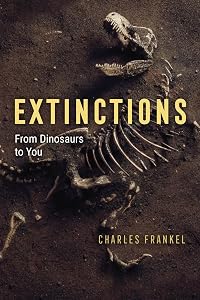
Extinctions: From Dinosaurs to You
by Charles Frankel
On This Page
Description
"A distinguished geologist and a popular science writer Charles Frankel turns his attention in his latest book to the mass extinctions on our planet, considering what the past can tell us about the future. Explaining Earth's past mass extinctions, Frankel suggests that, each time, a decrease in biodiversity created fragile conditions that eventuated into widespread and cataclysmic disappearances. The rise of mammals led to the rise of humans, who, over the past 200,000 years, have become show more their own geological force, forever affecting the bio-environment, from the massacre of megafauna in the Ice Age to the impoverishment of soils and pollution of waterways and air, to the unwitting transfer of invasive species from one part of the globe to another. After a compelling account of the latest research, Frankel ends with speculations on planetary peril and whether the widespread extinctions, climate change, and loss of biodiversity that we are currently experiencing can be slowed or even reversed. His answer inspires hope and urgency. If humans can redirect and curb some of our basic behaviors (like the obsession to kill and consume other species), we might stand a chance. Still, he eloquently explains that, even if we succeed in this, our way of life and even some of our ways of being human will be transformed forever. As extinction repeatedly shows those who survive, life is not eternal"-- show lessTags
Member Reviews
On the whole, I can't say that I had great expectations for this book, but since it seemed to be well-received I decided to plow forward. However, once I tripped over the phrase of how the early mammals that survived the end of the Cretaceous period were just "a bunch of cowardly, nocturnal, unsophisticated rodents" rather put me off, as this underrates their neurological and sensory advancement, and their efficiency (see Elsa Panciroli's "Beasts Before Us" (2021)). It certainly made me wonder about how well Frankel had assimilated the science of it all.
Still, to give Frankel his due, this book was apparently his own exercise in self-education, as he works through the various kinds of extinction processes, from human intervention to big show more rocks from space, and generally does so in a tone that mostly seems non-patronizing and preachy (an admitted problem for a lot of the unconverted). show less
Still, to give Frankel his due, this book was apparently his own exercise in self-education, as he works through the various kinds of extinction processes, from human intervention to big show more rocks from space, and generally does so in a tone that mostly seems non-patronizing and preachy (an admitted problem for a lot of the unconverted). show less
There is no doubt that homo sapiens got where they are at the expense of other living beings. Many creatures had to go extinct to leave us our place in the world, and others owe their disappearance to our intense predatory activity. By predatory activity, however, in the modern age we can no longer speak of active hunting, which has all in all become marginal, but relative to the environment, which reduces the animals' means of subsistence.
This volume discusses all the extinctions that have dotted the Earth's history since the earliest times, examining their reasons and describing the consequences, and also hints at possible future extinctions, including our own...
This volume discusses all the extinctions that have dotted the Earth's history since the earliest times, examining their reasons and describing the consequences, and also hints at possible future extinctions, including our own...
Members
- Recently Added By
Lists

Science: Zoology
107 works; 1 member
Author Information
8 Works 99 Members
Classifications
Statistics
- Members
- 5
- Popularity
- 3,437,344
- Reviews
- 2
- Rating
- (3.75)
- Languages
- English
- Media
- Paper, Ebook
- ISBNs
- 2