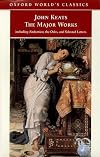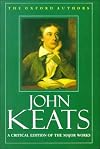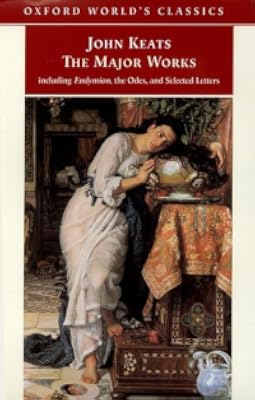
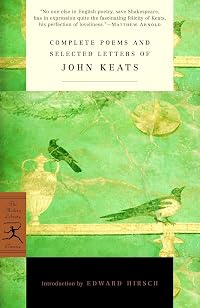
The Major Works: Including Endymion, the Odes and Selected Letters
by John Keats
The Oxford authors (Keats)
288 Members (4.52)
On This Page
Description
This new edition in the 21st-Century Oxford Authors series presents a substantial selection of Keats's writings arranged chronologically as his contemporary readers first encountered them. Its backbone is provided by the poems published in Keats's lifetime?the three volumes, 'Poems' (1817), 'Endymion' (1818), and 'Lamia, Isabella, The Eve of St. Agnes, and Other Poems' (1820), together with the small number of poems he published elsewhere. But a much larger body of Keats's writing was seen show more only in manuscript, if at all, by Keats's friends and family-the unpublished poems which include the dream vision, 'The Fall of Hyperion', his annotations of Shakespeare and Milton, and, above all, his extraordinary letters. These are placed at the date on which they were written or at their probable date. 0This selection of poems, prose, and letters therefore creates a double time scheme. It places the poetry by which Keats was known to a frequently antagonistic reading public in his lifetime within the extensive biographical context provided by his unpublished poems and letters. This substantial body of manuscript evidence, some of it not discovered until the twentieth-century and none of it known to Keats's reading public, is now part of our understanding of his life and work, and allows us to follow his extraordinary intellectual, emotional, and artistic self-making in the three short years between 'Poems' (1817) and 1820. show lessTags
Recommendations






Member Reviews
Members
- Recently Added By
Lists

Ambleside Year 7
69 works; 1 member
Author Information

444+ Works 13,707 Members
John Keats was born in London, the oldest of four children, on October 31, 1795. His father, who was a livery-stable keeper, died when Keats was eight years old, and his mother died six years later. At age 15, he was apprenticed to an apothecary-surgeon. In 1815 he began studying medicine but soon gave up that career in favor of writing poetry. show more The critic Douglas Bush has said that, if one poet could be recalled to life to complete his career, the almost universal choice would be Keats, who now is regarded as one of the three or four supreme masters of the English language. His early work is badly flawed in both technique and critical judgment, but, from his casually written but brilliant letters, one can trace the development of a genius who, through fierce determination in the face of great odds, fashioned himself into an incomparable artist. In his tragically brief career, cut short at age 25 by tuberculosis, Keats constantly experimented, often with dazzling success, and always with steady progress over previous efforts. The unfinished Hyperion is the only English poem after Paradise Lost that is worthy to be called an epic, and it is breathtakingly superior to his early Endymion (1818), written just a few years before. Isabella is a fine narrative poem, but The Eve of St. Agnes (1819), written soon after, is peerless. In Lamia (1819) Keats revived the couplet form, long thought to be dead, in a gorgeous, romantic story. Above all it was in his development of the ode that Keats's supreme achievement lies. In just a few months, he wrote the odes "On a Grecian Urn" (1819), "To a Nightingale" (1819), "To Melancholy" (1819), and the marvelously serene "To Autumn" (1819). Keats is the only romantic poet whose reputation has steadily grown through all changes in critical fashion. Once patronized as a poet of beautiful images but no intellectual content, Keats is now appreciated for his powerful mind, profound grasp of poetic principles, and ceaseless quest for new forms and techniques. For many readers, old and young, Keats is a heroic figure. John Keats died in Rome on February 23, 1821 and was buried in the Protestant Cemetery, Rome. His last request was to be placed under a tombstone bearing no name or date, only the words, "Here lies One whose Name was writ in Water." (Bowker Author Biography) show less
Series

Belongs to Publisher Series
Common Knowledge
- Canonical title
- The Major Works: Including Endymion, the Odes and Selected Letters
- First words
- Now Morning from her orient chamber came, / And her first footsteps touch'd a verdant hill; / Crowning its lawny crest with amber flame, / Silv'ring the untainted gushes of its rill; / Which, pure from mossy beds, did down di... (show all)still, / And after parting beds of simple flowers, / By many streams a little lake did fill, / Which round its marge reflected woven bowers, / And, in its middle space, a sky that never lowers.
- Last words
- (Click to show. Warning: May contain spoilers.)And this is why I sojourn here / Alone and palely loitering, / Though the sedge is wither'd from the lake, / And no birds sing.
- Disambiguation notice
- This collection, edited by Elizabeth Cook, was first published as John Keats (1990) in the series "The Oxford authors". It was reissued in the "Oxford world's classics" series as The major works (2001).
Classifications
Statistics
- Members
- 288
- Popularity
- 111,231
- Rating
- (4.52)
- Languages
- Czech, English
- Media
- Paper, Audiobook, Ebook
- ISBNs
- 19
- UPCs
- 1
- ASINs
- 3