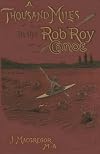
A Thousand Miles in the Rob Roy Canoe
by John Macgregor
On This Page
Description
Finally available, a high quality book of the original classic edition of A Thousand Miles in the Rob Roy Canoe on Rivers and Lakes of Europe. It was previously published by other bona fide publishers, and is now, after many years, back in print. This is a new and freshly published edition of this culturally important work by John MacGregor, which is now, at last, again available to you. Get the PDF and EPUB NOW as well. Included in your purchase you have A Thousand Miles in the Rob Roy show more Canoe on Rivers and Lakes of Europe in EPUB AND PDF format to read on any tablet, eReader, desktop, laptop or smartphone simultaneous - Get it NOW. Enjoy this classic work today. These selected paragraphs distill the contents and give you a quick look inside A Thousand Miles in the Rob Roy Canoe on Rivers and Lakes of Europe: Look inside the book: In the wildest parts of the best rivers the channel is too narrow for oars, or, if wide, it is too shallow for a row-boat; and the tortuous passages, the rocks and banks, the weeds and snags, the milldams, barriers, fallen trees, rapids, whirlpools, and waterfalls that constantly occur on a river winding among hills, make those very parts where the scenery is wildest and best to be quite unapproachable in an open boat, for it would be swamped by the sharp waves, or upset over the sunken rocks which it is utterly impossible for a steersman to see. ...Again, the canoe is safer than a rowing-boat, because you sit so low in it, and never require to shift your place or lose hold of the paddle; while for comfort during long hours, for days and weeks of hard work, it is evidently the best, because you lean all the time against a backboard, and the moment you rest the paddle on your lap you are as much at ease as in an arm-chair; so that, while drifting along with the current or the wind, you can gaze around, and eat or read or chat with the starers on the bank, and yet, in a moment of sudden danger, the hands are at once on the faithful paddle ready for action. Finally, you can lie at full length in the canoe, with the sail as an awning for the sun, or a shelter for rain, and you can sleep in it thus at night, under cover, with an opening for air to leeward, and at least as much room for turning in your bed as sufficed for the great Duke of Wellington; or, if you are tired of the water for a time, you can leave your boat at an inn-it will not be 'eating its head off, ' like a horse; or you can send it home or sell it, and take to the road yourself, or sink into the dull old cushions of the 'Premi re Classe, ' and dream you are seeing the world. show lessTags
Member Reviews
The original canoe-touring book, which inspired RLS and thousands of others to have kayaks built and set off around Europe on their own "inland voyages", no doubt to the annoyance of fishermen, millers, lock-keepers and railway porters across the Continent...
MacGregor is a genuine Victorian eccentric. His writing isn't as smooth and professional as Stevenson's, but he writes with tremendous passion, energy and self-confidence. He is a fierce advocate of the pleasures of canoe travel (one of which, as with so many outdoor activities, is clearly the pleasure of boasting about the discomforts you have endured). He is utterly unembarrassed at all times—if he gets stuck somewhere, or arrives in a strange town after everyone has gone to show more bed, he simply sings at the top of his voice until some curious person comes to see what's going on. Where Stevenson goes on for about three chapters about the indignity of being mistaken for a commercial traveller, MacGregor just doesn't care. He loves impressing journalists and small boys with the oddity of his means of transport, and he is pleased when people come to gawp at him because they've read about his journey in the papers.
Unlike Stevenson, he makes practically no attempt to give us standard tourist descriptions of places and sights: the book is all about the practical business of travelling by canoe and how he and the people he meets react to that. Where we get scenery, it is there to show us how different the world looks from the water, not because travel books are supposed to have scenery.
MacGregor was clearly a competent draughtsman as well as a writer: his illustrations, worked up from the pencil sketches he made during his tour, and done in a droll Victorian style rather reminiscent of Thackeray, give the book a lot of its charm. When we see the way he caricatures himself in the illustrations, it's hard to take offence at the occasional brashness of the text.
He's a bit less aggressive in his Evangelicalism than in his later sailing book, but he's still pretty confrontational about it. His minimal luggage for a three-month trip still includes a bundle of tracts to be handed out to all and sundry, and it gives him something to be proud of when foreigners are puzzled that he doesn't travel on Sundays: if he's somewhere without a protestant church, that gives him the opportunity to pen a satirical account of whatever antics the ludicrous Roman Catholics are getting up to. The spirit of George Borrow was plainly alive and well in mid-Victorian Britain. show less
MacGregor is a genuine Victorian eccentric. His writing isn't as smooth and professional as Stevenson's, but he writes with tremendous passion, energy and self-confidence. He is a fierce advocate of the pleasures of canoe travel (one of which, as with so many outdoor activities, is clearly the pleasure of boasting about the discomforts you have endured). He is utterly unembarrassed at all times—if he gets stuck somewhere, or arrives in a strange town after everyone has gone to show more bed, he simply sings at the top of his voice until some curious person comes to see what's going on. Where Stevenson goes on for about three chapters about the indignity of being mistaken for a commercial traveller, MacGregor just doesn't care. He loves impressing journalists and small boys with the oddity of his means of transport, and he is pleased when people come to gawp at him because they've read about his journey in the papers.
Unlike Stevenson, he makes practically no attempt to give us standard tourist descriptions of places and sights: the book is all about the practical business of travelling by canoe and how he and the people he meets react to that. Where we get scenery, it is there to show us how different the world looks from the water, not because travel books are supposed to have scenery.
MacGregor was clearly a competent draughtsman as well as a writer: his illustrations, worked up from the pencil sketches he made during his tour, and done in a droll Victorian style rather reminiscent of Thackeray, give the book a lot of its charm. When we see the way he caricatures himself in the illustrations, it's hard to take offence at the occasional brashness of the text.
He's a bit less aggressive in his Evangelicalism than in his later sailing book, but he's still pretty confrontational about it. His minimal luggage for a three-month trip still includes a bundle of tracts to be handed out to all and sundry, and it gives him something to be proud of when foreigners are puzzled that he doesn't travel on Sundays: if he's somewhere without a protestant church, that gives him the opportunity to pen a satirical account of whatever antics the ludicrous Roman Catholics are getting up to. The spirit of George Borrow was plainly alive and well in mid-Victorian Britain. show less
John MacGregor ( http://en.wikipedia.org/wiki/John_MacGregor_%28sportsman%29 ), outdoor writer and distant relative of Scottish folk hero and outlaw Rob Roy, designed and built a sort of hybrid canoe / kayak with a sail and kayaking paddle which he named the "Rob Roy". He then paddled through the rivers, lakes and canals of Germany, France and Switzerland, portaging between waterways on a cart or on trains. This was a completely novel idea for the time, traveling alone, by water, in a boat so light it can be carried, and it fired popular imaginations across Europe. His account of the journey became a best seller read by royalty and laymen alike, attracting newspaper attention and crowds along the route.
"A Thousand Miles" was written as show more both an account of the journey and a sort of travel guide for those wishing to follow in MacGregors wake. Indeed, fellow Scotsman Robert Louis Stevenson was so enthralled by MacGregors trip, he soon made his own in a Rob Roy, which he wrote about in "An Inland Voyage", Stevenson's first published book. One can profitably find comparison between MacGregor and Stevenson's accounts, Stevenson being the genre imitator, but superior in writing quality.
MacGregor's account has a degree of Victorian optimism that is refreshing, not unlike Jules Verne's "Around the World in Eighty Days", the world is an Englishman's oyster with new and exciting modes of transportation making outdoor expeditions available to everyman. At times his account becomes journal-like and banal, commenting on every town, supper and rapid he comes across, and there is no central narrative other than the curious mode of travel and incidental encounters - but for learning about the details of European life in the 1860s and the zeitgeist of the time it is an authentic and pleasurable journey that was influential.
A scanned illustrated first edition is available online:
http://www.archive.org/details/thousandmilesinr00macguoft
There were many later editions, I think up to nine, that had additions including a map, discussions of the Prussian War etc.. the success of "A Thousand Miles" would spur Macgregor to take many more voyages and write other travel accounts of his trips in the Rob Roy. show less
"A Thousand Miles" was written as show more both an account of the journey and a sort of travel guide for those wishing to follow in MacGregors wake. Indeed, fellow Scotsman Robert Louis Stevenson was so enthralled by MacGregors trip, he soon made his own in a Rob Roy, which he wrote about in "An Inland Voyage", Stevenson's first published book. One can profitably find comparison between MacGregor and Stevenson's accounts, Stevenson being the genre imitator, but superior in writing quality.
MacGregor's account has a degree of Victorian optimism that is refreshing, not unlike Jules Verne's "Around the World in Eighty Days", the world is an Englishman's oyster with new and exciting modes of transportation making outdoor expeditions available to everyman. At times his account becomes journal-like and banal, commenting on every town, supper and rapid he comes across, and there is no central narrative other than the curious mode of travel and incidental encounters - but for learning about the details of European life in the 1860s and the zeitgeist of the time it is an authentic and pleasurable journey that was influential.
A scanned illustrated first edition is available online:
http://www.archive.org/details/thousandmilesinr00macguoft
There were many later editions, I think up to nine, that had additions including a map, discussions of the Prussian War etc.. the success of "A Thousand Miles" would spur Macgregor to take many more voyages and write other travel accounts of his trips in the Rob Roy. show less
Adventure and exploring in a small boat not much bigger then a modern kayak during the 19th century.
Members
- Recently Added By
Lists

Adventure Travel & Exploration In Europe
18 works; 3 members
Author Information
4 Works 69 Members
Classifications
- Genres
- Travel, Nonfiction, Sports and Leisure, Biography & Memoir, General Nonfiction
- DDC/MDS
- 914.04286 — History & geography Geography & travel Geography of and travel in Europe subdivisions and modified standard subdivisions Travel; guidebooks 1453-
- LCC
- D919 .H642 — History of Europe, Asia, Africa and Oceania History (General) Europe (General) Description and travel
- BISAC
Statistics
- Members
- 17
- Popularity
- 1,454,389
- Reviews
- 3
- Rating
- (3.83)
- Languages
- English, German
- Media
- Paper
- ISBNs
- 5
- ASINs
- 1