
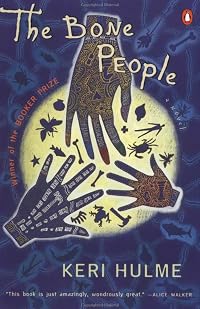
The Bone People
by Keri Hulme
On This Page
Description
This unusual novel, set in New Zealand, concentrates on three people: Kerewin Holmes, a part-Maori painter who has chosen to isolate herself in a tower she built from lottery winnings; Simon, a troubled and mysterious little boy; and Joe Gillayley, the Maori factory worker who is Simon's foster father. Elements of Maori myth and culture are woven into the novel's exploration of the passions and needs that bind these three people together, for good or ill. It's not easy reading, but the story show more is compelling despite its stylistic eccentricities and great length. The novel is the winner of the Pegasus Prize. show lessTags
Recommendations













Member Reviews
Okay, so this is a review by someone who was (and still is, to a lesser extent) abused by her father.
And yeah, that's important, if you've read this book.
Book content warnings:
abuse
child abuse
homophobic slurs
alcoholism
So if you look at the book's page, The Bone People has a rating of over four stars, which is pretty darn good on goodreads. Reviews sing its praises, etc. etc., and I just . . . can't relate.
My problem with this beautifully-written book? You guessed it! The abuse!!
I just can't get past it.
I don't know a thing about Keri Hulme's background, but unless she's faced a similar issue, her coverage of child abuse is so damn distasteful. It's like a slap in the face to all abused people who read this. Let me tell you why:
The show more book centers around three well-written, completely-rounded out and fully-fleshed beautiful characters: Kerewin, a rich ex-artist who's holed herself up in a self-built tower and prefers to be alone and lonely; Joe, a Maori man with a drinking problem and an equal spread of temper and charm; and his foster child Haimona (Simon), who's mute and probably one of the best characters I've read in a long time (also the reason this is 2 stars instead of 1).
So, mostly when he drinks, Joe beats Haimona, or finds a reason to beat him. And Haimona is repeatedly labeled as a "difficult" and "troubled" child. He runs away from school, steals things, sometimes breaks property, etc. And even when it's brought to Joe's attention that he does these things because he wants attention (even if it's the wrong kind of attention!), Joe continues to tell Haimona that he's a bad, BAD kid.
It's like a self-fulfilling prophecy: the kid is told so often he's BAD, that he'd begin to believe it and continue to act out. Is it not obvious to any of the characters?? (or to the writer?)
But anyway, Haimona continues to do things in his own way to communicate with the adults, and they continue to lash out at him in the worst way, and the worst thing is the book continues to say it's O K ?? Because they still somehow love him?
In one part, Joe tells Kerewin that it's okay, because "it's not like I'm beating Haimona, I'm beating the 'badness' out of him!" like W T F!? It's the most abusive thing I've ever heard in my life. And stuff I've heard personally. You are still literally beating your child. The things you tell yourself while you're doing it to reassure yourself literally doesn't matter at all, okay? It's not about how you feel while you're doing it. Literally. It's about your child.
And then in the middle-ish part of the book, Joe beats Haimona viciously enough that Haimona is hospitalized and almost dies. His head is bashed in on a door frame, and he risks permanent head trauma. Like what the fuck, I'm sorry, but really.
You know what the book does afterward? The book goes on to talk about how baaaaad the poor abuser feels, oh waah. I couldn't care less about how Joe feels after hurting his foster son, I honestly couldn't. At this point, it honestly feels like this book was written to make people feel sorry for child abusers. Like the author said "how NOVEL would it be if I wrote a book from a child abuses point of view and made people sympathetic to their pain?" HA HA. Listen, if you beat your child up, it's never, ever, EVER the child's fault.
It took me 26 years to learn this. And I'm finally standing up for myself. I'm finally distancing myself from my abuser and learning to say no and cutting him out of my life. And for this book to be sympathetic for the abuser and say the child is better off with the abuser after all is just disgusting. I'm sorry.
I love Kerewin and Haimona as characters, but the book is nasty.
Nasty. show less
And yeah, that's important, if you've read this book.
Book content warnings:
abuse
child abuse
homophobic slurs
alcoholism
So if you look at the book's page, The Bone People has a rating of over four stars, which is pretty darn good on goodreads. Reviews sing its praises, etc. etc., and I just . . . can't relate.
My problem with this beautifully-written book? You guessed it! The abuse!!
I just can't get past it.
I don't know a thing about Keri Hulme's background, but unless she's faced a similar issue, her coverage of child abuse is so damn distasteful. It's like a slap in the face to all abused people who read this. Let me tell you why:
The show more book centers around three well-written, completely-rounded out and fully-fleshed beautiful characters: Kerewin, a rich ex-artist who's holed herself up in a self-built tower and prefers to be alone and lonely; Joe, a Maori man with a drinking problem and an equal spread of temper and charm; and his foster child Haimona (Simon), who's mute and probably one of the best characters I've read in a long time (also the reason this is 2 stars instead of 1).
So, mostly when he drinks, Joe beats Haimona, or finds a reason to beat him. And Haimona is repeatedly labeled as a "difficult" and "troubled" child. He runs away from school, steals things, sometimes breaks property, etc. And even when it's brought to Joe's attention that he does these things because he wants attention (even if it's the wrong kind of attention!), Joe continues to tell Haimona that he's a bad, BAD kid.
It's like a self-fulfilling prophecy: the kid is told so often he's BAD, that he'd begin to believe it and continue to act out. Is it not obvious to any of the characters?? (or to the writer?)
But anyway, Haimona continues to do things in his own way to communicate with the adults, and they continue to lash out at him in the worst way, and the worst thing is the book continues to say it's O K ?? Because they still somehow love him?
In one part, Joe tells Kerewin that it's okay, because "it's not like I'm beating Haimona, I'm beating the 'badness' out of him!" like W T F!? It's the most abusive thing I've ever heard in my life. And stuff I've heard personally. You are still literally beating your child. The things you tell yourself while you're doing it to reassure yourself literally doesn't matter at all, okay? It's not about how you feel while you're doing it. Literally. It's about your child.
And then in the middle-ish part of the book, Joe
You know what the book does afterward? The book goes on to talk about how baaaaad the poor abuser feels, oh waah. I couldn't care less about how Joe feels after hurting his foster son, I honestly couldn't. At this point, it honestly feels like this book was written to make people feel sorry for child abusers. Like the author said "how NOVEL would it be if I wrote a book from a child abuses point of view and made people sympathetic to their pain?" HA HA. Listen, if you beat your child up, it's never, ever, EVER the child's fault.
It took me 26 years to learn this. And I'm finally standing up for myself. I'm finally distancing myself from my abuser and learning to say no and cutting him out of my life. And for this book to be sympathetic for the abuser and say the child is better off with the abuser after all is just disgusting. I'm sorry.
I love Kerewin and Haimona as characters, but the book is nasty.
Nasty. show less
A strangely moving ramble through the distraught lives of three New Zealanders, Kerewin an artist who has lost her art, Joe, a man who lost his wife and infant son and Simon, the strange speechless boy who nevertheless can be adept at communication. Simon finds the artist's direct and unsentimental acceptance a great draw and she, estranged from her family is in turn drawn to him and Joe. But the relationship is complex and violent in the present and rests on the broken shards of the past including Kerewin's non-sexual identity and history of broken trust.
I am having a hard time digesting this book. I was glad I read it after reading a memoir/history of New Zealand so that I understood a bit more of the wonderful folklore and Maori myth woven into this story. I still can't decide, however, if I can accept that a parent who deals repeated, disfiguring, violent abuse can be understood, forgiven, and given a second redeeming chance. Am I being realistic or uncharitable? Am I seeing things only from the point of view of a white, European-descended Pakeha? I found the story beautiful, yet disturbing. Although the ending made sense in the context of the book, outside the author's magical spell, I don't know that I can accept it.
Kerewin and Joe are an unlikely couple. They come together because of a mysterious mute boy of four or five named Simon. Confessional: I was not sure I was supposed to like Kerewin. She likes to drink herself into a stupor and, as a self-exiled recluse, she has the time and inclination to take to the bottle often. She also spends her time making art, having won her independent wealth from a lottery ticket. She is estranged from her family, considers herself unlovable, and doesn't like companionship so when she comes across mute Simon, she cannot explain why she takes him in. Second confessional: I wasn't sure I was supposed to like Joe. Hard working and rugged, Joe has been a self-imposed foster father to Simon. When provoked he likes show more to beat the tar out of someone, but he gives just as many kisses as he does kicks. His passions are confused. Third confessional: I wasn't sure I was supposed to like Simon. He's a devilish imp. He has a way of stealing things and acting out when he doesn't get his way. He can be just as violent as Kerewin and Joe in action and emotion. Yet...Kerewin, Joe, and Simon somehow belong together and I found myself rooting for them.
The Bone People is like a slow moving train. At first you are not sure if you are on the right ride, but once it gets going it's a runaway success. I couldn't put it down after the first hundred pages. Maybe it took me that long to get used to Hulme's style?
You know a book is going to be good when it is endorsed by Alice Walker. show less
The Bone People is like a slow moving train. At first you are not sure if you are on the right ride, but once it gets going it's a runaway success. I couldn't put it down after the first hundred pages. Maybe it took me that long to get used to Hulme's style?
You know a book is going to be good when it is endorsed by Alice Walker. show less
i know that the first time i read this, i really didn't understand it. so probably that 1 star wasn't fair since it was (at least partly, if not mostly) my fault. i am somehow both not entirely sure why and in total understanding of why i didn't get it last time. i feel like so much of what i didn't see last time was obvious this time, and i also still feel like i'm missing quite a bit, and unsure of things at the end.
first - a complaint about the language. i love that she weaves maori words or phrases into the book, but the translations are terrible. (not the actual translations; i don't speak maori so have no idea how accurate they are, but they way it's done is terrible. they are translated in the endnotes, by page number. not all show more the maori words are translated, and the ones that are aren't noted in the text, so you're constantly flipping to the back to see if this particular maori word is one of the translated ones. but the page numbers they cite are wrong, so you have to look around the page number you're on. also, if a phrase has already been translated earlier, but used again, it's not translated again, so if you don't remember its meaning (and really, how could you?), you have to scan the list of translated words to see if you can find the other mention of the word to figure out what it says. really, how hard is it to endnote each word or phrase, and use the old/first number for the repeating words? it's a total pet peeve of mine to not translate everything, so that really bugged me, too, but i was almost more annoyed with the difficulty of what was translated.)
ok, that said and set entirely aside, this isn't an easy book to read. it's unusual, and uncomfortable, but that's her intention. from the writing side, it's odd in that the perspective sometimes changes back and forth (not like an every-other chapter sort of thing, but paragraph to paragraph) so we jump from kerewin's head to simon's head to third person, all in the same page. it's inconsistent and comes out of nowhere at first and somehow it works but can be hard to get used to, and i think really threw me off last time i read this. every so often she also changes tense but that might be more of an editing issue? it's primarily in present tense but here and there she slips a verb or two into past tense. again, strange and awkward, but i think intentional. the point of view shifts would normally be a problem, because we end up knowing things we shouldn't or not knowing things we should, in a traditional book. again, somehow this works here, but it also contributed to my confusion the first time around.
ok, so the writing is a little tough. but also this story itself is part of what makes this hard to read. she writes about child abuse, but in a way that i don't think i've seen done before. it's the most realistic depiction i feel like i've read, in the way she shows the love the child has for his abuser, and the love the abuser has for the child. it's so much more realistic in how gray the entire thing is. there are very few instances of black and white in the story. even many of the beatings themselves aren't as cut and dried as outsiders want to think they are, and she shows this. she also shows that it's likely that the abusers are probably the best and even safest people to parent this child, in spite of the abuse. it makes me so sad to think of how we ignore some things in the face of others, and also that the people who hurt children are usually the ones who love them the most. and i don't know that i agree that these children should maybe stay with the abusers, but i also don't know that stripping them of that love is right either. so she gives food for thought along those lines. shows that it's complex and complicated, and it feels such an echo of real life; i hadn't realized that other stories of abuse were just shadows, but this feels so filled in in comparison to others (even ones i thought were well done and complete).
but this isn't just about child abuse. it's also about finding your people and yourself, and (and this is where i get more fuzzy, which is too bad because i think it's the crux of it) the resurrection of maori life and culture. ("...we changed. We ceased to nurture the land. We fought among ourselves. We were overcome by those white people in their hordes.") it's about starting over, with the bones of a beginning, both individually and communally, and the bones of all the ancestors who came before.
there's a lot to take from this and i must have missed literally all of it last time to not have written anything at all in my review. i'm glad to have reread this, even if i still don't fully appreciate it. maybe with a 3rd reading?
also, it was written in 1983 and has an asexual main character and terms for a "neutered personal pronoun" (ve/ver/vis). that must be pretty unusual.
"With the careless suppleness of the young, he has his foot nearly on his chest."
"Between waking and being awake there is a moment full of doubt and dream, when you struggle to remember what the place and when the time and whether you really are."
"There is a time, when passing through a light, that you walk in your own shadow."
"I named it. One must name cats, people, whoever whatever comes close, even though they carry their real names hidden inside them."
3.5 stars
from 7/2008:
1 star show less
first - a complaint about the language. i love that she weaves maori words or phrases into the book, but the translations are terrible. (not the actual translations; i don't speak maori so have no idea how accurate they are, but they way it's done is terrible. they are translated in the endnotes, by page number. not all show more the maori words are translated, and the ones that are aren't noted in the text, so you're constantly flipping to the back to see if this particular maori word is one of the translated ones. but the page numbers they cite are wrong, so you have to look around the page number you're on. also, if a phrase has already been translated earlier, but used again, it's not translated again, so if you don't remember its meaning (and really, how could you?), you have to scan the list of translated words to see if you can find the other mention of the word to figure out what it says. really, how hard is it to endnote each word or phrase, and use the old/first number for the repeating words? it's a total pet peeve of mine to not translate everything, so that really bugged me, too, but i was almost more annoyed with the difficulty of what was translated.)
ok, that said and set entirely aside, this isn't an easy book to read. it's unusual, and uncomfortable, but that's her intention. from the writing side, it's odd in that the perspective sometimes changes back and forth (not like an every-other chapter sort of thing, but paragraph to paragraph) so we jump from kerewin's head to simon's head to third person, all in the same page. it's inconsistent and comes out of nowhere at first and somehow it works but can be hard to get used to, and i think really threw me off last time i read this. every so often she also changes tense but that might be more of an editing issue? it's primarily in present tense but here and there she slips a verb or two into past tense. again, strange and awkward, but i think intentional. the point of view shifts would normally be a problem, because we end up knowing things we shouldn't or not knowing things we should, in a traditional book. again, somehow this works here, but it also contributed to my confusion the first time around.
ok, so the writing is a little tough. but also this story itself is part of what makes this hard to read. she writes about child abuse, but in a way that i don't think i've seen done before. it's the most realistic depiction i feel like i've read, in the way she shows the love the child has for his abuser, and the love the abuser has for the child. it's so much more realistic in how gray the entire thing is. there are very few instances of black and white in the story. even many of the beatings themselves aren't as cut and dried as outsiders want to think they are, and she shows this. she also shows that it's likely that the abusers are probably the best and even safest people to parent this child, in spite of the abuse. it makes me so sad to think of how we ignore some things in the face of others, and also that the people who hurt children are usually the ones who love them the most. and i don't know that i agree that these children should maybe stay with the abusers, but i also don't know that stripping them of that love is right either. so she gives food for thought along those lines. shows that it's complex and complicated, and it feels such an echo of real life; i hadn't realized that other stories of abuse were just shadows, but this feels so filled in in comparison to others (even ones i thought were well done and complete).
but this isn't just about child abuse. it's also about finding your people and yourself, and (and this is where i get more fuzzy, which is too bad because i think it's the crux of it) the resurrection of maori life and culture. ("...we changed. We ceased to nurture the land. We fought among ourselves. We were overcome by those white people in their hordes.") it's about starting over, with the bones of a beginning, both individually and communally, and the bones of all the ancestors who came before.
there's a lot to take from this and i must have missed literally all of it last time to not have written anything at all in my review. i'm glad to have reread this, even if i still don't fully appreciate it. maybe with a 3rd reading?
also, it was written in 1983 and has an asexual main character and terms for a "neutered personal pronoun" (ve/ver/vis). that must be pretty unusual.
"With the careless suppleness of the young, he has his foot nearly on his chest."
"Between waking and being awake there is a moment full of doubt and dream, when you struggle to remember what the place and when the time and whether you really are."
"There is a time, when passing through a light, that you walk in your own shadow."
"I named it. One must name cats, people, whoever whatever comes close, even though they carry their real names hidden inside them."
3.5 stars
from 7/2008:
1 star show less
There are three main figures in The Bone People. Kerewin, a reclusive New Zealand artist estranged from her family and her art. Joe, a Maori laborer with a terrible drinking problem. And Simon, a small, strangely mute child. Joe found Simon on the beach after a shipwreck and became his foster father. But he can't control Simon's wild, erratic behavior. The two strike up a strange friendship with the aloof Kerewin. All three of them are terribly dysfunctional people, seeking healing and trying to find a sense of family together. When I first read the book, I assumed Simon was autistic. But it turns out that something entirely different and terrible is going on...
The book is written in a stream of consciousness fashion, alternating show more between present and past tense. The words swing from vivid, poetic descriptions to the crude, rough talk between people and exotic-sounding Maori phrases (glossary included). The style is so unique I think it is a book you will either love or hate. It is really a strange, beautiful, sad and amazing book. Not only does it address grief, love, isolation, violence and redemption; it also deals with the conflict and meeting of Maori and European cultures. One of my very favorite books.
Original review on Dog Ear Diary show less
The book is written in a stream of consciousness fashion, alternating show more between present and past tense. The words swing from vivid, poetic descriptions to the crude, rough talk between people and exotic-sounding Maori phrases (glossary included). The style is so unique I think it is a book you will either love or hate. It is really a strange, beautiful, sad and amazing book. Not only does it address grief, love, isolation, violence and redemption; it also deals with the conflict and meeting of Maori and European cultures. One of my very favorite books.
Original review on Dog Ear Diary show less
Art and family by blood; home and family by love…regaining any one was worth this fiery journey to the heart of the sun.
Keri Hulme’s [b:The Bone People|460635|The Bone People|Keri Hulme|https://i.gr-assets.com/images/S/compressed.photo.goodreads.com/books/1348988500l/460635._SY75_.jpg|1294681] is a complex story of love, isolation, and a search for identity, set in her native New Zealand. Much of the complexity of this novel rises from its treatment of opposites and how they interact and weave together in a life. How, for example, do love and cruelty exist within the same person and toward the same object? How does a person sort the good and bad and decide whether the one can ever offset the other? How does an individual balance his show more need for solitude with his need for companionship and understanding?
The three main characters are a half-Maori woman, Kerewin Holmes, who becomes involved in the lives of Joe, a Maori man, and his foster son, Simon, a white child. Kerewin is separated from her family and living an isolated life by choice, but in despair for the family she has lost.
A family can be the bane of one's existence. A family can also be most of the meaning of one's existence. I don't know whether my family is bane or meaning, but they have surely gone away and left a large hole in my heart.
Joe is grieving the loss of his wife and natural child to flu, and he is struggling with the difficulties that come with being a single parent to his foster son, who has disabilities and sometimes unbridled rage. Simon is unable to speak, an affliction that stems from his own loss of parents, and which is apparently psychosomatic rather than physical, but he has an intelligence that is sharp and so he rebels against not being understood or sometimes even acknowledged. Unlikely as it seems, the three form a bond that stems from some ability they have to understand one another, an ability that no doubt stems from their lonely, unfathomable similarities.
There is, at the heart of this novel, a dichotomy that I had difficulty dealing with, and that is the idea that a person could love deeply someone and yet hurt them repeatedly and severely. In order for the book to work, I believe this is a contradiction that you must accept. And, you must accept this as a path to self-discovery and self-recognition that can bring redemption. While I doubt I could ever believe this in the real world I live in, somehow I came to within the confines of this story.
Another aspect of the book that is very important, and which I admit to understanding only on a level that feels wholly inadequate, is the Maori culture and the search for identity within the peoples of New Zealand. Both Joe and Kerewin are a part of the Maori culture, and both are trying to live within the Pakeha (European) culture that has displaced it. The strength for each of them comes from the connection to their Maori roots and a large part of their hope for salvation lies in being able to reconnect to that lost part of themselves. I believe it is no accident that the pure Maori, the mixed Maori/Pakeha, and the pure Pakeha are represented in the three main characters, and that part of the struggle for them is to learn how to live together in harmony.
This is not an easy book. It is well-written, but written in an unusual style that incorporates various voices and the use of both prose, poetry and a vague stream of consciousness. It suffers a few times from being bogged down and repetitive, and would have benefited from being cut down in length by a good editor. However, it is a prodigious enterprise that leaves a stunning impression on the reader. Hats off to Keri Hulme. Definitely worth the reading! show less
Keri Hulme’s [b:The Bone People|460635|The Bone People|Keri Hulme|https://i.gr-assets.com/images/S/compressed.photo.goodreads.com/books/1348988500l/460635._SY75_.jpg|1294681] is a complex story of love, isolation, and a search for identity, set in her native New Zealand. Much of the complexity of this novel rises from its treatment of opposites and how they interact and weave together in a life. How, for example, do love and cruelty exist within the same person and toward the same object? How does a person sort the good and bad and decide whether the one can ever offset the other? How does an individual balance his show more need for solitude with his need for companionship and understanding?
The three main characters are a half-Maori woman, Kerewin Holmes, who becomes involved in the lives of Joe, a Maori man, and his foster son, Simon, a white child. Kerewin is separated from her family and living an isolated life by choice, but in despair for the family she has lost.
A family can be the bane of one's existence. A family can also be most of the meaning of one's existence. I don't know whether my family is bane or meaning, but they have surely gone away and left a large hole in my heart.
Joe is grieving the loss of his wife and natural child to flu, and he is struggling with the difficulties that come with being a single parent to his foster son, who has disabilities and sometimes unbridled rage. Simon is unable to speak, an affliction that stems from his own loss of parents, and which is apparently psychosomatic rather than physical, but he has an intelligence that is sharp and so he rebels against not being understood or sometimes even acknowledged. Unlikely as it seems, the three form a bond that stems from some ability they have to understand one another, an ability that no doubt stems from their lonely, unfathomable similarities.
There is, at the heart of this novel, a dichotomy that I had difficulty dealing with, and that is the idea that a person could love deeply someone and yet hurt them repeatedly and severely. In order for the book to work, I believe this is a contradiction that you must accept. And, you must accept this as a path to self-discovery and self-recognition that can bring redemption. While I doubt I could ever believe this in the real world I live in, somehow I came to within the confines of this story.
Another aspect of the book that is very important, and which I admit to understanding only on a level that feels wholly inadequate, is the Maori culture and the search for identity within the peoples of New Zealand. Both Joe and Kerewin are a part of the Maori culture, and both are trying to live within the Pakeha (European) culture that has displaced it. The strength for each of them comes from the connection to their Maori roots and a large part of their hope for salvation lies in being able to reconnect to that lost part of themselves. I believe it is no accident that the pure Maori, the mixed Maori/Pakeha, and the pure Pakeha are represented in the three main characters, and that part of the struggle for them is to learn how to live together in harmony.
This is not an easy book. It is well-written, but written in an unusual style that incorporates various voices and the use of both prose, poetry and a vague stream of consciousness. It suffers a few times from being bogged down and repetitive, and would have benefited from being cut down in length by a good editor. However, it is a prodigious enterprise that leaves a stunning impression on the reader. Hats off to Keri Hulme. Definitely worth the reading! show less
Members
- Recently Added By
Lists

Best Contemporary Literary Fiction (Around the Last 30 Years)
388 works; 123 members

Recommend the 20 best books you've read in the last five years
2,168 works; 602 members
Favourite Booker Prize contenders
73 works; 21 members
Booker Prize
491 works; 62 members

Best of World Literature
432 works; 51 members

Magic Realism
371 works; 52 members

Native American / Indigenous Literature
172 works; 100 members
Booker Prize Shortlist: Titles Read
103 works; 10 members

500 Great Books by Women
507 works; 60 members

Big Jubilee List
70 works; 3 members

A Novel Cure
742 works; 23 members

Most Disturbing Books
124 works; 27 members

Man Booker Prize Longlist 1985
6 works; 1 member

Five star books
1,755 works; 108 members

Books Read in 2023
5,547 works; 145 members

Fiction: Historical
288 works; 3 members

Maybe This Year? Books to Look Forward To
409 works; 9 members

Stories set on Australian Continent
67 works; 5 members

Myth (Reuse and Retelling)
188 works; 24 members
First Novels
373 works; 17 members

Books Read in 2022
5,166 works; 114 members

Allie's Wishlist
217 works; 2 members

Mind Expanding Books by hackerkid
581 works; 8 members

What Makes This Book So Great
102 works; 16 members

Books With Body Parts in the Title
153 works; 9 members

Books Read in 2008
335 works; 7 members

Gen X Library
245 works; 4 members

Unmarried women
66 works; 6 members

Read in 2008
32 works; 1 member

Read in 1999–2000
24 works; 1 member
Books We Want To Read Again For The First Time
384 works; 160 members

Pacific Islander Literature
21 works; 1 member

Take Four Books
130 works; 1 member
Author Information

Keri Hulme had been writing for several years, little known outside New Zealand feminist and Maori literary circles. Then, during the mid-1980s, she gained international attention for her novel The Bone People. In 1984 she received the Mobil Pegasus Award for Maori Writers and the New Zealand Book of the Year Award for fiction, and, in the show more following year, the distinguished Booker-McConnel Prize, Britain's highest literary honor. Hulme, who was born in Christchurch, is of Maori descent on her mother's side; her father was an Englishman from Lancashire. Studying for a law degree but not completing it, she worked at various jobs before settling down to write full time. The Bone People (1984) remains Hulme's major work. Almost impossible to describe in a coherent way, the novel is a sprawling and puzzling story about a relationship between a strange child, a powerful woman named Kerewin who reluctantly takes him in, and the child's father, who treats him brutally. According to the critic Margery Fee, the implausible yet metaphoric and sophisticated structure of the text sets out "to rework the old stories that govern the way New Zealanders---both Maori (indigenous New Zealanders) and Pakeha (New Zealanders of European origin)---think about their country." Hulme has also published two books of short stories about Maori life, Lost Possessions (1985) and Te Kaihau: The Windeater (1986); the short fiction, too, incorporates the intentionally chaotic and often bombastic style that dominates The Bone People. She has written two volumes of free verse as well, The Silences Between (Moeraki Conversations) (1982) and Strands (1992). Hulme has received extensive attention from international critics who see her, as Margery Fee says, in the forefront of the "postcolonial discursive formation evolving worldwide"---that is, writers who have set out to reinvent the history of imperialism. (Bowker Author Biography) show less
Some Editions
Awards and Honors
Awards
Notable Lists
The Big Jubilee Read (1982-1991 – 1984)
Series
Belongs to Publisher Series
Work Relationships
Has as a student's study guide
Common Knowledge
- Canonical title
- The Bone People
- Original title
- The Bone People
- Original publication date
- 1984
- People/Characters
- Kerewin Holmes; Joe Gillayley; Simon; Maori
- Important places
- New Zealand
- First words
- He walks down the street.
- Last words*
- (Click to show. Warning: May contain spoilers.)TE MUTUNGA – RANEI TE TAKE
- Blurbers
- Walker, Alice
- Original language
- English
*Some information comes from Common Knowledge in other languages. Click "Edit" for more information.
Classifications
Statistics
- Members
- 4,145
- Popularity
- 3,696
- Reviews
- 121
- Rating
- (4.07)
- Languages
- 7 — Danish, Dutch, English, Finnish, German, Norwegian (Bokmål), Spanish
- Media
- Paper, Ebook
- ISBNs
- 43
- ASINs
- 18