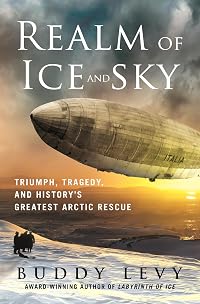
Realm of Ice and Sky: Triumph, Tragedy, and History's Greatest Arctic Rescue
by Buddy Levy
On This Page
Description
"National Outdoor Book Award-winning author Buddy Levy's thrilling narrative of polar exploration via airship--and the men who sacrificed everything to make history. Arctic explorer and American visionary Walter Wellman pioneered both polar and trans-Atlantic airship aviation, making history's first attempts at each. Wellman has been cast as a self-promoting egomaniac known mostly for his catastrophic failures. Instead he was a courageous innovator who pushed the boundaries of polar show more exploration and paved the way for the ultimate conquest of the North Pole--which would be achieved not by dogsled or airplane, but by airship. American explorer Dr. Frederick Cook was the first to claim he made it to the North Pole in 1908. A year later, so did American Robert Peary, but both Cook's and Peary's claims had been seriously questioned. There was enough doubt that Norwegian explorer extraordinaire Roald Amundsen--who'd made history and a name for himself by being first to sail through the Northwest Passage and first man to the South Pole-picked up where Walter Wellman left off, attempting to fly to the North Pole by airship. He would go in the Norge, designed by Italian aeronautical engineer Umberto Nobile. The 350-foot Norge flew over the North Pole on May 12, 1926, and Amundsen was able to accurately record and verify their exact location. However, the engineer Nobile felt slighted by Amundsen. Two years later, Nobile returned, this time in the Italia, backed by Prime Minister Benito Mussolini. This was an Italian enterprise, and Nobile intended to win back the global accolades and reputation he believed Amundsen had stripped from him. The journey ended in disaster, death, and accusations of cannibalism, launching one of the great rescue operations the world had ever seen. Realm of Ice and Sky is the thrilling narrative of polar exploration via airship--and the men who sacrificed everything to make history"-- show lessTags
Recommendations
































Member Reviews
I was stunned. I never expected to read about an Arctic exploration team blessed by the Pope and funded by Mussolini. How did Fascist Italy ever get involved in such an endeavor?
It was their state-of-the-art airship that was the attraction. After a hundred-plus years of sailing into the Arctic and finally reaching the North Pole, men of adventure were looking for the next big thing. The cutting edge technology of air power–airplanes and dirigibles–appeared to be the next vehicle to scientific discovery and fame.
The explorers of the frozen Arctic and Antarctic were the culture heroes of their time, like astronauts were in the early days of the Space Race. Of course, scientific discovery was their tacit reason, but who could deny the show more attraction of fame and the wealth that came with it, the newsheadlines, the income from speaking engagements and writing articles and books.
The first to use air power was explorer and newspaperman Walter Wellman. After his failure, the first man to reach the South Pole, Roald Amundsen, selected an Italian manufactured airship for his endeavor. The Italian engineer who designed the airship, Umberto Nobile, went along, and when Amundsen failed, Nobile determined to organize his own expedition, which met a most grievous end.
Such hubris! We imagine our science and technology can arm to battle nature’s gales and squalls and ice and freezing temperatures! We risk our lives and are shocked to discover our fate leads to tragedy.
Nobile’s party crashed, were separated. Men died. Hiss failure looked bad for his country and their story was suppressed and lost to time. Plus, Amundsen had flown into the Arctic searching for them, never to be seen again.
Levy again delivers a nail-biting, page-turner of an adventure story from the pages of history that reminds us of our fragility compared to the forces of nature.
Thanks to the publisher for a free book through NetGalley. show less
It was their state-of-the-art airship that was the attraction. After a hundred-plus years of sailing into the Arctic and finally reaching the North Pole, men of adventure were looking for the next big thing. The cutting edge technology of air power–airplanes and dirigibles–appeared to be the next vehicle to scientific discovery and fame.
The explorers of the frozen Arctic and Antarctic were the culture heroes of their time, like astronauts were in the early days of the Space Race. Of course, scientific discovery was their tacit reason, but who could deny the show more attraction of fame and the wealth that came with it, the newsheadlines, the income from speaking engagements and writing articles and books.
The first to use air power was explorer and newspaperman Walter Wellman. After his failure, the first man to reach the South Pole, Roald Amundsen, selected an Italian manufactured airship for his endeavor. The Italian engineer who designed the airship, Umberto Nobile, went along, and when Amundsen failed, Nobile determined to organize his own expedition, which met a most grievous end.
Such hubris! We imagine our science and technology can arm to battle nature’s gales and squalls and ice and freezing temperatures! We risk our lives and are shocked to discover our fate leads to tragedy.
Nobile’s party crashed, were separated. Men died. Hiss failure looked bad for his country and their story was suppressed and lost to time. Plus, Amundsen had flown into the Arctic searching for them, never to be seen again.
Levy again delivers a nail-biting, page-turner of an adventure story from the pages of history that reminds us of our fragility compared to the forces of nature.
Thanks to the publisher for a free book through NetGalley. show less
A little over two years ago I reviewed Buddy Levy’s book Empire of Ice and Stone, his fascinating account of the wreck of the ship the Karluk, part of the Canadian Arctic Expedition of 1913. I called that book “a well-crafted true story that reads like an action-adventure novel” and gave it five stars.
Levy is back again with a new nonfiction book that tells the story of a forgotten chapter of Arctic exploring, when the Age of the Airships took polar adventurers out of their dog sleds and to the North Pole.
In particular Levy tells the stories of three men - American Walter Wellman, Norwegian Roald Amundsen and Italian Umberto Nobile, the pioneers of Arctic aviation. These men all led expeditions in experimental lighter-than-air show more craft in attempts to reach the Pole. Together these stories form the “serial history” (the author’s words) that Levy once again turns into a well-crafted book that reads like an action-adventure novel.
Walter Wellman was an American journalist, explorer and innovator who took the first airship into the polar regions in an attempt to reach the North Pole. His story starts this book, and I found myself rooting for Wellman as he overcame obstacles and almost succeeded in his self-appointed task.
While his final voyage set numerous records, he did not make it to the North Pole. Nevertheless, the public reception when Wellman returned to America was triumphant. Contemporary adventurers and explorers however, looked down on Wellman as a failure and a showman. They felt his self-promotion through newspaper deals was a stunt and made a mockery of the “serious business” of exploring.
He remained a respected journalist throughout his life though, and Levy makes a solid case that Wellman should also be viewed as a pioneer both of polar exploration and of aviation. He set a record for longest dirigible flight up to that time, over any terrain, let alone the frozen north. He went further north by airship than anyone had before him. And he was the first Arctic explorer to report his progress to the world in real-time, using telegraphic messages sent by radio from his airship.
The stories of Roald Amundsen and Umberto Nobile are intertwined. Their partnership brought success, but their personalities could not have been more different. Amundsen, the “last Viking” was a seasoned polar explorer motivated by going where others had not been. Nobile was an airship designer and pawn of Benito Mussolini, who seemed mostly driven by career considerations within the Italian armed forces. Theirs was a marriage of convenience, and while they were successful together, they were often at odds and drew their nations into contentious rivalry. Nobile’s second attempt, without Amundson, proved a disaster to both men.
All three of these stories are compelling — just as fascinating for the courage and daring of the men involved as for the history they tell. I have to admit that I’ve read several polar exploration books over the last few years, so that when I saw yet another one was coming out I didn’t really have high expectations. But Buddy Levy has hit this one out of the park. show less
Levy is back again with a new nonfiction book that tells the story of a forgotten chapter of Arctic exploring, when the Age of the Airships took polar adventurers out of their dog sleds and to the North Pole.
In particular Levy tells the stories of three men - American Walter Wellman, Norwegian Roald Amundsen and Italian Umberto Nobile, the pioneers of Arctic aviation. These men all led expeditions in experimental lighter-than-air show more craft in attempts to reach the Pole. Together these stories form the “serial history” (the author’s words) that Levy once again turns into a well-crafted book that reads like an action-adventure novel.
Walter Wellman was an American journalist, explorer and innovator who took the first airship into the polar regions in an attempt to reach the North Pole. His story starts this book, and I found myself rooting for Wellman as he overcame obstacles and almost succeeded in his self-appointed task.
While his final voyage set numerous records, he did not make it to the North Pole. Nevertheless, the public reception when Wellman returned to America was triumphant. Contemporary adventurers and explorers however, looked down on Wellman as a failure and a showman. They felt his self-promotion through newspaper deals was a stunt and made a mockery of the “serious business” of exploring.
He remained a respected journalist throughout his life though, and Levy makes a solid case that Wellman should also be viewed as a pioneer both of polar exploration and of aviation. He set a record for longest dirigible flight up to that time, over any terrain, let alone the frozen north. He went further north by airship than anyone had before him. And he was the first Arctic explorer to report his progress to the world in real-time, using telegraphic messages sent by radio from his airship.
The stories of Roald Amundsen and Umberto Nobile are intertwined. Their partnership brought success, but their personalities could not have been more different. Amundsen, the “last Viking” was a seasoned polar explorer motivated by going where others had not been. Nobile was an airship designer and pawn of Benito Mussolini, who seemed mostly driven by career considerations within the Italian armed forces. Theirs was a marriage of convenience, and while they were successful together, they were often at odds and drew their nations into contentious rivalry. Nobile’s second attempt, without Amundson, proved a disaster to both men.
All three of these stories are compelling — just as fascinating for the courage and daring of the men involved as for the history they tell. I have to admit that I’ve read several polar exploration books over the last few years, so that when I saw yet another one was coming out I didn’t really have high expectations. But Buddy Levy has hit this one out of the park. show less
I've read a lot of Arctic exploration books recently, but this is the first that has detailed the use of air ships... Which I thought for sure would be the worst way to explore there?! Somehow there were some successful trips, though there were so so many that ended before they even really began. And like all dangerous exploration, one of those trips was deadly. I felt pretty bad for the Italian in the end, and appreciated the treatment he got at least in this book.
At the time I'm composing these thoughts on Levy's Realm of Ice and Sky, in November 2024, I have no idea how closely my copy will match those which go on sale in January 2025. My copy is clearly marked “Advance Reader Copy,” “Uncorrected Proof,” and “Quotations for Review Should Be Checked Against a Finished Copy of the Book....” Inasmuch as I have no way of knowing what changes may be made to the “finished copy,” I feel limited in what I can safely say about the book.
In a way, I was glad to read the admonition that mine is an “uncorrected proof.” I sincerely hope that the sixteen errors that leapt at me from the pages will be identified and fixed before the “finished copy” is printed. These are things such as show more omitted words (such as prepositions and articles) and omitted or misplaced punctuation marks (especially commas). Rarely, I was struck by more substantial errors, such as describing a dirigible as “spherical” even as the very same paragraph mentions its “oblong form.” At one point, a ship is said to be weighing its anchor when in reality it is dropping or deploying its anchor. In another case, I was totally unable to fathom an intended measurement when arches were described as being “eight-five feet high.” Sometimes, an excess letter intruded as in the phrase “ices floes.” On one page, the word “cachet” was rendered as “cache,” which, obviously, is a quite different thing. These errors permeate the text, the first occurring on page 1 and the last on page 317. While these certainly interfered with the flow of the narrative, interrupted the story being told, and materially reduced my enjoyment of the history being recounted, I hope they are limited to my “uncorrected draft” copy and will not appear in the “finished copy.”
Other than the textual faux pas mentioned above, I found Levy to be an exceptionally entertaining story teller. Realm of Ice and Sky reads like an adventure story, albeit based on historical fact. This is exactly the sort of book I'd like to have with me on a transatlantic flight aboard a slow turboprop airliner. From the prelude through the postscript, Levy's writing ensnares the reader's attention with an unceasing litany of events evoking astonishment, expectation, anxiety, relief, amazement, and, for readers who have themselves struggled through deep snow or across tractionless ice, maybe even recognition and empathy.
The book is not only entertaining, however, for the reader gleans a surprising amount of historical and technological fact as well. The early 20th century, in which the events transpire, saw the end of the Heroic Era of arctic exploration with dog sleds and the advent of airborne exploration. Even there, an active debate raged between adherents of heavier-than-air craft and lighter-than-air craft such as dirigibles. As Levy's engrossing recounting of this history shows, both types of craft were challenged—and often bested—by weather at the top of the world. Speaking of dirigibles, the reader learns a bit about their construction and operation, enough to dissuade me from pursuing my fantasy of a leisurely flight over the ocean aboard one!
The book also offers, gratis, a “bonus” benefit for any students in desperate need of a good example of irony for their English class. The career of arctic and antarctic explorer Roald Amundsen is well and widely known, that of Italian explorer Umberto Nobile only slightly less so. Unless one is an aficionado of 1920s newspaper headlines, the rift and animosity between the two may well be new information. The irony, of course, comes when one of these implacable foes vanishes without a trace into an Atlantic fog bank while launching a search and rescue mission for the other. This incomplete summary, of course, lacks all of the immediacy and the feeling of Levy's telling.
Not to be overlooked are a couple of maps in the front of the book that help the reader visualize routes of the exploratory trips described later in the text as well as a glossary of airship and aviation terms in the back should the reader be in need of brief explanations of such. I do wish that Levy had included a few photographs or drawings to illustrate some of the aircraft and, indeed, the people that populate the book.
There is history to be learned in Levy's Realm of Ice and Sky, and the author makes the learning so entertaining, enticing, and rewarding that the reader is swept up in the story and is loath to put the book down no matter how late the hour. Despite the distracting errors in my “uncorrected proof” copy, I do find the book worth the hours of a finite lifetime spent in its perusal and recommend it to all with an interest in early 20th century polar exploration, in the use of dirigibles, or simply in a rousing adventure that gallops nonstop across every page. show less
In a way, I was glad to read the admonition that mine is an “uncorrected proof.” I sincerely hope that the sixteen errors that leapt at me from the pages will be identified and fixed before the “finished copy” is printed. These are things such as show more omitted words (such as prepositions and articles) and omitted or misplaced punctuation marks (especially commas). Rarely, I was struck by more substantial errors, such as describing a dirigible as “spherical” even as the very same paragraph mentions its “oblong form.” At one point, a ship is said to be weighing its anchor when in reality it is dropping or deploying its anchor. In another case, I was totally unable to fathom an intended measurement when arches were described as being “eight-five feet high.” Sometimes, an excess letter intruded as in the phrase “ices floes.” On one page, the word “cachet” was rendered as “cache,” which, obviously, is a quite different thing. These errors permeate the text, the first occurring on page 1 and the last on page 317. While these certainly interfered with the flow of the narrative, interrupted the story being told, and materially reduced my enjoyment of the history being recounted, I hope they are limited to my “uncorrected draft” copy and will not appear in the “finished copy.”
Other than the textual faux pas mentioned above, I found Levy to be an exceptionally entertaining story teller. Realm of Ice and Sky reads like an adventure story, albeit based on historical fact. This is exactly the sort of book I'd like to have with me on a transatlantic flight aboard a slow turboprop airliner. From the prelude through the postscript, Levy's writing ensnares the reader's attention with an unceasing litany of events evoking astonishment, expectation, anxiety, relief, amazement, and, for readers who have themselves struggled through deep snow or across tractionless ice, maybe even recognition and empathy.
The book is not only entertaining, however, for the reader gleans a surprising amount of historical and technological fact as well. The early 20th century, in which the events transpire, saw the end of the Heroic Era of arctic exploration with dog sleds and the advent of airborne exploration. Even there, an active debate raged between adherents of heavier-than-air craft and lighter-than-air craft such as dirigibles. As Levy's engrossing recounting of this history shows, both types of craft were challenged—and often bested—by weather at the top of the world. Speaking of dirigibles, the reader learns a bit about their construction and operation, enough to dissuade me from pursuing my fantasy of a leisurely flight over the ocean aboard one!
The book also offers, gratis, a “bonus” benefit for any students in desperate need of a good example of irony for their English class. The career of arctic and antarctic explorer Roald Amundsen is well and widely known, that of Italian explorer Umberto Nobile only slightly less so. Unless one is an aficionado of 1920s newspaper headlines, the rift and animosity between the two may well be new information. The irony, of course, comes when one of these implacable foes vanishes without a trace into an Atlantic fog bank while launching a search and rescue mission for the other. This incomplete summary, of course, lacks all of the immediacy and the feeling of Levy's telling.
Not to be overlooked are a couple of maps in the front of the book that help the reader visualize routes of the exploratory trips described later in the text as well as a glossary of airship and aviation terms in the back should the reader be in need of brief explanations of such. I do wish that Levy had included a few photographs or drawings to illustrate some of the aircraft and, indeed, the people that populate the book.
There is history to be learned in Levy's Realm of Ice and Sky, and the author makes the learning so entertaining, enticing, and rewarding that the reader is swept up in the story and is loath to put the book down no matter how late the hour. Despite the distracting errors in my “uncorrected proof” copy, I do find the book worth the hours of a finite lifetime spent in its perusal and recommend it to all with an interest in early 20th century polar exploration, in the use of dirigibles, or simply in a rousing adventure that gallops nonstop across every page. show less
biography, memoir, historical-figures, historical-places-events, historical-research, historical-setting, history-and-culture, airships, north-pole, explorers, rescue, reconstruction, re-enactment*****
Who would have believed that a book of this topic would be so very readable and kind of riveting?
The reality is epic, but the manner of telling drew me in even better than a Cussler novel. And it's all true and the research is very well documented, even the events of 2023!
I requested and received a temporary review copy from St. Martin's Press via NetGalley. Thank you!
Pub Date Jan 28 2025
#RealmOfIceAndSky #NetGalley @buddylevy #PolarRescue #Airships #NarrativeHistory
Who would have believed that a book of this topic would be so very readable and kind of riveting?
The reality is epic, but the manner of telling drew me in even better than a Cussler novel. And it's all true and the research is very well documented, even the events of 2023!
I requested and received a temporary review copy from St. Martin's Press via NetGalley. Thank you!
Pub Date Jan 28 2025
#RealmOfIceAndSky #NetGalley @buddylevy #PolarRescue #Airships #NarrativeHistory
This book tells the story of 3 men and their attempts to be the first to get to the North Pole, not by dogsled, but by air, which had not been considered at all, let alone seriously. The first man, an American by the name of Walter Wellman, was a true visionary who knew what he wanted to do, and how, and didn't let anyone or anything stop him from trying to reach the arctic by airship (dirigible), and boy were there a lot of setbacks! Because he was attempting something that had never been done, there were many, many failures, and he never did reach the arctic, but he got further than anyone thought he would, and he set things in motion that would allow the next man to pick up where he left off.
The next man, a Norwegian explorer by the show more name of Roald Amundsen, had been the first man to reach the South Pole, and wanted to be the first to reach the North Pole as well. He also attempted to reach it by airship, and while he did reach the Pole, he wasn't able to explore it, although he, too, experienced many catastrophes, and he ended his voyage with bad blood between himself and his engineer, Italian Umberto Nobile, who then picked up where Amundsen left off. Nobile also ran into problems, with his being the most harrowing story of all. He did reach the Pole and indeed was able to obtain scientific readings no one else had been able to accomplish to that point, but his reputation would be forever altered by what transpired during his voyage.
In essence, we have 3 different men, all attempting the same thing, and their successes and failures, told in a very exciting way that has you on the edge of your seat, were not what you expect from your usual nonfiction book. While the beginning of the book does drag with all of the specifics of the airship building, materials, measurements, etc., the rest was fascinating.
All in all, I enjoyed this book very much.
5/5 stars.
*** I would like to thank NetGalley, St. Martin's Press, and Buddy Levy for the opportunity to read and review Realm of Ice and Sky. show less
The next man, a Norwegian explorer by the show more name of Roald Amundsen, had been the first man to reach the South Pole, and wanted to be the first to reach the North Pole as well. He also attempted to reach it by airship, and while he did reach the Pole, he wasn't able to explore it, although he, too, experienced many catastrophes, and he ended his voyage with bad blood between himself and his engineer, Italian Umberto Nobile, who then picked up where Amundsen left off. Nobile also ran into problems, with his being the most harrowing story of all. He did reach the Pole and indeed was able to obtain scientific readings no one else had been able to accomplish to that point, but his reputation would be forever altered by what transpired during his voyage.
In essence, we have 3 different men, all attempting the same thing, and their successes and failures, told in a very exciting way that has you on the edge of your seat, were not what you expect from your usual nonfiction book. While the beginning of the book does drag with all of the specifics of the airship building, materials, measurements, etc., the rest was fascinating.
All in all, I enjoyed this book very much.
5/5 stars.
*** I would like to thank NetGalley, St. Martin's Press, and Buddy Levy for the opportunity to read and review Realm of Ice and Sky. show less
Buddy Levy is an under-read author IMO, he has written some of the best non-fiction about true life adventure. Realm is the third book in a trilogy all containing the word "Ice" in the title. They run in roughly chronological order, during the heroic age of Arctic exploration. This is the last in the trilogy, about the first persons verified to reach the North Pole. Who knew, it was actually by blimp, not dog-sled or ship. And it included Roald Amundsen, who was also the first person to reach the South Pole. There are also stories the now forgotten American Walter Wellman, who deserves more credit as well.
Members
- Recently Added By
Lists

Polar exploration
54 works; 4 members

Thriller Authors to read
59 works; 1 member
Author Information

9+ Works 1,534 Members
Buddy Levy is clinical associate professor of English at Washington State University.
Awards and Honors
Awards
Common Knowledge
- Original publication date
- 2024
- People/Characters
- Walter Wellman; Roald Amundsen; Lincoln Ellsworth; Umberto Nobile
- Important places
- Danes Island; North Pole; Svalbard, Norway
- Dedication
- For my granddaughter Palmer Drew - the newest adventurer in the family
- First words
- (Prelude) To rise from the earth into the sky and soar freely aloft had been dreamed of and desired since humans first began watching birds wing and hover overhead, their effortless dance in the wind a wonder and an envy.
(Prologue) Camp Wellman, Danes Island
Whitecaps lashed against the icy shoreline of Norway's Smeerenburg Sound.
When noted American journalist Walter Wellman boarded the airship America at Danes Island in 1907 and attempted to fly into history and polar exploration immortality, he was nearly fifty years old. - Last words
- (Click to show. Warning: May contain spoilers.)He described Nobile's polar airship explorations as "feats which attain the highest beauty and sublimity that can be encountered in this life."
(Click to show. Warning: May contain spoilers.)(Epilogue) As it turns out, the sun seems to be rising on the airship once more.
(Click to show. Warning: May contain spoilers.)(Postscript) After all, what would Walter Wellmand, Roald Amundsen, and Umberto Nobile do? - Blurbers
- Millard, Candice; Rosolie, Paul; Sancton, Julian
- Original language
- English US
Classifications
- Genres
- Travel, Nonfiction, General Nonfiction, Biography & Memoir, History, Science & Nature
- DDC/MDS
- 910.911 — History & geography Geography & travel modified standard subdivisions of Geography and travel Explorers & Travelers Geography of and travel in areas, regions, places in general Frigid Zones
- LCC
- G700 — Geography, Anthropology and Recreation Geography (General) Arctic and Antarctic regions
- BISAC
Statistics
- Members
- 105
- Popularity
- 308,615
- Reviews
- 9
- Rating
- (4.50)
- Languages
- English
- Media
- Paper, Ebook
- ISBNs
- 4
- ASINs
- 1