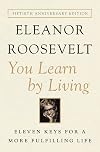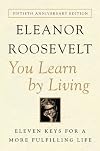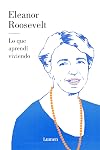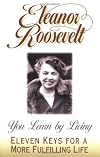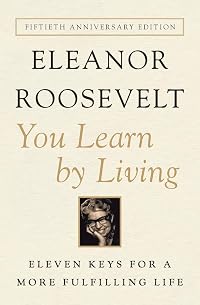
You Learn by Living: Eleven Keys for a More Fulfilling Life
by Eleanor Roosevelt
On This Page
Description
From one of the world's most celebrated and admired public figures, a wise and intimate book on how to get the most of out life. Courage is more exhilarating than fear and in the long run it is easier. We do not have to become heroes overnight. Just a step at a time, meeting each new thing that comes up, seeing it is not as dreadful as it appeared, discovering we have the strength to stare it down. One of the most beloved figures of the twentieth century, First Lady Eleanor Roosevelt remains show more a role model for a life well lived. At the age of seventy-six, Roosevelt penned this simple guide to living a fuller life-a powerful volume of enduring commonsense ideas and heartfelt values. Offering her own philosophy on living, she takes readers on a path to compassion, confidence, maturity, civic stewardship, and more. Her keys to a fulfilling life? Learning to Learn - Fear-the Great Enemy - The Uses of Time - The Difficult Art of Maturity - Readjustment is Endless - Learning to Be Useful- The Right to Be an Individual - How to Get the Best Out of People -Facing Responsibility - How Everyone Can Take Part in Politics - Learning to Be a Public Servant A crucial precursor to better-living guides like Mark Nepo's The Book of Awakening or Robert Pirsig's Zen and the Art of Motorcycle Maintenance, as well as political memoirs such as John F. Kennedy's Profiles in Courage, the First Lady's illuminating manual is a window into Eleanor Roosevelt herself and a trove of timeless wisdom that resonates in any era. show lessTags
Recommendations

Member Reviews
Life for Dummies this book ain't. Television programming and bookstore self-help aisles are filled to overflowing with Dr. Phil and Dr. Larura and Oprah and on and on and on. Entertainment, disguised as advice or direction, is a multi-million dollar industry. In such an immediate gratification, consumer driven world, Eleanor Roosevelt may seem dated and square. But she's just what the doctor ordered.
Purposed as a way to answer thousands of letters written to her with pleas for advice or wisdom, Roosevelt has composed a primer on living which would do us all good to read and keep close to our hearts. Her book is not filled with checklists or cutesy, life-affirming cliches but is bursting with soulful, and often, convicting perspectives show more on life and living. Though the subjects might seem to run to the mundane, like "The Uses of Time" or "Learning to Learn", Roosevelt scratches deeper, suggesting a way of life, a goal for character, rather than mere courses of action calculated to deal with a specific symptom of larger ills.
What Roosevelt proposes with each chapter is a different facet of the same life, a life of responsibility, conviction, honor, and perserverance. The chapters, building on one another, are constantly focused on how an individual must be prepared to engage in constant and honest self-examination, to take responsibility for their own lives and choices, and to view each choice in the context of how it affects other people and the country as a whole. A good deal of what Roosevelt proposes suggests a course of education for our country's children which is more home and family focused than traditional public education. She asserts that a good deal of a child's preparation for life should entail developing self confidence, establishing the ability to think and reason, and learning proper social interaction, rather than attempts at filling a child's head with endless facts and figures or vocations. Though her advice is sometimes aimed at parents, the values are the building blocks for the way of life she advocates and are, therefore, useful to anyone of any age.
Roosevelt's simple writing style allows her thoughts to pierce without obstacle. She uses the difficulties of her early years and later public life to demonstrate the process of life, and in so doing, avoids any possibility of pride or self agrandizement. What shines through is Roosevelt's earnest and humble character, a character that is easy to know yet difficult to emulate.
Read this book and then read it again. I took page after page of notes in my journal, reaching for the pencil as my heart was constantly quickened by Roosevelt's insight.
5 bones!!!!! Another one which will make my list of favorites for the year. show less
Purposed as a way to answer thousands of letters written to her with pleas for advice or wisdom, Roosevelt has composed a primer on living which would do us all good to read and keep close to our hearts. Her book is not filled with checklists or cutesy, life-affirming cliches but is bursting with soulful, and often, convicting perspectives show more on life and living. Though the subjects might seem to run to the mundane, like "The Uses of Time" or "Learning to Learn", Roosevelt scratches deeper, suggesting a way of life, a goal for character, rather than mere courses of action calculated to deal with a specific symptom of larger ills.
What Roosevelt proposes with each chapter is a different facet of the same life, a life of responsibility, conviction, honor, and perserverance. The chapters, building on one another, are constantly focused on how an individual must be prepared to engage in constant and honest self-examination, to take responsibility for their own lives and choices, and to view each choice in the context of how it affects other people and the country as a whole. A good deal of what Roosevelt proposes suggests a course of education for our country's children which is more home and family focused than traditional public education. She asserts that a good deal of a child's preparation for life should entail developing self confidence, establishing the ability to think and reason, and learning proper social interaction, rather than attempts at filling a child's head with endless facts and figures or vocations. Though her advice is sometimes aimed at parents, the values are the building blocks for the way of life she advocates and are, therefore, useful to anyone of any age.
Roosevelt's simple writing style allows her thoughts to pierce without obstacle. She uses the difficulties of her early years and later public life to demonstrate the process of life, and in so doing, avoids any possibility of pride or self agrandizement. What shines through is Roosevelt's earnest and humble character, a character that is easy to know yet difficult to emulate.
Read this book and then read it again. I took page after page of notes in my journal, reaching for the pencil as my heart was constantly quickened by Roosevelt's insight.
5 bones!!!!! Another one which will make my list of favorites for the year. show less
I didn't enjoy this as much as I expected to, as I do somewhat consider myself an Eleanor Roosevelt fan. The book occupies some sort of space between a collection of personal essays and a self-help/self-improving book, and that in-betweenery didn't really work for me. Also, while I can certainly deploy my brain in one of its many intended uses and filter out what is good and useful here from what no longer feels relevant and/or now smacks of hurtfulness (teach children to cry to themselves in the bath so as not to bother others with their personal upsets?!), there was just a little too much I had to filter out for this to be a fully enjoyable read. Still, some good stuff here. Worth the read, if not as great a read as I'd hoped.
Just delightful. While some observation or advice is very particular to the time, most of it is timeless. The passages worth remembering or referencing later filled three typed pages. Fear -- the Great Enemy; The Uses of Time; The Art of Maturity; Readjustment is Endless; The right to BE an Individual were chapters I found ripe with wisdom.
"I never can understand why so many people are afraid to live their own lives as they themselves think is right. You can get rid of your neighbors but you cannot get rid of yourself, so you are the person to be satisfied." (125)
This time through I read a library copy. I know I need one of my own.
"I never can understand why so many people are afraid to live their own lives as they themselves think is right. You can get rid of your neighbors but you cannot get rid of yourself, so you are the person to be satisfied." (125)
This time through I read a library copy. I know I need one of my own.
Although some of the information is a little dated, largely this is an interesting and informative read on her philosophy of life and how to live a good life. It's like listening to a wise older woman who doesn't take your nonsense and will not brook any poor me-ing. She's quite interesting and occasionally shows where she fell down, but believes whole-heartedledy in learning from mistakes and keeping going.
It's a book I would press into the hands of my nephew and tell him to use it for living.
She is interesting and wise and has a great way with words.
From page 111 ""We are facing a great danger today - the loss of our individuality. It is besieged on all sides by pressures to conform: to a standardized way of living, to regognized - or show more required- codes of behaviour, to rubber-stamp thinking. But the worst threat comes from within, from a man's or a woman's apathy, his willingness to surrender to pressure, to "do it the easy way," to give up the one thing that is himself, his value and his meaning as a person - his individuality."
No different now than in 1960
The above is also a good sample of her writing. show less
It's a book I would press into the hands of my nephew and tell him to use it for living.
She is interesting and wise and has a great way with words.
From page 111 ""We are facing a great danger today - the loss of our individuality. It is besieged on all sides by pressures to conform: to a standardized way of living, to regognized - or show more required- codes of behaviour, to rubber-stamp thinking. But the worst threat comes from within, from a man's or a woman's apathy, his willingness to surrender to pressure, to "do it the easy way," to give up the one thing that is himself, his value and his meaning as a person - his individuality."
No different now than in 1960
The above is also a good sample of her writing. show less
A nonfiction piece by the former First Lady. I love the point she makes about learning through every thing you do, but much of what she says feels dated and elitist. She talks about how to train your servants and things like that, which obviously is not applicable to most people. Good to read, but take it with a grain of salt.
If you have anxiety, do yourself a favor and read this book.
I was deathly bored at a job once and found this YouTube channel (do yourself a favor and check it out sometime). On that channel I found this video . It was fascinating to watch this legendary woman-- the woman who, from all I had read, reinvented the role of first lady (Dolley Madison seemed to focus more on entertaining than charitable and other causes). She was poised, perfectly calm in front of the camera, and seemed to be full of wisdom.
I found this book to reflect the same. There are a couple of phrases that reveal the gap in years and customs--- in-house help and some words used to define some roles. But, nevertheless, she writes with experience and sense. The entire show more book is, in a way, an answer to Roosevelt's own life and growth. To summarize her own account, she struggled greatly with fear and uncertainty. But she conquered it and the entire book is a brief account of her victories. Again, to return to the woman in front of the camera, she is relaxed, genuine, and confident--- a perfect example of her own example. show less
I was deathly bored at a job once and found this YouTube channel (do yourself a favor and check it out sometime). On that channel I found this video . It was fascinating to watch this legendary woman-- the woman who, from all I had read, reinvented the role of first lady (Dolley Madison seemed to focus more on entertaining than charitable and other causes). She was poised, perfectly calm in front of the camera, and seemed to be full of wisdom.
I found this book to reflect the same. There are a couple of phrases that reveal the gap in years and customs--- in-house help and some words used to define some roles. But, nevertheless, she writes with experience and sense. The entire show more book is, in a way, an answer to Roosevelt's own life and growth. To summarize her own account, she struggled greatly with fear and uncertainty. But she conquered it and the entire book is a brief account of her victories. Again, to return to the woman in front of the camera, she is relaxed, genuine, and confident--- a perfect example of her own example. show less
The former First Lady and social activist gives worthwhile practical advice for everyone. Several of her core principles remain current in the philosophy of mindfulness, which she apparently adopted through experience. Her compassion for ordinary people and social justice shines here throughout. We now live in an age when principled leaders like her have been replaced by hardened economic materialists and even corporate criminals, making her vision even more important than ever.
Members
- Recently Added By
Lists

Books To Get From The Library
115 works; 5 members

Books Read in 2022
5,226 works; 115 members
Author Information

59+ Works 2,700 Members
Eleanor Roosevelt, October 11, 1884 - November 7, 1962 Eleanor Roosevelt was born in New York City on October 11, 1884, to Anna Hall and Elliott Roosevelt. Her mother died in 1892, and she and her brother went to live with Grandmother Hall. Her father died only two years later. She attended a distinguished school in England when she became of age, show more at 15. She met and married her distant cousin Franklin, in 1905. In Albany, Franklin served in the state Senate from 1910 to 1913, and Eleanor started her career as political helpmate. She gained a knowledge of Washington and its ways while he served as Assistant Secretary of the Navy. When he was stricken with polio in 1921, she tended him and became active in the women's division of the State Democratic Committee to keep his interest in politics alive. He successfully campaigned for governor in 1928 and eventually won the Presidency with Eleanor by his side. She was the longest-serving First Lady of the United States, holding the post from March 1933 to April 1945 during her husband President Franklin D. Roosevelt's four terms in office. When Eleanor came to the White House in 1933, she understood social conditions better than any of her predecessors and she transformed the role of First Lady. She never shirked official entertaining. She broke precedence to hold press conferences, traveled to all parts of the country and give lectures and radio broadcasts, and also wrote a daily syndicated newspaper column, "My Day." After the President's death in 1945 she returned to a cottage at his Hyde Park estate. Within a year, however, she became the American spokeswoman in the United Nations. She continued her career until her strength began to wane in 1962. She died in New York City that November, and was buried at Hyde Park beside her husband. (Bowker Author Biography) show less
Series
Belongs to Publisher Series
Harper Perennial Olive Editions (2016 Olive)
Common Knowledge
- Original publication date
- 1960
- Dedication
- To my grandchildren and great-grandchildren in the hope that sometime they may find a little help in these pages.
- First words
- One of the most intriguing questions that comes to me in the mail is: "How did you plan your career and how did you prepare for it?"
Foreword: Over the years I have received hundreds of thousands of letters--at the present time about a hundred a day. - Quotations
- You gain strength, courage, and confidence by every experience in which you really stop to look fear in the face.
- Last words
- (Click to show. Warning: May contain spoilers.)We need such men; when we find them we owe them our gratitude and, above all, our respect.
(Click to show. Warning: May contain spoilers.)[Foreword] And the choices we make are ultimately our own responsibility.
(Click to show. Warning: May contain spoilers.)[Afterword] "Oh, he meant well, the old rascal," replied the Count with a curious little smile.
Classifications
Statistics
- Members
- 511
- Popularity
- 58,900
- Reviews
- 11
- Rating
- (3.96)
- Languages
- English, Spanish
- Media
- Paper, Audiobook, Ebook
- ISBNs
- 12
- ASINs
- 10