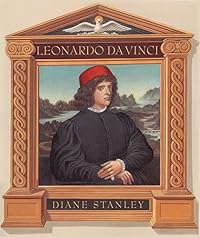
Leonardo da Vinci (Time-Traveling Twins)
by Diane Stanley
On This Page
Description
A biography of the Italian Renaissance artist and inventor who, at about age thirty, began writing his famous notebooks which contain the outpourings of his amazing mind.Tags
Recommendations














Member Reviews
B+ This is a wonderful biography book. The illustrations, I believe, really help and show readers who da Vinci was. His paintings and inventions are well done, and even comparing the front cover illustration, the Mona Lisa, and da Vinci’s sketch of himself is a great way of getting the readers/students more interested into even more art
LEONARDO DAVINCI tells the amazing life of Davinci. It tells interesting facts that students would find engaging. Explanations may need to be given for students to understand the situation. Stanley does an excellent job of tying in actual drawings and paintings from Davinci with her own illustrations. This insightful book helps readers to recognize the brilliance of Davinci and how he was far more than an artist.
For being a biography about a historical figure--not to mention one that is so well-known in popular culture--I really enjoyed Stanley's book. I found myself in awe over aspects of da Vinci's life that I had not known about prior to reading this biography.
That being said, the biography succeeds in getting across important points about da Vinci's life to readers in an entertaining though brief manner. The paired illustrations work exceedingly well with the text as they draw the interest of the reader into the story even further. Although, some of the illustrations take liberties in suggesting how particular scenes in da Vinci's life may have appeared, which also leads readers to make assumptions. This leading of the reader coupled with show more a few assumptions made by Stanley throughout the text makes the book seem less accurate.
Despite any possible inaccuracies, I would certainly use this book for a quick reference to a biography that does well to summarize momentous events in a historical figure's life. In other words, in grades 8th through 12th grade, I would have my class focus more on the writing and less on the subject matter. Nonetheless, the subject matter can also be used as a launching point for students to form their own ideas about da Vinci's life, and they could possibly write short stories or other fiction based on this nonfiction piece. show less
That being said, the biography succeeds in getting across important points about da Vinci's life to readers in an entertaining though brief manner. The paired illustrations work exceedingly well with the text as they draw the interest of the reader into the story even further. Although, some of the illustrations take liberties in suggesting how particular scenes in da Vinci's life may have appeared, which also leads readers to make assumptions. This leading of the reader coupled with show more a few assumptions made by Stanley throughout the text makes the book seem less accurate.
Despite any possible inaccuracies, I would certainly use this book for a quick reference to a biography that does well to summarize momentous events in a historical figure's life. In other words, in grades 8th through 12th grade, I would have my class focus more on the writing and less on the subject matter. Nonetheless, the subject matter can also be used as a launching point for students to form their own ideas about da Vinci's life, and they could possibly write short stories or other fiction based on this nonfiction piece. show less
Retelling: Leonardo Da Vinci was born an illegitimate child to Ser Piero and a peasant woman named Caterina. Because of that status, he would not be admitted to school and received only a country education. After his mother died, he was raised in Ser Piero's grandfather's house where his Uncle Francesco took an interest in him. Ser Piero recognized Leonardo's talent for drawing and sent him to be an apprentice in Florence under Andrea del Verrocchio. He excelled at drawing and music and spent the rest of his life supported by various royal and noble patrons who commissioned him for projects. The author of this book describes Da Vinci's process, which frequently did not end in a finished project but lingered indefinitely on the planning show more and development stage. Meanwhile, he kept (now famous) notebooks where he drew sketches and designed inventions in backwards handwriting. (He was left-handed and found it easier to write this way). Leonardo died in 1519 under the Patronage of King Francis I of France.
Thoughts and Feelings: I thoroughly enjoyed reading this history of Leonardo da Vinci. Several parts stand out in my mind: When he said that when you are alone you belong only to yourself but when you are with even one other person only half of yourself belongs to you and when he said that the scholars who answer questions by referring to the bible or to the writings of the Ancient Greeks alone they are relying on memory only and not their minds.
I will give extra credit to anyone who can find one or more of the 6,000 pages still missing from Leonardo's notebooks and/or to anyone who writes a dramatic work of historical fiction about the quest to find them. show less
Thoughts and Feelings: I thoroughly enjoyed reading this history of Leonardo da Vinci. Several parts stand out in my mind: When he said that when you are alone you belong only to yourself but when you are with even one other person only half of yourself belongs to you and when he said that the scholars who answer questions by referring to the bible or to the writings of the Ancient Greeks alone they are relying on memory only and not their minds.
I will give extra credit to anyone who can find one or more of the 6,000 pages still missing from Leonardo's notebooks and/or to anyone who writes a dramatic work of historical fiction about the quest to find them. show less
This book provided me an interesting viewpoint in regards to Leonardo Da Vinci. For example, I was not aware that Leonardo was the illegitimate son of a nobleman, and it was only his insatiable love of knowledge that allowed him to reach the upper echelons of society and academia. This work focuses on the life of the great Renaissance man, and provides a wonderful variety of facts and little known bits of information about him that make the work by Stanley move along smoothly. While this book was interesting and informative, I am not sure if I would use it in my own classroom. The images were cartoon like and slightly childish, and the prose was so basic that there is a chance that high school students would be offended at having to show more read it. If I were to use this book, I would use it as an ancillary text to modify and enhance the experience of reading a different anchor text that focuses on Leonardo Da Vinci. show less
I really enjoyed this book, especially for the pictures and the way it written. It seems as the though the writer fit in all the small, various, and wonderful details about Da Vinci's life effortlessly, and many of these details I knew nothing about. This book is one that can be read over and over by a child, staying entertained by the details and pictures and noticing new information about Da Vinci's life that they may have skimmed through in the first read. On another note, I did find the book broad and simplistic in the fact that the author mentioned these minor facts, but did not elaborate on them. For instance, when the author mentioned that Da Vinci was left-handed or briefly mentioning his "apprenticeship" relationship with his show more mentor, my adult brain couldn't help but ask questions, doubt, and want to know more information. Unfortunately, I find that the book neglects to bring to light some of the darker facts and evoke the inquisitive minds of children at higher reading/cognitive levels.
I would not use this book in my middle or high school curriculum. I would most likely chose a book that is more centrally focused on one aspect of Da Vinci's life, that is more realistic and in depth. Because this book covers a wide range of Leonardo's life, it does not allow one to understand Da Vinci as a man, a real life character, that the student's can relate to. If the book offered more of an in depth understanding of Da Vinci, I would use this text to examine characters in an analytic essay. On the other hand, paired with other books on Da Vinci, the book perhaps would be a great way to demonstrate how different nonfiction books offer a totally different perspective and tone, depending on the audience and author's point of view. show less
I would not use this book in my middle or high school curriculum. I would most likely chose a book that is more centrally focused on one aspect of Da Vinci's life, that is more realistic and in depth. Because this book covers a wide range of Leonardo's life, it does not allow one to understand Da Vinci as a man, a real life character, that the student's can relate to. If the book offered more of an in depth understanding of Da Vinci, I would use this text to examine characters in an analytic essay. On the other hand, paired with other books on Da Vinci, the book perhaps would be a great way to demonstrate how different nonfiction books offer a totally different perspective and tone, depending on the audience and author's point of view. show less
An interesting book and I learned many things I did not know before about Leonardo Da Vinci. The book uses great illustrations, and I think the author may have been paying homage to Davinci's talent as an artist. Stanley draws the reader in with the illustrations and I think this is the strong feature of the book. Her chronilogical approach keeps the reader flowing from one event to the next. I think this book effectively captures the attention of the reader even if it is not 100% accurate. I would recommend this book for students just learning about famous people from the rennaisance era.
Members
- Recently Added By
Lists

CCE 1000 Good Books List
1,033 works; 12 members

Mensa for Kids Excellence in Reading Award Program (Nonfiction)
54 works; 4 members

Beautiful Feet Books
304 works; 7 members

The Story of the World: History for the Classical Child: Activity Book Two
415 works; 2 members
Author Information

58+ Works 16,743 Members
Diane Stanley was born in 1943 and was raised in Abilene, Texas. She later attended both Trinity University and Johns Hopkins University. Her portfolio of children's book illustrations was creative enough for her to begin publication in 1978. She became an art director for G.P. Putnam & Sons and later began retelling and illustrating classic show more children's books. Stanley has revamped the fairy tale, Rumpelstiltskin's Daughter and has also researched the children's biographies Cleopatra and Leonardo Da Vinci. She also illustrated her mother's book, The Last Princess. (Bowker Author Biography) show less
Awards and Honors
Awards
Distinctions
Notable Lists
Common Knowledge
- Canonical title
- Leonardo da Vinci (Time-Traveling Twins) (Time-Traveling Twins)
- Original title
- Léonard de Vinci
- Original publication date
- 1996
- People/Characters
- Leonardo da Vinci
- Publisher's editor*
- Rappa, Zsuzsa
*Some information comes from Common Knowledge in other languages. Click "Edit" for more information.
Classifications
Statistics
- Members
- 1,194
- Popularity
- 20,722
- Reviews
- 30
- Rating
- (3.84)
- Languages
- English, Greek, Hungarian
- Media
- Paper
- ISBNs
- 11
- ASINs
- 5