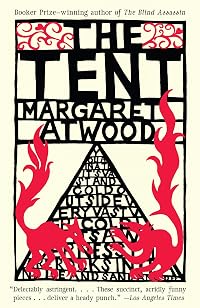
The Tent
by Margaret Atwood
On This Page
Description
One of the world's most celebrated authors, Margaret Atwood has penned a collection of smart and entertaining fictional essays, in the genre of her popular books Good Bones and Murder in the Dark, punctuated with wonderful illustrations by the author.--from publisher description.Tags
Recommendations





Member Reviews
Lots of VERY short but thought-provoking pieces. They are varied, though many involve common Atwood themes (relationships, environmental catastrophe, heaven and hell, women). Some are quite poetic and a few are actual poems; there is an allegorical riddle, or perhaps it's a riddling allegory. There are also a few faux-naive woodcut illustrations.
You could easily read the whole thing in an hour or two, but you'd probably feel sea-sick and you really wouldn't appreciate them. Because they are so brief, you still have the taste of the previous one, and just as you "get" the one you are now reading, it ends. So dip in and out.
This review will echo the bitty nature of the book.
The collection opens with an exploration of memory, and the show more temptation to edit one's personal history.
A singer describes "my voice attached like an invisible vampire to my throat".
The frustration of endlessly being photographed is explained, though whether by a celebrity or someone in a pre-industrial society is not clear: "No more photos... shadows of myself thrown by light onto pieces of paper... I'm watery, I ripple, from moment to moment I dissolve into my other selves."
The next one is more raw: examining the negative ideas, and fears some people have about orphans, and the nasty things they say and do as a consequence. "It is loss to which everything flows, absence in which everything flowers. It is you, not we, who have always been the children of the gods." Ouch.
There is humour, especially "Resources of the Ikarians". A self-deprecating islander discusses the community's attempts to raise foreign income. "The child sex trade is not for us" (phew), but only because "our children are unattractive and rude"! A parody of Chicken Little's fears about the sky falling is very good, too.
A longer item is actually a poem, and although it starts with a bear rejecting the name applied to his species by humans, it progresses to the unravelling of almost everything - a similar trick to Martin Amis' "Time's Arrow" (review here: http://www.goodreads.com/review/show/207770668)
"Three novels I won't write soon" is an intriguing title, and the three plot summaries are good pastiches of Atwood's own themes and styles. The real trick is that one can ALMOST (but only almost) imagine her actually writing them.
The repeating pattern of a children's story is used to great effect in "Take Charge". The nursery/liturgical familiarity contrasts sharply with the more dystopian subject.
Atwood is often portrayed as a feminist writer, and although she clearly has strong views on feminist matters, that label can sound off-putting. One piece here exposes these ideas in a powerful but also funny and sad way: it starts with a (presumably modern) narrator longing for a traditional housewife-cum-mother, but it ends pointedly, "and we can be careless again... and ignore you as we used to".
The item that lends its title to the collection is near the end. It cleverly describes the compulsion to convert the world around into words, whilst staying separate from it. show less
You could easily read the whole thing in an hour or two, but you'd probably feel sea-sick and you really wouldn't appreciate them. Because they are so brief, you still have the taste of the previous one, and just as you "get" the one you are now reading, it ends. So dip in and out.
This review will echo the bitty nature of the book.
The collection opens with an exploration of memory, and the show more temptation to edit one's personal history.
A singer describes "my voice attached like an invisible vampire to my throat".
The frustration of endlessly being photographed is explained, though whether by a celebrity or someone in a pre-industrial society is not clear: "No more photos... shadows of myself thrown by light onto pieces of paper... I'm watery, I ripple, from moment to moment I dissolve into my other selves."
The next one is more raw: examining the negative ideas, and fears some people have about orphans, and the nasty things they say and do as a consequence. "It is loss to which everything flows, absence in which everything flowers. It is you, not we, who have always been the children of the gods." Ouch.
There is humour, especially "Resources of the Ikarians". A self-deprecating islander discusses the community's attempts to raise foreign income. "The child sex trade is not for us" (phew), but only because "our children are unattractive and rude"! A parody of Chicken Little's fears about the sky falling is very good, too.
A longer item is actually a poem, and although it starts with a bear rejecting the name applied to his species by humans, it progresses to the unravelling of almost everything - a similar trick to Martin Amis' "Time's Arrow" (review here: http://www.goodreads.com/review/show/207770668)
"Three novels I won't write soon" is an intriguing title, and the three plot summaries are good pastiches of Atwood's own themes and styles. The real trick is that one can ALMOST (but only almost) imagine her actually writing them.
The repeating pattern of a children's story is used to great effect in "Take Charge". The nursery/liturgical familiarity contrasts sharply with the more dystopian subject.
Atwood is often portrayed as a feminist writer, and although she clearly has strong views on feminist matters, that label can sound off-putting. One piece here exposes these ideas in a powerful but also funny and sad way: it starts with a (presumably modern) narrator longing for a traditional housewife-cum-mother, but it ends pointedly, "and we can be careless again... and ignore you as we used to".
The item that lends its title to the collection is near the end. It cleverly describes the compulsion to convert the world around into words, whilst staying separate from it. show less
This is Atwood at her best, reflective, with a touch of acerbic humour, and a little cynical in places. Not actually stories, more like ideas, vignettes, all of them clever and thought-provoking. As expected some sparkled, some merely glowed but there are no duds. It's a slim book yet not to be read in one or two sessions, but rather to be dipped into and savoured in individual bites. I started noting favourites but the list got too long. These were at the top of the list: Encouraging the Young; Gateway; Our Cat Enters Heaven; Chicken Little Goes Too Far; and best of all, The Tent.
i'm not going to give margaret atwood less than 2 stars, but the honest truth is that if this was written by someone else, i probably would. to me, this reads like a notebook that she keeps, with story ideas and paragraphs that she can use to make longer works out of. i'm not partial to vignettes in general, so that could be more of a take based on that, but this felt to me like a collection of partial essays and stories and paragraphs, ideas and starts, missing the filler. still, there are some ideas that she handles well and felt more complete, even as i'd like them longer. she wouldn't be margaret atwood if she couldn't take a few vignettes and make them awesome. i especially liked Our Cat Enters Heaven, Post-Colonial, Heritage show more House, Nightingale (based on a greek myth), and titular story is pretty fantastic, The Tent. this wasn't my thing in general but she still managed to put down some great ideas and sentences, as she does. show less
“your tent is made of paper”
Reminiscent in look and style of Good Bones and Simple Murders (1994), The Tent (2006) is a short collection of Margaret Atwood’s stories, prose, and poetry – much of it more recent, some of it previously published elsewhere (including “The Walrus,” “Harper’s Magazine,” and several special fundraising anthologies). As with three-poled tents, THE TENT is “supported,” in a manner of speaking, by three sections of related material.
While the stories are varied and diverse, time is a central theme, with lives bending, flexing, and twisting around the stuff. Time is not always linear, but folds and flexes (“Wibbly Wobbly Timey Wimey...Stuff,” in Doctor-speak.) Time “folds you in its show more arms and gives you one last kiss, and then it flattens you out and folds you up and tucks you away until it’s time for you to become someone else’s past time, and then time folds again.” [“Time Folds,” page 148.] Time softens and broadens, reunites and tears asunder. Time both binds and separates us all.
As with most anthologies, some of the pieces are more memorable than others. Most are complex, hinting at layer upon layer of meaning, the intricacies of which the reader can only begin to grasp. (Such is Margaret Atwood!) As per usual, those stories I love the best feature nonhuman protagonists (“Our Cat Enters Heaven” – and gets his testicles back; “Thylacine Ragout”; “The Animals Reject Their Names and Things Return to Their Origins”) or are retellings of classics, be they fairy tales or Shakespeare (“Encouraging the Young” – right into my gingerbread house; “It’s Not Easy Being Half-Divine”; “Horatio’s Version”; “Nightingale”). Nostalgic, heartbreaking, and not a little cruel, “Bring Back Mom: An Invocation” is another favorite, as is “Post-Colonial”: “It’s a constant worry, this we, this them.” [page 100]
Though I prefer Atwood’s novels to her shorter works, The Tent and other such collections are helping to tide me over until the release of Mad Adam. Let’s hope that she doesn’t take quite as long as dear Horatio!
Perfect for: hardcore Atwood fans, or lovers of feminist poetry and eclectic short fiction. Keep it on your nightstand for some impromptu, late-night reading.
http://www.easyvegan.info/2012/07/19/the-tent-by-margaret-atwood/ show less
Reminiscent in look and style of Good Bones and Simple Murders (1994), The Tent (2006) is a short collection of Margaret Atwood’s stories, prose, and poetry – much of it more recent, some of it previously published elsewhere (including “The Walrus,” “Harper’s Magazine,” and several special fundraising anthologies). As with three-poled tents, THE TENT is “supported,” in a manner of speaking, by three sections of related material.
While the stories are varied and diverse, time is a central theme, with lives bending, flexing, and twisting around the stuff. Time is not always linear, but folds and flexes (“Wibbly Wobbly Timey Wimey...Stuff,” in Doctor-speak.) Time “folds you in its show more arms and gives you one last kiss, and then it flattens you out and folds you up and tucks you away until it’s time for you to become someone else’s past time, and then time folds again.” [“Time Folds,” page 148.] Time softens and broadens, reunites and tears asunder. Time both binds and separates us all.
As with most anthologies, some of the pieces are more memorable than others. Most are complex, hinting at layer upon layer of meaning, the intricacies of which the reader can only begin to grasp. (Such is Margaret Atwood!) As per usual, those stories I love the best feature nonhuman protagonists (“Our Cat Enters Heaven” – and gets his testicles back; “Thylacine Ragout”; “The Animals Reject Their Names and Things Return to Their Origins”) or are retellings of classics, be they fairy tales or Shakespeare (“Encouraging the Young” – right into my gingerbread house; “It’s Not Easy Being Half-Divine”; “Horatio’s Version”; “Nightingale”). Nostalgic, heartbreaking, and not a little cruel, “Bring Back Mom: An Invocation” is another favorite, as is “Post-Colonial”: “It’s a constant worry, this we, this them.” [page 100]
Though I prefer Atwood’s novels to her shorter works, The Tent and other such collections are helping to tide me over until the release of Mad Adam. Let’s hope that she doesn’t take quite as long as dear Horatio!
Perfect for: hardcore Atwood fans, or lovers of feminist poetry and eclectic short fiction. Keep it on your nightstand for some impromptu, late-night reading.
http://www.easyvegan.info/2012/07/19/the-tent-by-margaret-atwood/ show less
This little book is fantastic! I am not always a fan of books of essays on rather random topics, but Atwood's wit and intelligence permeates every little story or essay in here. I enjoyed it so much that I wanted to read several of them out loud. To add to the delight, Atwood includes sketches (drawings) of her own.
A publisher’s blurb on the back cover of the paperback edition calls this book “A delightfully pointed mélange of fictional pieces.” But I disagree. These short – sometimes funny, sometimes sad, but always poignant – pieces are far too poetic to deserve the title of “fictional pieces.”
I love Margaret Atwood. I have loved her since I read The Handmaid’s Tale some 20 plus years ago. I loved her when I drove six hours in an old, beat-up Chevy toting a pile of books to hear her read at the Harvard Book Store Café in Boston. She graciously signed all eight, and she smiled, and she thanked me, and I loved her more.
Shamefully, I have not read much by her the last couple of years, but The Tent is the first step in remedying show more that situation. This slim volume contains so many of her thoughts and musings, her streams of consciousness, so much of her humor, her intelligence, I hardly know where to begin describing anything on these pages.
My favorite piece is the eponymous entry, and it begins:
“You’re in a tent. It’s vast and cold outside, very vast, very cold. It’s a howling wilderness…But you have a candle in your tent. You can keep warm” (143).
“The trouble is, your tent is made of paper. Paper won’t keep anything out. You know you must right on the walls, on the paper walls, on the inside of your tent. You must write upside down and backwards, you must cover every available space on the paper with writing” (144).
“Wind comes in, your candle tips over and flares up, and a loose tent-flap catches fire, and through the widening black-edged gap you can see the eyes of the howlers, red and shining in the light from your burning paper shelter, but you keep on writing anyway because what else can you do?” (146).
I guess the paper tent could not protect her from fans toting bags of books either. Get this book and read it now. That’s an order! 5 stars.
--Jim, 6/21/09 show less
I love Margaret Atwood. I have loved her since I read The Handmaid’s Tale some 20 plus years ago. I loved her when I drove six hours in an old, beat-up Chevy toting a pile of books to hear her read at the Harvard Book Store Café in Boston. She graciously signed all eight, and she smiled, and she thanked me, and I loved her more.
Shamefully, I have not read much by her the last couple of years, but The Tent is the first step in remedying show more that situation. This slim volume contains so many of her thoughts and musings, her streams of consciousness, so much of her humor, her intelligence, I hardly know where to begin describing anything on these pages.
My favorite piece is the eponymous entry, and it begins:
“You’re in a tent. It’s vast and cold outside, very vast, very cold. It’s a howling wilderness…But you have a candle in your tent. You can keep warm” (143).
“The trouble is, your tent is made of paper. Paper won’t keep anything out. You know you must right on the walls, on the paper walls, on the inside of your tent. You must write upside down and backwards, you must cover every available space on the paper with writing” (144).
“Wind comes in, your candle tips over and flares up, and a loose tent-flap catches fire, and through the widening black-edged gap you can see the eyes of the howlers, red and shining in the light from your burning paper shelter, but you keep on writing anyway because what else can you do?” (146).
I guess the paper tent could not protect her from fans toting bags of books either. Get this book and read it now. That’s an order! 5 stars.
--Jim, 6/21/09 show less
Witty, enlightening, entertaining and sometimes confusing, The Tent by Margaret Atwood was a collection of essays and prose with that famous Atwoodian look at life. Each essay stood individually as its own; however, one can sense a theme of self-exploration and concern for the state of “humanness” throughout all of the stories.
Admittedly, several of the pieces went right over my head, but overall, most were succinct but profound. My favorite essay was one about cat heaven, where a family cat died, met God and asked if he could catch the “mice” in the field. God corrected the cat, saying they were actually human souls that he should capture and torture as long as he can: “Our heaven is their hell, said God. I like a balanced show more universe.” (page 65). Perhaps it’s my dry humor, but I found that line laugh-out-loud funny (perhaps because I have cats who love to play with my head here on earth).
The Tent is a nice companion book to Atwood’s fiction, revealing another side to the dynamic writing of Margaret Atwood. This is a must-read for Atwood fans. show less
Admittedly, several of the pieces went right over my head, but overall, most were succinct but profound. My favorite essay was one about cat heaven, where a family cat died, met God and asked if he could catch the “mice” in the field. God corrected the cat, saying they were actually human souls that he should capture and torture as long as he can: “Our heaven is their hell, said God. I like a balanced show more universe.” (page 65). Perhaps it’s my dry humor, but I found that line laugh-out-loud funny (perhaps because I have cats who love to play with my head here on earth).
The Tent is a nice companion book to Atwood’s fiction, revealing another side to the dynamic writing of Margaret Atwood. This is a must-read for Atwood fans. show less
Members
- Recently Added By
Lists

Literature About Women and Girls
394 works; 39 members

My Wishlist
9 works; 1 member

Books Read in 2013
1,630 works; 51 members
Author Information

287+ Works 199,355 Members
Margaret Atwood was born on November 18, 1939 in Ottawa, Canada. She received a B.A. from Victoria College, University of Toronto in 1961 and an M.A. from Radcliff College in 1962. Her first book of verse, Double Persephone, was published in 1961 and was awarded the E. J. Pratt Medal. She has published numerous books of poetry, novels, story show more collections, critical work, juvenile work, and radio and teleplays. Her works include The Journals of Susanna Moodie, Power Politics, Cat's Eye, The Robber Bride, Morning in the Buried House, the MaddAdam trilogy, and The Heart Goes Last. She has won numerous awards including the Prince of Asturias Award for Literature, the Booker Prize in 2000 for The Blind Assassin, the Giller Prize and the Premio Mondello for Alias Grace, and the Governor General's Award in 1966 for The Circle Game and in 1986 for The Handmaid's Tale, which also won the very first Arthur C. Clarke Award in 1987. She won the PEN Pinter prize in 2016 for her political activism. She was awarded the 2016 PEN Pinter Prize for the outstanding literary merit of her body of work. (Bowker Author Biography) show less
Common Knowledge
- Canonical title
- The Tent
- Original title
- The Tent
- Original publication date
- 2006
- Dedication
- For Graeme
- First words
- Why the hunger for these?
- Quotations
- Listen: the leaves no longer rustle, the wind no longer sighs, our hearts no longer beat. [...] Perhaps it's not the world that is soundless but we who are deaf. ("Something Has Happened")
We want to get there faster. Get where? Wherever we are not. But a human soul can only go as fast as a man can walk, they used to say. In that case, where are all the souls? Left behind. They wander here and there, slowly, di... (show all)m lights flickering in the marshes at night, looking for us. But they're not nearly fast enough, not for us, we're way ahead of them, they'll never catch up. That's why we can go so fast: our souls don't weigh us down. ("Faster") - Last words
- (Click to show. Warning: May contain spoilers.)It was the right thing to do on the darkest day of the year.
- Original language
- English
Classifications
Statistics
- Members
- 1,313
- Popularity
- 18,443
- Reviews
- 43
- Rating
- (3.50)
- Languages
- 9 — Chinese, Czech, Dutch, English, French, German, Italian, Polish, Portuguese
- Media
- Paper, Ebook
- ISBNs
- 22
- ASINs
- 4