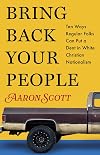
Bring Back Your People: Ten Ways Regular Folks Can Put a Dent in White Christian Nationalism
by Aaron Scott
On This Page
Description
"White Christians, from evangelical to progressive mainline to Catholic, who have watched congregations and friends and relatives become enamored of White Christian nationalism and are concerned and feeling helpless about how to counteract those messages and who are seeking to address racism within White communities"--Tags
Recommendations













































Member Reviews
Summary: A blunt discussion of how to reach out to those who have embraced Christian nationalism.
You might know “Randy.” He (or she, in this case Brandy) may be a sibling or relative. Maybe a next door neighbor. Or it could be your auto mechanic, or hair dresser, or a favorite waitstaff at a restaurant you frequent. Randy embraces ideas of American greatness, often coated with an icing of Christianity. As I write, Randy is probably in hog heaven. And you may be dismayed and wondering where do you go from here.
Aaron Scott has worked with a lot of Randys in his ministry. He helped start a church among the rural poor on coastal Washington State, many of whom have been attracted by Christian nationalism. He offers a blunt, plain-spoken show more ten-step guidebook to talking with the Randys in our lives. He begins by discussing the tenets of Christian nationalism and why they attracted Randy. Often it came down to someone talking to Randy and caring about him and offering a vision and ground game of how his life and community could be better. And sadly, more progressive folk probably never did.
That’s the starting place: talking to Randy and caring about his life. Sometimes, that means getting past the things that get under your skin to see the person and taking time to really listen. Scott also takes a deep dive into American history and how white supremacy, nationalism, and white evangelicalism have sadly walked together. Randy may well be where he is because a church embracing Christian nationalist ideas has taken him in and provided a place of belonging. Many progressive folk have nothing nearly as compelling to offer.
Scott shows how so much of the political rhetoric of both parties tries to recruit the poor while preserving the wealth of a tiny number. He believes the answer is mobilizing a people’s movement that calls both to account. He also recognizes this could be emotionally and physically dangerous. He discusses honestly assessing these to navigate both safely and strategically. He also argues that progressives need a religious strategy. Spirituality matters to Randy, yet progressives often shun it like the plague. All of this so that you can offer Randy a new home, one speaking compellingly into the real-life issues of one’s own community. He argues that we have to stop blaming people and “pledge allegiance to the bottom.”
In sum, Scott seeks to rally the church, not to the cause of American greatness, but to the 140 million poor in our country. He offers a bracing call to get to work. Christian nationalism has succeeded by relentless organizing that has extended into poor communities. Yet they are not delivering for the poor, an opportunity to “bring back” people like Randy. But it means talking to Randy, organizing to reach and serve Randy, and taking Randy seriously rather than dismissively.
As I mentioned, Scott speaks bluntly. His writing is laced with profanity (but that’s often the language Randy uses). While progressive both theologically and politically, he is critical of the abandonment of the rural poor by many progressives. His approach is one that goes beyond the church truly being the church to community and political organizing. It doesn’t strike me as an approach to healing the divides but rather of outdoing the opposition. I’m not sure I agree with that but Scott makes me ask hard questions about how we are caring for the Randys in our lives.
____________________
Disclosure of Material Connection: I received a complimentary copy of this book for review from the publisher through LibraryThing’s Early Reviewers Program. show less
You might know “Randy.” He (or she, in this case Brandy) may be a sibling or relative. Maybe a next door neighbor. Or it could be your auto mechanic, or hair dresser, or a favorite waitstaff at a restaurant you frequent. Randy embraces ideas of American greatness, often coated with an icing of Christianity. As I write, Randy is probably in hog heaven. And you may be dismayed and wondering where do you go from here.
Aaron Scott has worked with a lot of Randys in his ministry. He helped start a church among the rural poor on coastal Washington State, many of whom have been attracted by Christian nationalism. He offers a blunt, plain-spoken show more ten-step guidebook to talking with the Randys in our lives. He begins by discussing the tenets of Christian nationalism and why they attracted Randy. Often it came down to someone talking to Randy and caring about him and offering a vision and ground game of how his life and community could be better. And sadly, more progressive folk probably never did.
That’s the starting place: talking to Randy and caring about his life. Sometimes, that means getting past the things that get under your skin to see the person and taking time to really listen. Scott also takes a deep dive into American history and how white supremacy, nationalism, and white evangelicalism have sadly walked together. Randy may well be where he is because a church embracing Christian nationalist ideas has taken him in and provided a place of belonging. Many progressive folk have nothing nearly as compelling to offer.
Scott shows how so much of the political rhetoric of both parties tries to recruit the poor while preserving the wealth of a tiny number. He believes the answer is mobilizing a people’s movement that calls both to account. He also recognizes this could be emotionally and physically dangerous. He discusses honestly assessing these to navigate both safely and strategically. He also argues that progressives need a religious strategy. Spirituality matters to Randy, yet progressives often shun it like the plague. All of this so that you can offer Randy a new home, one speaking compellingly into the real-life issues of one’s own community. He argues that we have to stop blaming people and “pledge allegiance to the bottom.”
In sum, Scott seeks to rally the church, not to the cause of American greatness, but to the 140 million poor in our country. He offers a bracing call to get to work. Christian nationalism has succeeded by relentless organizing that has extended into poor communities. Yet they are not delivering for the poor, an opportunity to “bring back” people like Randy. But it means talking to Randy, organizing to reach and serve Randy, and taking Randy seriously rather than dismissively.
As I mentioned, Scott speaks bluntly. His writing is laced with profanity (but that’s often the language Randy uses). While progressive both theologically and politically, he is critical of the abandonment of the rural poor by many progressives. His approach is one that goes beyond the church truly being the church to community and political organizing. It doesn’t strike me as an approach to healing the divides but rather of outdoing the opposition. I’m not sure I agree with that but Scott makes me ask hard questions about how we are caring for the Randys in our lives.
____________________
Disclosure of Material Connection: I received a complimentary copy of this book for review from the publisher through LibraryThing’s Early Reviewers Program. show less
 This review was written for LibraryThing Early Reviewers.
In "Bring Back Your People: Ten Ways Regular Folks Can Put a Dent in White Christian Nationalism," Arron Scott has done a really fine job of helping the reader to understand the people drawn to White Christian Nationalism. I'm not talking about the powerful, well-off people who head the various factions of the movement, but rather the everyday, common people who have been sucked (or better yet, suckered) into the movement. As Scott points out, they are like your cousin "Randy."
In a down-to-earth (and sometimes downright earthy) style, Scott describes so much of what has made the White Christian Nationalism movement attractive to many, and he elaborates on ways to draw people back from that movement. Fair warning: Even with what the show more author describes and his ten steps, it is NOT easy work. Far from it; it is dirty, hard, long, taxing work. But if one realizes the problems with White Christian Nationalism and the insidious path on which it is taking the United States, it is work worth doing to draw people back.
Since the author is an Episcopal priest, questions might arise about the book. For example, is the book full of preaching? If the reader is an atheist, will the reader be turned off? I think it's fair to say that anyone -- of any or of no religious bent -- will appreciate what the book has to offer. Yes, there are some references to things in the Bible, and the author (with a forewarning from the author) does just a little preaching.
The book really comes down to this: We have to care -- actively care -- for the people who have felt lost in some way, and who, as a result of being lost, downtrodden, persecuted, discriminated against, etc., have been drawn to some light of hope in White Christian Nationalism.
Disclosure: The reviewer received a free copy of the book via LibraryThing, but this was not contingent on writing a review nor did it influence the review. show less
In a down-to-earth (and sometimes downright earthy) style, Scott describes so much of what has made the White Christian Nationalism movement attractive to many, and he elaborates on ways to draw people back from that movement. Fair warning: Even with what the show more author describes and his ten steps, it is NOT easy work. Far from it; it is dirty, hard, long, taxing work. But if one realizes the problems with White Christian Nationalism and the insidious path on which it is taking the United States, it is work worth doing to draw people back.
Since the author is an Episcopal priest, questions might arise about the book. For example, is the book full of preaching? If the reader is an atheist, will the reader be turned off? I think it's fair to say that anyone -- of any or of no religious bent -- will appreciate what the book has to offer. Yes, there are some references to things in the Bible, and the author (with a forewarning from the author) does just a little preaching.
The book really comes down to this: We have to care -- actively care -- for the people who have felt lost in some way, and who, as a result of being lost, downtrodden, persecuted, discriminated against, etc., have been drawn to some light of hope in White Christian Nationalism.
Disclosure: The reviewer received a free copy of the book via LibraryThing, but this was not contingent on writing a review nor did it influence the review. show less
This review was written for LibraryThing Early Reviewers.I think we are all aware of the growing menace (yes, I said menace) of White Christian Nationalism. The January 6 insurrection, the Nazi salutes by professional people, even down to the racist bumper stickers on trucks.
Scott attempts to give us (regular folk?) a path to confront the menace, one person at a time. He lists ten different ideas to accomplish this intervention. Some I believe are reasonably easy to do, while others more difficult. He created a fictional character named Randy to use as a demonstration. Most of all, it comes down to listening. Listen to what the racist person is saying, instead of walking away shaking your head, or giving them a bunch of canned responses they have heard a million times. By listening show more carefully, you might learn how the person came to these beliefs, and then you can work on helping them change.
I appreciate the author's confidence in his ideas. He seems to concentrate on the lower financial class of people. What I had hoped to find was how to change the racist people on the upper end of financial security. People like our VP, the Kristi Noehms, the Marjorie Taylor Greens. Perhaps he will write another book about how to cope with those types.
Thank you to LibraryThing for an ARC of this book. show less
Scott attempts to give us (regular folk?) a path to confront the menace, one person at a time. He lists ten different ideas to accomplish this intervention. Some I believe are reasonably easy to do, while others more difficult. He created a fictional character named Randy to use as a demonstration. Most of all, it comes down to listening. Listen to what the racist person is saying, instead of walking away shaking your head, or giving them a bunch of canned responses they have heard a million times. By listening show more carefully, you might learn how the person came to these beliefs, and then you can work on helping them change.
I appreciate the author's confidence in his ideas. He seems to concentrate on the lower financial class of people. What I had hoped to find was how to change the racist people on the upper end of financial security. People like our VP, the Kristi Noehms, the Marjorie Taylor Greens. Perhaps he will write another book about how to cope with those types.
Thank you to LibraryThing for an ARC of this book. show less
This review was written for LibraryThing Early Reviewers.This book contains a common sense approach to dealing with the challenging times we live in. The pastor discusses a one-on-one approach to meeting people where they are in local communities to move the needle away from extremism. The book is filled with anecdotes about community activism and building connection. Thia work is steeped in care and compassion and will strike a chord with people looking for ways to take action in a thoughtful and meaningful way.
This review was written for LibraryThing Early Reviewers.It’s taken me quite a while to pick this book up and read it. The election campaign and results overloaded me to the point that I couldn’t seem to want to take the effort to immerse myself in this specific topic. But now, I am very glad I read it. It far exceeded my expectations. I learned so much about the origins of White Christian Nationalism, which I feel is not widely understood. The author’s use of his “cousin Randy” hits close to home since I have an identical cousin Doug. The author presents a clear, practical guide for steps we can take to combat the rise of Christian nationalism with a one on one approach. I received this book via LT early readers.
This review was written for LibraryThing Early Reviewers.This book is a step-by-step guide to and provides concrete ways for bringing friends, family, and anyone else in your life back from the claws of white Christian nationalism. It’s funny, written gorgeously, and needed now more than ever! It gives hope in an otherwise hopeless political landscape, especially in the very current-day events.
This review was written for LibraryThing Early Reviewers.Hard to know who the intended audience is for this book. A number of recent books have addressed the problem of Christian Nationalism and been well accepted and reviewed. Starting out this book showed real promise with an irreverent snarky approach to the problems that it purports to solve. This quickly fades away with the overuse of profanity and a real world example of personal shaming as a form of retaliation. These words and actions will do little to change anyone’s views and may have the opposite effect on “regular folks”. Feel this one misses the mark on solving this very real problem in America today
This review was written for LibraryThing Early Reviewers.Members
- Recently Added By
Lists

US White Christian Nationalism
24 works; 1 member
Author Information
7 Works 28 Members
Classifications
- Genres
- Religion & Spirituality, Nonfiction, General Nonfiction
- DDC/MDS
- 261.70973 — Religion Christian organization, social work & worship Social theology and interreligious relations and attitudes Christianity and political affairs
- LCC
- BR115 .C66 .S625 — Philosophy, Psychology and Religion Christianity Christianity Christianity in relation to special subjects
- BISAC
Statistics
- Members
- 23
- Popularity
- 1,148,923
- Reviews
- 9
- Rating
- (3.50)
- Languages
- English
- Media
- Paper, Ebook
- ISBNs
- 2