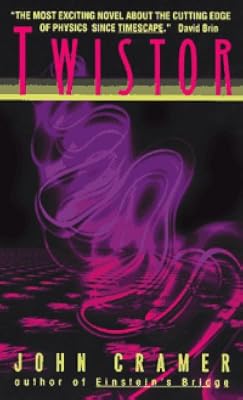
Twistor
by John Cramer
On This Page
Description
"True hard science fiction--deftly done, with plenty of fine surprises." -- Gregory Benford. "Twistor marks the arrival of a major new science-fiction talent." -- Gene Wolfe. "A fine hard science thriller, very enjoyable." -- Greg Bear. Research scientist David Harrison happens upon the "twistor effect," a phenomenon that opens doors into countless alternate universes. The discovery's potential for unlimited power draws the attention of industrial spies and corporate killers, driving Dr. show more Harrison to seek sanctuary in a mysterious shadow world--a place of both wonder and danger, with no certain way out. Written by a professional physicist, this gripping novel of hard science fiction offers a captivating adventure as well as fascinating glimpses at the business of science, from the demands of university life and the politics intrinsic to academic funding to the complex interplay between pure research and commercial applications. An Afterword provides insights into the distinctions between real science and fictional speculation. show lessTags
Recommendations
















Member Reviews
Twistor is a blast from the past (and the future!) a "hard science" science fiction novel written in the 1980's.
Which means that the author works like a horse to set up his fictional physics premise (Get on with the story already!), and then is almost charmingly out-of-date with his computer hacking sub-plot. (4800 baud modems - oh my!)
A physics professor and a grad student are building a machine and discover by chance that the machine allows access to a "Shadow Universe".
Of course you know Part II - the young physicist and two cute but resourceful kids get sucked into the "shadow universe" and have to learn how to survive and try to get back.
Meanwhile back on Earth two or three different groups of Big Bads are doing strange spy show more thriller stuff to try to get the secret of the "shadow universe" for their own - though honestly I can't see why.
(And the less said about the romantic sub-plot, the better)
The problem for me is twofold: everyone makes long speeches that rather clumsily set up the exposition and try to justify the science. .
But the bigger problem is that despite torture and kidnapping and being dumped into another universe, nobody ever seems to be in peril and nothing ever seems to be at stake.
I read it as a period piece and enjoyed it. But believe me science fiction has (thankfully) moved on from this. show less
Which means that the author works like a horse to set up his fictional physics premise (Get on with the story already!), and then is almost charmingly out-of-date with his computer hacking sub-plot. (4800 baud modems - oh my!)
A physics professor and a grad student are building a machine and discover by chance that the machine allows access to a "Shadow Universe".
Of course you know Part II - the young physicist and two cute but resourceful kids get sucked into the "shadow universe" and have to learn how to survive and try to get back.
Meanwhile back on Earth two or three different groups of Big Bads are doing strange spy show more thriller stuff to try to get the secret of the "shadow universe" for their own - though honestly I can't see why.
(And the less said about the romantic sub-plot, the better)
The problem for me is twofold: everyone makes long speeches that rather clumsily set up the exposition and try to justify the science. .
But the bigger problem is that despite torture and kidnapping and being dumped into another universe, nobody ever seems to be in peril and nothing ever seems to be at stake.
I read it as a period piece and enjoyed it. But believe me science fiction has (thankfully) moved on from this. show less
 This review was written for LibraryThing Early Reviewers.
Since I only took Physics for Poets in school, the first section of this book, defining the science part, was a little boring for me. However, that means (for me) that regardless of when it was written and where science has gone since then, really doesn't matter to me.
I very much enjoyed the book as the "fiction" part took over. Scientists developing a way to find a shadow universe, existing in the same time and space as our own. David Harrison and the children of a fellow scientist accidently get themselves "sent" to the alternative universe. Conveniently, they arrive in a big tree. Things go pretty well for them, problems solved, adventure happens, and a "twist" at the end.
I found 3 stories. David and the two children in the shadow show more universe, the scientists working to get them back and fighting some bad guys (read mega corporation) and a third story that is a fairy tale that David tells the kids over several periods. I was engrossed in all three. Loved the book! show less
I very much enjoyed the book as the "fiction" part took over. Scientists developing a way to find a shadow universe, existing in the same time and space as our own. David Harrison and the children of a fellow scientist accidently get themselves "sent" to the alternative universe. Conveniently, they arrive in a big tree. Things go pretty well for them, problems solved, adventure happens, and a "twist" at the end.
I found 3 stories. David and the two children in the shadow show more universe, the scientists working to get them back and fighting some bad guys (read mega corporation) and a third story that is a fairy tale that David tells the kids over several periods. I was engrossed in all three. Loved the book! show less
This review was written for LibraryThing Early Reviewers.I love hard science fiction and this book did not disappoint. While the writing is often dry, perhaps staid, the story, the science, is well worth the little bit of extra effort to stay with it.
This review was written for LibraryThing Early Reviewers.I enjoyed this book more and more the longer it went on. I thought that it took a while to really get going, and there were some things that I found irritating towards the beginning, but about halfway through I forgot about all of that because I couldn't wait to find out what would happen next, as it seemed like the possibilities were endless. I especially enjoyed the afterword, in which the curtain was pulled aside to reveal where the real science ended and the science fiction began - a very welcome addition to a hard science fiction novel.
This review was written for LibraryThing Early Reviewers.This book was incredibly fascinating, even though I found some of the hard science fiction a bit confusing. It is well written, the plot is interesting, intriguing and flows superbly from page to page. Some of the theories used in the novel have since come to passes the book was written some years ago, but this does nothing to detract from the intensity of the novel. The characters are fairly well developed, although it is more centered on the scientific experiments rather than too much on the character's backgrounds. It is most certainly well worth the read for the suspense and multiple universes questions it poses and leaves one wondering, what if.
This review was written for LibraryThing Early Reviewers.This is quite an interesting book - the basic story is about a couple of university researchers have stumbled on a new electromagnetic effect whilst undertaking some research for the woman's doctoral research.
At first her research advisor doesn't see the point of the new directions of research - his company was suffering financially, and he'd just been threatened by on of his contractors over some, er, dubious research he'd undertaken for them but when some of the implications became clear, he reckons this could be the saviour of his company, but the main researchers had other thoughts! Research should be shared, not put into corporate silos but they don't realise the risks they were putting themselves in. First, it was the bugs in the show more lab and their advisor's office, then the bungled attempt to steal the tech that left one of the researchers and a colleague's children exiled in another universe! The kidnapping of the second researcher and the advisor succeeded but the kidnappers refused to believe the truth...
The story itself worked quite well and the way that Dr Cramer went about describing the research parts of the story were quite good fun too but some parts of the story depend on computer technology and this story, written in 1987, totally misses any mention of the internet (though Cramer ought to have been aware of its predecessor), and some of the terminology used for the computers is just laughable these days so you find yourself jarred out of the story every so often (the story is set in an undefined 'day after tomorrow') show less
At first her research advisor doesn't see the point of the new directions of research - his company was suffering financially, and he'd just been threatened by on of his contractors over some, er, dubious research he'd undertaken for them but when some of the implications became clear, he reckons this could be the saviour of his company, but the main researchers had other thoughts! Research should be shared, not put into corporate silos but they don't realise the risks they were putting themselves in. First, it was the bugs in the show more lab and their advisor's office, then the bungled attempt to steal the tech that left one of the researchers and a colleague's children exiled in another universe! The kidnapping of the second researcher and the advisor succeeded but the kidnappers refused to believe the truth...
The story itself worked quite well and the way that Dr Cramer went about describing the research parts of the story were quite good fun too but some parts of the story depend on computer technology and this story, written in 1987, totally misses any mention of the internet (though Cramer ought to have been aware of its predecessor), and some of the terminology used for the computers is just laughable these days so you find yourself jarred out of the story every so often (the story is set in an undefined 'day after tomorrow') show less
I was a bit surprised by this book. I read the introduction and I knew the publication date, so I went in well aware that this was a sci-fi book written about technology, but it had been published quite a number of years ago. At first, the aspects of technology that had become dated or never became true were a turn-off. I mean, really? "Hacking" into Unix mainframes with an early Apple computer and briefcase sized laptops? But as I read, this became less of a distraction and I became more interested in the characters and the plot development as it pertained to the people. This book was kind of an introduction to hard sci-fi for me. I hadn't even been aware of the term. Many people will read these kinds of books because of the cool show more pseudo-science, and I did enjoy that, but it was more of a sideline for me. I appreciated that the author had an epilogue where he briefly covered what parts were science and what were not.
All in all, this was a pretty enjoyable book and I would recommend it since I consider it to be at least on par with much of the other sci-fi that I have read. show less
All in all, this was a pretty enjoyable book and I would recommend it since I consider it to be at least on par with much of the other sci-fi that I have read. show less
This review was written for LibraryThing Early Reviewers.Members
- Recently Added By
Author Information
3+ Works 670 Members
Awards and Honors
Awards
Common Knowledge
- Original title
- Twistor
- Original publication date
- 1989
- Dedication
- "For Pauline
who wanted me to,
and David
who knew I could" - First words
- The towers and battlements of Physics Hall shone wetly in the morning light filtering through the Seattle drizzle.
- Last words
- (Click to show. Warning: May contain spoilers.)Together they clinked glasses and drank the dark fragrant liquid. — Chapter 24
The scientific journals published by the American Institute of Physics, e.g. Physical Review, accept manuscripts submitted on computer media. — Afterword - The Physics of Twistor - Blurbers
- Brin, David; Wolfe, Gene; Preuss, Paul; van Vogt, A.E.; Schmidt, Stanley; Busby, F.M. (show all 8); Benford, Gregory; Anderson, Poul
- Original language
- English
Classifications
Statistics
- Members
- 269
- Popularity
- 120,693
- Reviews
- 24
- Rating
- (3.87)
- Languages
- English
- Media
- Paper, Ebook
- ISBNs
- 6
- ASINs
- 3