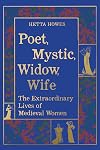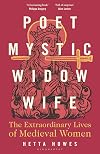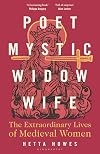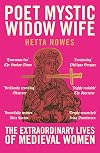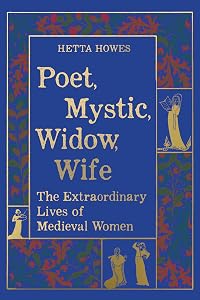
Poet, Mystic, Widow, Wife: The Extraordinary Lives of Medieval Women
by Hetta Howes
On This Page
Description
"Poet, Mystic, Widow, Wife charts the life and times of four medieval women-Marie de France, a poet; Julian of Norwich, a mystic and anchoress; Christine de Pizan, a widow and court writer; and Margery Kempe, a no-good wife-who all bucked convention and forged their own path. Largely forgotten by modern readers, these women have an astonishing amount to teach us about love, marriage, motherhood, friendship, and earning a living. Through these four writers, Hetta Howes engagingly reveals how show more everyday women lived, survived, and thrived in medieval times. Who did they marry and why? Were they expected to have children? Did they ever have extramarital affairs? Could they earn money and become self-sufficient? How did they make friends? Could they be leaders? What did they think about death-and what about life and their place in it? While in many ways the Middle Ages was a terrible time to be a woman, there were areas of life that were surprisingly progressive. Poet, Mystic, Widow, Wife paints a vibrant portrait of these women, their world, and the ways they speak to us today"-- show lessTags
Recommendations



Member Reviews
The audio book was extremely well read -- excellent pacing, good vocal modulation, just really well done. As book -- I think it's an excellent dissertation on a feminist interpretation of the lives of 4 medieval women authors in their own words. Great depth without losing accessibility, very clear arguments and an intriguing investigation into how things differ between now and then. It's also great at laying down the context for each theme, and giving us the background behind each of these works. Altogether, I enjoyed it.
My quibbles -- honestly, it's a bit dry, but hey, nonfiction. There is a huge focus on Christian religion -- I mean, how could there not be, given the subject matter? But my tolerance for Christianity is at a very low show more ebb currently, so that's a me problem. Also, I've read quite a bit about this subject matter, including studying the Leis of Marie de France, so I didn't feel like I learned a lot here.
My biggest issue is that there are exactly 2 mentions of the cause of the Black Plague in Europe, and on both occasions, the author explicitly says that we now know that the Plague was caused by rats. What now?!? I am baffled how someone who has written such a well researched and thorough work can just drop a major inaccuracy into her text. Yersinia pestis bacteria in *fleas*, my dear. The rats are carriers of fleas, the fleas bite and transmit the bacteria. It would take so little effort to change the wording, and yet the author declines. Sigh, it's a great book, covering so many interesting things, but I'm pretty sure this is the only thing I will remember about it. However, it did cause me to review the excellent history teachers video on the subject, so that's a win for today -- https://youtu.be/rZy6XilXDZQ
....oooh, oooh, fleas on rats, fleas on rats....
Advanced Listening Copy Provided by libro.fm. show less
My quibbles -- honestly, it's a bit dry, but hey, nonfiction. There is a huge focus on Christian religion -- I mean, how could there not be, given the subject matter? But my tolerance for Christianity is at a very low show more ebb currently, so that's a me problem. Also, I've read quite a bit about this subject matter, including studying the Leis of Marie de France, so I didn't feel like I learned a lot here.
My biggest issue is that there are exactly 2 mentions of the cause of the Black Plague in Europe, and on both occasions, the author explicitly says that we now know that the Plague was caused by rats. What now?!? I am baffled how someone who has written such a well researched and thorough work can just drop a major inaccuracy into her text. Yersinia pestis bacteria in *fleas*, my dear. The rats are carriers of fleas, the fleas bite and transmit the bacteria. It would take so little effort to change the wording, and yet the author declines. Sigh, it's a great book, covering so many interesting things, but I'm pretty sure this is the only thing I will remember about it. However, it did cause me to review the excellent history teachers video on the subject, so that's a win for today -- https://youtu.be/rZy6XilXDZQ
....oooh, oooh, fleas on rats, fleas on rats....
Advanced Listening Copy Provided by libro.fm. show less
This examination of the lives and writings of four medieval women was enjoyable, informative, and very well-narrated. While I vaguely remember the names of these women from my very long ago history and literature classes, Hetta Howes re=ignited my interest in learning more about their lives and times. Highly recommended—you won’t regret the time you spend with these women.
I received a complimentary copy of this book. Opinions expressed in this review are completely my own.
I received a complimentary copy of this book. Opinions expressed in this review are completely my own.
men, Christine de Pizan decided she could do better. The Book of the City of Ladies, completed around 1405, was the result, becoming her most famous work. The widowed Christine went on to make a living from her writing, supporting her family as the first professional female author in Europe.
Margery Kempe gave up her duties as a wife and mother in order to devote herself to God and to take pilgrimages both in England and abroad; upon her return she dictated her memoirs, authoring, around 1430, the first surviving English autobiography. One of the people Margery met on her travels was the mystic and anchoress Julian of Norwich, who had locked herself away from the world to concentrate on spiritual matters and write her Revelations of show more Divine Love, a work still widely quoted today (‘all shall be well and all shall be well and all manner of thing shall be well’). And some two centuries before any of these three women were born, the poet Marie de France left her homeland for England, there to compose subversive tales featuring resourceful heroines who were very different from the heroes of the prevailing male-dominated literature.
These women are the titular subjects of Hetta Howes’ lively and enjoyable Poet, Mystic, Widow, Wife: The Extraordinary Lives of Medieval Women, which uses their careers and writings as a springboard for a wide-ranging discussion of women’s lives in the Middle Ages. This is not a simple group biography, but rather an examination, in a series of thematic chapters, of topics such as experiences of childbirth, being a wife, travelling and earning a living, religious life and the power of female friendship. The result is illuminating, although the stylistically jarring conclusion, speculating on hat the four subjects would make of the modern world and listing the many disadvantages women still face, is a disappointing end to a book that otherwise evokes the spirit of the period so well; modern attitudes on what constitutes ‘legitimate rape’ do not tell us much about the Middle Ages.
Read the rest of the review at https://www.historytoday.com/archive/review/poet-mystic-widow-wife-and-gods-own-...
Catherine Hanley’s latest book is 1217: The Battles That Saved England (Osprey, 2024). show less
Margery Kempe gave up her duties as a wife and mother in order to devote herself to God and to take pilgrimages both in England and abroad; upon her return she dictated her memoirs, authoring, around 1430, the first surviving English autobiography. One of the people Margery met on her travels was the mystic and anchoress Julian of Norwich, who had locked herself away from the world to concentrate on spiritual matters and write her Revelations of show more Divine Love, a work still widely quoted today (‘all shall be well and all shall be well and all manner of thing shall be well’). And some two centuries before any of these three women were born, the poet Marie de France left her homeland for England, there to compose subversive tales featuring resourceful heroines who were very different from the heroes of the prevailing male-dominated literature.
These women are the titular subjects of Hetta Howes’ lively and enjoyable Poet, Mystic, Widow, Wife: The Extraordinary Lives of Medieval Women, which uses their careers and writings as a springboard for a wide-ranging discussion of women’s lives in the Middle Ages. This is not a simple group biography, but rather an examination, in a series of thematic chapters, of topics such as experiences of childbirth, being a wife, travelling and earning a living, religious life and the power of female friendship. The result is illuminating, although the stylistically jarring conclusion, speculating on hat the four subjects would make of the modern world and listing the many disadvantages women still face, is a disappointing end to a book that otherwise evokes the spirit of the period so well; modern attitudes on what constitutes ‘legitimate rape’ do not tell us much about the Middle Ages.
Read the rest of the review at https://www.historytoday.com/archive/review/poet-mystic-widow-wife-and-gods-own-...
Catherine Hanley’s latest book is 1217: The Battles That Saved England (Osprey, 2024). show less
Ratings
Members
- Recently Added By
Author Information

1+ Work 117 Members
Common Knowledge
- Original publication date
- 2024
Classifications
- Genres
- Sexuality and Gender Studies, History, Literature Studies and Criticism, Biography & Memoir, Fiction and Literature
- DDC/MDS
- 808.803522 — Literature & rhetoric Literature, rhetoric & criticism Composition Literature Collections > By Theme Humanity
- LCC
- PN682 .W6 .H69 — Language and Literature Literature (General) Literature (General) Literary history By period Medieval (to 1500)
- BISAC
Statistics
- Members
- 119
- Popularity
- 273,710
- Reviews
- 3
- Rating
- (3.40)
- Languages
- English
- Media
- Paper, Audiobook, Ebook
- ISBNs
- 8
- ASINs
- 2