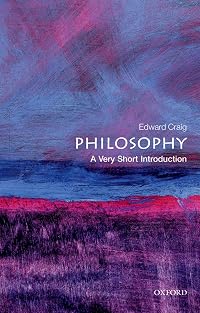
Philosophy: A Very Short Introduction
by Edward Craig
On This Page
Description
How ought we to live? What really exists? How do we know? Edward Craig discusses some of the key questions philosophy engages with. He explores important themes in ethics, knowledge, and the self, alongside a new chapter for this edition on free will, discussing determinism and indeterminism in the context of Descartes and Hegel's work.Tags
Recommendations





Member Reviews
Easily the best of the Very Short Introductions that I've read. The narrator of the audiobook has a warm, professorial tone that matches the text perfectly. It deftly fulfils its stated missions of providing a roadmap to further reading and piquing interest in doing so, something that I couldn't say about, for example the VSI to the Dead Sea Scrolls. I'm now as keen to try Descartes and de Beauvoir in the original as I am to avoid Hegel.
(First published at Blogcritics at http://blogcritics.org/archives/2005/10/02/183815.php)
Philosophy, A Very Short Introduction is an excellent place to start educating oneself about philosophy. It is one of the Oxford University Press's excellent Very Short Introductions.
Craig's approach is to explain the project of philosophy and to examine a few of the problems that philosophy has addressed. His definition of philosophy is delivered in a kind of parable. Imagine when human beings became conscious that sensory data could be interpreted through concrete symbols and ideas. An animal track means an animal has passed, which might be pursued as prey, or avoided. Human beings perceived and visualized events by indirect evidence and ideas, show more and then considered how human beings could act to influence events. Human beings became aware of forces of nature and events beyond human control. Human beings investigated nature, but encountered mysteries, and developed a sense of the supernatural. The project of understanding and explaining nature is science, and the project of recovering from the shock of mystery is philosophy.
Craig maintains that philosophy has progessed, but progress in the discourse of ideas is much slower than progress in science. The answers aren't always verifiable and clearly true, and the ideas don't quickly gain traction in a diverse culture. Historians of science can trace the rise and fall of theories and paradigms fairly clearly. Bad theories are generally discounted except by kooks. Philosophical ideas can be traced too, but the problems tend to persist.
His approach is to examine a few key problems by looking at how a select group of thinkers dealt with issues: Plato's Crito on the ethical and political question of why Socrates, given the chance to escape, allowed the Athenian state to execute him. Hume's On Miracles on evidence and reality. The unknown Buddhist writer of King Milenda's Chariot outlining an idea of the self.
From there, he sketches some of the main themes of philosophy—ethical consequentialism, integrity, political authority, evidence, rationality, the self. He sketches the main groupings of ideas—dualism, materialism, idealism, empiricism, rationalism, skepticism, relativism. After that he looks at a few interesting works. He talks about Descartes's Discourse on Method, Hegel's Introduction to the Philosophy of History, Darwin, and Nietzsche's Genealogy of Morals. The sections on Hume, Darwin and Nietzsche, were good in explaining what they wrote, and why their ideas have been influential. The fact that he includes Darwin is interesting. Darwin wasn't a philosopher, but he had an interesting and influential idea, which many others have used and abused.
At the end, he suggests reading other introductory books: Thomas Nagel's What Does it All Mean, or Simon Blackburn's Think and moving on to Bertrand Russell's History of Western Philosophy.
This book is nicely written, in a good clean style with convincing arguments and good ideas.
Craig's approach to philosophy is that it is important and useful. He takes it beyond the narrow concerns of current professional philosophers who are mainly occupied, with many exceptions of course, in dealing with logic and language. He doesn't claim that philosophy can explain everything. His approach is common sense—he doesn't use philosophy to confuse or speculate or rationalize. Philosophy is a discipline of enquiry and discourse, which tends to take apart speculative systems and to take down thinkers who are too wrapped up in their own ideas.
All of the books in the Oxford University Press's Very Short Introduction series are short—usually not more than 125-150 pages—quality-paperback introductions to challenging and complex topics or writers. The writers are experts in their areas, communicating ideas to intelligent readers. They respect the reader, and they guide the reader to further reading. Some of them—this one for instance—may have a light tone and use some dry humour but they don't pretend to be talking to Bubbas and Bimbos. (The series seems to have started as a reprint of a series called Past Masters, started in the late 1970's. At that stage, they were being printed as regular paperbacks on cheap paper. As far as I can tell, the OUP has reprinted all the titles in the Past Masters series as Very Short Introductions, and built the series. A few of the books are dry, but the later titles have been written with the clear view of avoiding technical jargon). show less
Philosophy, A Very Short Introduction is an excellent place to start educating oneself about philosophy. It is one of the Oxford University Press's excellent Very Short Introductions.
Craig's approach is to explain the project of philosophy and to examine a few of the problems that philosophy has addressed. His definition of philosophy is delivered in a kind of parable. Imagine when human beings became conscious that sensory data could be interpreted through concrete symbols and ideas. An animal track means an animal has passed, which might be pursued as prey, or avoided. Human beings perceived and visualized events by indirect evidence and ideas, show more and then considered how human beings could act to influence events. Human beings became aware of forces of nature and events beyond human control. Human beings investigated nature, but encountered mysteries, and developed a sense of the supernatural. The project of understanding and explaining nature is science, and the project of recovering from the shock of mystery is philosophy.
Craig maintains that philosophy has progessed, but progress in the discourse of ideas is much slower than progress in science. The answers aren't always verifiable and clearly true, and the ideas don't quickly gain traction in a diverse culture. Historians of science can trace the rise and fall of theories and paradigms fairly clearly. Bad theories are generally discounted except by kooks. Philosophical ideas can be traced too, but the problems tend to persist.
His approach is to examine a few key problems by looking at how a select group of thinkers dealt with issues: Plato's Crito on the ethical and political question of why Socrates, given the chance to escape, allowed the Athenian state to execute him. Hume's On Miracles on evidence and reality. The unknown Buddhist writer of King Milenda's Chariot outlining an idea of the self.
From there, he sketches some of the main themes of philosophy—ethical consequentialism, integrity, political authority, evidence, rationality, the self. He sketches the main groupings of ideas—dualism, materialism, idealism, empiricism, rationalism, skepticism, relativism. After that he looks at a few interesting works. He talks about Descartes's Discourse on Method, Hegel's Introduction to the Philosophy of History, Darwin, and Nietzsche's Genealogy of Morals. The sections on Hume, Darwin and Nietzsche, were good in explaining what they wrote, and why their ideas have been influential. The fact that he includes Darwin is interesting. Darwin wasn't a philosopher, but he had an interesting and influential idea, which many others have used and abused.
At the end, he suggests reading other introductory books: Thomas Nagel's What Does it All Mean, or Simon Blackburn's Think and moving on to Bertrand Russell's History of Western Philosophy.
This book is nicely written, in a good clean style with convincing arguments and good ideas.
Craig's approach to philosophy is that it is important and useful. He takes it beyond the narrow concerns of current professional philosophers who are mainly occupied, with many exceptions of course, in dealing with logic and language. He doesn't claim that philosophy can explain everything. His approach is common sense—he doesn't use philosophy to confuse or speculate or rationalize. Philosophy is a discipline of enquiry and discourse, which tends to take apart speculative systems and to take down thinkers who are too wrapped up in their own ideas.
All of the books in the Oxford University Press's Very Short Introduction series are short—usually not more than 125-150 pages—quality-paperback introductions to challenging and complex topics or writers. The writers are experts in their areas, communicating ideas to intelligent readers. They respect the reader, and they guide the reader to further reading. Some of them—this one for instance—may have a light tone and use some dry humour but they don't pretend to be talking to Bubbas and Bimbos. (The series seems to have started as a reprint of a series called Past Masters, started in the late 1970's. At that stage, they were being printed as regular paperbacks on cheap paper. As far as I can tell, the OUP has reprinted all the titles in the Past Masters series as Very Short Introductions, and built the series. A few of the books are dry, but the later titles have been written with the clear view of avoiding technical jargon). show less
This introduction was very short indeed but as the author intended succeeded in slaking my thirst for more philosophy. I appreciated the historical and chronological perspectives. That helped me to organize things in my head better. Also, the definitional approach to certain concepts like duality, materialism, or idealism were also extremely helpful. That gives me a general basis for knowing where my ideas fit in and helps me choose future philosophical works to consume.
Just what it claims to be: an easily readable introduction to some of the major ideas of philosophy. It also provides a pretty good reading list with suggestions for where to go next.
Brief outline of some important philosophical 'moments'. Not really an introduction but how do you even go about introducing philosophy anyway? Written well and clearly, would recommend.
Philosophy: A Very Short Introduction
Edward Craig
The Quest for Wisdom
Edward Craig book in the VSI series delivers what it promises, a glimpse in the main subjects of philosophy. The author strategy is a good one: the diverses questions of philosophy are presented to the reader by importants works of philosophers. In this way, one get acquainted with the philosophic endeavour knowing the philosophers and the questions they debated. The book shows the relations between philosophers and the emphasis they gave to the problems that ocupied its works. Futher readings in philosophy are indicated with a brief explanation about the scope of each book. Must read for the philosophy student and lover!
Edward Craig
The Quest for Wisdom
Edward Craig book in the VSI series delivers what it promises, a glimpse in the main subjects of philosophy. The author strategy is a good one: the diverses questions of philosophy are presented to the reader by importants works of philosophers. In this way, one get acquainted with the philosophic endeavour knowing the philosophers and the questions they debated. The book shows the relations between philosophers and the emphasis they gave to the problems that ocupied its works. Futher readings in philosophy are indicated with a brief explanation about the scope of each book. Must read for the philosophy student and lover!
Alternates sections on the author's list of favourite philosophers and on themes and questions. Mostly concerned with the European tradition with occasional glances at India. Does what it says on the tin, serves as an introduction.
Members
- Recently Added By
Author Information

19+ Works 1,164 Members
Edward Craig is Knightbridge Professor of Philosophy at the University of Cambridge and a Fellow of the British Academy. He is author of The Mind of God and the Works of Man (Clarendon Press, 1987), and General Editor of the ten-volume Routledge Encyclopedia of Philosophy (1998).
Series
Belongs to Publisher Series
Work Relationships
Is contained in
Common Knowledge
- Canonical title
- Philosophy: A Very Short Introduction
- Original title
- Philosophy: A Very Short Introduction
- Original publication date
- 2002
- First words
- Anyone reading this book is to some extent a philosopher already.
- Last words
- (Click to show. Warning: May contain spoilers.)Wishing it were otherwise would be close to wishing that human beings didn't have minds.
- Original language
- English
Classifications
Statistics
- Members
- 646
- Popularity
- 45,082
- Reviews
- 8
- Rating
- (3.64)
- Languages
- 6 — Chinese, Dutch, English, Greek, Spanish, Turkish
- Media
- Paper, Audiobook, Ebook
- ISBNs
- 18
- ASINs
- 5