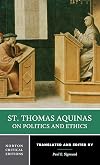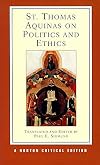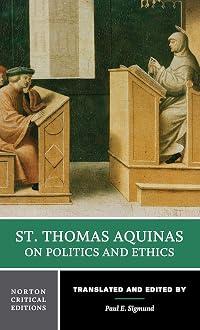
St. Thomas Aquinas on Politics and Ethics (Norton Critical Edition)
by Thomas Aquinas, Paul Eugene Sigmund (Editor), Paul Sigmund (Editor)
On This Page
Description
The selections not only include St. Thomas Aquinas's views on government, law, war, property, and sexual ethics, but also provide the theological, epistemological, and psychological background for his political and ethical thought, including the Five Proofs on the existence of God and Aquinas's theories of knowledge, the soul, the purpose of man, and the order of the universe. Throughout the book, footnotes explain technical terms and historical, biblical, and classical references. show more "Backgrounds and Sources" follows the text, with selections from the writings of Aristotle, St. Augustine, and Dionysius the Areopagite. "Interpretations" traces Aquinas's influence on medieval thought, on Roman Catholicism during the Renaissance, on early modern political thought (Richard Hooker and Francisco Suarez), on nineteenth-and twentieth-century papal social thought, and on contemporary Christian Democratic political parties in Europe and Latin America. The volume concludes with "Contemporary Problems in Thomistic Ethics", which contains eight analyses of the influence of Aquinas's thought on modern debates on war, contraception, and abortion. A Selected Bibliography is included. show lessTags
Recommendations






Member Reviews
Aquinas, Thomas. Thomas Aquinas on Politics and Ethics. Edited and Translated by Paul E. Sigmund. Norton Critical Edition. W. W. Norton, 1987.
This collection contains new translations of selections from Aquinas and commentaries on the Thomist tradition from the Middle Ages to the twentieth century. It is especially useful on the controversies over the meaning of natural law and the importance of Aquinas’s effort to reconcile Aristotle with the platonic tradition of Augustine. It was enlightening to see how the arguments of Aquinas were used by some twentieth-century theologians to support democratic and communitarian views that would have shocked Aquinas and his monarchist contemporaries. The selections from Jacques Maritain were show more especially enlightening. The translations of Aquinas were clear and readable. I will leave it to Latinists to assess their accuracy. I was surprised that there was not more substantial discussion of the principle of double effect and the arguments of abortion and contraception. After thirty years, this book is still a useful and relatively painless way to get to know Aquinas. show less
This collection contains new translations of selections from Aquinas and commentaries on the Thomist tradition from the Middle Ages to the twentieth century. It is especially useful on the controversies over the meaning of natural law and the importance of Aquinas’s effort to reconcile Aristotle with the platonic tradition of Augustine. It was enlightening to see how the arguments of Aquinas were used by some twentieth-century theologians to support democratic and communitarian views that would have shocked Aquinas and his monarchist contemporaries. The selections from Jacques Maritain were show more especially enlightening. The translations of Aquinas were clear and readable. I will leave it to Latinists to assess their accuracy. I was surprised that there was not more substantial discussion of the principle of double effect and the arguments of abortion and contraception. After thirty years, this book is still a useful and relatively painless way to get to know Aquinas. show less
Found the book interesting enough. It was generally thought provoking, although a bit difficult to follow at times. The second half of the book was interesting, since it contained works from various authors and figures to were influenced by Aquinas. Reading the various works was especially interesting, since there were very different conclusions drawn from the theologian's work.
The selections not only include St. Thomas Aquinas's views ongovernment, law, war, property, and sexual ethics, but also provide thetheological, epistemological, and psychological background for hispolitical and ethical thought, including the Five Proofs on theexistence of God and Aquinas's theories of knowledge, the soul, thepurpose of man, and the order of the universe. Throughout the book,footnotes explain technical terms and historical, biblical, andclassical references.
backgrd and sources
By Thomas Aquinas
Norton Critical Editions, 1st edition
Norton Critical Editions, 1st edition
Ratings
Members
- Recently Added By
Author Information

2,204+ Works 28,019 Members
Thomas Aquinas, the most noted philosopher of the Middle Ages, was born near Naples, Italy, to the Count of Aquino and Theodora of Naples. As a young man he determined, in spite of family opposition to enter the new Order of Saint Dominic. He did so in 1244. Thomas Aquinas was a fairly radical Aristotelian. He rejected any form of special show more illumination from God in ordinary intellectual knowledge. He stated that the soul is the form of the body, the body having no form independent of that provided by the soul itself. He held that the intellect was sufficient to abstract the form of a natural object from its sensory representations and thus the intellect was sufficient in itself for natural knowledge without God's special illumination. He rejected the Averroist notion that natural reason might lead individuals correctly to conclusions that would turn out false when one takes revealed doctrine into account. Aquinas wrote more than sixty important works. The Summa Theologica is considered his greatest work. It is the doctrinal foundation for all teachings of the Roman Catholic Church. show less

Paul E. Sigmund is Professor of Politics at Princeton University. His many publications include Liberation Theology at the Crossroads: Democracy or Revolution?
Series
Belongs to Publisher Series
Common Knowledge
- Canonical title
- St. Thomas Aquinas on Politics and Ethics (Norton Critical Edition) (Norton Critical Edition)
- First words
- St. Thomas Aquinas (1225--1274) was the most important and influential philosopher of the Middle Ages.
- Original language
- Latin
- Disambiguation notice
- Do Not Combine: This is a "Norton Critical Edition", it is a unique work with significant added material, including essays and background materials. Do not combine with other editions of the work. Please maintain the p... (show all)hrase "Norton Critical Edition" in the Canonical Title and Series fields.
Classifications
- Genres
- Religion & Spirituality, Nonfiction, Philosophy, General Nonfiction, Politics and Government, History
- DDC/MDS
- 230.2 — Religion Christianity Christianity Pre-reformation and Roman Catholic
- LCC
- BX890 .T62 .E6 — Philosophy, Psychology and Religion Christian Denominations Christian Denominations Catholic Church General collected works
- BISAC
Statistics
- Members
- 628
- Popularity
- 46,572
- Reviews
- 5
- Rating
- (3.65)
- Languages
- English, Latin
- Media
- Paper
- ISBNs
- 2
- ASINs
- 4