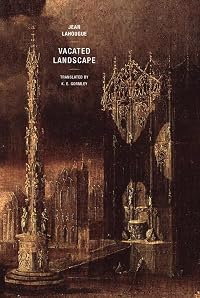
Vacated Landscape
by Jean LAHOUGUE
On This Page
Description
A truly mind-bending novel from an author prized for his experimental fusions of nouveau roman techniques and Oulipian constraintsAn editor at a Parisian publishing house receives a manuscript by someone calling himself Desiderio--a manuscript that bears an eerie resemblance to his own life and to a book he was planning to write on a Renaissance painter of the same name. He decides to use his vacation time to visit the place from which it was sent--the quaint, historical seaside town of show more V.--and believes he has identified the author: one Jean Morelle, himself a tourist, who disappeared the very day the manuscript was mailed. The narrator decides to play amateur detective and track down Morelle, unaware that as he becomes more deeply enmeshed in the mystery, the streets of V. will bend around him like a Möbius strip to form a loop that seems to offer no escape.A portrait of obsession, Vacated Landscape is both ingeniously fractal and exuberantly byzantine. It is the first novel of Jean Lahougue's to be translated into English.Jean Lahougue (born 1945) is a French novelist. A lifelong Agatha Christie fan, he won (and refused) the Prix Médicis in 1980 for Comptine des Height, a puzzle-novel patterned on Ten Little Indians. show lessTags
Recommendations







Member Reviews
The postmodern/experimental detective stori is kind of its own form with a pretty distinct history, stretching from weird fiction and Agatha Christie through Paul Auster and Twin Peaks to the present day. Well, this might be the best entry in this subgenre I've read. Vacated Landscape is a novel that I can best describe as "impressive," as the degree to which it pulls everything off really blows me away.
Firstly, the structure of this book is really interesting, Gormley is spot-on when he describes it as both a mobius strip and a fractal. The themes and narrative style of the novel echo through doublings and scalings-up-and-down. It feels as if you can look at the story from any level and angle and find that interpretation reflected show more infinitely through the rest of the story. Adding to this is Lahougue's excellent prose, which is both evocative and very funny, as our narrator hems and haws and writes incredibly convoluted sentences that read like a parody of Proust. Which, of course, reflect the larger structure of the novel.
Secondly, this book feels like it has a much deeper engagement with themes of reading, writing, and desire than similar works. The protagonist is an editor (of children's books) and this mean that the novel is less about what it means to write and more about what it means to edit, to seek to perfect a narrative, and so on. So many of the doublings and reflections in this book are through varying levels of incompleteness - such as two identical houses, one of which is ruined, or miniature reproductions of paintings displayed in another city. Through this we're given this really ambivalent, complicated meditation on how you can engage with incompleteness and perfection, narrativization and humanity. In fact, one of the more mundane readings of this book is that it's essentially about a man ruining his life because of his inability to think of people as people instead of as characters that point to a higher truth.
That brings me to the thing that really surprised me and is one of the elements that pushes it to five stars: it's a lot less weird about women than most stories of this sort. Very common in postmodernism, especially of the mystery kind, is the child-woman or madonna-whore sort of character. A woman who, in her womanly naivete, her sexuality, her innocence, whatever, is a lead into a truth that the male protagonist with all his cultural baggage can't access by himself. As I said in my review of Book of Illusions: the idea that women are a sort of lever to help men get their lives together. In this book it feels like Lahougue tackles this mindset quite directly. The second half of the book is highly concerned with the protagonist's love affair with an odd woman. However, instead of her helping him access something he can't, it all falls apart at the attempt. The narrator tries to get all the mysteries and fears of the story to coalesce in the identity of his girlfriend and the result is that it ruins their relationship as he becomes more and more obsessed with the answers she represents, instead of the person she is. It's cool and very refreshing.
And, as icing on the cake, the ending is absolutely killer - another thing this genre tends to struggle with. This book blew me away and I really hope more Lahougue makes it to English. show less
Firstly, the structure of this book is really interesting, Gormley is spot-on when he describes it as both a mobius strip and a fractal. The themes and narrative style of the novel echo through doublings and scalings-up-and-down. It feels as if you can look at the story from any level and angle and find that interpretation reflected show more infinitely through the rest of the story. Adding to this is Lahougue's excellent prose, which is both evocative and very funny, as our narrator hems and haws and writes incredibly convoluted sentences that read like a parody of Proust. Which, of course, reflect the larger structure of the novel.
Secondly, this book feels like it has a much deeper engagement with themes of reading, writing, and desire than similar works. The protagonist is an editor (of children's books) and this mean that the novel is less about what it means to write and more about what it means to edit, to seek to perfect a narrative, and so on. So many of the doublings and reflections in this book are through varying levels of incompleteness - such as two identical houses, one of which is ruined, or miniature reproductions of paintings displayed in another city. Through this we're given this really ambivalent, complicated meditation on how you can engage with incompleteness and perfection, narrativization and humanity. In fact, one of the more mundane readings of this book is that it's essentially about a man ruining his life because of his inability to think of people as people instead of as characters that point to a higher truth.
That brings me to the thing that really surprised me and is one of the elements that pushes it to five stars: it's a lot less weird about women than most stories of this sort. Very common in postmodernism, especially of the mystery kind, is the child-woman or madonna-whore sort of character. A woman who, in her womanly naivete, her sexuality, her innocence, whatever, is a lead into a truth that the male protagonist with all his cultural baggage can't access by himself. As I said in my review of Book of Illusions: the idea that women are a sort of lever to help men get their lives together. In this book it feels like Lahougue tackles this mindset quite directly. The second half of the book is highly concerned with the protagonist's love affair with an odd woman. However, instead of her helping him access something he can't, it all falls apart at the attempt. The narrator tries to get all the mysteries and fears of the story to coalesce in the identity of his girlfriend and the result is that it ruins their relationship as he becomes more and more obsessed with the answers she represents, instead of the person she is. It's cool and very refreshing.
And, as icing on the cake, the ending is absolutely killer - another thing this genre tends to struggle with. This book blew me away and I really hope more Lahougue makes it to English. show less
Members
- Recently Added By
Lists

Wakefield Press Ranked
20 works; 1 member

Sandra's Wishlist
57 works; 1 member
Author Information
3 Works 47 Members
Common Knowledge
- Original title
- Non-lieu dans un paysage
- Original publication date
- 1977
Classifications
Statistics
- Members
- 38
- Popularity
- 765,238
- Reviews
- 1
- Rating
- (5.00)
- Languages
- English
- Media
- Paper
- ISBNs
- 1