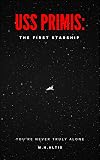
USS Primis: The First Starship
by M.H. Altis
On This Page
Tags
Member Reviews
USS Primis: The First Starship by M. H. Altis
"Two poorly assembled jigsaw puzzles."
Summary: Two half-books come together and attempt to tell a meaningful story that ultimately leaves you wanting a twist that never comes.
Synopsis: The captain of Earth's first extra-solar colonization and terraforming mission assesses his fellow crewmembers and their chances of successfully completing their mission to save humanity from complete destruction. Unsurprisingly, things go badly aboard the USS Primis and, with the mission in danger of utter failure, Captain Davis must decide what sort of victory he is going to claim.
Review: No matter how you approach this book, half of it feels irrelevant. In the first nine chapters, Captain Davis breezily show more evaluates each of his eleven crew members, detailing their personalities and abilities in his personal log, which we somehow have access to. But this lengthy assessment feels pointless because, in the end, only two of the twelve characters have any bearing on the second half of the book. Alternatively, the second half could be seen as the wasted portion, where most of the characters are permanently sidelined, leaving just two to fight for survival and decide how to complete what little remains of the original mission. The second half hinges entirely on the inevitability laid out by the Captain in the first.
This reads like two novellas awkwardly mashed together in an effort to create a single novel. It's as if two different jigsaw puzzles were cut from the same mold — the pieces technically fit, but the final picture is disjointed and unsatisfying.
On one hand, we get an intriguing look at the crew, their motivations, skills, and specialties. They've been chosen to colonize a distant extra-solar planet in a last-ditch effort to save humanity from an Earth that’s on the brink of destruction. Apparently, we sealed our fate by intentionally launching nukes into the sun. Why? It’s unclear and, in the end, irrelevant. The real focus of chapters one through nine isn’t the reason everyone’s desperate to escape Earth but rather the captain's personal take on his crew. It’s key to remember that these aren’t full profiles, just the captain's impressions. So, what we’re really exploring here is the captain’s psychology, not the crew’s.
The disconnect between the two halves of the book becomes obvious in the second half. After hyper-sleep, one of the crew members (no spoilers, but again, it doesn’t really matter) wakes up too early because their sleep pod malfunctions thanks to their own mistake. With centuries of travel still ahead and the realization that they'll be alone in space for the rest of their life, they begin to unravel. Their solution? Wake up another crew member. Instead of owning up to their error, they try to convince the newly awakened Captain that everything is fine, and they’re still on course. Naturally, this fails spectacularly. Once the Captain catches on, a tense game of cat and mouse ensues, with the Captain trying to stop the rogue crew member from sabotaging the entire mission.
Given that part of the game is eliminating the rest of the crew while they’re still in hyper-sleep, it’s puzzling why so much of the first half was spent introducing them. We have no real investment in their fates, except for one, because we’ve only seen them through the captain’s eyes. All we have to go on are his impressions and feelings. Since he’s already told us what he thinks of them, we adopt his perspective by default. As a result, we can't care about the crew any more than Captain Davis does. And Captain Davis definitely does not like all of them.
This leads to another issue: the second half is told from the wrong perspective, at least initially. After hyper-sleep, we’re dropped into the offending crew member’s point of view, even though we spent the entire first half in Captain Davis’. Then, once the Captain wakes up, we switch back to his POV, but from there the narrative flips between the two. The problem is that the second half is trying hard to be suspenseful and tense — it wants to be a thriller. But because the POV shifts freely, we always know what’s happening and what both characters are thinking. If we had stayed in the Captain’s perspective, unaware that the other crew member woke up early and was attempting a ruse, real tension could have developed as the Captain slowly pieces together what’s off. Keeping the reader in the dark would have made the earlier psychological focus more relevant, while heightening the suspense as the inevitable conclusion of USS Primis unfolds.
Ultimately, the conclusion of Primis is disappointing, especially for those familiar with The Twilight Zone TV series. The writing led me to anticipate a big reveal at the end — perhaps the crew was all in a simulation, being evaluated for their roles on an upcoming mission. This could have served as a psychological dry run to identify who would succeed and who should be overlooked due to underlying, undetected issues. It needed a big twist at the end to make reading it worthwhile.
Overall, while M. H. Altis' USS Primis: The First Starship includes a few intriguing elements, its two stages feel mismatched, and it ultimately fails to launch. show less
"Two poorly assembled jigsaw puzzles."
Summary: Two half-books come together and attempt to tell a meaningful story that ultimately leaves you wanting a twist that never comes.
Synopsis: The captain of Earth's first extra-solar colonization and terraforming mission assesses his fellow crewmembers and their chances of successfully completing their mission to save humanity from complete destruction. Unsurprisingly, things go badly aboard the USS Primis and, with the mission in danger of utter failure, Captain Davis must decide what sort of victory he is going to claim.
Review: No matter how you approach this book, half of it feels irrelevant. In the first nine chapters, Captain Davis breezily show more evaluates each of his eleven crew members, detailing their personalities and abilities in his personal log, which we somehow have access to. But this lengthy assessment feels pointless because, in the end, only two of the twelve characters have any bearing on the second half of the book. Alternatively, the second half could be seen as the wasted portion, where most of the characters are permanently sidelined, leaving just two to fight for survival and decide how to complete what little remains of the original mission. The second half hinges entirely on the inevitability laid out by the Captain in the first.
This reads like two novellas awkwardly mashed together in an effort to create a single novel. It's as if two different jigsaw puzzles were cut from the same mold — the pieces technically fit, but the final picture is disjointed and unsatisfying.
On one hand, we get an intriguing look at the crew, their motivations, skills, and specialties. They've been chosen to colonize a distant extra-solar planet in a last-ditch effort to save humanity from an Earth that’s on the brink of destruction. Apparently, we sealed our fate by intentionally launching nukes into the sun. Why? It’s unclear and, in the end, irrelevant. The real focus of chapters one through nine isn’t the reason everyone’s desperate to escape Earth but rather the captain's personal take on his crew. It’s key to remember that these aren’t full profiles, just the captain's impressions. So, what we’re really exploring here is the captain’s psychology, not the crew’s.
The disconnect between the two halves of the book becomes obvious in the second half. After hyper-sleep, one of the crew members (no spoilers, but again, it doesn’t really matter) wakes up too early because their sleep pod malfunctions thanks to their own mistake. With centuries of travel still ahead and the realization that they'll be alone in space for the rest of their life, they begin to unravel. Their solution? Wake up another crew member. Instead of owning up to their error, they try to convince the newly awakened Captain that everything is fine, and they’re still on course. Naturally, this fails spectacularly. Once the Captain catches on, a tense game of cat and mouse ensues, with the Captain trying to stop the rogue crew member from sabotaging the entire mission.
Given that part of the game is eliminating the rest of the crew while they’re still in hyper-sleep, it’s puzzling why so much of the first half was spent introducing them. We have no real investment in their fates, except for one, because we’ve only seen them through the captain’s eyes. All we have to go on are his impressions and feelings. Since he’s already told us what he thinks of them, we adopt his perspective by default. As a result, we can't care about the crew any more than Captain Davis does. And Captain Davis definitely does not like all of them.
This leads to another issue: the second half is told from the wrong perspective, at least initially. After hyper-sleep, we’re dropped into the offending crew member’s point of view, even though we spent the entire first half in Captain Davis’. Then, once the Captain wakes up, we switch back to his POV, but from there the narrative flips between the two. The problem is that the second half is trying hard to be suspenseful and tense — it wants to be a thriller. But because the POV shifts freely, we always know what’s happening and what both characters are thinking. If we had stayed in the Captain’s perspective, unaware that the other crew member woke up early and was attempting a ruse, real tension could have developed as the Captain slowly pieces together what’s off. Keeping the reader in the dark would have made the earlier psychological focus more relevant, while heightening the suspense as the inevitable conclusion of USS Primis unfolds.
Ultimately, the conclusion of Primis is disappointing, especially for those familiar with The Twilight Zone TV series. The writing led me to anticipate a big reveal at the end — perhaps the crew was all in a simulation, being evaluated for their roles on an upcoming mission. This could have served as a psychological dry run to identify who would succeed and who should be overlooked due to underlying, undetected issues. It needed a big twist at the end to make reading it worthwhile.
Overall, while M. H. Altis' USS Primis: The First Starship includes a few intriguing elements, its two stages feel mismatched, and it ultimately fails to launch. show less
 This review was written for LibraryThing Early Reviewers.
Review of eBook
The issues of climate change paled when experimentation and war led to Earth’s sun growing larger and redder . . . and threatening all life on the planet. Scientists are attempting to reverse-engineer the damage, but is it even possible to “fix” the sun? Actions have consequences, and it appears that humanity needs a new home.
And the USS Primis, powered by starlight, carries a small crew and a cargo of invaluable embryos [both plant and human], heading for Kepler-186f, better known among the crew as Nova, a nickname from Terra Nova, meaning new land. It’s a voyage of some five hundred seventy-five year; of course, everyone would be in their individual hypersleep pods.
What could possibly go wrong?
=========
Written show more in the form of a captain’s diary, the first chapters of this narrative provide the background for the galactic journey and the colonization of a new world. Character-driven, told from multiple points of view, and with strong, well-defined world-building, readers will find much to appreciate here.
As readers might expect, the telling of this tale is, at times, as claustrophobic as the starship. A diverse group of characters fill the various necessary positions; all seems well-planned. And, that is the time when things go catastrophically wrong. Intriguing and captivating, readers will find events keep those pages turning as fast as possible.
The only downside here is the unnecessary inclusion of a particularly offensive expletive that adds nothing to the story and is likely to offend many readers; it lowers the rating for this book.
I received a free copy of this book through the LibraryThing Early Readers program and am leaving this review voluntarily. show less
The issues of climate change paled when experimentation and war led to Earth’s sun growing larger and redder . . . and threatening all life on the planet. Scientists are attempting to reverse-engineer the damage, but is it even possible to “fix” the sun? Actions have consequences, and it appears that humanity needs a new home.
And the USS Primis, powered by starlight, carries a small crew and a cargo of invaluable embryos [both plant and human], heading for Kepler-186f, better known among the crew as Nova, a nickname from Terra Nova, meaning new land. It’s a voyage of some five hundred seventy-five year; of course, everyone would be in their individual hypersleep pods.
What could possibly go wrong?
=========
Written show more in the form of a captain’s diary, the first chapters of this narrative provide the background for the galactic journey and the colonization of a new world. Character-driven, told from multiple points of view, and with strong, well-defined world-building, readers will find much to appreciate here.
As readers might expect, the telling of this tale is, at times, as claustrophobic as the starship. A diverse group of characters fill the various necessary positions; all seems well-planned. And, that is the time when things go catastrophically wrong. Intriguing and captivating, readers will find events keep those pages turning as fast as possible.
The only downside here is the unnecessary inclusion of a particularly offensive expletive that adds nothing to the story and is likely to offend many readers; it lowers the rating for this book.
I received a free copy of this book through the LibraryThing Early Readers program and am leaving this review voluntarily. show less
This review was written for LibraryThing Early Reviewers.I enjoyed the premise of USS Primis (even if it held SOME similarities with a semi-recent sci-fi movie) It was smart and tense and I was not disappointed by the ending.
What kept snagging was the captain’s log and inner dialogue. He came off as boneheaded, especially for an astronaut. I don’t expect astronauts to be automatons but I would assume that to get to where they are in life some professionalism would be a result and their log wouldn’t be so informal. It seemed to be trying too hard to be funny. Maybe I’m being too picky but it ruined the flow of an otherwise interesting story for me.
What kept snagging was the captain’s log and inner dialogue. He came off as boneheaded, especially for an astronaut. I don’t expect astronauts to be automatons but I would assume that to get to where they are in life some professionalism would be a result and their log wouldn’t be so informal. It seemed to be trying too hard to be funny. Maybe I’m being too picky but it ruined the flow of an otherwise interesting story for me.
This review was written for LibraryThing Early Reviewers.Written in the first person, the USS Primis story is primarily told in the voice of the starship’s captain, Commander Davis. I would describe the story as a Psycho-SciFi. For those looking for action, there is some toward the end of the book where one of the crew members has a mental breakdown that drives her to kill the crew and the ship’s payload of zygotes intended to populate a new world. Although Commander Davis is targeted in this maniacal attack as well, after being poisoned and near death, he manages to overcome and kill the troubled crew member; and using a poison antidote, manages to save his own life.
Other than that heart-pounding part, most of the book was about Davis’s thoughts about his crew members and past.
The end show more of the book, where Davis bio-engineers the new planet with plant seeds and animal zygotes remaining in his ship’s hole, was rushed and the seeming brevity and ease of those efforts resist plausibility. While interesting, I don’t particularly like this writing style and won’t select a Psycho-SciFi to read again. show less
Other than that heart-pounding part, most of the book was about Davis’s thoughts about his crew members and past.
The end show more of the book, where Davis bio-engineers the new planet with plant seeds and animal zygotes remaining in his ship’s hole, was rushed and the seeming brevity and ease of those efforts resist plausibility. While interesting, I don’t particularly like this writing style and won’t select a Psycho-SciFi to read again. show less
This review was written for LibraryThing Early Reviewers.This was a quick read, and full of action. I felt some of the language was unnecessary. I am not against swearing (and after years in the Army, I am intimately aware of how necessary and redundant swearing can be), but it didn't particularly drive the story to me. I would have liked to see a bit more character development without having to use the language.
That said, it was a fun take on apocalypse, long-term space travel, and the psychology of being alone in space.
That said, it was a fun take on apocalypse, long-term space travel, and the psychology of being alone in space.
This review was written for LibraryThing Early Reviewers.USS Primis: The First Starship is a science fiction tragedy set in a future in which the sun is unstable, and Earth is making frantic attempts to establish colonies on distant Earth-like planets.
Although the premise sounds interesting, the book is flawed beyond redemption. The story’s first half unfolds as a diary-like Captain’s log with spare descriptions of events and little or no dialogue. The initial chapter describes the present situation. Next, the 11 crew members of the USS Primis are described, and their preparation for the mission is summarized briefly. Instead of a massive info dump, the essential elements of this half of the book could have been integrated into the plot. However, almost none of it is relevant. The 11 crew show more members immediately enter hypersleep, and only two survive to play an active role in the rest of the story.
I cannot recommend this book show less
Although the premise sounds interesting, the book is flawed beyond redemption. The story’s first half unfolds as a diary-like Captain’s log with spare descriptions of events and little or no dialogue. The initial chapter describes the present situation. Next, the 11 crew members of the USS Primis are described, and their preparation for the mission is summarized briefly. Instead of a massive info dump, the essential elements of this half of the book could have been integrated into the plot. However, almost none of it is relevant. The 11 crew show more members immediately enter hypersleep, and only two survive to play an active role in the rest of the story.
I cannot recommend this book show less
This review was written for LibraryThing Early Reviewers.Poor. The central premise is poor, and the characters even worse. I quite like hard-SF where the authors consider some of the actual distances involved in crossing space. There are two main proposed versions, generational ships where the crew live and successive generations pass on the knowledge involved, or as here, some form of 'sleep' preservation technology. The former allow for plenty of psychological insight into how humans cope with small populations and restricted spaces. The latter are more technologically innovative and generally assume the crew are more or less the same after waking. This story fails to combine the two, including a (two really because the captain is hardly well balanced) character with mental neurosis into a show more hypersleep scenario, when everything in the build-up indicates such unstable people would be screened out and never given a position of such responsibility.
It's also a strange choice to allow the story to start with diary entries from the captain, but then later to switch to real-time points of view from him and the other awake crew-member. The AI was conspicuously absent despite a big build-up. In fact many of the technological explanations (including the start whereby the author posits it's possible to interfere with the sun's processes by adding human-scale amounts of uranium), are flawed or at least unbelievable.
Additionally this ARC ebook copy was badly formatted with an entire chapter un-accessible. show less
It's also a strange choice to allow the story to start with diary entries from the captain, but then later to switch to real-time points of view from him and the other awake crew-member. The AI was conspicuously absent despite a big build-up. In fact many of the technological explanations (including the start whereby the author posits it's possible to interfere with the sun's processes by adding human-scale amounts of uranium), are flawed or at least unbelievable.
Additionally this ARC ebook copy was badly formatted with an entire chapter un-accessible. show less
This review was written for LibraryThing Early Reviewers.Members
- Recently Added By
Author Information
7 Works 96 Members
Classifications
Statistics
- Members
- 15
- Popularity
- 1,594,671
- Reviews
- 10
- Rating
- (2.92)
- Languages
- English
- Media
- Ebook
- ISBNs
- 1
- ASINs
- 1