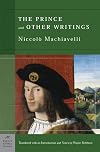
The Prince and Other Writings (Barnes & Noble Classics)
by Niccolò Machiavelli
On This Page
Description
&&LDIV&&R&&LDIV&&R&&LDIV&&R&&LI&&RThe Prince and Other Writings&&L/I&&R, by &&LB&&RNiccolo Machiavelli&&L/B&&R, is part of the&&LI&&RBarnes & Noble Classics&&L/I&&R&&LI&&R &&L/I&&Rseries, which offers quality editions at affordable prices to the student and the general reader, including new scholarship, thoughtful design, and pages of carefully crafted extras. Here are some of the remarkable features of &&LI&&RBarnes & Noble Classics&&L/I&&R: &&LDIV&&R New introductions commissioned from show more today''s top writers and scholars Biographies of the authors Chronologies of contemporary historical, biographical, and cultural events Footnotes and endnotes Selective discussions of imitations, parodies, poems, books, plays, paintings, operas, statuary, and films inspired by the work Comments by other famous authors Study questions to challenge the reader''s viewpoints and expectations Bibliographies for further reading Indices & Glossaries, when appropriate All editions are beautifully designed and are printed to superior specifications; some include illustrations of historical interest. &&LI&&RBarnes & Noble Classics &&L/I&&Rpulls together a constellation of influences--biographical, historical, and literary--to enrich each reader''s understanding of these enduring works.&&L/DIV&&R&&L/DIV&&R&&L/DIV&&R&&LDIV&&R &&L/DIV&&R&&LDIV&&ROne of history''s greatest political philosophers, &&LB&&RNiccolò Machiavelli&&L/B&&R is notorious for his treatise &&LI&&RThe Prince&&L/I&&R, which has become a cornerstone of modern political theory. Written in 1513 and published in 1532, after Machivelli''s death, &&LI&&RThe Prince&&L/I&&R immediately provoked controversy that has continued unabated to this day. &&LBR&&R&&LBR&&RDefining human nature as inherently selfish, Machiavelli proposes that social conflict and violence are natural phenomena that help determine the ablest, most versatile form of government. Asserting that idealism has no place in the political arena, &&LI&&RThe Prince&&L/I&&R primarily addresses a monarch''s difficulties in retaining authority. Considered the first expression of political realism, it has often been accused of advocating a political philosophy in which "the end justifies the means." Indeed the emphasis in &&LI&&RThe Prince&&L/I&&R on practical success, at the expense even of traditional moral values, earned Machiavelli a reputation for ruthlessness, deception, and cruelty. Many scholars contend, however, that the author''s pragmatic views of ethics and politics reflected the realities of his time, as exemplified by the Medici family of Florence. &&LBR&&R&&LBR&&RDebates about Machiavelli''s theories are as lively today as they were 450 years ago, but no one questions the importance of his fundamental contribution to Western political thought. This newly translated edition also includes Machiavelli''s &&LI&&RLetter to Francesco Vettori&&L/I&&R, &&LI&&RThe Life of Castruccio Castracani&&L/I&&R, and excerpts from the &&LI&&RDiscourses on Livy&&L/I&&R.&&LBR&&R&&L/DIV&&R&&LDIV&&R&&LP style="MARGIN: 0in 0in 0pt"&&R&&LSTRONG&&RWayne A. Rebhorn&&L/B&&R&&L/B&&R, Celanese Centennial Professor of English at the University of Texas, has authored numerous studies of Renaissance European literature. His &&LI&&RFoxes and Lions: Machiavelli''s Confidence Men&&L/I&&R won the Howard R. Marraro Prize of the Modern Language Association of America in 1990. &&L/P&&R&&L/DIV&&R&&L/DIV&&R show lessTags
Recommendations









Member Reviews
The book that provided rehab for my politics addiction.
I now watch each election with a cynical eye as people extol the virtues of different candidates with conviction and idealism. I know that these people have never read "The Prince" and if they did, failed to grasp its primary message. After reading this book I am even more proud of the fact that I have never voted for a presidential candidate from either of the two major parties.......and I have voted in every presidential election since 1984.
Politics and government will not change for the better or make the world a better place. Only one thing can bring about true change and improvement and that is the improvement of the human species itself. When human beings cease to suck this show more world will be a pretty fine place.
Stop devolving now! show less
I now watch each election with a cynical eye as people extol the virtues of different candidates with conviction and idealism. I know that these people have never read "The Prince" and if they did, failed to grasp its primary message. After reading this book I am even more proud of the fact that I have never voted for a presidential candidate from either of the two major parties.......and I have voted in every presidential election since 1984.
Politics and government will not change for the better or make the world a better place. Only one thing can bring about true change and improvement and that is the improvement of the human species itself. When human beings cease to suck this show more world will be a pretty fine place.
Stop devolving now! show less
Reading The Prince made me realize that I liked Machiavelli's take on the justness and rightness of war better than the Catholic philosophers. To use a metaphor from a class I took on the Great Books on World Politics, where the Catholics tried to fit a square peg into a round hole, Machiavelli just used the round peg. In other words, rather than using convoluted logic to make a dubious argument as Aquinas insisted upon, Machiavelli used one maxim--uphold the benefit of the people of the state above all else--and drew conclusions from that. Sure, this may require unsavory acts, but at least he is upfront and honest about it. He doesn't cloak it in the way Aquinas and Augustine do.
To write a review of a classic of this type is a fool’s game. The Prince is a discussion of how individuals can keep control of principalities and kingdoms. Its writing has influenced people throughout the ages. And the mere fact that the book has lasted this long is an indication of the power it contains.
But now, to the more casual reader. Not surprisingly, this is not an easy read. The sentences are circuitous and, to be honest, so is some of the logic. There are good points throughout. However, as I read them, I began to wonder about some of the conclusions he was making.
There are business books out there (hang in there with me, this will tie in) where the authors have a premise they want to make. Then they go out and find show more successful (or unsuccessful – depending on the premise) companies which support that premise. To some extent, this is the way it felt with Machiavelli – he has a point he wants to make, and finds the events in history that support it. And, to be honest, some of his conclusions do not, completely, follow from the story he tells.
It is a book that should be read by anyone that is involved in any politics – all types of politics, even office politics – because there are truths within. But the revelations have to be dug for.
The additional material within this volume follows in the same form, if at a somewhat lower success rate. However, the absolute highlight for me – even better than The Prince – was the end of The Life of Castruccio Castracani of Lucca. After describing the aforementioned life, Machiavelli provides some of Castracani’s “retorts and stinging remarks.” These are excellent and should be required reading for all – even required before The Prince. show less
But now, to the more casual reader. Not surprisingly, this is not an easy read. The sentences are circuitous and, to be honest, so is some of the logic. There are good points throughout. However, as I read them, I began to wonder about some of the conclusions he was making.
There are business books out there (hang in there with me, this will tie in) where the authors have a premise they want to make. Then they go out and find show more successful (or unsuccessful – depending on the premise) companies which support that premise. To some extent, this is the way it felt with Machiavelli – he has a point he wants to make, and finds the events in history that support it. And, to be honest, some of his conclusions do not, completely, follow from the story he tells.
It is a book that should be read by anyone that is involved in any politics – all types of politics, even office politics – because there are truths within. But the revelations have to be dug for.
The additional material within this volume follows in the same form, if at a somewhat lower success rate. However, the absolute highlight for me – even better than The Prince – was the end of The Life of Castruccio Castracani of Lucca. After describing the aforementioned life, Machiavelli provides some of Castracani’s “retorts and stinging remarks.” These are excellent and should be required reading for all – even required before The Prince. show less
This was a very interesting read. Machiavelli was certainly an interesting man with some interesting, and somewhat complicated, ideas. I appreciate that this particular translation of The Prince included other related works by Machiavelli, including even some portions of his Discourses on Livy. The translation was also spectacular and I especially appreciate that the translator pointed out in the text each time that Machiavelli used the Italian word "virtu" or a related word, a word that is very important in Machiavelli's lexicon and has great implications for his philosophy. The introduction and notes at the end of each chapter were also excellent resources for further information about references that Machiavelli makes to events and show more people in his own life as well as throughout European history. The Prince is an interesting work all on its own, a foundational work for modern political philosophy, but this particular version made it much more accessible and for that I am very grateful! show less
Excellent introduction to this figure so important to the development of the state and politics. There is a very good biographical sketch of Michiavelli that places him in the historical and geographical context of the time, begins with a chronology, has maps, then selections of his writings. He lived a full life in difficult times.
The best way to manipulate a group of people. Very readable translation. GMA's bible in controlling the Filipino masses.
rec by oldest son - he has studied this - thank you Michael - would never have thought to read this
Members
- Recently Added By
Author Information

450+ Works 43,022 Members
Niccolo Machiavelli was born on May 3, 1469 in Florence, Italy. He was a political philosopher, statesman, and court advisor. Starting out as a clerk, he quickly rose in the ranks because he understood balance of power issues involved in many of his diplomatic missions. His political pursuits quickly ended after he was imprisoned by the Medici show more family. He is best known for The Prince, his guide to power attainment and cutthroat leadership. He also wrote poetry and plays, including a comedy named Mandragola. He died on June 21, 1527 at the age of 58. (Bowker Author Biography) show less
Common Knowledge
- Original language
- Italian
Classifications
Statistics
- Members
- 947
- Popularity
- 28,020
- Reviews
- 7
- Rating
- (3.71)
- Languages
- English
- Media
- Paper
- ISBNs
- 1
- ASINs
- 1