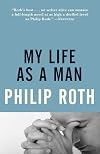
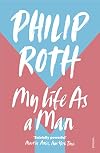
My Life as a Man
by Philip Roth
On This Page
Description
A fiction-within-a-fiction, a labyrinthine edifice of funny, mournful, and harrowing meditations on the fatal impasse between a man and a woman, My Life as a Man is Roth's most blistering novel. At its heart lies the marriage of Peter and Maureen Tarnopol, a gifted young writer and the woman who wants to be his muse but who instead is his nemesis. Their union is based on fraud and shored up by moral blackmail, but it is so perversely durable that, long after Maureen's death, Peter is still show more trying--and failing--to write his way free of it. Out of desperate inventions and cauterizing truths, acts of weakness, tenderheartedness, and shocking cruelty, Philip Roth creates a work worthy of Strindberg--a fierce tragedy of sexual need and blindness. show lessTags
Recommendations




















Member Reviews
Because Peter Tarnopol (self-destructive novelist who, having won the Prix de Rome for a first novel whose high seriousness cemented him as a writer of the self-serious fifties, is desperately attempting to drag himself into the sixties with a new novel built upon the sordid details of his destructive marriage to a manipulative, soul-eating sociopath) and Nate Zuckerman, his fictional alter ego (or rather alter egos, two Zuckermans, each with a slightly different personal history, protagonists respectively of the two abortive short stories by Tarnopol that begin this novel)--because both of them share the same distinctive narrative voice, characterized by paragraphs of long periodic sentences (with parenthetical asides) alternating, show more here and there, with a blunt declarative sentence with the word "fuck" or "cunt" in it--and because this narrative voice is also the voice of every single other Roth narrator, from Portnoy to the "Philip Roth" of Operation Shylock--because, that is to say, every Roth novel is written in sentences more or less just like this one except written with more verve since I am no Philip Roth and whatever one thinks of him the guy can write--since all his narrators sound exactly alike, the metafictional conceit of My Life as a Man feels pretty much like the red herring it is.
Here Roth fictionalizes the history of his relationship with his first wife, Margaret Martinson (who married Roth in 1959, separated from him in 1963, and then, it would seem, dragged him through the purgatory of early 1960s divorce law until she died in a car crash in 1968) ostensibly to demonstrate the slipperiness and relativity of "truth," not, mind you, by narrating part of the story through the eyes of a woman whom Roth/Tarnopol/Zuckerman depicts as a demonic and possessive lunatic, but to tell the events three times, varying details of plot (his father is a Dale Carnegie-reading shoe store owner or else a bookkeeper; his brother a lapsed musician or else a human rights activist; his sister married to a couple of stock Italian stereotypes or else a Lincolnesque land developer; his "other woman" is a neurotic pill-popping heiress or else the daughter of the Zipper King) but in every case from the perspective of the wounded man, in more or less the same angry, ranting style.
Here are three versions of reality, Roth says, with a wink, and in each of them, my first wife was a monstrous, deranged succubus.
A classic case of he said, he said, he said.
The metafictional structure, then, comes off as a smokescreen, masking a sustained attempt to settle one's scores with a woman who is no longer around to defend herself. And even supposing Roth/Tarnopol/Zuckerman's crucifixion of Margaret/Maureen/Lydia is fully merited by her, the cross to which he nails her serves as a ladder to sweeping assertions about women and men in general:
How little chance that coy qualification has, not only against the sweeping and damning generalization it qualifies, but against the meaning inherent in the novel's form, which gives three versions of reality, always from the man's perspective. The phrase that comes to mind is not "unreliable narrator" but "plausible deniability."
However strangely compelling and occasionally very funny the resulting novel may be (at least I found it so, from time to time and despite myself, though some readers may well be repelled by the unremitting intensity of rage) it is also an unpleasant one. show less
Here Roth fictionalizes the history of his relationship with his first wife, Margaret Martinson (who married Roth in 1959, separated from him in 1963, and then, it would seem, dragged him through the purgatory of early 1960s divorce law until she died in a car crash in 1968) ostensibly to demonstrate the slipperiness and relativity of "truth," not, mind you, by narrating part of the story through the eyes of a woman whom Roth/Tarnopol/Zuckerman depicts as a demonic and possessive lunatic, but to tell the events three times, varying details of plot (his father is a Dale Carnegie-reading shoe store owner or else a bookkeeper; his brother a lapsed musician or else a human rights activist; his sister married to a couple of stock Italian stereotypes or else a Lincolnesque land developer; his "other woman" is a neurotic pill-popping heiress or else the daughter of the Zipper King) but in every case from the perspective of the wounded man, in more or less the same angry, ranting style.
Here are three versions of reality, Roth says, with a wink, and in each of them, my first wife was a monstrous, deranged succubus.
A classic case of he said, he said, he said.
The metafictional structure, then, comes off as a smokescreen, masking a sustained attempt to settle one's scores with a woman who is no longer around to defend herself. And even supposing Roth/Tarnopol/Zuckerman's crucifixion of Margaret/Maureen/Lydia is fully merited by her, the cross to which he nails her serves as a ladder to sweeping assertions about women and men in general:
Now I realize that it is possible to dismiss these generalizations as a manifestation of my bitterness and cynicism [this is Tarnopol, by the way, but as I have suggested above, what difference does it make?]...Well, I grant that I do not find myself feeling very 'typical' at this moment, nor am I telling this story in order to argue that my life is representative of anything; nonetheless, I am naturally interested in looking around to see how much of my experience with women has been special to me and--if you must have it that way--my pathology, and how much is symptomatic of a more extensive social malaise. And looking around, I conclude this: in Maureen and Susan I came in contact with two of the more virulent strains of a virus to which only a few women among us are immune.
Outwardly, of course, Maureen and Susan couldn't have been more dissimilar, not could either have had a stronger antipathy for the 'type' she took the other to be. However, what drew them together as women--which is to say, what drew me to them, for that is the subject here--was that in her own extreme and vivid way, each of these antipathetic originals demonstrated that sense of defenselessness and vulnerability that has come to be a mark of their sex and is often at the core of their relations with men. (172-173)
How little chance that coy qualification has, not only against the sweeping and damning generalization it qualifies, but against the meaning inherent in the novel's form, which gives three versions of reality, always from the man's perspective. The phrase that comes to mind is not "unreliable narrator" but "plausible deniability."
However strangely compelling and occasionally very funny the resulting novel may be (at least I found it so, from time to time and despite myself, though some readers may well be repelled by the unremitting intensity of rage) it is also an unpleasant one. show less
I don't know off hand how many Roth books I've read now, but I suspect it's easily in the two digits. I've also read more essays, reviews and entire books of criticism of Roth than any sane person should. A common criticism of his work is that he portrays women poorly, that he is in fact a misogynist.
Maybe it's because I didn't graduate from college and was therefore able to avoid any sort of Gender Studies class, but I never really had a problem with his portrayal of women. He typically has two extreme versions of women in his novels.
Woman 1 : Simple, easy to get along with. There to please. Lacking any sort of personality or sense of self.
Woman 2 : Bold, articulate, straight forward. Demanding and challenging.
In most of his stories, show more his protagonist will at some point have to decide between these two types of women. They always struggle to choose and the outcome is never the same. While I have considered that it would be nice if he'd occasionally write about a more balanced woman, I don't think that every book I read has to incorporate every type of person ever, so I mostly scoff and roll my eyes at the more feminist criticisms of his work.
Then, I read this book.
Stop the presses, it's true : Philip Roth hates women. Knowing as much as I do about his background, it is clear to me that this book was a direct attack on his first wife, who died well before the book was written. This novel is the story of their relationship, their downfall and her eventual death. It reads as a bitter, scathing, one-sided and completely unfair assessment of their relationship. The woman is a crazy person, he is perfect. All of their problems were her fault.
It was gossipy, hostile and downright unpleasant to read. I will not be reading this again and I'm hoping to soon forget it.
That said, the prose was beautiful. He wrote some interesting tidbits about Chicago and the first 1/4 of the book, before he got nasty, was intriguing enough.
In summation : Uh, don't read this unless you really, really hate women. show less
Maybe it's because I didn't graduate from college and was therefore able to avoid any sort of Gender Studies class, but I never really had a problem with his portrayal of women. He typically has two extreme versions of women in his novels.
Woman 1 : Simple, easy to get along with. There to please. Lacking any sort of personality or sense of self.
Woman 2 : Bold, articulate, straight forward. Demanding and challenging.
In most of his stories, show more his protagonist will at some point have to decide between these two types of women. They always struggle to choose and the outcome is never the same. While I have considered that it would be nice if he'd occasionally write about a more balanced woman, I don't think that every book I read has to incorporate every type of person ever, so I mostly scoff and roll my eyes at the more feminist criticisms of his work.
Then, I read this book.
Stop the presses, it's true : Philip Roth hates women. Knowing as much as I do about his background, it is clear to me that this book was a direct attack on his first wife, who died well before the book was written. This novel is the story of their relationship, their downfall and her eventual death. It reads as a bitter, scathing, one-sided and completely unfair assessment of their relationship. The woman is a crazy person, he is perfect. All of their problems were her fault.
It was gossipy, hostile and downright unpleasant to read. I will not be reading this again and I'm hoping to soon forget it.
That said, the prose was beautiful. He wrote some interesting tidbits about Chicago and the first 1/4 of the book, before he got nasty, was intriguing enough.
In summation : Uh, don't read this unless you really, really hate women. show less
this was my first roth, and probably not the best choice for starting, so i'll persevere. obviously his womanhatred is plain to see but when he stops beating that dead horse and does actual satire he is VERY funny. and when you get through it all you're rewarded with some really satisfying exploration of the literary form, the capacity of the novel, the unreliable narrator. but christ. exhausting
The first two stories of this book are about the early career of a long-running Roth character, the novelist Nathan Zuckerman. Things get a little skewed when Book II introduces Peter Tarnopol, Roth's fictional author of the Zuckerman stories. The two Zuckerman stories are referred to in the Tarnopol narrative, which is primarily about his failed romantic relationships, particularly a failed marriage to a poisonous psycho who constantly blitzkriegs his life attempting to get him to return to her. Well-written, but Tarnopol (and Zuckerman) become tedious rather quickly with their self-destructive flailing attempts to find emotional freedom and happiness. It would be interesting to know how much of this is autobiographical. A good deal, I show more imagine. show less
Un po' indispettito dalla cronologia delle traduzioni (tali per cui mi trovo a leggere ora la prima apparizione di Zuckerman dopo che ne ho gia' letta l'ultima) non posso tuttavia che scivolare lietamente tra questi dialoghi e questa New York cosi' cinematografica - almeno, nella mia immaginazione.
Non c'e' trama da salvare; non rimango piacevolmente stupito dagli intrecci dei tre racconti: dal meta-intreccio tra i tre racconti invece si'. Una bella capacita': ma d'altronde, lo si sapeva gia'.
Altro tassello dell'opera omnia di Roth, da accostare agli altri, con sempre sommo piacere.
Non c'e' trama da salvare; non rimango piacevolmente stupito dagli intrecci dei tre racconti: dal meta-intreccio tra i tre racconti invece si'. Una bella capacita': ma d'altronde, lo si sapeva gia'.
Altro tassello dell'opera omnia di Roth, da accostare agli altri, con sempre sommo piacere.
A little too over the top for me. The meta-fiction works well, but I kept thinking to myself, "Wow, each Philip Roth in this book really hates women."
Members
- Recently Added By
Published Reviews
ThingScore 50
Never in our history have Americans been so driven to expose themselves; in our recent revaluation of all values, privacy has been one of the big losers.
added by bergs47
This then, baldly and barely basted together, is Roth's very own kind of Jewish intellectual slapshtick, worked and reworked from earlier sources and all going back to that primal motherlode of neurosis which has led him through other areas of "erotic anthropology" to further difficulties entailing either making it or letting go. However familiar or strenuous, there is that bravura and this is show more the funniest book he's written since Portnoy. So Nu, "Let's begin. show less
added by Richardrobert
Lists

Harold Bloom - The Western Canon: D. The Chaotic Age
833 works; 24 members

National Book Award Finalists - Fiction
377 works; 12 members
Author Information

114+ Works 74,554 Members
Philip Milton Roth was born in Newark, New Jersey on March 19, 1933. He attended Rutgers University for one year before transferring to Bucknell University where he completed a B.A. in English with highest honors in 1954. He received an M.A. from the University of Chicago in 1955. His first book, Goodbye, Columbus, received the National Book Award show more in 1960. His other books include Letting Go, When She Was Good, Portnoy's Complaint, My Life as a Man, The Ghostwriter, Zuckerman Unbound, I Married a Communist, The Plot Against America, The Facts, The Anatomy Lesson, Exit Ghost, Deception, Nemesis, Everyman, Indignation, and The Humbling. He won the National Book Critic Circle Awards in 1987 for his novel The Counterlife and in 1992 for his memoir Patrimony: A True Story. He won the PEN/Faulkner Award for Fiction in 1993 for Operation Shylock: A Confession and in 2001 for The Human Stain, the National Book Award in 1995 for Sabbath's Theater, and the Pulitzer Prize in 1998 for American Pastoral. He stopped writing in 2010. He died from congestive heart failure on May 22, 2018 at the age of 85. (Bowker Author Biography) show less
Some Editions
Awards and Honors
Awards
Notable Lists
Series
Belongs to Publisher Series
Work Relationships
Common Knowledge
- Canonical title
- My Life as a Man
- Original title
- My life as a man
- Original publication date
- 1974
- People/Characters
- Peter Tarnopol; Maureen Tarnopol; Nathan Zuckerman; Sharon Shatzky; Dr. Spielvogel
- Dedication
- To Aaron Asher and Jason Epstein
- First words
- First, foremost, the puppyish, protected upbringing above his father's shoe store in Camden.
- Last words
- (Click to show. Warning: May contain spoilers.)This me who is me being me and none other!
- Blurbers
- Dickstein, Morris; Wood, Michael
- Original language*
- Engels
*Some information comes from Common Knowledge in other languages. Click "Edit" for more information.
Classifications
Statistics
- Members
- 826
- Popularity
- 33,174
- Reviews
- 8
- Rating
- (3.66)
- Languages
- 11 — Danish, Dutch, English, Finnish, German, Greek, Italian, Norwegian (Bokmål), Russian, Spanish, Swedish
- Media
- Paper, Audiobook, Ebook
- ISBNs
- 43
- ASINs
- 17