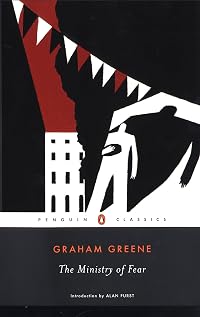
The Ministry of Fear
by Graham Greene 
On This Page
Description
In London during the Blitz, an amnesiac must outwit a twisted Nazi plot in this "master thriller" of espionage, murder, and deception (Time). On a peaceful Sunday afternoon, Arthur Rowe comes upon a charity fete in the gardens of a Cambridgeshire vicarage where he wins a game of chance. If only this were an ordinary day. Britain is under threat by Germany, and the air raid sirens that bring the bazaar to a halt expose Rowe as no ordinary man. Recently released from a psychiatric prison for show more the mercy killing of his wife, he is burdened by guilt, and now, in possession of a seemingly innocuous prize, on the run from a nest of Nazi spies who want him dead. Pursued on a dark odyssey through the bombed-out streets of London, he becomes enmeshed in a tangle of secrets that reach into the dark recesses of his own forgotten past. And there isn't a soul he can trust, not even himself. Because Arthur Rowe doesn't even know who he really is. show lessTags
Recommendations
















Member Recommendations

Member Reviews
"Don't tell me the past. Tell me the future."
I will never look at a cake the same way again.
Winning a cake at a little street fair. Such a simple thing that gets our story rolling, sending our protagonist on a dangerous adventure that he certainly doesn't consciously want, but surely needs if he is to learn who he is in the world, and how he fits in it.
Greene places us in WWII Britain during the Blitz. We are there, without a doubt. Perhaps it is so real because Greene was there, writing this novel as the bombs fell around him. Or, it may be because Greene's prose, as a rule, is just so tight and sharp. Probably both.
Arthur Rowe is such a superb character--real in his faults and emotions, and ignorant of his own latent heroism. The show more dialogue is crisp and perfect. The descriptions are precise. The writing is economical, and so much so, you wonder after finishing the novel how you can know so much, and feel as if you've lived it yourself. Such a master of story-telling in only 221 pages.
"One can't love humanity. One can only love people."
"It occurred to him that perhaps after all one could atone even to the dead if one suffered for the living enough." show less
I will never look at a cake the same way again.
Winning a cake at a little street fair. Such a simple thing that gets our story rolling, sending our protagonist on a dangerous adventure that he certainly doesn't consciously want, but surely needs if he is to learn who he is in the world, and how he fits in it.
Greene places us in WWII Britain during the Blitz. We are there, without a doubt. Perhaps it is so real because Greene was there, writing this novel as the bombs fell around him. Or, it may be because Greene's prose, as a rule, is just so tight and sharp. Probably both.
Arthur Rowe is such a superb character--real in his faults and emotions, and ignorant of his own latent heroism. The show more dialogue is crisp and perfect. The descriptions are precise. The writing is economical, and so much so, you wonder after finishing the novel how you can know so much, and feel as if you've lived it yourself. Such a master of story-telling in only 221 pages.
"One can't love humanity. One can only love people."
"It occurred to him that perhaps after all one could atone even to the dead if one suffered for the living enough." show less
Another effective spy/crime/psychological thriller from Graham Greene. This one is set during the blitz in London, and again the insights into the historical period would pretty much make the book worth reading even if it weren't so well written. The most interesting thing about the book is the protagonist. What makes him interesting? He's a wife-murderer, for a start (he killed her out of pity for a debilitating disease). After spending some time in an asylum, he's back out on the street when a chance encounter trips him up in a ring of spies/traitors who are trying to smuggle incriminating pictures out of England. Before long he's back in an asylum, this time with amnesia. The prose is easy to read, and the plot is well constructed. show more Greene throws in a couple of nice surprises (this is one of those books where neither people nor things are what they initially seem). The dream sequences are particularly impressive. The most unconvincing aspect of the book was again the romance between a young woman and a much older man. Almost as if he were writing for Hollywood, for the next young starlet to be cast against a mature leading man. show less
Summary: Just released from a psychiatric hospital for the mercy killing of his wife, Arthur Rowe inadvertently gets caught up in a twisty espionage plot.
It is 1943, the middle of World War 2 in London, with nightly bombing raids and no one knowing if they will live to the next morning. Arthur Rowe lives quietly in a flat, reading and re-reading The Old Curiosity Shop. He’s been exempted from the war effort because he was recently released from a psychiatric facility where he had served a sentence of the mercy killing of his wife.
Inadvertently, he is caught up in an espionage affair, surviving poisoning, escaping another murder charge only to survive a bomb blast when a case, supposedly of books that he is carrying to a hotel show more rendezvous explodes. He loses his memory, narrowly escapes a sinister psychiatrist, and joins the effort to hunt down the espionage mastermind, the brother of a woman he has fallen in love with, Anna Hilfe. I’ve seen plenty of plot movement and narrow escapes in other Greene novels, but nothing like the madcap adventures of this novel, reminiscent more of G. K. Chesterton’s The Man Who Was Thursday than anything else I’ve read by Greene.
It begins at a charity fete where Rowe visits a fortune teller who mistakes him for one of the conspirators, that enables him to win a cake in which a role of microfilm has been hidden. He is poisoned, but survives, when he will not give up the cake. After working with a detective, he visits the fortune teller again, and when the lights go out, a man is murdered with a knife carried by Rowe. Knowing he could be charged with murder, he flees, ends up carrying a case of what he thinks are books to a hotel for a man he met at a book seller.
The case explodes, he survives but with the loss of his memory, recovering in a bucolic country psychiatric facility (again!) headed by a soothing but sinister doctor up to no good. He’s visited by Anna Hilfe, who works at the charity that ran the fete, who he’d met earlier and encountered just before the suitcase bomb exploded. He comes to love her, even though he does not remember the prior connection, nor the ways her brother Willi is involved in the espionage plot, ways that become clearer as memory returns and he joins the effort to uncover the ring and retrieve a crucial microfilm.
“The Ministry of Fear” formally is an espionage ring, but becomes more in Greene’s plot. It is the dull reality of the nightly existence of Londeners. For Rowe, it is the fear of being found guilty of a murder he didn’t commit while struggling to justify the one he did. Fear and distrust taints love as both Rowe and Anna know things of the other and of themselves that they dare not reveal. With the catastrophic losses of war and the gray world of espionage, one senses people anxiously clinging to illusions of normalcy in a world gone wrong, and living off balance as a result. It may well be Greene’s snapshot of his times–and a parable for our own. show less
It is 1943, the middle of World War 2 in London, with nightly bombing raids and no one knowing if they will live to the next morning. Arthur Rowe lives quietly in a flat, reading and re-reading The Old Curiosity Shop. He’s been exempted from the war effort because he was recently released from a psychiatric facility where he had served a sentence of the mercy killing of his wife.
Inadvertently, he is caught up in an espionage affair, surviving poisoning, escaping another murder charge only to survive a bomb blast when a case, supposedly of books that he is carrying to a hotel show more rendezvous explodes. He loses his memory, narrowly escapes a sinister psychiatrist, and joins the effort to hunt down the espionage mastermind, the brother of a woman he has fallen in love with, Anna Hilfe. I’ve seen plenty of plot movement and narrow escapes in other Greene novels, but nothing like the madcap adventures of this novel, reminiscent more of G. K. Chesterton’s The Man Who Was Thursday than anything else I’ve read by Greene.
It begins at a charity fete where Rowe visits a fortune teller who mistakes him for one of the conspirators, that enables him to win a cake in which a role of microfilm has been hidden. He is poisoned, but survives, when he will not give up the cake. After working with a detective, he visits the fortune teller again, and when the lights go out, a man is murdered with a knife carried by Rowe. Knowing he could be charged with murder, he flees, ends up carrying a case of what he thinks are books to a hotel for a man he met at a book seller.
The case explodes, he survives but with the loss of his memory, recovering in a bucolic country psychiatric facility (again!) headed by a soothing but sinister doctor up to no good. He’s visited by Anna Hilfe, who works at the charity that ran the fete, who he’d met earlier and encountered just before the suitcase bomb exploded. He comes to love her, even though he does not remember the prior connection, nor the ways her brother Willi is involved in the espionage plot, ways that become clearer as memory returns and he joins the effort to uncover the ring and retrieve a crucial microfilm.
“The Ministry of Fear” formally is an espionage ring, but becomes more in Greene’s plot. It is the dull reality of the nightly existence of Londeners. For Rowe, it is the fear of being found guilty of a murder he didn’t commit while struggling to justify the one he did. Fear and distrust taints love as both Rowe and Anna know things of the other and of themselves that they dare not reveal. With the catastrophic losses of war and the gray world of espionage, one senses people anxiously clinging to illusions of normalcy in a world gone wrong, and living off balance as a result. It may well be Greene’s snapshot of his times–and a parable for our own. show less
I saw the film version of this a few weeks ago. It was not a bad film, but it left me curious about the motivation of one of the baddies, so I decided to read the book. I’m glad I did. I tried to read a Graham Greene novel many years ago and bailed on it, so now I was surprised at how much I enjoyed this. The writing is crisp, and the plot takes more interesting turns than the film could allow itself. Beyond that, the book explores more deeply the inner life of the main character, Arthur Rowe, as well as the consequences of his main flaw, pity (“the worst passion of all,” page 184). The result is that what seems on the surface merely a (well-concocted) spy thriller has more to do with moral weakness, guilt, and the close alliance show more of falsehood, fear, and love.
One doesn’t have to have read any Greene to know that these are recurrent themes for him, a lapsed Catholic. What I particularly savored in this book was that half-way through, Arthur loses memory of his entire adult life in an explosion, so he reenters the world as a middle-aged man with an adolescent’s idealism and sense of adventure. Inevitably, he ages quickly. As he does, he becomes the person he was before; his character had remained, even though he’d forgotten the incidents that had formed it. And though in both film and book he gets the girl in the end, in the book, it will not be happily ever after, simply the best that can be hoped for in the circumstances. The circumstances being, of course, the human condition. show less
One doesn’t have to have read any Greene to know that these are recurrent themes for him, a lapsed Catholic. What I particularly savored in this book was that half-way through, Arthur loses memory of his entire adult life in an explosion, so he reenters the world as a middle-aged man with an adolescent’s idealism and sense of adventure. Inevitably, he ages quickly. As he does, he becomes the person he was before; his character had remained, even though he’d forgotten the incidents that had formed it. And though in both film and book he gets the girl in the end, in the book, it will not be happily ever after, simply the best that can be hoped for in the circumstances. The circumstances being, of course, the human condition. show less
A kind of dark "Through the Looking Glass" story of one person's experience in World War II London. Greene excels in placing an ordinary character in dramatic, historical circumstances to play out the choices that make up his life.
In this book, it's Arthur Rowe. Rowe steps nostalgically into a church bazaar, visits a fortuneteller, follows a chance mis-identification by the fortuneteller into a winning guess at a cake's weight, and ends up a central figure in international espionage, with the right side and wrong side, guilt and innocence, and even Arthur's own identity all thrown up in the air
It's a good ride through a winding plot, with a twist I'm not used to from Greene -- an involvement of the reader in the novel as a puzzle, show more almost like more modern or postmodern stories such as the movie Memento.
Greene calls this book one of his "entertainments". I thought it was certainly entertaining, as well as another of his explorations of character under personal and historical stress. show less
In this book, it's Arthur Rowe. Rowe steps nostalgically into a church bazaar, visits a fortuneteller, follows a chance mis-identification by the fortuneteller into a winning guess at a cake's weight, and ends up a central figure in international espionage, with the right side and wrong side, guilt and innocence, and even Arthur's own identity all thrown up in the air
It's a good ride through a winding plot, with a twist I'm not used to from Greene -- an involvement of the reader in the novel as a puzzle, show more almost like more modern or postmodern stories such as the movie Memento.
Greene calls this book one of his "entertainments". I thought it was certainly entertaining, as well as another of his explorations of character under personal and historical stress. show less
Arthur Rowe should have left that cake out in the rain, even if it did take such a long time to make it, and the makers probably would not have that recipe again (or at least real eggs to make it with). Attending a village fête during the Blitz, Arthur inadvertently wins a cake that he was not supposed to win, and this ends up putting him on the hit list of a mysterious organization, which hunts him up and down an embattled London. What is this organization, what do they want, and how can they manage to develop contingency plans for every move Arthur makes?
This is one of what Graham Greene refers to as his "entertainments", and according to the introduction in the edition I read, it was his favourite one. It was inspired by reading a show more book by Michael Innes, a mystery author whom Greene actually liked. Most mystery novels of the time were not to Greene's taste because to him they lacked realism: they often contained "carefully documented references to Bradshaw's railway timetables or to the technique of campanology or to the geography -- complete with plan -- of a country house", there were too many suspects and the eventual culprit was usually not of "what used to be called the criminal class." But the Innes book pleased him greatly and led him to think, "If Innes can write a fantastic and funny thriller, then I can too."
Of course, modern readers may be somewhat disbelieving that this is supposed to be funny; Greene himself admits that the underlying scenario "was not after all very funny, though it might have other merits." (It's more of a subtle irony than a "HAHAHA THAT IS HILARIOUS" kind of funny.) What I found extremely amusing was all this fuss over a cake. It lent a touch of the absurd to the proceedings. The story itself was certainly interesting, as I kept reading to find out how Arthur would attempt to dodge the conspiracy and how it would set up another roadblock (what would they think of next?!), but I wouldn't describe it as "funny", at least in the laugh-out-loud sense.
One major strength of Greene's is his writing. He pens exquisite sentences: the chapter entitled "A Load of Books", for example, contains some very good quotes about the magic of literature read when people are children and how experience and age changes our perspective on what we read. Another notable quote describes how one character talks: "It was as if he had come from an old-fashioned family among whom it wasimportant to speak clearly and use the correct words; his care had an effect of charm, not pedantry" and "When he used a colloquialism you could hear the inverted commas drop gently and apologetically around it." Some of the colloquialisms are rather amusing to the modern ear, like saying you'll "hang on to something" or you want to "swop" one thing for another -- I would argue these have become pretty much standard English in all but the most academic of writing. At the very least they are a lot less colloquial than they were in the early 1940s. (It's like when you read older novels and they write 'phone and 'bus, with the apostrophe denoting the removal of "tele" and "omni" from the beginnings of those words -- these days we don't bother.)
Greene also draws on some of his own experiences in this writing, namely in descriptions of the bombing raids (one scene in particular was straight out of his diary) and the character of Mr. Prentice, who was heavily inspired by someone Greene actually knew.
To sum up, this was an enjoyable read but I would perhaps suggest it to someone who has already had a taste of Greene's writing style. He and Deighton are writers I think you have to be in the right mood for: when you want "an entertainment" that also feels somewhat substantial. It's like when you're craving something sweet that you don't feel bad about eating, like homemade oatmeal chocolate chip cookies. If that's the kind of treat you're hankering for, pick this book up. show less
This is one of what Graham Greene refers to as his "entertainments", and according to the introduction in the edition I read, it was his favourite one. It was inspired by reading a show more book by Michael Innes, a mystery author whom Greene actually liked. Most mystery novels of the time were not to Greene's taste because to him they lacked realism: they often contained "carefully documented references to Bradshaw's railway timetables or to the technique of campanology or to the geography -- complete with plan -- of a country house", there were too many suspects and the eventual culprit was usually not of "what used to be called the criminal class." But the Innes book pleased him greatly and led him to think, "If Innes can write a fantastic and funny thriller, then I can too."
Of course, modern readers may be somewhat disbelieving that this is supposed to be funny; Greene himself admits that the underlying scenario "was not after all very funny, though it might have other merits." (It's more of a subtle irony than a "HAHAHA THAT IS HILARIOUS" kind of funny.) What I found extremely amusing was all this fuss over a cake. It lent a touch of the absurd to the proceedings. The story itself was certainly interesting, as I kept reading to find out how Arthur would attempt to dodge the conspiracy and how it would set up another roadblock (what would they think of next?!), but I wouldn't describe it as "funny", at least in the laugh-out-loud sense.
One major strength of Greene's is his writing. He pens exquisite sentences: the chapter entitled "A Load of Books", for example, contains some very good quotes about the magic of literature read when people are children and how experience and age changes our perspective on what we read. Another notable quote describes how one character talks: "It was as if he had come from an old-fashioned family among whom it wasimportant to speak clearly and use the correct words; his care had an effect of charm, not pedantry" and "When he used a colloquialism you could hear the inverted commas drop gently and apologetically around it." Some of the colloquialisms are rather amusing to the modern ear, like saying you'll "hang on to something" or you want to "swop" one thing for another -- I would argue these have become pretty much standard English in all but the most academic of writing. At the very least they are a lot less colloquial than they were in the early 1940s. (It's like when you read older novels and they write 'phone and 'bus, with the apostrophe denoting the removal of "tele" and "omni" from the beginnings of those words -- these days we don't bother.)
Greene also draws on some of his own experiences in this writing, namely in descriptions of the bombing raids (one scene in particular was straight out of his diary) and the character of Mr. Prentice, who was heavily inspired by someone Greene actually knew.
To sum up, this was an enjoyable read but I would perhaps suggest it to someone who has already had a taste of Greene's writing style. He and Deighton are writers I think you have to be in the right mood for: when you want "an entertainment" that also feels somewhat substantial. It's like when you're craving something sweet that you don't feel bad about eating, like homemade oatmeal chocolate chip cookies. If that's the kind of treat you're hankering for, pick this book up. show less
Végtelen hálás vagyok annak, aki feltalálta a Detektívet, Akinek Van Mit Levezekelnie. Ez a típus egy elkövetett bűn emlékét hordozza magában, amit képtelen feldolgozni – így amikor a világ rendbetételén ügyködik, valójában saját morális „aranykorát” akarja visszaállítani. Ez pedig erkölcsi mélységet ad a karakternek. Én pedig szeretem a karaktereket, akiknek erkölcsi mélysége van – izgalmasabbak lesznek tőle. Arthur Rowe betűre megfelel ennek a leírásnak, attól az apróságtól eltekintve, hogy nem detektív. De hát tudjuk, a detektívnek lenni pont olyan, mint focibírónak vagy immunológusnak: ha annak érzed magad, akkor az vagy. Így hát amikor valami különös kémtörténetbe show more keveredik, kapva kap az alkalmon, nekiáll felfejteni az ügyet, hátha addig sem gondol arra, mit tett anno saját feleségével.
Igazán Graham Greene-nek való téma. Mert Greene igen jó író, okos és lendületes. Plasztikusan oda tudja tenni a sztori mögé a hátteret, a második világháborús Londont a maga paranoiáival, meg a lehulló bombákkal. De ami igazán jól megy neki, az a moralizálás. Bár a cselekmény sodró, a lényeg mégiscsak Arthur Rowe belső világa, az, ahogy életét egyfajta börtönként rendezi be, amiben megbüntetheti önmagát. Csakhogy ez sem elég, talán mert amíg a társadalom nem szentesíti az önmagára mért büntetést, addig maga sem tud megbocsátani magának – ez a permanens lelkiismereti válság pedig pont az a téma, amivel az erős katolikus kötődésekkel rendelkező Greene szívesen bíbelődik. A „bűnügyi szál” ebben a kontextusban a felszabadulás lehetőségét hordozza magában, nem csak mert eltereli Rowe figyelmét az önkínzástól, hanem egyfajta egérutat kínál: vagy segít felszámolni egy Angliát veszélyeztető összeesküvést, vagy hősiesen megöleti magát – a morális mérleg nyelve így is, úgy is egyensúlyba kerül. Nincs veszíteni valója.
Nem hibák nélküli regény. A gonoszok inkább tűnnek James Bond-típusfiguráknak, mint egy történelmi valóság részeinek, a romantikus szál pedig enyhén hiteltelen, néha pedig indokolatlanul hozza be a cselekménybe az ideális naplementék csiricsáré színvilágát. De ettől függetlenül kedvvel olvastam – Greene-t amúgy is kedvvel szoktam olvasni. show less
Igazán Graham Greene-nek való téma. Mert Greene igen jó író, okos és lendületes. Plasztikusan oda tudja tenni a sztori mögé a hátteret, a második világháborús Londont a maga paranoiáival, meg a lehulló bombákkal. De ami igazán jól megy neki, az a moralizálás. Bár a cselekmény sodró, a lényeg mégiscsak Arthur Rowe belső világa, az, ahogy életét egyfajta börtönként rendezi be, amiben megbüntetheti önmagát. Csakhogy ez sem elég, talán mert amíg a társadalom nem szentesíti az önmagára mért büntetést, addig maga sem tud megbocsátani magának – ez a permanens lelkiismereti válság pedig pont az a téma, amivel az erős katolikus kötődésekkel rendelkező Greene szívesen bíbelődik. A „bűnügyi szál” ebben a kontextusban a felszabadulás lehetőségét hordozza magában, nem csak mert eltereli Rowe figyelmét az önkínzástól, hanem egyfajta egérutat kínál: vagy segít felszámolni egy Angliát veszélyeztető összeesküvést, vagy hősiesen megöleti magát – a morális mérleg nyelve így is, úgy is egyensúlyba kerül. Nincs veszíteni valója.
Nem hibák nélküli regény. A gonoszok inkább tűnnek James Bond-típusfiguráknak, mint egy történelmi valóság részeinek, a romantikus szál pedig enyhén hiteltelen, néha pedig indokolatlanul hozza be a cselekménybe az ideális naplementék csiricsáré színvilágát. De ettől függetlenül kedvvel olvastam – Greene-t amúgy is kedvvel szoktam olvasni. show less
Members
- Recently Added By
Published Reviews
Few writers can distill drama from a twisted soul with more skill than Mr. Greene; few experts in the field would dare to combine all the elements you will find in "The Ministry of Fear." The novel begins as a case-history in psychiatry, and ends as a spy hunt, complete with roving Heinkels, pukka sahibs, and a pale Austrian beauty who keeps her enigma to the end. Only the Graham Greene fans show more will know how cunningly this English virtuoso endows his lumber-room items with life. "The Ministry of Fear" is top-hole entertainment and then some -- a guaranteed chiller to beat the first Summer heat-wave. show less
added by John_Vaughan
If you’re after brilliant writing and an exciting plot and don’t mind dodgy theology then Graham Greene’s The Ministry of Fear is the book for you.
Greene called his novel an ‘entertainment’ but it is clearly much more than that. Despite creating one or two implausible moments in the plot, Greene draws us into the action from the very first pages and doesn’t let us go. The show more descriptive writing is tremendous and the sense of fear is utterly palpable as Arthur Rowe, the novel’s anti-hero, flees for his life after getting caught up with a Nazi spy ring when attending a fête during the darkest days of the London blitz. show less
Greene called his novel an ‘entertainment’ but it is clearly much more than that. Despite creating one or two implausible moments in the plot, Greene draws us into the action from the very first pages and doesn’t let us go. The show more descriptive writing is tremendous and the sense of fear is utterly palpable as Arthur Rowe, the novel’s anti-hero, flees for his life after getting caught up with a Nazi spy ring when attending a fête during the darkest days of the London blitz. show less
added by John_Vaughan
Lists

The Guardian's 1000 Novels Everyone Must Read
1,005 works; 550 members

Best Spy Fiction
153 works; 102 members

My list of 100 books to read next
100 works; 4 members

Armed Services Editions
150 works; 1 member

Books available on Open Library
171 works; 4 members

THE WAR ROOM
813 works; 24 members

Art Bourgeau's Favorites [Mystery Lovers Companion, 1986]
124 works; 2 members
Author Information

356+ Works 87,436 Members
Born in 1904, Graham Greene was the son of a headmaster and the fourth of six children. Preferring to stay home and read rather than endure the teasing at school that was a by-product of his father's occupation, Greene attempted suicide several times and eventually dropped out of school at the age of 15. His parents sent him to an analyst in show more London who recommended he try writing as therapy. He completed his first novel by the time he graduated from college in 1925. Greene wrote both entertainments and serious novels. Catholicism was a recurring theme in his work, notable examples being The Power and the Glory (1940) and The End of the Affair (1951). Popular suspense novels include: The Heart of the Matter, Our Man in Havana and The Quiet American. Greene was also a world traveler and he used his experiences as the basis for many books. One popular example, Journey Without Maps (1936), was based on a trip through the jungles of Liberia. Greene also wrote and adapted screenplays, including that of the 1949 film, The Third Man, which starred Orson Welles. He died in Vevey, Switzerland in 1991. (Bowker Author Biography) show less
Graham Greene has a Legacy Library. Legacy libraries are the personal libraries of famous readers, entered by LibraryThing members from the Legacy Libraries group.
Some Editions
Awards and Honors
Notable Lists
Series
Belongs to Publisher Series
Work Relationships
Is contained in
Has the adaptation
Has as a student's study guide
Common Knowledge
- Canonical title
- The Ministry of Fear
- Original title
- The Ministry of Fear
- Original publication date
- 1943
- People/Characters
- Arthur Rowe; Mr. Rennit; Anna Hilfe; Willi Hilfe
- Important events
- The Blitz (1940 | 1941)
- Related movies
- Ministry of Fear (1944 | IMDb)
- Epigraph
- 'Have they brought home the haunch?
Charlotte M. Yonge
The Little Duke - First words
- There was something about a fete which drew Arthur Rowe irresistibly, bound him a helpless victim to the distant blare of a band and the knock-knock of wooden balls against coconuts.
- Last words
- (Click to show. Warning: May contain spoilers.)It seemed to him that after all one could exaggerate the value of happiness…
- Original language
- English
Classifications
Statistics
- Members
- 1,859
- Popularity
- 11,599
- Reviews
- 36
- Rating
- (3.69)
- Languages
- 16 — Catalan, Chinese, Czech, Danish, Dutch, English, French, German, Greek, Hungarian, Italian, Polish, Portuguese, Russian, Spanish, Swedish
- Media
- Paper, Audiobook, Ebook
- ISBNs
- 40
- ASINs
- 45