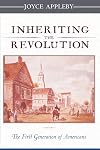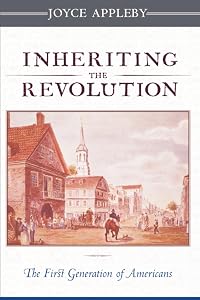
Inheriting the Revolution: The First Generation of Americans
by Joyce Appleby
On This Page
Description
Born after the Revolution, the first generation of Americans inherited a truly new world ́and, with it, the task of working out the terms of Independence. Anyone who started a business, marketed a new invention, ran for office, formed an association, or wrote for publication was helping to fashion the world ́s first liberal society. These are the people we encounter in Inheriting the Revolution, a vibrant tapestry of the lives, callings, decisions, desires, and reflections of those show more Americans who turned the new abstractions of democracy, the nation, and free enterprise into contested realities. Through data gathered on thousands of people, as well as hundreds of memoirs and autobiographies, Joyce Appleby tells myriad intersecting stories of how Americans born between 1776 and 1830 reinvented themselves and their society in politics, economics, reform, religion, and culture. They also had to grapple with the new distinction of free and slave labor, with all its divisive social entailments; the rout of Enlightenment rationality by the warm passions of religious awakening; the explosion of small business opportunities for young people eager to break out of their parents ́ colonial cocoon. Few in the nation escaped the transforming intrusiveness of these changes. Working these experiences into a vivid picture of American cultural renovation, Appleby crafts an extraordinary ́and deeply affecting ́account of how the first generation established its own culture, its own nation, its own identity. The passage of social responsibility from one generation to another is always a fascinating interplay of the inherited and the novel; this book shows how, in the early nineteenth century, the very idea of generations resonated with new meaning in the United States. show lessTags
Recommendations













Member Reviews
The author focuses on a single generation, those who came of age during the 1790-1830 period. Jefferson is her hero and Federalists the enemy, but she acknowledges that Federalists were far more opposed to slavery and protective of Indian rights than Jefferson's Republicans, who were incensed by Northern efforts to block Missouri's admission as a slave state.
The book is heavily anecdotal, based on her reading of some 200 autobiographies written during the period. She covers topics such as enterprise, careers, distinctions, intimate relations and reform, but the theme is the new national identities that emerged, one Northern and the other Southern, during the period. Three primary forces that shaped the Northern identity, economic show more enterprise, political participation and religious revival, also caused a reaction in the South that no less shaped it, but it ways that left it bewildered, defensive and conservative. Readers not already thoroughly conversant with the period will miss any discussion of the emergence of party politics, though she notes the personal vilification and "unchecked vituperation of public controversies" that resulted from the proliferation of new voices and new publications. The elements behind the rise of Jacksonian radical politics is absent, as is any treatment of the economic factors that encouraged the enterprise and careers she celebrates.
More troubling is her misreading of the religious situation during the period. She notes "the religious revivalists successfully challenged the religious hegemony of the Anglican and Congregational churches," but that hegemony was regional, not national to begin with, and neither the Congregational church, challenged at home by Unitarians and in the western territories by Presbyterians, nor the Anglican church, still attempting to recover from its moribund situation following the war, carried the weight she implies. Moreover, the Presbyterians, Baptists and Methodists had been ceded the field; the proselytizing zeal of the Quakers had long passed, the Dutch and German Reformed churches had never been anything by regional, more concerned with language and culture than with creed and salvation. Apart from the wonderfully vivid accounts of the Cane Ridge revival, I read much of the record of revivals as activities or campaigns that were generated by ministers in established churches attempting to attract new members to church rolls depleted by western migration, rather than an unprecedented religious fervor that swept the country. She does note that women were the vast majority of those affected by the revival and reform movements and credits the Second Great Awakening with bringing blacks, free and slave, into the Protestant church, but neglects any discussion of the significant impact of the African Methodist Episcopal church, for example, in building black communities and opportunity. My conclusion: interesting and stimulating, but unreliable in its interpretation of the major forces of the period. show less
The book is heavily anecdotal, based on her reading of some 200 autobiographies written during the period. She covers topics such as enterprise, careers, distinctions, intimate relations and reform, but the theme is the new national identities that emerged, one Northern and the other Southern, during the period. Three primary forces that shaped the Northern identity, economic show more enterprise, political participation and religious revival, also caused a reaction in the South that no less shaped it, but it ways that left it bewildered, defensive and conservative. Readers not already thoroughly conversant with the period will miss any discussion of the emergence of party politics, though she notes the personal vilification and "unchecked vituperation of public controversies" that resulted from the proliferation of new voices and new publications. The elements behind the rise of Jacksonian radical politics is absent, as is any treatment of the economic factors that encouraged the enterprise and careers she celebrates.
More troubling is her misreading of the religious situation during the period. She notes "the religious revivalists successfully challenged the religious hegemony of the Anglican and Congregational churches," but that hegemony was regional, not national to begin with, and neither the Congregational church, challenged at home by Unitarians and in the western territories by Presbyterians, nor the Anglican church, still attempting to recover from its moribund situation following the war, carried the weight she implies. Moreover, the Presbyterians, Baptists and Methodists had been ceded the field; the proselytizing zeal of the Quakers had long passed, the Dutch and German Reformed churches had never been anything by regional, more concerned with language and culture than with creed and salvation. Apart from the wonderfully vivid accounts of the Cane Ridge revival, I read much of the record of revivals as activities or campaigns that were generated by ministers in established churches attempting to attract new members to church rolls depleted by western migration, rather than an unprecedented religious fervor that swept the country. She does note that women were the vast majority of those affected by the revival and reform movements and credits the Second Great Awakening with bringing blacks, free and slave, into the Protestant church, but neglects any discussion of the significant impact of the African Methodist Episcopal church, for example, in building black communities and opportunity. My conclusion: interesting and stimulating, but unreliable in its interpretation of the major forces of the period. show less
Ratings
Members
- Recently Added By
Lists

Best U.S. History Books (1754-1828)
363 works; 18 members
Author Information

38+ Works 2,160 Members
Joyce Oldham Appleby was born in Omaha, Nebraska on April 9, 1929. She graduated from Stanford University in 1950. She worked for the Restaurant Reporter, a trade magazine based in Beverly Hills, and later as a stringer for The Star-News, a local South Pasadena newspaper. She received a Ph.D. from Claremont Graduate University. She taught at San show more Diego State University and at the University of California, Los Angeles. She retired from there in 2001. She wrote several books during her lifetime including Economic Thought and Ideology in 17th Century England, Inheriting the Revolution: The First Generation of Americans, Capitalism and a New Social Order: The Republican Vision of the 1790s, Liberalism and Republicanism in the Historical Imagination, The Relentless Revolution: A History of Capitalism, and Shores of Knowledge: New World Discoveries and the Scientific Imagination. She died from complications of pneumonia on December 23, 2016 at the age of 87. (Bowker Author Biography) show less
Common Knowledge
- Canonical title
- Inheriting the Revolution: The First Generation of Americans
- Blurbers
- Countryman, Edward; Yardley, Jonathan; Middlekauff, Robert
Classifications
Statistics
- Members
- 280
- Popularity
- 115,239
- Reviews
- 1
- Rating
- (3.50)
- Languages
- English
- Media
- Paper, Ebook
- ISBNs
- 3
- ASINs
- 2