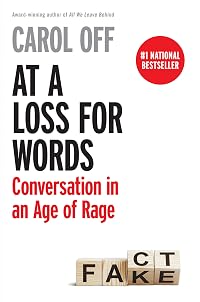
At a Loss for Words: Conversation in the Age of Rage
by Carol Off
On This Page
Description
AN INSTANT #1 NATIONAL BESTSELLER A HILL TIMES BEST BOOK 2024 Award-winning author and broadcast journalist Carol Off digs deep into six words whose meanings have been distorted and weaponized in recent years--including democracy, freedom and truth--and asks whether we can reclaim their value. As co-host of CBC Radio's As It Happens, Carol Off spent a decade and a half talking to people in the news five nights a week. On top of her stellar writing and reporting career, those 25,000 show more interviews have given her a unique vantage point on the crucial subject at the heart of her new book--how, in these polarizing years, words that used to define civil society and social justice are being put to work for a completely different political agenda. Or they are being bleached of their meaning as the values they represent are mocked and distorted. As Off writes, "If our language doesn't have a means to express an idea, then the idea itself is gone--even the range of thought is diminished." And, as she argues, that's a dangerous loss. In six, wide-ranging chapters, Off explores the mutating meanings and the changing political impact of her six chosen words--freedom, democracy, truth, woke, choice and taxes--unpacking the forces, from right and left, that have altered them beyond recognition. She also shows what happens when we lose our shared political vocabulary: we stop being able to hear each other, let alone speak with each other in meaningful ways. This means we stop being able to reckon with the complexity of the crises we face, leaving us prey to conspiracy theories, autocrats and the machinations of greed. At a Loss for Words is both an elegy and a call to arms. show lessTags
Recommendations






Member Recommendations
Member Reviews
I’ve just finished reading At a Loss for Words: Conversations in an Age of Rage by Carol Off. I have a much better understanding now of what far-right parties around the world hope to achieve, and it runs counter to everything I was brought up to believe in by a father who was, I expect, the first in his family to obtain a university degree and a mother who lived her Christian beliefs by helping other people. Carol Off says, “The Canadian system of redistributed wealth for the common good made sense to my father, based on his life experience, and it makes sense to me … What I hope for is that we find ways to renew our commitment to being citizens who contribute, and not serfs who labour and customers who bargain. It’s about show more reconstructing a government that takes care of its people (even those who fail to vote for it) and a political system that’s transparent … Oliver Wendell Holmes Jr. said it best: taxes are the price we pay for civilization. My father was on his team and so am I.”
“We can still avert disaster. We have the ability to listen, to attempt to understand, to vote, to accept people who are not exactly like us into our societies and our circles to care for each other again. But we need to talk to each other, to be able to disagree with people’s opinions without hating them for expressing them.” show less
“We can still avert disaster. We have the ability to listen, to attempt to understand, to vote, to accept people who are not exactly like us into our societies and our circles to care for each other again. But we need to talk to each other, to be able to disagree with people’s opinions without hating them for expressing them.” show less
This book looks at communication in t he political sphere and examines how certain words have been co-opted by one side or the other. These co-opted words sometimes lose virtually any meaning; at other times, their meaning becomes warped or even weaponized. Six words are examined in depth, citing examples from recent political discourse. These words are: freedom, democracy, truth, woke, choice and taxes.
As a long-time journalist, the author draws on her experience to show how discourse is changing for the worse and how the power of words affect our politics, and ultimately, our future. She sees t he potential consequences of weaponized language as far ranging and serious in terms of what kind of society we will have Her analysis is show more solid and well presented.
Well written, engaging and thought-provoking. show less
As a long-time journalist, the author draws on her experience to show how discourse is changing for the worse and how the power of words affect our politics, and ultimately, our future. She sees t he potential consequences of weaponized language as far ranging and serious in terms of what kind of society we will have Her analysis is show more solid and well presented.
Well written, engaging and thought-provoking. show less
I couldn't finish this. Although I have no sympathy for the crazies that participated in the occupation of Ottawa and other such nonsense about 'freedom' neither do I believe that countries like Canada are particularly democratic. Does it make a difference that some nitwits vote people into great power on the basis of the appeal of their portraits or family photos whilst others threaten to overthrow this foolishness because they follow confused buffoons. Ms Off comes off sounding like an apologist for what we used to call The Establishment.
Ratings
Members
- Recently Added By
Lists

Globe and Mail | Canadian Non-Fiction: September 14, 2024
10 works; 1 member

Globe and Mail | Canadian Non-Fiction: September 21, 2024
10 works; 1 member
Globe and Mail | Canadian Non-Fiction: September 28, 2024
10 works; 1 member

Globe and Mail | Canadian Non-Fiction: October 5, 2024
10 works; 1 member

Globe and Mail | Canadian Non-Fiction: October 12, 2024
10 works; 1 member
Globe and Mail | Canadian Non-Fiction: October 26, 2024
10 works; 1 member

Globe and Mail | Canadian Non-Fiction: November 2, 2024
10 works; 1 member

Globe and Mail | Canadian Non-Fiction: November 30, 2024
10 works; 1 member

Globe and Mail | Canadian Non-Fiction: March 8, 2025
10 works; 1 member
Author Information

5 Works 418 Members
Carol Off is co-host of CBC Radio's current affairs program As It Happens.
Common Knowledge
- Original publication date
- 2024; 2025 (2nd edition) (2nd edition)
- Epigraph
- It's a beautiful thing, the destruction of words. --Syme, in George Orwell's Nineteen Eighty-Four
- Dedication
- In memory of my parents, Wallace and Shirley.
And for my siblings, Terry, Mary Jean, Michael, David, Joanne and Christopher - First words
- The British author Robert Macfarlane taught me that words are key to our ability to imagine our world and to embrace its possibilities. Macfarlane discovered that the Oxford Junior Dictionary had dropped word from natu... (show all)re - dandelion, willow, otter, newt - and replaced them with words from the realm of technology, such as blog, voicemail, attachment, and broadband. Macfarlane worried that if children no longer knew the exact words for those animal and plants, then the species themselves wouldn't find a place in their imagination. "To name something," he told me in n interview, "is to know it a little etter, to see it a little more clearly. And maybe to care for it a bit more." He wrote The Lost Words: A Spell Book as a lament for the endangered vernacular of the natural world. -Introduction
- Last words
- (Click to show. Warning: May contain spoilers.)Use your words.
- Blurbers
- Dallaire, Romeo A.; Rae, Bob; LaFlamme, Lisa; Talaga, Tanya; Milde, Michael
- Canonical DDC/MDS
- 302.224
- Canonical LCC
- HM1166.O34
Classifications
- Genres
- Nonfiction, Politics and Government, General Nonfiction
- DDC/MDS
- 302.224 — Society, government, & culture Social sciences, sociology & anthropology Mass Communication & Media Communication Kinds of communication Verbal communication
- LCC
- HM1166 .O34 — Social sciences Sociology (General) Sociology Social psychology Interpersonal relations. Social behavior
- BISAC
Statistics
- Members
- 59
- Popularity
- 522,636
- Reviews
- 3
- Rating
- (4.35)
- Languages
- English
- Media
- Paper, Audiobook, Ebook
- ISBNs
- 4
- ASINs
- 1