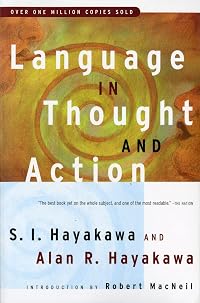
Language in Thought and Action
by S. I. Hayakawa, Alan R. Hayakawa (Author)
On This Page
Description
In this thoroughly revised, updated edition of his classic "Language in Thought and Action, " S.I. Hayakawa discusses the role of language in human life, the many functions of language, and how language--sometimes without our knowing--shapes our thinking.Tags
Recommendations
















Member Reviews
It had been nigh on 50 years since I last read this book in a college linguistics class. That's way too long. I had forgotten how important this book really is.This is a seminal work that explains so much about humanity that it's difficult to describe. Read this book. I can't say much else. If I could give it ten stars here I would. Certainly the best non-fiction book in my library, and I've got a lot of non-fiction. Try to find this edition if you can - comments on Amazon indicated that later editions had been edited for political correctness, which tells me that the editors that did that didn't read the book.
This book is a classic, which first appeared in 1939 and was most recently updated and revised in 1991. Clearly, we are not talking cutting edge here, but this book did introduce the concepts of semantics to many, many readers. I was one of them: this was the first serious book about language that I read, at the age of 10 in 1954, and it triggered an interest that has lasted through my life. First time readers will find ideas in Hayakawa's book -- that language affects what we think and what we do -- that are important and still fresh.
Not what I was expecting, but very interesting and enjoyable reading. How language shapes our thinking and, sometimes, derails our thinking. Something here for the philosopher, the historian, and the linguist.
Although a linguist friend didn't think much of Hayakawa's book, I found it very thought provoking, and therefore meaningful.
My favorite quote from this book wasn’t even by Hayakawa:
"A classic is a work which gives pleasure to the minority which is intensely and permanently interested in literature. It lives on because the minority, eager to renew the sensation of pleasure, is eternally curious and is therefore engaged in an internal process of rediscovery. A classic does not survive because of any ethical reason it does not survive because it conforms to certain cannons, or because neglect would kill it. It survived because it is a source of pleasure and because the passionate few can no more neglect it then a bee can neglect a show more flower. The passionate few do not read "the right things" because they are right. That is to put the cart before the horse "the right things" are the right things solely because the passionate few like reading them …"
"Nobody at all is quite in a position to choose with certainty among modern Works. To sift the wheat from the chaff is a process that takes an exceedingly long time. Modern Works have to pass before the bar of the taste of successive Generations semicolon whereas, with Classics, which have been through the ordeal, almost the reverse is the case. Your taste has to pass before the bar of the classics. That is the point. If you differ with a classic, it is you who are wrong, and not the book. If you differ with a modern work, you may be wrong or you may be right, but no judge is authoritative to decide your taste is unformed. It needs guidance and it needs a thority of guidance."
Arnold Bennett, Literary Taste: How to Form It, as quoted by S. I. Hayakawa in Language in Thought & Action, 4th Ed, p 139-140 show less
My favorite quote from this book wasn’t even by Hayakawa:
"A classic is a work which gives pleasure to the minority which is intensely and permanently interested in literature. It lives on because the minority, eager to renew the sensation of pleasure, is eternally curious and is therefore engaged in an internal process of rediscovery. A classic does not survive because of any ethical reason it does not survive because it conforms to certain cannons, or because neglect would kill it. It survived because it is a source of pleasure and because the passionate few can no more neglect it then a bee can neglect a show more flower. The passionate few do not read "the right things" because they are right. That is to put the cart before the horse "the right things" are the right things solely because the passionate few like reading them …"
"Nobody at all is quite in a position to choose with certainty among modern Works. To sift the wheat from the chaff is a process that takes an exceedingly long time. Modern Works have to pass before the bar of the taste of successive Generations semicolon whereas, with Classics, which have been through the ordeal, almost the reverse is the case. Your taste has to pass before the bar of the classics. That is the point. If you differ with a classic, it is you who are wrong, and not the book. If you differ with a modern work, you may be wrong or you may be right, but no judge is authoritative to decide your taste is unformed. It needs guidance and it needs a thority of guidance."
Arnold Bennett, Literary Taste: How to Form It, as quoted by S. I. Hayakawa in Language in Thought & Action, 4th Ed, p 139-140 show less
This is actually a reprint of his famous 1939 book and a world of sociolinguistic research has accrued since then, but this was the pioneering text. It is still interesting and fun to read, but don't stop here. It's a very interesting field.
A classic. I try to read this at least once a year since I first read it in 1998.
Members
- Recently Added By
Lists

Great Books About Language
73 works; 48 members

Ten Books That Have Stayed With Me
160 works; 30 members

In or About the 1930s
198 works; 27 members

1930s
262 works; 5 members

Books Read in 2004
212 works; 7 members
LibraryThingers' 1001 Books You Must Read Before You Die
442 works; 30 members

Pleasant Surprises: Books That Exceeded Our Expectations
418 works; 143 members

College Reads (Lit Edition)
75 works; 5 members
Best Books of the 20th Century
193 works; 5 members

Five star books
1,767 works; 110 members

The Five Books That Represent Us
391 works; 150 members
Author Information

31+ Works 1,976 Members
S.I. Hayakawa's full name is Samuel Ichiye Hayakawa. The son of an import-export merchant, Hayakawa was born on July 18, 1906, in Vancouver, British Columbia. Hayakawa received his bachelors degree from the University of Manitoba and his masters degree from McGill University. While he was studying for his Ph.D. at the University of Wisconsin, show more Hayakawa worked as an assistant instructor in English, becoming a professor in the English extension division in 1936. In the 40 years that followed, Hayakawa joined the faculties at numerous universities and colleges as a professor, eventually becoming president emeritus at San Francisco State University. Hayakawa is the author of a number of books that cover the meaning of language and similar subjects. Among his book credits are the Book-of-the-Month selection Language in Action, Modern Guide to Synonyms and Related Words, Dimensions in Meaning, and Quotations from Chairman S.I. Hayakawa. The periodical ETC: Of Our Language and Our World is considered one of Hayakawa's greatest contributions to modern letters. Hayakawa has also contributed to New Republic, Harper's, Sewanee Review, and other periodicals. (Bowker Author Biography) show less
Some Editions
Common Knowledge
- Canonical title
- Language in Thought and Action
- Original title
- Language in Thought and Action
- Alternate titles*
- Sprache im Denken und Handeln
- Original publication date
- 1939
- Epigraph
- Whenever agreement or assent is arrived at in human affairs...this agreement is reached by linguistic processes, or else it is not reached. - Benjamin Lee Whorf
- First words
- People in our culture who like to think of themselves as tough-minded and realistic, including influential political leaders and businessmen as well as go-getters and hustlers of smaller caliber, tend to take it for granted t... (show all)hat human nature is "selfish" and that life is a struggle in which only the fittest may survive. [1949 Printing Edition]
- Last words
- (Click to show. Warning: May contain spoilers.)The purpose of this book has been to lay before the reader some of the ways in which, whether as speakers or listeners, we may use or be used by the mechanisms of linguistic communication. What the reader may wish to do with these mechanisms is up to him. [1949 Printing Edition]
*Some information comes from Common Knowledge in other languages. Click "Edit" for more information.
Classifications
- Genres
- Nonfiction, General Nonfiction, Philosophy, Literature Studies and Criticism
- DDC/MDS
- 420.143 — Language English & Old English languages English and Old English (Anglo-Saxon) Philosophy and theory Communication; semantics, pragmatics, languages for special purposes Semantics
- LCC
- PE1585 .H36 — Language and Literature English language English Modern English
- BISAC
Statistics
- Members
- 1,040
- Popularity
- 24,954
- Reviews
- 11
- Rating
- (4.36)
- Languages
- 5 — Chinese, English, Finnish, German, Portuguese
- Media
- Paper
- ISBNs
- 18
- ASINs
- 18
