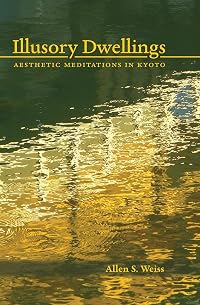
Illusory Dwellings: Aesthetic Meditations in Kyoto
by Allen S. Weiss
On This Page
Description
Essays on the nature, creation, and presentation of art, craft, andarchitecture in Japan, springing from the author's experiences in Kyoto.Tags
Recommendations







































Member Recommendations
Member Reviews
If you pick up this book expecting a guidebook to Kyoto, you will, perhaps, be disappointed. But if you pick it up expecting a guidebook to Japanese aesthetics, philosophy, design, art, you will be satisfied. It is natural that Weiss' first chapter, "Equivocal Thresholds", should be about the Tea Room, that quintessential Japanese space for appreciation of art (tea objects), company, tea itself, light, architecture. His chapter "Other Modernities: the Museum" contrasts the way objects made for use, such as tea bowls, are displayed in museums with the idea, quoting Yanagi Soetsu, that "if we want to see a thing well, we must use it well".
If I have any criticism of the book, it is that the photographs are in black and white. For the most show more part, this is not only not an issue, but a tribute to the idea of light and shadow. But in one instance it works against Weiss' thoughts. He contrasts a piece by the ceramicist Kuwata Takurō "with its exaggerated thick white glaze and artificial bright red color" with a piece by Kakurezaki Ryūichi, "perfectly attuned to the natural wood colors and subdued lighting of a Japanese gallery, tea room, or restaurant". Yet to truly understand this contrast, one must go outside the book to seek out color images (and one really should).
It is appropriate that his last chapter, "Tanizaki's Tomb: the Cemetery", for as I read this book I could not help but think of Junichiro Tanizaki's book "In Praise of Shadows", also a meditation on aesthetics, a work I return to often, as I expect I will to this one. show less
If I have any criticism of the book, it is that the photographs are in black and white. For the most show more part, this is not only not an issue, but a tribute to the idea of light and shadow. But in one instance it works against Weiss' thoughts. He contrasts a piece by the ceramicist Kuwata Takurō "with its exaggerated thick white glaze and artificial bright red color" with a piece by Kakurezaki Ryūichi, "perfectly attuned to the natural wood colors and subdued lighting of a Japanese gallery, tea room, or restaurant". Yet to truly understand this contrast, one must go outside the book to seek out color images (and one really should).
It is appropriate that his last chapter, "Tanizaki's Tomb: the Cemetery", for as I read this book I could not help but think of Junichiro Tanizaki's book "In Praise of Shadows", also a meditation on aesthetics, a work I return to often, as I expect I will to this one. show less
 This review was written for LibraryThing Early Reviewers.
This book is one I'll have to come back to over and over again. One part travelogue (but not really), one part biography (but not really), one part art history (mostly art history), it threads a weird path between scholarly, pompous, conversational, critical, wondrous, and meditative. Almost all adjectives can be employed here -- there were moments of weird anger following by a serenity not usually found in modern art literature. If any of that was the slightest bit intriguing, pick this one up.
This review was written for LibraryThing Early Reviewers.Not long ago, I initiated a list on LT (my first) called "jewels" in which I intended to list books that were 'short' in terms of number of pages but ... well, beautifully complete and self contained. Books you could gaze into and get lost.
Allen S. Weiss's Illusory Dwellings can certainly go on that list.
Illusory Dwellings is a wide-ranging (especially given its brevity!) study of Japanese aesthetics, apparently inspired by the author's experiences in Kyoto. Weiss covers a lot of ground, often in very striking ways: you'll be urged to consider the play of shadow and light in a tea pavilion, and the interplay between the edge of a ceramic plate and the meal contained within that edge.
The book is reasonably adamant about *not* being a show more list of "things to do in Kyoto." I in fact experienced a mild disappointment that the text did not really stay in Kyoto proper, but toured the world with the author chatting knowledgeably at one's shoulder. Illusory Dwellings really is about how to see, or more specifically how to adjust one's seeing so as to better admit and appreciate the things at which one is looking. The Japanese aesthetic can be initially confounding for western audiences -- Weiss shows the reader a number of ways in, a number of ways to situate oneself in order to better appreciate."One need *respect* the spirit of a place," he writes, "and one must obviously also *see* according to that spirit. Such is the responsibility of the visitor" (113).
Weiss is intellectually omnivorous and erudite and draws on a number of authors, disciplines and aesthetic traditions to make some pretty sophisticated points about Japanese culture ancient and modern. He doesn't always hit the mark, to my mind. In fact he may be a bit too subtle or "head-y" for many readers -- he does from time to time dip into what I've come to call "theory-speak," an echo of the recondite-unto-madness style of late 20th century literary theory. I was also taken aback at some of the ways the author inserts himself into the text. A little bit of this is okay, but a lot ... is not. Your mileage may vary.
This is the second Stone Bridge Press title I've reviewed and, as before, the physical book is quite lovely: beautifully designed and printed, and with nary a typo! This last point is especially surprising given how shoddy things have gotten across the board, in recent decades. show less
Allen S. Weiss's Illusory Dwellings can certainly go on that list.
Illusory Dwellings is a wide-ranging (especially given its brevity!) study of Japanese aesthetics, apparently inspired by the author's experiences in Kyoto. Weiss covers a lot of ground, often in very striking ways: you'll be urged to consider the play of shadow and light in a tea pavilion, and the interplay between the edge of a ceramic plate and the meal contained within that edge.
The book is reasonably adamant about *not* being a show more list of "things to do in Kyoto." I in fact experienced a mild disappointment that the text did not really stay in Kyoto proper, but toured the world with the author chatting knowledgeably at one's shoulder. Illusory Dwellings really is about how to see, or more specifically how to adjust one's seeing so as to better admit and appreciate the things at which one is looking. The Japanese aesthetic can be initially confounding for western audiences -- Weiss shows the reader a number of ways in, a number of ways to situate oneself in order to better appreciate."One need *respect* the spirit of a place," he writes, "and one must obviously also *see* according to that spirit. Such is the responsibility of the visitor" (113).
Weiss is intellectually omnivorous and erudite and draws on a number of authors, disciplines and aesthetic traditions to make some pretty sophisticated points about Japanese culture ancient and modern. He doesn't always hit the mark, to my mind. In fact he may be a bit too subtle or "head-y" for many readers -- he does from time to time dip into what I've come to call "theory-speak," an echo of the recondite-unto-madness style of late 20th century literary theory. I was also taken aback at some of the ways the author inserts himself into the text. A little bit of this is okay, but a lot ... is not. Your mileage may vary.
This is the second Stone Bridge Press title I've reviewed and, as before, the physical book is quite lovely: beautifully designed and printed, and with nary a typo! This last point is especially surprising given how shoddy things have gotten across the board, in recent decades. show less
This review was written for LibraryThing Early Reviewers.Illusory Dwellings by Allen S Weiss presents a way into appreciating not only Kyoto and Japan but any place you might visit or live for a time. Less travelogue and more a perspective on life and how it is lived through aesthetic practice, whether that practice is architecture, gardening, craft, or traditional practices.
I have only been to Japan twice and never to Kyoto, so I didn't come to this expecting a new way to appreciate a place I already knew but rather I came with the hope of understanding how better to look beyond the surface of any place I might travel or have traveled. And I definitely was rewarded for my interest.
I certainly gained a better appreciation of Japanese culture, of why some things are done as they are. Yet the show more meditations, as Weiss calls them, also offers the reader ways to approach locales both known and unknown to them. I went back and reread some of the passages about the tea ceremony and the space within which it is conducted several times. The first few was mostly gaining insight and finding the idea of the ceremony very appealing. But I kept going back because I began to relate the how of his meditation, the knowledgeable yet curious approach to understanding, to other cultures I have had some intimate experience with. I came away with, for lack of a better term, an openminded and respectful way to gain whatever access I can to the meaning of some practices I don't understand.
I think this will be a wonderful book for anyone who has spent time in Japan and especially Kyoto, but it is equally rewarding for those of us with little to no time spent in Japan but are interested in understanding how to find meaning in the most subtle aspects of a culture's aesthetics.
Reviewed from a copy made available by the publisher via NetGalley. show less
I have only been to Japan twice and never to Kyoto, so I didn't come to this expecting a new way to appreciate a place I already knew but rather I came with the hope of understanding how better to look beyond the surface of any place I might travel or have traveled. And I definitely was rewarded for my interest.
I certainly gained a better appreciation of Japanese culture, of why some things are done as they are. Yet the show more meditations, as Weiss calls them, also offers the reader ways to approach locales both known and unknown to them. I went back and reread some of the passages about the tea ceremony and the space within which it is conducted several times. The first few was mostly gaining insight and finding the idea of the ceremony very appealing. But I kept going back because I began to relate the how of his meditation, the knowledgeable yet curious approach to understanding, to other cultures I have had some intimate experience with. I came away with, for lack of a better term, an openminded and respectful way to gain whatever access I can to the meaning of some practices I don't understand.
I think this will be a wonderful book for anyone who has spent time in Japan and especially Kyoto, but it is equally rewarding for those of us with little to no time spent in Japan but are interested in understanding how to find meaning in the most subtle aspects of a culture's aesthetics.
Reviewed from a copy made available by the publisher via NetGalley. show less
Allen S. Weiss’s Illusory Dwellings is a luminous exploration of Kyoto’s timeless beauty and intricate artistry. Rather than offering a surface-level guide to the city, Weiss immerses readers in the profound aesthetics that define Kyoto’s cultural heart—from the delicate harmony of a tea room to the intricate craftsmanship of contemporary ceramics.
What sets this book apart is its deeply meditative tone. Weiss invites readers to slow down and truly see the world through the lens of Japanese aesthetics. His reflections on the tea ceremony and the culinary artistry of kaiseki meals are both scholarly and poetic, weaving historical context with personal insight in a way that feels both intimate and universal.
The inclusion of over 50 show more black-and-white photographs adds another layer of depth, allowing readers to visually engage with the subjects of Weiss’s meditations. Each image feels carefully chosen, complementing the text while offering moments of stillness to linger in.
Weiss’s ability to navigate the balance between tradition and modernity is particularly striking. His discussions of how Western museums interpret Japanese art highlight the nuanced differences in cultural perspectives, encouraging readers to rethink how they approach and appreciate these works.
For those seeking not just to learn about Kyoto but to experience its soul through the written word, Illusory Dwellings is an exceptional choice. Weiss has crafted more than a book—this is an aesthetic journey, a meditation on beauty that lingers long after the final page. Highly recommended for lovers of art, culture, and contemplative travel. show less
What sets this book apart is its deeply meditative tone. Weiss invites readers to slow down and truly see the world through the lens of Japanese aesthetics. His reflections on the tea ceremony and the culinary artistry of kaiseki meals are both scholarly and poetic, weaving historical context with personal insight in a way that feels both intimate and universal.
The inclusion of over 50 show more black-and-white photographs adds another layer of depth, allowing readers to visually engage with the subjects of Weiss’s meditations. Each image feels carefully chosen, complementing the text while offering moments of stillness to linger in.
Weiss’s ability to navigate the balance between tradition and modernity is particularly striking. His discussions of how Western museums interpret Japanese art highlight the nuanced differences in cultural perspectives, encouraging readers to rethink how they approach and appreciate these works.
For those seeking not just to learn about Kyoto but to experience its soul through the written word, Illusory Dwellings is an exceptional choice. Weiss has crafted more than a book—this is an aesthetic journey, a meditation on beauty that lingers long after the final page. Highly recommended for lovers of art, culture, and contemplative travel. show less
This review was written for LibraryThing Early Reviewers.As an anthropology professor, discussing the culturally-constructed bases of perception, aesthetic, and cognition is my stock-in-trade; I therefore anticipated an insightful read with this book but I was sadly mistaken. When Weiss does ruminate on differential perspectives in Japanese and Western thought, the essays shine and his personal anecdotes make the discussions real and immediate; truly, the last brief essay is an outstanding reflection on life, the universe, and everything through a Japanese lens that sufficiently well portrays the whole work that I wonder if perhaps it should have been placed earlier in the collection to walk the reader better into contemplation of Japanese thought.
However, a weighty boat anchor holds this show more book back from satisfying any but the most ardent reader and that is Weiss' explicit focus, not on Japanese culture but on _connoisseurship_ (his own word choice). This book is about the red velvet rope that separates the deeply (and very specifically) educated, the supercilious glances, those few invited to the tea ceremony who alone will experience the things, those who knowingly cite the "great architects" and the "famous philosophers" from, well, everyone else. I am multilingual, have lived and worked in several non-anglophone countries, and taught culture studies in universities and yet this book is not meant for me. Weiss' very language makes that clear.
For a discussion panel at a curatorship conference, this would be appropriate. As food for thought on aesthetics to a general, educated reader, the rarified air it brings is too thin to breathe. show less
However, a weighty boat anchor holds this show more book back from satisfying any but the most ardent reader and that is Weiss' explicit focus, not on Japanese culture but on _connoisseurship_ (his own word choice). This book is about the red velvet rope that separates the deeply (and very specifically) educated, the supercilious glances, those few invited to the tea ceremony who alone will experience the things, those who knowingly cite the "great architects" and the "famous philosophers" from, well, everyone else. I am multilingual, have lived and worked in several non-anglophone countries, and taught culture studies in universities and yet this book is not meant for me. Weiss' very language makes that clear.
For a discussion panel at a curatorship conference, this would be appropriate. As food for thought on aesthetics to a general, educated reader, the rarified air it brings is too thin to breathe. show less
This review was written for LibraryThing Early Reviewers.The book is an in depth, perhaps philosophical, examination of art and how it relates to nature, time, culture, other cultures. The 'meditations' in the title are a great label for the meandering explorations of Japanese art, life, time and the relevance of context.
Following the author was challenging at times without having much context or previous knowledge - but felt like expanding understanding how intricately woven cultural elements are with everything else.
For someone who is somewhat interested in Japanese culture, this book from 'early reviewers' was a gift: I would not have picked it up in a store or catalog, but have thoroughly enjoyed 'learning' from the author's reflections.
Following the author was challenging at times without having much context or previous knowledge - but felt like expanding understanding how intricately woven cultural elements are with everything else.
For someone who is somewhat interested in Japanese culture, this book from 'early reviewers' was a gift: I would not have picked it up in a store or catalog, but have thoroughly enjoyed 'learning' from the author's reflections.
This review was written for LibraryThing Early Reviewers.Members
- Recently Added By
Author Information

21+ Works 243 Members
Classifications
Statistics
- Members
- 33
- Popularity
- 860,443
- Reviews
- 21
- Rating
- (3.65)
- Languages
- English
- Media
- Paper, Ebook
- ISBNs
- 2