On This Page
Description
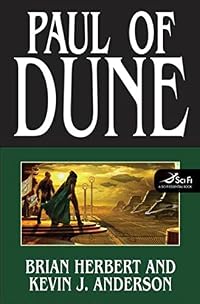
Frank Herbert's Dune ended with Paul Muad'Dib in control of the planet Dune. Herbert's next Dune book, Dune Messiah, picked up the story several years later after Paul's armies had conquered the galaxy. But what happened between Dune and Dune Messiah? How did Paul create his empire and become the Messiah? Following in the footsteps of Frank Herbert, New York Times bestselling authors Brian Herbert and Kevin J. Anderson are answering these questions in Paul of Dune.Tags
Recommendations












Member Reviews
Sigh. Where do we start? The cardboard characters? The plot inconsistencies? The contradictions with Frank Herbert's books?
Again, another unnecessary addition to the Dune series. If Brian and Kevin had put all their effort into writing Dune 7 than piddling around with two prequel trilogies, then we MIGHT have a worthy read.
But no. They just couldn't stop at Dune 7 and move on to go back to writing their own original series. No. Dune is their cash cow, and they're going to milk it, by gum!
Here, we see an wholly unnecessary novel. 'Dune Messiah' was about the consequences of Paul's Jihad. That was what Frank Herbert was concentrating on. He wanted to show us the consequences of Paul's vision, and not waste time with explaining about all show more of the battles on various planets and what not. And we were happy with that, because Frank Herbert wrote about what was relevant, and though sometimes it's fun to see how things happened or what happened to make things the way they were in the future, in the Dune series this was not missed because Herbert had a greater message to share with us. (which was completely ignored in Hunters/Sandworms of Dune, BTW)
Here we are presented with a book that spends a good amount of time in the past in Paul's childhood - entirely unnecessary as the House trilogy was - and all you can do is bang your head in frustration. The Harkonnen/Fenrig offspring that was hinted at in the canon Dune books was supposed to be just that - a tempting little rumor that made us think. Here, it's ridiculous. The Fremen are also very out of character, and the editing mistakes in this book are downright laughable. Contradictions are abound - in this book, Paul has been offplanet several times before the family move to Arrakis, yet in the original Dune novels, Frank Herbert makes it clear that Paul has never been offplanet, and Arrakis was his first trip away from home. This is but one of many mistakes and contradictions that plague this... this... "book".
Many things are told, not shown. Frank Herbert was wonderful at putting in details here and there that add up to the greater picture, without wasting time on useless fluff and filler. But here in Paul of Dune, so much time is wasted on so many things, and the characters of Dune are not quite the same here in Paul of Dune, and there were far too many Brian/Kevin-created characters for my liking.
The classic Dune was like a lovingly prepared homecooked meal by Mom, who clearly cared about what we were eating and put all her effort into making the meal as best as it could, and boy, do we ever remember these meals with love and fondness! The books by Brian and Kevin are like greasy fast food - easily snarfed down when there's nothing else to eat, hunger momentarily sated, and then stomach cramps and other rather unpleasant effects later on. They even admit themselves that they're making Dune more "accessible" to the reading crowd. Meaning, dumbed-down.
Near the end of this book, another disturbing "fact" is revealed to us - that Herbert Sr's works are no longer canon, and are rather an inaccurate history (because Irulan wrote so many books), which is Brian and Kevin's way of saying to us 'We'll retcon whatever we want out of Dune, and you will LIKE IT!'
To do this to someone else's work takes unmitigated gall, but after two poorly-written trilogies and a horribly disappointing Dune 7, should we be THAT surprised?
If you MUST read this book out of curiosity (or out of masochistic urges), then go to the library. Don't waste a single penny.
The six books by Frank Herbert, along with the Dune Encyclopedia, are canon, and nothing but. Brian and Kevin's books are poorly written fanfiction at best, and an utter and complete abomination at worst.
Repeat after me, my fellow Dune fans. This is the litany against the False Dune books.
I must not fear the false Dune books.
The false Dune books is the mind-killer.
The false Dune books is the little-death that brings total obliteration. I will face the false Dune books.
I will permit it to pass over me.
And when it has gone past I will turn the inner eye to see its path. Where the false Dune books has gone there will be nothing.
Only I will remain.
(Originally, the fifth line was 'permit it to pass over me and through me', but I do not want the false Dune books to pass through me, no way!)
Repeat that Litany, my fellow Dune fans, and do not fear. There are only six (or seven, including the Encyclopedia) Dune books. No more, no less. The books written by Brian and Kevin are nothing but a blasphemy, and I await with bated breath (in disgust) for Jessica of Dune. show less
Again, another unnecessary addition to the Dune series. If Brian and Kevin had put all their effort into writing Dune 7 than piddling around with two prequel trilogies, then we MIGHT have a worthy read.
But no. They just couldn't stop at Dune 7 and move on to go back to writing their own original series. No. Dune is their cash cow, and they're going to milk it, by gum!
Here, we see an wholly unnecessary novel. 'Dune Messiah' was about the consequences of Paul's Jihad. That was what Frank Herbert was concentrating on. He wanted to show us the consequences of Paul's vision, and not waste time with explaining about all show more of the battles on various planets and what not. And we were happy with that, because Frank Herbert wrote about what was relevant, and though sometimes it's fun to see how things happened or what happened to make things the way they were in the future, in the Dune series this was not missed because Herbert had a greater message to share with us. (which was completely ignored in Hunters/Sandworms of Dune, BTW)
Here we are presented with a book that spends a good amount of time in the past in Paul's childhood - entirely unnecessary as the House trilogy was - and all you can do is bang your head in frustration. The Harkonnen/Fenrig offspring that was hinted at in the canon Dune books was supposed to be just that - a tempting little rumor that made us think. Here, it's ridiculous. The Fremen are also very out of character, and the editing mistakes in this book are downright laughable. Contradictions are abound - in this book, Paul has been offplanet several times before the family move to Arrakis, yet in the original Dune novels, Frank Herbert makes it clear that Paul has never been offplanet, and Arrakis was his first trip away from home. This is but one of many mistakes and contradictions that plague this... this... "book".
Many things are told, not shown. Frank Herbert was wonderful at putting in details here and there that add up to the greater picture, without wasting time on useless fluff and filler. But here in Paul of Dune, so much time is wasted on so many things, and the characters of Dune are not quite the same here in Paul of Dune, and there were far too many Brian/Kevin-created characters for my liking.
The classic Dune was like a lovingly prepared homecooked meal by Mom, who clearly cared about what we were eating and put all her effort into making the meal as best as it could, and boy, do we ever remember these meals with love and fondness! The books by Brian and Kevin are like greasy fast food - easily snarfed down when there's nothing else to eat, hunger momentarily sated, and then stomach cramps and other rather unpleasant effects later on. They even admit themselves that they're making Dune more "accessible" to the reading crowd. Meaning, dumbed-down.
Near the end of this book, another disturbing "fact" is revealed to us - that Herbert Sr's works are no longer canon, and are rather an inaccurate history (because Irulan wrote so many books), which is Brian and Kevin's way of saying to us 'We'll retcon whatever we want out of Dune, and you will LIKE IT!'
To do this to someone else's work takes unmitigated gall, but after two poorly-written trilogies and a horribly disappointing Dune 7, should we be THAT surprised?
If you MUST read this book out of curiosity (or out of masochistic urges), then go to the library. Don't waste a single penny.
The six books by Frank Herbert, along with the Dune Encyclopedia, are canon, and nothing but. Brian and Kevin's books are poorly written fanfiction at best, and an utter and complete abomination at worst.
Repeat after me, my fellow Dune fans. This is the litany against the False Dune books.
I must not fear the false Dune books.
The false Dune books is the mind-killer.
The false Dune books is the little-death that brings total obliteration. I will face the false Dune books.
I will permit it to pass over me.
And when it has gone past I will turn the inner eye to see its path. Where the false Dune books has gone there will be nothing.
Only I will remain.
(Originally, the fifth line was 'permit it to pass over me and through me', but I do not want the false Dune books to pass through me, no way!)
Repeat that Litany, my fellow Dune fans, and do not fear. There are only six (or seven, including the Encyclopedia) Dune books. No more, no less. The books written by Brian and Kevin are nothing but a blasphemy, and I await with bated breath (in disgust) for Jessica of Dune. show less
Dune stands as of the most brilliant books ever written. The Dune Universe stands as of the one the most brilliant story settings as well.
Frank Herbert, the original author, wrote sequels to the Dune, but I never got into them as much because most of the original characters died off. This book attempts to fill in the gaps of the events after Paul make the Emperor.
Most readers hate the book because it isn't Dune. It's not Dune. It's more like spectacular fan fiction from the Dune Universe. And I've always felt a little gypped that I never got to read more about Paul the Emperor.
Paul jealously thinks that Alexander the Great was considered great because he just conquered and created an empire and never had to manage an empire. And this show more book is about Paul's struggle to manage the empire and make tough decisions for the good of humanity at the expense of entire planets. Perhaps, that's what I liked most of the book. Great leadership (and life) requires us sometimes to piss of some innocent people. show less
Dune by Frank Herbert is one of my favorite books. My mom (who hates science fiction) brought home a copy for me from a garage sale while I was in high school. I devoured it at band camp one year, loved it, and have read it several times since (it's about due for another re-read, actually). I went on to read the next couple of books in the series, Dune Messiah and Children of Dune, but didn't like them nearly as well, though I feel like I should give them another try in the near future. I haven't read any of Frank Herbert's other Dune books, nor have I read any of the books written after his death, co-authored by his son Brian Herbert and Kevin J. Anderson (which I've read exceedingly mixed reviews for). However, when the newest show more installment, Paul of Dune was offered up for review, I happily nabbed a copy.
Paul of Dune acts as a direct sequel to Dune, covering the time period between it and Dune Messiah. It also serves as the first volume of a new trilogy, Heroes of Dune (Paul of Dune will be followed by Jessica of Dune and Irulan of Dune), which will continue to fill in gaps and expand upon the original trilogy. Paul of Dune chronicles the transition of the Empire after Paul Atreides, also known as Paul Muad'Dib and considered a Messiah by many, overthrows Emperor Shaddam IV and instates himself on the throne. What follows is a violent and bloody Jihad that sweeps the galaxy as his followers are willing to do anything to ensure his dominance and divinity, quickly making Paul despised and hated across the universe. In addition to this, much of the book jumps back in time, exploring Paul's youth and the formative years partially responsible for making him who he is now. The story bounces around quite a bit, following the perspective of the major players in the unfolding drama, including Paul, Princess Irulan, Stilgar, Shaddam IV, Count Fenring, and many, many others, making the book feel a little unfocused.
Despite the fact that it has been many years since I have read any of the Dune books, I noticed several inconsistencies between them and Paul of Dune, and I suspect that there are others that I didn't pick up on. Some of these inconsistencies were cleverly explained away somewhat while others were completely ignored. (Granted, I'm led to believe that Frank Herbert's own books sometimes had consistency problems as well.) The plot and characters were hardly complicated or deep and seemed at times rather superficial and shallow, and even contradictory. The writing was clear and readable, but unfortunately it frequently suffered from "telling" instead of "showing."
In all, I wasn't overly impressed with Paul of Dune--it wasn't horrendous, but it really wasn't that great, either. I wasn't expecting it to be on par with Dune (heck, even the senior Herbert's other Dune books weren't of the same caliber), but I did find it lacking in the sort of details and focus that I was hoping for and I struggled to keep myself interested. For the most part, I do think that it can work as a stand alone novel, which is an impressive feat considering the complexity of the Dune universe. For Dune completists, Paul of Dune is probably worth pursuing, but I would be hesitant in recommending it to many other people. However, the book has rekindled my love and interest for the original, so I will thank the Herbert and Anderson team for that.
Experiments in Reading show less
Paul of Dune acts as a direct sequel to Dune, covering the time period between it and Dune Messiah. It also serves as the first volume of a new trilogy, Heroes of Dune (Paul of Dune will be followed by Jessica of Dune and Irulan of Dune), which will continue to fill in gaps and expand upon the original trilogy. Paul of Dune chronicles the transition of the Empire after Paul Atreides, also known as Paul Muad'Dib and considered a Messiah by many, overthrows Emperor Shaddam IV and instates himself on the throne. What follows is a violent and bloody Jihad that sweeps the galaxy as his followers are willing to do anything to ensure his dominance and divinity, quickly making Paul despised and hated across the universe. In addition to this, much of the book jumps back in time, exploring Paul's youth and the formative years partially responsible for making him who he is now. The story bounces around quite a bit, following the perspective of the major players in the unfolding drama, including Paul, Princess Irulan, Stilgar, Shaddam IV, Count Fenring, and many, many others, making the book feel a little unfocused.
Despite the fact that it has been many years since I have read any of the Dune books, I noticed several inconsistencies between them and Paul of Dune, and I suspect that there are others that I didn't pick up on. Some of these inconsistencies were cleverly explained away somewhat while others were completely ignored. (Granted, I'm led to believe that Frank Herbert's own books sometimes had consistency problems as well.) The plot and characters were hardly complicated or deep and seemed at times rather superficial and shallow, and even contradictory. The writing was clear and readable, but unfortunately it frequently suffered from "telling" instead of "showing."
In all, I wasn't overly impressed with Paul of Dune--it wasn't horrendous, but it really wasn't that great, either. I wasn't expecting it to be on par with Dune (heck, even the senior Herbert's other Dune books weren't of the same caliber), but I did find it lacking in the sort of details and focus that I was hoping for and I struggled to keep myself interested. For the most part, I do think that it can work as a stand alone novel, which is an impressive feat considering the complexity of the Dune universe. For Dune completists, Paul of Dune is probably worth pursuing, but I would be hesitant in recommending it to many other people. However, the book has rekindled my love and interest for the original, so I will thank the Herbert and Anderson team for that.
Experiments in Reading show less
Review of the Audiobook: Paul of Dune was a science fiction novel I was supposed to read and discuss in my science fiction reading group. When I realized that I didn't have the time to tackle a 500+ page book, I grabbed the book-on-CD off of the library's new materials display and decided to give it a try. I'll have to admit, I'm one of the Dune fans who didn't see the need for all of the spin-off volumes that Anderson and Frank Herbert's son, Brian, have been releasing in recent years, most of which have been set generations away from the events in Frank Herbert's original series of novels. However, Paul of Dune is set in the multi-year gap between Herbert's first Dune novel and the second in the series, Dune Messiah. In the end, as a show more book standing on its own merits, I found Paul of Dune to be a bit slow, and with far too much description and not enough action. As an audio adaptation, I commend narrator Scott Brick on bringing a wide variety of characters to life with subtle nuances and voice inflections. Whether you're a long-time fan of the Dune universe, or just want to sample some of the latest fare in Dune novels, I would recommend this audio version. It is very well done.
Originally reviewed for my local library's website: http://www.lincolnlibraries.org/depts/bookguide/srec/staffrec09-07.htm show less
Originally reviewed for my local library's website: http://www.lincolnlibraries.org/depts/bookguide/srec/staffrec09-07.htm show less
A worthy addition to the Dune Universe. I have read the 6 original and the 8 subsequent novels, and I've found there is always more paths to explore. I Know some consider the later novels to be 'meddling' with Frank Herberts classics. But I consider them a valuable expansion and fascinating in their own right (though a couple do drag).
So how did I find this latest extension?
I honestly wondered at first how they could spin it, but they have managed to explore the rise of Paul Maud'Dib without lessening his mythos. Full of intrigue and conflict, ironically the path of perscient Paul is never clear.The task of balancing wild unpredictable factons, politics and religion has fallen on his weary shoulders. Becoming Emperor is not the role he show more would of chosen, but only he can prepare mankind for the turmoil that lays ahead. show less
So how did I find this latest extension?
I honestly wondered at first how they could spin it, but they have managed to explore the rise of Paul Maud'Dib without lessening his mythos. Full of intrigue and conflict, ironically the path of perscient Paul is never clear.The task of balancing wild unpredictable factons, politics and religion has fallen on his weary shoulders. Becoming Emperor is not the role he show more would of chosen, but only he can prepare mankind for the turmoil that lays ahead. show less
Brian Herbert's Dune novels are like comfort food. It isn't haute cuisine, but it makes you feel good.
I always wondered what Paul did between Dune and Dune Messiah, and this novel at least partially explains it. I have a feeling one or more subsequent books will yet intervene (the next I guess being Jessica of Dune). As an added bonus, the novel flashes back to Paul's pre-Dune days. It seems he didn't have quite the sheltered upbringing implied in Dune.
In preparation to reading this book, I read Brian's pre-Dune triology (House Atreides, House Harkonnen, House Corrino) and Frank's original Dune (read for the third time). The character's in Paul of Dune are all familiar, the stories mildly interesting, if not shocking. I'm left witrh show more some interest as to why Hasimir Fenring was allowed to live after an assassination attempt. I'm looking forward to the next book. show less
I always wondered what Paul did between Dune and Dune Messiah, and this novel at least partially explains it. I have a feeling one or more subsequent books will yet intervene (the next I guess being Jessica of Dune). As an added bonus, the novel flashes back to Paul's pre-Dune days. It seems he didn't have quite the sheltered upbringing implied in Dune.
In preparation to reading this book, I read Brian's pre-Dune triology (House Atreides, House Harkonnen, House Corrino) and Frank's original Dune (read for the third time). The character's in Paul of Dune are all familiar, the stories mildly interesting, if not shocking. I'm left witrh show more some interest as to why Hasimir Fenring was allowed to live after an assassination attempt. I'm looking forward to the next book. show less
Whelp this novel seeks to place the inconsistencies in the 'McDune' universe (novels by KJA and BH) by saying that the original books are written by Irulan as propaganda and are therefore less true than the substandard stories they've written. Ugh why not just write within the original canon?
I did like the storyline involving Count Fenrig and family.
I did like the storyline involving Count Fenrig and family.
Members
- Recently Added By
Author Information

136+ Works 35,263 Members
Brian Herbert is an author and the son of Frank Herbert, the creator of the Dune series. Brian Herbert has had several stand-alone novels published but he is perhaps most well-known for his books that expand on his father's Dune novels. Written with author Kevin J. Anderson, these novels have been commercially successful and generally well show more received by the public. Brian Herbert is the co-author of the Dune novels House Atreides, House Harkonnen, House Corrino, The Butlerian Jihad, The Machine Crusade, The Battle of Corrin, The Road To Dune, Hunters of Dune, Sandworms Of Dune, Paul Of Dune, The Winds Of Dune, and Sisterhood of Dune. Brian Herbert has also edited several works relating to the Dune universe and to his father. In 2003, he authored Dreamer of Dune, the biography of Frank Herbert, a Hugo Award finalist nomination. (Bowker Author Biography) show less

461+ Works 86,171 Members
Kevin J. Anderson was born on March 27, 1962. Before becoming a full-time author, he worked in California for twelve years as a technical writer and editor at the Lawrence Livermore National Laboratory. His science fiction books include Resurrection, Inc., the Star Wars Jedi Academy Trilogy, the Young Jedi Knights series, Ground Zero, Ruins, show more Climbing Olympus, Blindfold, and The Dark Between the Stars. He has also written several books with Doug Beason including Ignition, Virtual Destruction, Fallout, and Ill Wind. (Bowker Author Biography) Kevin J. Anderson has written twenty seven bestsellers and has been nominated for the Nebula Award, the Bram Stoker Award, and the SFX Reader's Choice Award. He also holds the Guinness world record for "The Largest Single-Author Signing". (Publisher Provided) show less
Some Editions
Awards and Honors
Distinctions
Series

Belongs to Publisher Series
Work Relationships
Is contained in
Common Knowledge
- Canonical title
- Paul of Dune
- Original title
- Paul of Dune
- Original publication date
- 2008-09-16
- People/Characters
- Paul Atreides; Chani Kynes; Stilgar; Jessica Atreides; Hasimir Fenring; Margot Fenring (show all 15); Shaddam Corrino IV; Irulan Corrino; Marie Fenring; Duncan Idaho; Gurney Halleck; Whitmore Bludd; Alia Atreides; Gaius Helen Mohiam; Thallo
- Important places
- Arrakis (fictional planet); Caladan (fictional planet); Arrakeen, Arrakis; Giedi Prime (fictional planet)
- Dedication
- To JANET HERBERT and REBECCA MOESTA ANDERSON
Thank you for your patience, your wisdom, and your love,
and for so much more than we can possibly list here.
If we were to describe everything you've contribute... (show all)d,
it would require a book much longer than this novel. - First words
- A serene ocean of sand stretched as far as the eye could see, silent and still, carrying the potential for terrible storms.
- Last words
- (Click to show. Warning: May contain spoilers.)By the holy grace of Muad'Dib.
- Publisher's editor
- LoBrutto, Pat
- Original language
- English
- Canonical DDC/MDS
- 813.087625
Classifications
- Genres
- Science Fiction, Fiction and Literature
- DDC/MDS
- 813.087625 — Literature & rhetoric American literature in English American fiction in English By type Genre fiction Adventure fiction Speculative fiction Science fiction Space opera
- LCC
- PS3558 .E617 .P38 — Language and Literature American literature American literature Individual authors 1961-
- BISAC
Statistics
- Members
- 1,536
- Popularity
- 14,874
- Reviews
- 25
- Rating
- (3.49)
- Languages
- 7 — Czech, Dutch, English, French, German, Hungarian, Polish
- Media
- Paper, Audiobook, Ebook
- ISBNs
- 24
- ASINs
- 14