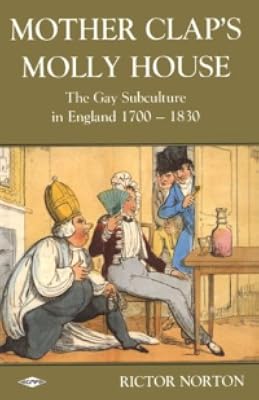
Mother Clap's Molly House: The Gay Subculture in England 1700-1830
by Rictor Norton
On This Page
Description
This pioneering study breaks new ground in presenting the gay community's history by sporting one of its more distinctive branches--molly houses. In this updated edition, with two new chapters, Rictor Norton digs deeper into both past and present to rediscover the original foundations of the molly subculture and challenges traditional notions by suggesting that it was primarily composed of the working class--blacksmiths, milkmen, publicans, and shoemakers. More extravagant personalities are show more investigated as well, such as dramatists Samuel Foote and Isaac Bickerstaff, and the Rev. John Church, denounced for blessing gay "marriages." show lessTags
Recommendations

















Member Reviews
This book is a great resource to start looking into 18th-century gay culture. It's endlessly interesting. (Also a good book to keep around and spout some #knowledge with your gay friends. Earn a little cred here and there, ya know?)
I was really looking forward to reading this book, but was ultimately disappointed.
The subject matter is very interesting. As the title says, Norton explores the begins of a distinct gay subculture, mainly in London. He focuses on male homosexuality rather than female, explaining that this is because of the source material available. Gay women left much less evidence for historians
Norton's book is refreshing in that it focuses mainly on the activitites of men from the working and lower middle classes who had sex with men. It throws light on how these men made contact. It shows the strength of public feeling against homosexuality. I think this was the most interesting aspect for me . The treatment of men who were publicly punished was show more horrendous and many were lucky not be killed by crowds baying for their blood.
Unfortunately, Norton's writing style, and what seems to be very sloppy editing, detract from the stories he tells and the points he wants to make.
He has obviously researched the subject extensively, but most of the evidence is taken from court cases and newspaper reports so each cases feels similar. He presents many examples to illustrate every point that he makes and this makes the book incredibly repetitive. For example, he discusses blackmail cases in one chapter. There actually isn' t that much variation in how these cases played out, yet Norton presents us with a very large amount of evidence. Each of these is explained, even those that have been mentioned in a previous chapter, bogging the reader down in a lot of repeated detail while the analysis gets lost. I understand his need to show that his assertions are based on primary sources, but there needs to be much tighter editing of this - the book could easily have been 100 pages shorter, and this would have given it much more impact.
This poor writing/editing is also shown by the fact that many of the cases Norton refers to end up with a man being placed in the pillory as punishment. However, the pillory is not actually described until 199 pages in to the book.
Finally, there is little sense of a developing subculture; the book feels more like a snapshot of gay men's activitites over 130 years rather than an analyses of developing trends. Indeed, there is no conclusion that would draw out the development and suggest how this is then taken forward after 1830. show less
The subject matter is very interesting. As the title says, Norton explores the begins of a distinct gay subculture, mainly in London. He focuses on male homosexuality rather than female, explaining that this is because of the source material available. Gay women left much less evidence for historians
Norton's book is refreshing in that it focuses mainly on the activitites of men from the working and lower middle classes who had sex with men. It throws light on how these men made contact. It shows the strength of public feeling against homosexuality. I think this was the most interesting aspect for me . The treatment of men who were publicly punished was show more horrendous and many were lucky not be killed by crowds baying for their blood.
Unfortunately, Norton's writing style, and what seems to be very sloppy editing, detract from the stories he tells and the points he wants to make.
He has obviously researched the subject extensively, but most of the evidence is taken from court cases and newspaper reports so each cases feels similar. He presents many examples to illustrate every point that he makes and this makes the book incredibly repetitive. For example, he discusses blackmail cases in one chapter. There actually isn' t that much variation in how these cases played out, yet Norton presents us with a very large amount of evidence. Each of these is explained, even those that have been mentioned in a previous chapter, bogging the reader down in a lot of repeated detail while the analysis gets lost. I understand his need to show that his assertions are based on primary sources, but there needs to be much tighter editing of this - the book could easily have been 100 pages shorter, and this would have given it much more impact.
This poor writing/editing is also shown by the fact that many of the cases Norton refers to end up with a man being placed in the pillory as punishment. However, the pillory is not actually described until 199 pages in to the book.
Finally, there is little sense of a developing subculture; the book feels more like a snapshot of gay men's activitites over 130 years rather than an analyses of developing trends. Indeed, there is no conclusion that would draw out the development and suggest how this is then taken forward after 1830. show less
Ratings
Members
- Recently Added By
Lists

The Best LGBTQ Nonfiction
218 works; 70 members
Author Information
8 Works 290 Members
Awards and Honors
Awards
Series
Belongs to Publisher Series
GAY MEN'S PRESS (GMP) (GMP-?)
Common Knowledge
- Original publication date
- 1992
Classifications
- Genres
- History, Nonfiction, LGBTQ+, Sexuality and Gender Studies, General Nonfiction, Sociology
- DDC/MDS
- 306.76 — Society, government, & culture Social sciences, sociology & anthropology Social Behavior - Dating, Marriage, Divorce Sexual relations Sexual orientation, transgender identity, intersexuality
- LCC
- HQ76.3 .G7 .N68 — Social sciences The family. Marriage, Women and Sexuality The Family. Marriage. Women Sexual life Homosexuality. Lesbianism
- BISAC
Statistics
- Members
- 128
- Popularity
- 256,070
- Reviews
- 2
- Rating
- (4.07)
- Languages
- English
- Media
- Paper
- ISBNs
- 2