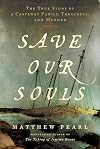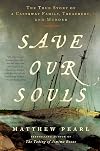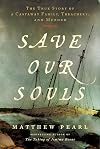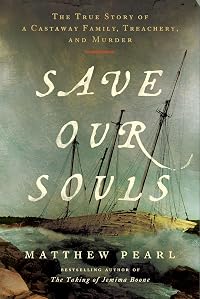
Save Our Souls: The True Story of a Castaway Family, Treachery, and Murder
by Matthew Pearl 
On This Page
Description
From the bestselling author of The Taking of Jemima Boone, the unbelievable true story of a real-life Swiss Family Robinson (and their dog) who faced sharks, shipwreck, and betrayal.On December 10, 1887, a shark fishing boat disappeared. On board the doomed vessel were the Walkers—the ship's captain Frederick, his wife Elizabeth, their three teenage sons, and their dog—along with the ship's crew. The family had spotted a promising fishing location when a terrible storm arose, splitting show more their vessel in two and leaving those onboard adrift on the perilous sea.
When the castaways awoke the next morning, they discovered they had been washed ashore—on an island inhabited by a large but ragged and emaciated man who introduced himself as Hans. Hans appeared to have been there for a while and could quickly educate the Walkers and their crew on the island's resources. But Hans had a secret . . . and as the Walker family gradually came to learn more, what seemed like a stroke of luck to have the mysterious man's assistance became something ominous, something darker.
Like David Grann and Stacy Schiff, Matthew Pearl unveils one of the most incredible yet little-known historical true stories, and the only known instance in history of an actual family of castaways. Save Our Souls asks us to consider who we might become if we found ourselves trapped on a deserted island.
. show less
Tags
Recommendations














Member Reviews
SAVE OUR SOULS by Matthew Pearl caught my eye because of its title. A true Swiss Family Robinson story that involves murder sounded like the perfect break from all the fantasy novels I have been reading. However, what sounded like an intriguing story is, in actuality, a regurgitation of research and not one done very well.
SAVE OUR SOULS suffers from a serious case of too much information. There is no doubt that Mr. Pearl researched the topic, as he includes at least one footnote with its corresponding citation on almost every page. But therein lies the problem. Mr. Pearl finds a way to incorporate all his research into a short book. His notes are nearly as many pages as the story itself. There is too much information in such a short show more space that it is akin to drinking water from a wide-open fire hose. You can't process it all.
To make matters worse, Mr. Pearl opts to tell the story chronologically. While this doesn't seem like a bad organizational methodology to use for a historical narrative, it is to the reader's disadvantage here. Mr. Pearl spends large swaths of SAVE OUR SOULS going off on tangents every time he introduces a new person into the drama. The same holds for every new location mentioned or occupation. For every advancement of the castaway story, you must walk down at least one, if not more, other paths before Mr. Pearl finally gets back to the main narrative. If you take out all of the tangential information, the crux of the Walkers' shipwreck takes up very little room, and this is not a long novel to begin with.
While there is an interesting story there in SAVE OUR SOULS, it is not worth the effort required to dig that story out of everything else. There is no doubt Mr. Pearl is enthusiastic about this little moment in history, but his enthusiasm is overwhelming. His tangential explanations cause the main narrative to be disjointed. Plus, he doesn't always tie those tangents back into that main narrative, which serves to increase any confusion you may already have. You could get everything you need to know about the Walkers' tale from a simple Wikipedia entry because, in the end, that is all it needs to be. SAVE OUR SOULS is nothing more than a spewing of facts and numerous tangential history lessons for a moment in time that had no lasting impact on the world at large. show less
SAVE OUR SOULS suffers from a serious case of too much information. There is no doubt that Mr. Pearl researched the topic, as he includes at least one footnote with its corresponding citation on almost every page. But therein lies the problem. Mr. Pearl finds a way to incorporate all his research into a short book. His notes are nearly as many pages as the story itself. There is too much information in such a short show more space that it is akin to drinking water from a wide-open fire hose. You can't process it all.
To make matters worse, Mr. Pearl opts to tell the story chronologically. While this doesn't seem like a bad organizational methodology to use for a historical narrative, it is to the reader's disadvantage here. Mr. Pearl spends large swaths of SAVE OUR SOULS going off on tangents every time he introduces a new person into the drama. The same holds for every new location mentioned or occupation. For every advancement of the castaway story, you must walk down at least one, if not more, other paths before Mr. Pearl finally gets back to the main narrative. If you take out all of the tangential information, the crux of the Walkers' shipwreck takes up very little room, and this is not a long novel to begin with.
While there is an interesting story there in SAVE OUR SOULS, it is not worth the effort required to dig that story out of everything else. There is no doubt Mr. Pearl is enthusiastic about this little moment in history, but his enthusiasm is overwhelming. His tangential explanations cause the main narrative to be disjointed. Plus, he doesn't always tie those tangents back into that main narrative, which serves to increase any confusion you may already have. You could get everything you need to know about the Walkers' tale from a simple Wikipedia entry because, in the end, that is all it needs to be. SAVE OUR SOULS is nothing more than a spewing of facts and numerous tangential history lessons for a moment in time that had no lasting impact on the world at large. show less
As noted by prior reviewers, what should have been a compelling story is obfuscated by the author's style of including far too much unnecessary detail and/or digressions.
The fascinating facts are straightforward. A family and related crew are shipwrecked on a remote Pacific Island inhabited by a lone man who also is a murderer. Instead of focusing on these characters, the author has seemingly fallen in love with his research and insists upon including irrelevant detail. Concise emphasis on the main protagonists would have made this a far more enjoyable book.
The fascinating facts are straightforward. A family and related crew are shipwrecked on a remote Pacific Island inhabited by a lone man who also is a murderer. Instead of focusing on these characters, the author has seemingly fallen in love with his research and insists upon including irrelevant detail. Concise emphasis on the main protagonists would have made this a far more enjoyable book.
I understand the criticism that the book goes many different directions and offers a lot of information. I, too, was looking for a deeper look into the souls of the principle players across their 14 month ordeal, but that was just my expectation. I like survival stories. BUT, I feel patience is rewarded when the various strands come together by the final chapters. It wasn't what I expected, but I thought it was masterful writing. It wasn't merely one family's saga but a big picture of connectedness in that time period in that sailing world. A good book, a lesson in surrendering expectations and patient reading.
This has the bones of an exciting story, but the story teller didn't make anything of it. This wants to be narrative non-fiction but it's just a recitation of events.
nonfiction - historical adventure.
February 1888 - a world-traveling husband and wife originally from Britain and their three teenaged sons, plus their crew of 24 sailors are lucky to make their way to a deserted island at the Midway Atoll (famous for its ship-breaking reefs) after being shipwrecked, but the castaway Hans who has already been living on the island may not be as friendly nor as well-meaning as he pretends.
An action- and adventure-packed nonfiction narrative about the story that would loosely inspire RLS' (co-written with his stepson) novel The Wrecker.
February 1888 - a world-traveling husband and wife originally from Britain and their three teenaged sons, plus their crew of 24 sailors are lucky to make their way to a deserted island at the Midway Atoll (famous for its ship-breaking reefs) after being shipwrecked, but the castaway Hans who has already been living on the island may not be as friendly nor as well-meaning as he pretends.
An action- and adventure-packed nonfiction narrative about the story that would loosely inspire RLS' (co-written with his stepson) novel The Wrecker.
Ratings
Members
- Recently Added By
Lists

Thriller Authors to read
59 works; 1 member
Author Information

14+ Works 14,414 Members
Matthew Pearl received a degree in English and American Literature from Harvard University in 1997 and a law degree from Yale Law School in 2000. He writes novels including The Dante Club, The Poe Shadow, and The Last Dickens. He has also taught literature and creative writing at Harvard University and Emerson College. (Bowker Author Biography)
Matthew Pearl is a LibraryThing Author, an author who lists their personal library on LibraryThing.
Some Editions
Common Knowledge
- Canonical title
- Save Our Souls: The True Story of a Castaway Family, Treachery, and Murder
Classifications
- Genres
- Travel, History, General Nonfiction, Nonfiction, Biography & Memoir
- DDC/MDS
- 910.452 — History & geography Geography & travel modified standard subdivisions of Geography and travel Pirates & Shipwrecks Ocean voyages, pirates Shipwrecks
- LCC
- G530 .W269 .P43 — Geography, Anthropology and Recreation Geography (General) Adventures, shipwrecks, buried treasure, etc.
- BISAC
Statistics
- Members
- 114
- Popularity
- 286,019
- Reviews
- 5
- Rating
- (3.35)
- Languages
- English
- Media
- Paper, Audiobook, Ebook
- ISBNs
- 10
- ASINs
- 2