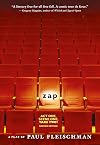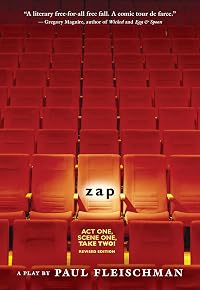
Zap: A Play
by Paul Fleischman
On This Page
Description
Contain a juxtaposition of several different plays that parody the works of Tennessee Williams, Anton Chekhov, Samuel Beckett, Neil Simon, and others.Tags
Recommendations













Member Reviews
This is a very odd little play written by a young adult writer of some note. Fleischman explains at the beginning that he had noticed high school drama departments doing Romeo and Juliet and Grease and not much else, and so he set out to write a play for production at the high school level that would be original, inventive, and humorous.
The title, Zap, refers to the use of a remote control that would allow audience members to "change channels," from one genre of drama to another, at any time. Of course the whole idea is a conceit, as the play is carefully scripted, but the idea would appeal to students. Fleischman describes the play as a "collision" between genres--as many as the audience can keep straight--and he decides on show more seven:
Shakespearean history (Richard the Third)
English mystery (a tribute to Agatha Christie)
Brooding Russian drama (think Chekhov)
Tennessee Williams--type southern drama (vanished fortunes, dwindling morals, drunkenness etc.)
Neil Simon-style comedy (a sort of Odd Couple)
Modern theater of the absurd (Samuel Beckett)
Performance Art monologue by an angst-filled teenage girl who hates her parents
The play literally zaps between each of these conventions while playfully blending characters, settings (there is only one unchanging set), and dialogue. I sort of have the feeling that I should be more impressed with Fleischman's effort than I am, but I just didn't get it. I think if high schoolers were to produce this play, they would do well with it if they had an accomplished teacher who could help them to understand the different genres (which I do, but it still didn't work for me), and I think young audiences would appreciate the humor, which doesn't just show up in the "comedy" parts but throughout. However, a student simply reading the play would have a difficult time imagining it well enough to enjoy it.
Meant for high school drama departments due, mostly to fleeting references to sex and alcohol. Not appropriate for middle schools. show less
The title, Zap, refers to the use of a remote control that would allow audience members to "change channels," from one genre of drama to another, at any time. Of course the whole idea is a conceit, as the play is carefully scripted, but the idea would appeal to students. Fleischman describes the play as a "collision" between genres--as many as the audience can keep straight--and he decides on show more seven:
Shakespearean history (Richard the Third)
English mystery (a tribute to Agatha Christie)
Brooding Russian drama (think Chekhov)
Tennessee Williams--type southern drama (vanished fortunes, dwindling morals, drunkenness etc.)
Neil Simon-style comedy (a sort of Odd Couple)
Modern theater of the absurd (Samuel Beckett)
Performance Art monologue by an angst-filled teenage girl who hates her parents
The play literally zaps between each of these conventions while playfully blending characters, settings (there is only one unchanging set), and dialogue. I sort of have the feeling that I should be more impressed with Fleischman's effort than I am, but I just didn't get it. I think if high schoolers were to produce this play, they would do well with it if they had an accomplished teacher who could help them to understand the different genres (which I do, but it still didn't work for me), and I think young audiences would appreciate the humor, which doesn't just show up in the "comedy" parts but throughout. However, a student simply reading the play would have a difficult time imagining it well enough to enjoy it.
Meant for high school drama departments due, mostly to fleeting references to sex and alcohol. Not appropriate for middle schools. show less
Imagine trying to provide the chance for high school actors to experience several genres of drama at one time. Imagine focusing on having parts for as many actors as possible. What happens when you interweave genres from the avaunt-garde play to the English mystery, from the comedy to Shakespeare’s Richard III, and from performance art monologue to Southern drama? Then, use common plot devices like a dead body and allow the characters to blur their performances between the play's characters and the actors (also characters) who play them. Then, just to keep things moving, grant the audience permission to switch from play to play using a device similar to a television remote to zap the action forward. The result is a hysterically funny show more mash up of seven different plays. Readers will find themselves laughing out loud while reading Zap as the characters respond to sound and prop catastrophes by switching roles and appearing to improvise. Mr. Fleischman’s writing is flawless and very, very funny. This play should be included in libraries and drama repertoires of every high school. Grades 9-12 show less
A murder mystery unfolds in the turn of the century England as a party awaits a war hero...ZAP! A disgruntled writer plots revenge on a fellow word craftsman steals and publishes his life story...ZAP! The classic Shakespearean play, Richard III begins...ZAP! A Russian woman is dragged to live in her...ZAP! A one woman show, performance art...ZAP! A couple sees it as no big deal when they find a corpse...ZAP! An artist plots to run away from his Southern home while his grandmother...ZAP!
So is the play by Paul Fleischman, which seems to stem from a conversation I had with my co-worker one afternoon about how short my attention span has become when watching movies on television. And that's just the idea of the play, isn't it not? How we show more continually flip channels during commercial breaks or during the most important parts of a movie or TV series just to see what's on the other channel? Theatre is dying and television is the box they'll bury it in.
It's a different high school play and quite the humorous read - reminiscent of Noises Off at some scenes. It starts off with something experimental, a play controlled by the audience. The idea is to give the audience remote controls to "change the channel" at any given time. A computer in the back will tally up the number of times a change is requested and when a sufficient number is hit - ZAP! - the play changes. Cramming seven plays into one single piece, Paul Fleischman not only keeps us entertain but holds a mirror to ourselves, examining how disenchanted and jaded we've become with the arts.
Zap is a must for every high school aged student and drama teacher. show less
So is the play by Paul Fleischman, which seems to stem from a conversation I had with my co-worker one afternoon about how short my attention span has become when watching movies on television. And that's just the idea of the play, isn't it not? How we show more continually flip channels during commercial breaks or during the most important parts of a movie or TV series just to see what's on the other channel? Theatre is dying and television is the box they'll bury it in.
It's a different high school play and quite the humorous read - reminiscent of Noises Off at some scenes. It starts off with something experimental, a play controlled by the audience. The idea is to give the audience remote controls to "change the channel" at any given time. A computer in the back will tally up the number of times a change is requested and when a sufficient number is hit - ZAP! - the play changes. Cramming seven plays into one single piece, Paul Fleischman not only keeps us entertain but holds a mirror to ourselves, examining how disenchanted and jaded we've become with the arts.
Zap is a must for every high school aged student and drama teacher. show less
Paul Fleischman’s Zap is a clever play, built upon a unique conceit: what if audience members in a theater could “change channels” and switch back and forth between theatrical productions? This concept gives Fleischman free reign to toy with traditional theater conventions and provide a text composed entirely of satire and non-sequiturs. By reveling in its own irreverence, Zap becomes a play that brings new life to the dusty old traditions of the theater.
In Zap, Fleischman skewers many of the archetypal high school genres: the English “whodunit” mystery, the Neil Simon-esque New York City neurotic romantic comedy, the disgruntled “real” performance monologue, the Chekhov-inspired Russian drama, the bourbon-soaked familial show more dysfunction of Tennessee Williams, the avant-garde Beckett absurdist comedy, and (of course) the requisite Shakespearean classic. It is rather impressive that Fleischman has managed to capture the essence of these genres in such a meticulous fashion, although the audience does feel shortchanged at times because none of the seven plays is ever fully fleshed out. The one time that this actually works in Fleischman’s favor is the running gag in which Shakespeare’s Richard III hardly gets any time on stage before it gets “zapped” to a new play. Obviously, this is Fleischman having fun with the traditional dislike/resentment of Shakespeare common in many (all?) high schools.
The rising action of the play tends to be slow and bogs down the momentum of the piece; of course, trying to introduce seven different storylines in a succinct fashion is no easy task, so Fleischman should be applauded for his efforts (regardless of how flawed they might be). Despite this slow build-up, the frantic last section of the play is where Zap really comes alive: characters “break” the fourth wall and (pre-planned) “mistakes” contort the seven sub-stories into one messy sequence. It is at this point in the play that Fleischman is clearly having fun, and one can only imagine how intriguing it must be to see this last section performed live.
The target audience for Zap is most likely today’s high school drama geek, someone familiar with theater conventions and classic plays (like those of Tennessee Williams, et al.). So much of Zap relies upon allusions to famous playwrights that to really “get” the play, one needs a wide range of knowledge to catch all of Fleischman’s clever allusions. Because of this, Zap certainly is an antidote to the traditional high school theater production, but it definitely is not a perfect text by any means. Although Zap has the potential to be a truly brilliant play, the lack of wit tends to overshadow the original, unique concept for most of the text. Of course, the sheer hilarity of the mixed genres and characters allows the opportunity for actors to bring their own creativity to the show. All in all, Zap is a unique foray into untraditional theater, but it may be inhibited by its own lack of genius.
ADDENDUM:
Last night, I went and saw a high school production of Neil Simon’s Barefoot in the Park, and I think that I might have been overly-harsh in my review of Fleischman’s Zap. As I watched the production, I couldn’t help but think that so much of the play’s success relies upon the performance of its actors: talented young men and women on stage can really bring out the hidden humor and subtext in a playwright’s work. That being said, I would really like to see a production of Zap… perhaps it might be enough to convince me to change my (show-)tune. show less
In Zap, Fleischman skewers many of the archetypal high school genres: the English “whodunit” mystery, the Neil Simon-esque New York City neurotic romantic comedy, the disgruntled “real” performance monologue, the Chekhov-inspired Russian drama, the bourbon-soaked familial show more dysfunction of Tennessee Williams, the avant-garde Beckett absurdist comedy, and (of course) the requisite Shakespearean classic. It is rather impressive that Fleischman has managed to capture the essence of these genres in such a meticulous fashion, although the audience does feel shortchanged at times because none of the seven plays is ever fully fleshed out. The one time that this actually works in Fleischman’s favor is the running gag in which Shakespeare’s Richard III hardly gets any time on stage before it gets “zapped” to a new play. Obviously, this is Fleischman having fun with the traditional dislike/resentment of Shakespeare common in many (all?) high schools.
The rising action of the play tends to be slow and bogs down the momentum of the piece; of course, trying to introduce seven different storylines in a succinct fashion is no easy task, so Fleischman should be applauded for his efforts (regardless of how flawed they might be). Despite this slow build-up, the frantic last section of the play is where Zap really comes alive: characters “break” the fourth wall and (pre-planned) “mistakes” contort the seven sub-stories into one messy sequence. It is at this point in the play that Fleischman is clearly having fun, and one can only imagine how intriguing it must be to see this last section performed live.
The target audience for Zap is most likely today’s high school drama geek, someone familiar with theater conventions and classic plays (like those of Tennessee Williams, et al.). So much of Zap relies upon allusions to famous playwrights that to really “get” the play, one needs a wide range of knowledge to catch all of Fleischman’s clever allusions. Because of this, Zap certainly is an antidote to the traditional high school theater production, but it definitely is not a perfect text by any means. Although Zap has the potential to be a truly brilliant play, the lack of wit tends to overshadow the original, unique concept for most of the text. Of course, the sheer hilarity of the mixed genres and characters allows the opportunity for actors to bring their own creativity to the show. All in all, Zap is a unique foray into untraditional theater, but it may be inhibited by its own lack of genius.
ADDENDUM:
Last night, I went and saw a high school production of Neil Simon’s Barefoot in the Park, and I think that I might have been overly-harsh in my review of Fleischman’s Zap. As I watched the production, I couldn’t help but think that so much of the play’s success relies upon the performance of its actors: talented young men and women on stage can really bring out the hidden humor and subtext in a playwright’s work. That being said, I would really like to see a production of Zap… perhaps it might be enough to convince me to change my (show-)tune. show less
This started out as a really strong, solid play for me. It is essentially seven plays in one, where the "audience" gets to choose which one they wish to watch by "zapping" or "changing the channel" with remotes provided. As the plays go on they slowly disintegrate and start to impede on each other. While this is amusing, I actually became invested in the plays and sort of wish we could have seen them acted out to fruition. I imagine seeing the play in real life would be hilarious and completely on point.
Zap was a very funny play to read through. I can only imagine that the actual performance would be hilarious. Fleischman has given the actors playing characters back-stories that bleed into the onstage performance. I would highly recommend this play to high school students and drama teachers.
Paul Fleischman brings the remote control out of the living room and onto the stage, employing the quick use of the "zap" to go from one scene to another. There are seven different story lines inspired by seven different genres, resulting in chaos and comedy as the boundaries between the plays are worn away. This play would appeal to teenagers with short attention spans. It could be read in a high school English class as an introduction to theater. With its large cast of characters, wide variety of challenging roles, and a simple set layout, the play might appeal to high school theater departments willing to experiment with something new.
Members
- Recently Added By
Author Information

53+ Works 15,882 Members
Paul Fleischman was born in Monterey, California on September 5, 1952. His father is fellow children's author, Sid Fleischman. He attended the University of California at Berkeley for two years, from 1970 to 1972. He dropped out to go on a cross-country train/bicycle trip and along the way took care of a 200-year-old house in New Hampshire. He show more eventually earned a Bachelor of Arts Degree from the University of New Mexico in 1977. Fleischman has written over 25 books for children and young adults including award winners such as Joyful Noise: Poems for Two Voices, Newberry Medal in 1989; Graven Images, Newberry Honor; Bull Run, Scott O'Dell Award for Historical Fiction; Breakout, Finalist for the National Book Award in 2003; Saturnalia, Boston Globe-Horn Book Fiction Honor. He has also garnered numerous awards and recognitions from the American Library Association, School Library Journal, Publisher's Weekly, Booklist, and NCTE. He founded the grammar watchdog groups ColonWatch and The Society for the Prevention of Cruelty to English. (Bowker Author Biography) show less
Awards and Honors
Distinctions
Common Knowledge
- Original publication date
- 2005
- People/Characters
- Emmaline Gray; Colonel Hardwicke; Irv Weinstein; Richard III, King of England; Nikolai Volnikov; Marsha
Classifications
Statistics
- Members
- 96
- Popularity
- 335,191
- Reviews
- 9
- Rating
- (3.43)
- Languages
- English
- Media
- Paper, Ebook
- ISBNs
- 10
- ASINs
- 1