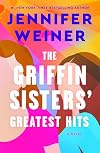
The Griffin Sisters' Greatest Hits
by Jennifer Weiner 
On This Page
Description
From #1 New York Times bestselling author Jennifer Weiner comes The Griffin Sisters' Greatest Hits, a deeply moving novel set against the glitz and chaos of early 2000s pop stardom. Equal parts heartfelt family saga and behind-the-scenes look at fame, this is a story about sisters, secrets, and the power of second chances.Cassie and Zoe Grossberg were thrust into the spotlight as The Griffin Sisters, a pop duo that defined the aughts. Together, they skyrocketed to the top, gracing MTV, SNL, show more and the cover of Rolling Stone. Cassie, a musical genius who never felt at ease in her own skin, preferred to stay in the shadows. Zoe, full of confidence and craving fame, lived for the stage. But fame has a price, and after one turbulent year, the band abruptly broke up.
Now, two decades later, the sisters couldn't be further apart. Zoe is a suburban mom warning her daughter Cherry to avoid the spotlight, while Cassie has disappeared from public life entirely. But when Cherry begins unearthing the truth behind their breathtaking rise and infamous breakup, long-buried secrets surface, forcing all three women to confront their choices, their desires, and their complicated bonds.
With richly developed characters, a nostalgic nod to the pop culture of the 2000s, and a resonant tale of ambition, forgiveness, and family, The Griffin Sisters' Greatest Hits will captivate readers from the first note to the final encore. Whether you've followed Jennifer Weiner for years or are discovering her for the first time, this book is a must-read for music lovers, fans of sisterly dramas, and anyone who cherishes a great story of second chances.
. show less
Tags
Recommendations





















Member Reviews
Listened to the audiobook, also bought the hardcover B&N Exclusive Edition which apparently doesn't exist by ISBN in LibraryThing
I do love Jennifer Weiner for her books that fly by like fluff, but aren't. This book had memorable, flawed characters -- I had to remind myself not to rate the book less just because one or two of the people in it were selfish, short-sighted monsters -- in a situation that hasn't been written to death. There were a few "but would she REALLY" moments. Not plot holes, just decisions that didn't make sense in context. But on the whole, a solidly enjoyable and moderately thought-provoking story about selfishness, neurodivergence, calculated egotistical selfishness, musical talent, raw unfettered selfishness, and show more sisterhood.
I liked the apology scenes. I took mental notes.
Dakota Fanning's narration was very good other than the fact that she, like another celebrity narrator I listened to recently, does that thing where she pauses for too long mid-sentence. It makes it sound whole passages are structured like free-verse poems. show less
I do love Jennifer Weiner for her books that fly by like fluff, but aren't. This book had memorable, flawed characters -- I had to remind myself not to rate the book less just because one or two of the people in it were selfish, short-sighted monsters -- in a situation that hasn't been written to death. There were a few "but would she REALLY" moments. Not plot holes, just decisions that didn't make sense in context. But on the whole, a solidly enjoyable and moderately thought-provoking story about selfishness, neurodivergence, calculated egotistical selfishness, musical talent, raw unfettered selfishness, and show more sisterhood.
I liked the apology scenes. I took mental notes.
Dakota Fanning's narration was very good other than the fact that she, like another celebrity narrator I listened to recently, does that thing where she pauses for too long mid-sentence. It makes it sound whole passages are structured like free-verse poems. show less
Vanity will lift you up and then knock you flat — and this book captures that feeling perfectly. Seriously, all the feels with this one. Jennifer Weiner took this Gen X-er straight back to the 80s, right into my backyard in Margate, NJ, and then through Haddonfield and Philly — felt like coming home.
I’m not gonna spoil anything, but the story dives deep into sisterhood (with all its messy layers), rock & roll, neurodiversity, obesity, loneliness, vanity, jealousy, forgiveness, and the heartbreak of wasted time. Weiner also sheds light on the crap women had to deal with in the music industry back then — but there's a ton of girl power and heart power shining through too.
Weiner’s a bestseller for a reason, and this one totally show more hits the mark!
*I received an arc from the publisher through NetGalley for an honest review show less
I’m not gonna spoil anything, but the story dives deep into sisterhood (with all its messy layers), rock & roll, neurodiversity, obesity, loneliness, vanity, jealousy, forgiveness, and the heartbreak of wasted time. Weiner also sheds light on the crap women had to deal with in the music industry back then — but there's a ton of girl power and heart power shining through too.
Weiner’s a bestseller for a reason, and this one totally show more hits the mark!
*I received an arc from the publisher through NetGalley for an honest review show less
⭐️⭐️⭐️⭐️⭐️ A Heartfelt, Hopeful Story That Balances Love, Loss, and Sisterhood Beautifully
The Griffin Sisters Greatest Hits is Jennifer Weiner at her absolute best — warm, witty, deeply human, and quietly devastating in all the right ways. What starts as a quick, engaging read unfolds into something far more layered, especially as the story explores the grief wrapped around a once‑in‑a‑lifetime love and the life that was built — and lost — alongside it.
Weiner doesn’t sensationalize the heartbreak. Instead, she lets it breathe. She shows how love doesn’t disappear just because someone is gone; it lingers in the routines, the memories, the music, and the tiny moments that catch you off guard. The way show more the book handles that emotional weight feels honest and tender, especially as the sisters navigate what it means to move forward without letting go of what mattered.
And yet, despite the heaviness, the story never feels bleak. The sister dynamics bring humor, warmth, and that messy, familiar chaos that makes you feel like you’re sitting in the room with them. The pacing is quick, the dialogue sparkles, and the emotional beats land with surprising force.
It’s the kind of book you pick up for a light read and end up thinking about long after you close it — a reminder that grief and joy can coexist, that love leaves echoes, and that family can be both the soft place to land and the push you need to keep going.
A beautiful, bingeable, heartfelt read. Five stars without hesitation. show less
The Griffin Sisters Greatest Hits is Jennifer Weiner at her absolute best — warm, witty, deeply human, and quietly devastating in all the right ways. What starts as a quick, engaging read unfolds into something far more layered, especially as the story explores the grief wrapped around a once‑in‑a‑lifetime love and the life that was built — and lost — alongside it.
Weiner doesn’t sensationalize the heartbreak. Instead, she lets it breathe. She shows how love doesn’t disappear just because someone is gone; it lingers in the routines, the memories, the music, and the tiny moments that catch you off guard. The way show more the book handles that emotional weight feels honest and tender, especially as the sisters navigate what it means to move forward without letting go of what mattered.
And yet, despite the heaviness, the story never feels bleak. The sister dynamics bring humor, warmth, and that messy, familiar chaos that makes you feel like you’re sitting in the room with them. The pacing is quick, the dialogue sparkles, and the emotional beats land with surprising force.
It’s the kind of book you pick up for a light read and end up thinking about long after you close it — a reminder that grief and joy can coexist, that love leaves echoes, and that family can be both the soft place to land and the push you need to keep going.
A beautiful, bingeable, heartfelt read. Five stars without hesitation. show less
I forgot how much I love Jennifer Weiner's books. I laughed so hard with her first book, Good in Bed, I had to stop reading it in public! I kept up with her books for many years, then lost touch. I'm so glad that I jumped back in with her newest book, The Griffin Sisters Greatest Hits. While it didn't make me laugh, it certainly held my interest as I read a great story about two very different sisters who become famous rock stars for a short time. The sisters, Zoe and Cassie Grossberg, born a year apart, are complete opposites. Zoe is charming and beautiful and yearns to be in the spotlight. Cassie is a music prodigy who isn't comfortable in her own skin and wants to hide in the shadows.
Twenty years later, Zoe is married and living in show more the suburbs and Cassie is living off the grid in Alaska. Cherry, Zoe's daughter, also musically talented has left home and is determined to find her Aunt Cassie and find out what exactly happened twenty years ago. show less
Twenty years later, Zoe is married and living in show more the suburbs and Cassie is living off the grid in Alaska. Cherry, Zoe's daughter, also musically talented has left home and is determined to find her Aunt Cassie and find out what exactly happened twenty years ago. show less
Bestselling author Jennifer Weiner published her first book, Good in Bed, in which the main character, Cannie Shapiro, struggles to make peace with her plus-size body, in 2001. At that time, it was rare to encounter a plus-size female character in a work of contemporary fiction. Weiner recalls the “bad old days” when “fat characters were comic relief, or they were on their way to being thin characters. They were the ‘before’ and ‘after’ ads.” But Weiner “wanted to write a story where the big girl stayed big and still got all the wonderful things.” Today, plus-sized characters are “seen as a much more acceptable, normal thing” and that encourages Weiner and makes her “happy.” She observes that today an entire show more generation of adult women have no awareness or appreciation of what a challenge it was to get Good in Bed published.
Inspiration for Weiner’s twentieth novel, The Griffin Sisters’ Greatest Hits, struck when she was vacationing in Alaska. She imagined a woman living there. Wearing an oversized parka, carrying cleaning supplies, she wondered who the woman was, how she ended up in Alaska, who she might be running from, and “who she used to be.” She had wanted for a long time to write a book about the music industry and while conducting research, recalled Wilson Phillips and the videos in which Carnie Wilson was dressed differently than the other female members of the band – “Even on a beach, she was in a pantsuit!” – and the idea that she needed to be hidden. She wanted to write The Griffin Sisters’ Greatest Hits “as an act of reclamation. I wanted to take those big girls who had been pushed to the side and put them back into the spotlight.”
Weiner created Zoe and Cassie Grossberg, sisters who could not be more different. Zoe is beautiful, outgoing, gregarious. From birth, she loved attention and wanted to be famous. For their mother, Janice, Zoe was easy to love because she was a happy, contented baby. But when she found herself pregnant again when Zoe was just seven months old, she was devastated. Another baby so soon was not what she and her husband, Sam, had planned. Their second child was not supposed to arrive until they saved up enough money to purchase their own home. Moreover, the pregnancy and delivery were difficult, and Janice was convinced she would never be able to love her second daughter who challenged Janice in ways Zoe never did. She named her Cassandra solely because she’d heard the name in a book about Greek mythology, with no knowledge that the Cassandra depicted in those myths “was a prophetess, cursed to speak the truth and have no one believe her.” Later, Janice would wonder if “the name shaped Cassie’s life somehow, condemning her to sorrow.”
Cassie was an overweight, awkward, quiet child who was not popular and did not make friends. Despite how different they were, the girls were close growing up and Zoe protected Cassie. Weiner relates the story from Janice’s perspective, as well as those of Zoe and Cassie, revealing details through flashbacks about the sisters’ childhood and how their parents learned that Cassie was a musical prodigy. They acquired a piano and arranged for her to have lessons. Eventually, she was accepted to a prestigious school where she studied classical music.
In high school, Zoe put together a rock band called Girl Power! (yes, the exclamation point was part of the band’s name), but she was exiled from the group following a dispute about – what else? – a boy. Intent on nonetheless performing in a battle of the bands at a local club, Zoe implored Cassie to sing with her, even though Cassie wanted no part of being on stage. Cassie had never displayed stage fright at her piano recitals, but singing before an audience was an entirely different matter. Self-conscious, she did not want people to look at her, certain that she would be judged on her appearance . . . and cruelly rejected. “The attention, even if it was positive attention, was unsettling, destabilizing and confusing.”
But for Zoe, Cassie relented. And when they took the stage, she closed her eyes as she played the piano and sang. A “reverent hush” fell over the appreciative audience. Zoe sensed it immediately and felt “the first threads of envy gathering inside her, twisting and knotting into something nasty and sharp-edged.” As Cassie’s confidence grew with each note, so did Zoe’s resentment. Zoe was supposed to be the one destined for stardom, but she instantly recognized that Cassie’s transcendent voice and raw, natural talent had relegated her to the role of backup singer. And always would. For a few brief moments, as the applause washed over them, Zoe’s jealousy abated because of her gratitude for Cassie helping her win the competition.
A talent scout soon arrived on the scene and arranged for the girls to work with songwriter Russell D’Angelo. Again, however, it was Cassie who possessed talent and promise. She and Russell worked well together and created songs that were more than beautiful – they were potential hits. The Grossberg sisters became the Griffin sisters, Russell became their guitar player. They recorded an album, began touring, and quickly achieved the kind of success that most musicians only dream about.
But, as Weiner details, everything fell apart in spectacular fashion. There was no second album, the band broke up, and Cassie disappeared immediately following a night of tragedy that, in the ensuing twenty years, become the stuff of legend and myth.
In 2024, Zoe is a married mother of three — eighteen-year-old Cherry and two younger boys — and a stepmother to Bix who is a year older than Cherry and extremely troubled. Bix’s behavior has been ignored by Zoe and minimized by Cherry’s stepfather. Cherry has had enough and now that she is eighteen, she is “free to become the only thing she’d ever wanted to be: A singer. A musician. A star.” Cherry sneaks out of the house, en route to compete on an American Idol-type show. Her mother has never told her the story of the Griffin Sisters. “Zoe would never talk about her days in the band, no matter how much Cherry pestered and pleaded, . . .” Nor would Zoe talk about Cherry’s deceased father. Cherry has never met her Aunt Cassie.
Cassie is living anonymously in vast, beautiful, but isolated Alaska where she owns fifty acres of woods and three tiny houses, living in one and renting the other two to tourists. She speaks to as few people as possible, preferring the company of her dog, Wesley. She hides from the world, and there is no more music in her life. She lives in a state of “constant torment, a crushed-glass sorrow” never relenting. She is convinced that she “hurt everyone who’d gotten close to her” and feels she is not worthy of forgiveness. She even employs a company to monitor mentions of her on social media and the internet, and have those references removed as quickly as possible. Only three people have her telephone number. To her mother, Janice, she sends a monthly text message, “I’m here. I’m fine.” Her Aunt Bess urges her to talk to Zoe, but she refuses. And CJ, the band’s former manager, calls periodically to try to convince Cassie to accept offers to perform, grant rights for the band’s music to be used, and the like. She always refuses. As the twenty-fifth anniversary of the band’s one hit album approaches, it is selling well again. But Cassie donates her income as part of her self-imposed punishment for whatever it is she did that was so horrific.
Gradually, from the alternating perspectives of her characters spanning more than a quarter of a century, Weiner unravels a complicated, layered, and emotionally fraught tale of the two sisters’ childhoods, quick rise to fame and legendary success in the music industry, and their act’s just as rapid, tragic demise.
Cassie is the beat and soundtrack of the story. Although Weiner never specifically describes her as being neurodivergent, her behavior and feelings suggest that. And, of course, when she was growing up, little was known or understood about neurodivergent children or adults. Thanks to a caring, observant teacher, Cassie’s parents were alerted to the musical talent she dud not exhibit at home. To their credit, they nurtured that talent and encouraged her studies. And when Zoe pressed Cassie to perform with her, the girls were “discovered” and given a contract by a record label, even as Cassie began to discover her talent both as a vocalist and songwriter. Her confidence grew, but Weiner describes the cruel manner in which Cassie was viewed as a commodity by those who stood to profit from her talent. Even if they didn’t belittle her to her face, Cassie was humiliated and hurt by the manner in which she was treated – everything from the wardrobe selected for her to her initial placement on stage was designed by the group’s own team to minimize Cassie’s appearance, even as her incomparable vocal performances refused to be diminished. Audiences adored Cassie’s music, but mocked the way she looked.
For Cassie, the music and Zoe were what mattered. And she developed a productive and meaningful songwriting partnership with Russell. She never sought stardom. Ironically, she could not evade it. The popularity of her music was unprecedented and unstoppable, as were the feelings she developed for Russell.
Zoe, in contrast, wanted fame and all of its accoutrements. Her physical attributes were accentuated by the wardrobe selected for her, the stage lighting, etc. Gradually, though, Zoe found herself pushed further and further from the audience as Cassie’s piano was eased toward the front rows. Cassie sang the lead, while Zoe’s mediocre vocal prowess was relegated to backup status. She became increasingly desperate to remain in the spotlight and engaged in shocking machinations and betrayals designed to ensure that Cassie did not upstage her — professionally or personally.
Zoe is a manipulative, controlling narcissist who, on the surface, is unlikable and undeserving of empathy or compassion. Those characteristics have impeded her ability to mother Cherry and hear her when she has sought her mother’s help and protection. But Zoe is multi-layered and complicated, as Weiner demonstrates, with her ambition fueled by her own insecurity and self-doubt, despite having been blessed with physical attributes that make it far easier for her to navigate the world than it is for Cassie. She may be beautiful on the outside, but Zoe lacks the internal beauty that radiates naturally from Cassie. Can she develop the self-awareness required to change her behavior and the way she relates to those she really does love?
Weiner expertly ramps up the dramatic tension as the narratives alternate. The girls’ history is detailed incrementally, and she eventually reveals exactly what caused their relationship to fracture beyond repair and the band to permanently break up.
Can anything or anyone bring the girls back together to finally talk about everything that happened so many years ago? Can they forgive each other and repair their relationship? Can they ever make beautiful music together again?
The Griffin Sisters’ Greatest Hits is a riveting story about dreams, ambition, and the high cost of achieving success in a competitive and demanding industry. Indeed, Weiner says that one of the principle questions considered in the tale is, “What is the price of having a gift?” Cassie struggles with whether she has an obligation to use the gift she has been given. Weiner examines the difficulty of retaining one’s humanity and care for others in a business that inspires conniving, cutthroat behavior. Weiner compassionately explores the ways in which sisters have the capacity to both love and hate each other; want the best for each other and experience debilitating jealousy and resentment when one excels while the other struggles; and the myriad ways in which they are able to fervently love yet hurt each other with unparalleled viciousness.
The book also illustrates the cruelly callous ways women are objectified, judged, and discarded on the basis of their physical appearance rather than acknowledged for their intellect, talent, and accomplishments. And stereotyped and pigeon-holed, labeled as “the pretty one,” “the fat one,” “the awkward one.” Female readers will recognize themselves and their experiences in the pages of Weiner’s unapologetic depiction of Cassie’s fight to be valued for her talent, and self-flagellation and sense of being “less than” for failing to live up to the standards imposed upon her not just by the music industry, but the culture as a whole.
Weiner delivers yet another book that is emotionally resonant, riveting – readers be anxious to discover what serves as the impetus for the band’s dramatic break up – and thought-provoking. The Griffin Sisters’ Greatest Hits features memorable characters. “I think as women we are taught to be very hard on ourselves, to set the bar high and to beat ourselves up if we don’t clear it,” Weiner says. “And as women, we can forgive everyone else, but sometimes we can’t forgive ourselves.” Cassie, Zoe, Cherry, and Janice are all fascinating, sympathetic, and trying to clear that bar in their own way. Readers will cheer for them to find a way to reconcile, forgive each other and themselves, and reunite.
Thanks to NetGalley for an Advance Readers' Copy and to the publisher for a paperback copy of the book. show less
Inspiration for Weiner’s twentieth novel, The Griffin Sisters’ Greatest Hits, struck when she was vacationing in Alaska. She imagined a woman living there. Wearing an oversized parka, carrying cleaning supplies, she wondered who the woman was, how she ended up in Alaska, who she might be running from, and “who she used to be.” She had wanted for a long time to write a book about the music industry and while conducting research, recalled Wilson Phillips and the videos in which Carnie Wilson was dressed differently than the other female members of the band – “Even on a beach, she was in a pantsuit!” – and the idea that she needed to be hidden. She wanted to write The Griffin Sisters’ Greatest Hits “as an act of reclamation. I wanted to take those big girls who had been pushed to the side and put them back into the spotlight.”
Weiner created Zoe and Cassie Grossberg, sisters who could not be more different. Zoe is beautiful, outgoing, gregarious. From birth, she loved attention and wanted to be famous. For their mother, Janice, Zoe was easy to love because she was a happy, contented baby. But when she found herself pregnant again when Zoe was just seven months old, she was devastated. Another baby so soon was not what she and her husband, Sam, had planned. Their second child was not supposed to arrive until they saved up enough money to purchase their own home. Moreover, the pregnancy and delivery were difficult, and Janice was convinced she would never be able to love her second daughter who challenged Janice in ways Zoe never did. She named her Cassandra solely because she’d heard the name in a book about Greek mythology, with no knowledge that the Cassandra depicted in those myths “was a prophetess, cursed to speak the truth and have no one believe her.” Later, Janice would wonder if “the name shaped Cassie’s life somehow, condemning her to sorrow.”
Cassie was an overweight, awkward, quiet child who was not popular and did not make friends. Despite how different they were, the girls were close growing up and Zoe protected Cassie. Weiner relates the story from Janice’s perspective, as well as those of Zoe and Cassie, revealing details through flashbacks about the sisters’ childhood and how their parents learned that Cassie was a musical prodigy. They acquired a piano and arranged for her to have lessons. Eventually, she was accepted to a prestigious school where she studied classical music.
In high school, Zoe put together a rock band called Girl Power! (yes, the exclamation point was part of the band’s name), but she was exiled from the group following a dispute about – what else? – a boy. Intent on nonetheless performing in a battle of the bands at a local club, Zoe implored Cassie to sing with her, even though Cassie wanted no part of being on stage. Cassie had never displayed stage fright at her piano recitals, but singing before an audience was an entirely different matter. Self-conscious, she did not want people to look at her, certain that she would be judged on her appearance . . . and cruelly rejected. “The attention, even if it was positive attention, was unsettling, destabilizing and confusing.”
But for Zoe, Cassie relented. And when they took the stage, she closed her eyes as she played the piano and sang. A “reverent hush” fell over the appreciative audience. Zoe sensed it immediately and felt “the first threads of envy gathering inside her, twisting and knotting into something nasty and sharp-edged.” As Cassie’s confidence grew with each note, so did Zoe’s resentment. Zoe was supposed to be the one destined for stardom, but she instantly recognized that Cassie’s transcendent voice and raw, natural talent had relegated her to the role of backup singer. And always would. For a few brief moments, as the applause washed over them, Zoe’s jealousy abated because of her gratitude for Cassie helping her win the competition.
A talent scout soon arrived on the scene and arranged for the girls to work with songwriter Russell D’Angelo. Again, however, it was Cassie who possessed talent and promise. She and Russell worked well together and created songs that were more than beautiful – they were potential hits. The Grossberg sisters became the Griffin sisters, Russell became their guitar player. They recorded an album, began touring, and quickly achieved the kind of success that most musicians only dream about.
But, as Weiner details, everything fell apart in spectacular fashion. There was no second album, the band broke up, and Cassie disappeared immediately following a night of tragedy that, in the ensuing twenty years, become the stuff of legend and myth.
In 2024, Zoe is a married mother of three — eighteen-year-old Cherry and two younger boys — and a stepmother to Bix who is a year older than Cherry and extremely troubled. Bix’s behavior has been ignored by Zoe and minimized by Cherry’s stepfather. Cherry has had enough and now that she is eighteen, she is “free to become the only thing she’d ever wanted to be: A singer. A musician. A star.” Cherry sneaks out of the house, en route to compete on an American Idol-type show. Her mother has never told her the story of the Griffin Sisters. “Zoe would never talk about her days in the band, no matter how much Cherry pestered and pleaded, . . .” Nor would Zoe talk about Cherry’s deceased father. Cherry has never met her Aunt Cassie.
Cassie is living anonymously in vast, beautiful, but isolated Alaska where she owns fifty acres of woods and three tiny houses, living in one and renting the other two to tourists. She speaks to as few people as possible, preferring the company of her dog, Wesley. She hides from the world, and there is no more music in her life. She lives in a state of “constant torment, a crushed-glass sorrow” never relenting. She is convinced that she “hurt everyone who’d gotten close to her” and feels she is not worthy of forgiveness. She even employs a company to monitor mentions of her on social media and the internet, and have those references removed as quickly as possible. Only three people have her telephone number. To her mother, Janice, she sends a monthly text message, “I’m here. I’m fine.” Her Aunt Bess urges her to talk to Zoe, but she refuses. And CJ, the band’s former manager, calls periodically to try to convince Cassie to accept offers to perform, grant rights for the band’s music to be used, and the like. She always refuses. As the twenty-fifth anniversary of the band’s one hit album approaches, it is selling well again. But Cassie donates her income as part of her self-imposed punishment for whatever it is she did that was so horrific.
Gradually, from the alternating perspectives of her characters spanning more than a quarter of a century, Weiner unravels a complicated, layered, and emotionally fraught tale of the two sisters’ childhoods, quick rise to fame and legendary success in the music industry, and their act’s just as rapid, tragic demise.
Cassie is the beat and soundtrack of the story. Although Weiner never specifically describes her as being neurodivergent, her behavior and feelings suggest that. And, of course, when she was growing up, little was known or understood about neurodivergent children or adults. Thanks to a caring, observant teacher, Cassie’s parents were alerted to the musical talent she dud not exhibit at home. To their credit, they nurtured that talent and encouraged her studies. And when Zoe pressed Cassie to perform with her, the girls were “discovered” and given a contract by a record label, even as Cassie began to discover her talent both as a vocalist and songwriter. Her confidence grew, but Weiner describes the cruel manner in which Cassie was viewed as a commodity by those who stood to profit from her talent. Even if they didn’t belittle her to her face, Cassie was humiliated and hurt by the manner in which she was treated – everything from the wardrobe selected for her to her initial placement on stage was designed by the group’s own team to minimize Cassie’s appearance, even as her incomparable vocal performances refused to be diminished. Audiences adored Cassie’s music, but mocked the way she looked.
For Cassie, the music and Zoe were what mattered. And she developed a productive and meaningful songwriting partnership with Russell. She never sought stardom. Ironically, she could not evade it. The popularity of her music was unprecedented and unstoppable, as were the feelings she developed for Russell.
Zoe, in contrast, wanted fame and all of its accoutrements. Her physical attributes were accentuated by the wardrobe selected for her, the stage lighting, etc. Gradually, though, Zoe found herself pushed further and further from the audience as Cassie’s piano was eased toward the front rows. Cassie sang the lead, while Zoe’s mediocre vocal prowess was relegated to backup status. She became increasingly desperate to remain in the spotlight and engaged in shocking machinations and betrayals designed to ensure that Cassie did not upstage her — professionally or personally.
Zoe is a manipulative, controlling narcissist who, on the surface, is unlikable and undeserving of empathy or compassion. Those characteristics have impeded her ability to mother Cherry and hear her when she has sought her mother’s help and protection. But Zoe is multi-layered and complicated, as Weiner demonstrates, with her ambition fueled by her own insecurity and self-doubt, despite having been blessed with physical attributes that make it far easier for her to navigate the world than it is for Cassie. She may be beautiful on the outside, but Zoe lacks the internal beauty that radiates naturally from Cassie. Can she develop the self-awareness required to change her behavior and the way she relates to those she really does love?
Weiner expertly ramps up the dramatic tension as the narratives alternate. The girls’ history is detailed incrementally, and she eventually reveals exactly what caused their relationship to fracture beyond repair and the band to permanently break up.
Can anything or anyone bring the girls back together to finally talk about everything that happened so many years ago? Can they forgive each other and repair their relationship? Can they ever make beautiful music together again?
The Griffin Sisters’ Greatest Hits is a riveting story about dreams, ambition, and the high cost of achieving success in a competitive and demanding industry. Indeed, Weiner says that one of the principle questions considered in the tale is, “What is the price of having a gift?” Cassie struggles with whether she has an obligation to use the gift she has been given. Weiner examines the difficulty of retaining one’s humanity and care for others in a business that inspires conniving, cutthroat behavior. Weiner compassionately explores the ways in which sisters have the capacity to both love and hate each other; want the best for each other and experience debilitating jealousy and resentment when one excels while the other struggles; and the myriad ways in which they are able to fervently love yet hurt each other with unparalleled viciousness.
The book also illustrates the cruelly callous ways women are objectified, judged, and discarded on the basis of their physical appearance rather than acknowledged for their intellect, talent, and accomplishments. And stereotyped and pigeon-holed, labeled as “the pretty one,” “the fat one,” “the awkward one.” Female readers will recognize themselves and their experiences in the pages of Weiner’s unapologetic depiction of Cassie’s fight to be valued for her talent, and self-flagellation and sense of being “less than” for failing to live up to the standards imposed upon her not just by the music industry, but the culture as a whole.
Weiner delivers yet another book that is emotionally resonant, riveting – readers be anxious to discover what serves as the impetus for the band’s dramatic break up – and thought-provoking. The Griffin Sisters’ Greatest Hits features memorable characters. “I think as women we are taught to be very hard on ourselves, to set the bar high and to beat ourselves up if we don’t clear it,” Weiner says. “And as women, we can forgive everyone else, but sometimes we can’t forgive ourselves.” Cassie, Zoe, Cherry, and Janice are all fascinating, sympathetic, and trying to clear that bar in their own way. Readers will cheer for them to find a way to reconcile, forgive each other and themselves, and reunite.
Thanks to NetGalley for an Advance Readers' Copy and to the publisher for a paperback copy of the book. show less
The Griffin Sisters' Greatest Hits by Jennifer Weiner is a very highly recommended family drama following three women: two sisters brief career in the world of pop music and the burgeoning talent of a daughter.
Sisters Zoe and Cassie Grossberg were born a year apart and are polar opposites. Zoe is pretty, popular, and wants to be a singer in a band. Cassie is a wildly talented musical prodigy who can sing, write songs, and play anything on the piano, but she is overweight and lacks confidence and self esteem. Cassie will sing with Zoe, however, so when she is talked into performing one night the two are discovered.
They form a group, The Griffin Sisters, and songwriter Russell D’Angelo, joins them. He and Cassie immediately connect when show more writing songs together. Zoe, who is used to be the sister everyone wants, sets her sights on Russell, in spite of his lack of interest in her. Her actions eventually lead the group breaking up, and, inadvertently, Russell's death. Cassie flees to Alaska and cuts off contact. Zoe has a baby, Cherry, and tries and fails to launch a solo career. She then marries and loses all aspirations for fame.
Cherry shows a real musical talent, but her mother discourages her from pursuing a career in music. At 18 she auditions, gets a spot on a talent search show, and leaves home without a word. This eventually leads her to trying to find her aunt Cassie for help and, in part, to learn the truth about what happened to the band years ago.
Chapters in the narrative follows Cassie, Zoe, and Cherry in the current day and also have chapters from two decades earlier when The Griffin Sisters began allowing you to get a good sense of their personalities and proclivities. The characters are all depicted as fully realized individuals with strengths, flaws, needs, and secrets. We know their inner struggles, failings, and thoughts. They are not all likeable, but they are portrayed as realistic with their own challenges.
The writing is excellent and the pace is fast. Once I started reading this novel, I was pleasantly surprised how quickly I became invested in the plot and caught up with the drama and complexities of the interaction between both the sisters and also the issues between mother and daughter. Knowing their inner thoughts and secrets, even those that were unpleasant and cruel, gave depth to the characters and their motives and desires. It also makes it a nuanced, realistic family drama.
This is a novel about sisters, dreams, music, motherhood, young love, forgiveness, and the courage it takes to follow your dreams. Along with that is also a realistic delineation of the adage that all actions have consequences and those consequences must be faced. Finally, clearly there is a message about not judging people by their looks.
The Griffin Sisters' Greatest Hits is a great choice for those who enjoy family dramas and music. Thanks to William Morrow for providing me with an advance reader's copy. My review is voluntary and expresses my honest opinion.
http://www.shetreadssoftly.com/2025/03/the-griffin-sisters-greatest-hits.html show less
Sisters Zoe and Cassie Grossberg were born a year apart and are polar opposites. Zoe is pretty, popular, and wants to be a singer in a band. Cassie is a wildly talented musical prodigy who can sing, write songs, and play anything on the piano, but she is overweight and lacks confidence and self esteem. Cassie will sing with Zoe, however, so when she is talked into performing one night the two are discovered.
They form a group, The Griffin Sisters, and songwriter Russell D’Angelo, joins them. He and Cassie immediately connect when show more writing songs together. Zoe, who is used to be the sister everyone wants, sets her sights on Russell, in spite of his lack of interest in her. Her actions eventually lead the group breaking up, and, inadvertently, Russell's death. Cassie flees to Alaska and cuts off contact. Zoe has a baby, Cherry, and tries and fails to launch a solo career. She then marries and loses all aspirations for fame.
Cherry shows a real musical talent, but her mother discourages her from pursuing a career in music. At 18 she auditions, gets a spot on a talent search show, and leaves home without a word. This eventually leads her to trying to find her aunt Cassie for help and, in part, to learn the truth about what happened to the band years ago.
Chapters in the narrative follows Cassie, Zoe, and Cherry in the current day and also have chapters from two decades earlier when The Griffin Sisters began allowing you to get a good sense of their personalities and proclivities. The characters are all depicted as fully realized individuals with strengths, flaws, needs, and secrets. We know their inner struggles, failings, and thoughts. They are not all likeable, but they are portrayed as realistic with their own challenges.
The writing is excellent and the pace is fast. Once I started reading this novel, I was pleasantly surprised how quickly I became invested in the plot and caught up with the drama and complexities of the interaction between both the sisters and also the issues between mother and daughter. Knowing their inner thoughts and secrets, even those that were unpleasant and cruel, gave depth to the characters and their motives and desires. It also makes it a nuanced, realistic family drama.
This is a novel about sisters, dreams, music, motherhood, young love, forgiveness, and the courage it takes to follow your dreams. Along with that is also a realistic delineation of the adage that all actions have consequences and those consequences must be faced. Finally, clearly there is a message about not judging people by their looks.
The Griffin Sisters' Greatest Hits is a great choice for those who enjoy family dramas and music. Thanks to William Morrow for providing me with an advance reader's copy. My review is voluntary and expresses my honest opinion.
http://www.shetreadssoftly.com/2025/03/the-griffin-sisters-greatest-hits.html show less
I have to start by saying that Weiner’s book GOOD IN BED is the book that turned me into a reader. So to say I am a big fan does not quite capture how I feel about her writing. So, when I say this book may be my new favorite by Weiner says A LOT! This book has everything…the story, the characters, the excitement, the emotions (highs and lows), the tension, the heartbreak…everything was pure gold! I could not stop reading/listening!!! It was brilliantly done. I was invested immediately. It all came together beautifully…but it was not without love, loss, struggles and triumphs. Such an emotionally charged read that will leave you wanting more!!! I highly recommend this amazing story.
Members
- Recently Added By
Lists

LoanStars | Adult List: April 2025
10 works; 1 member

Books Read in 2025
4,091 works; 97 members

Books Read in 2025
36 works; 1 member
Author Information

51+ Works 36,905 Members
Jennifer Weiner grew up in Simsbury, Connecticut. She attended Princeton University, where she studied with John McPhee, Toni Morrison and Joyce Carol Oates. She is currently a reporter/columnist at the "Philadelphia Inquirer" and a contributing editor at "Mademoiselle". Her short stories have been published in "Seventeen" and "Redbook". Her show more freelance work appears in Salon.com, "Time Out New York", "Animal Fair", the "Columbia Journalism Review" and "Seventeen". She lives in Philadelphia and appears regularly on "Philly after Midnight," Philadelphia's local late-night television show, as a commentator. (Publisher Provided) show less
Jennifer Weiner is a LibraryThing Author, an author who lists their personal library on LibraryThing.
Awards and Honors
Distinctions
Common Knowledge
- Canonical title
- The Griffin Sisters' Greatest Hits
- Original publication date
- 2025
- People/Characters
- Zoe Grossberg Rohrbach; Cassandra “Cassie” Grossberg; Cherry Rohrbach; Jason Rohrbach; Russell D'Angelo; Janice Grossberg (show all 11); Bix Rohrbach; Tommy Kelleher; Cam Gratz; Bess; CJ Carver
- Important places
- Philadelphia, Pennsylvania, USA; Alaska, USA; Haddonfield, New Jersey, USA; Los Angeles, California, USA
- Dedication
- FOR PHOEBE,
MY ROCKSTAR - First words
- I never should have touched you,” Russell D'Angelo says to the empty room.
- Quotations
- “People have questions. Songs are the answers,…”
It was a hopeless kind of cold; a cold without the possibility of warmth; a cold that told you spring was never coming and summer was a lie you'd told yourself. - Last words
- (Click to show. Warning: May contain spoilers.)For these gifts and more, make me grateful, Cherry thought. And then, along with her mother and her aunt, Cherry kissed her fingertips, and raised them to the sky.
Classifications
Statistics
- Members
- 466
- Popularity
- 65,418
- Reviews
- 22
- Rating
- (3.90)
- Languages
- English
- Media
- Paper, Audiobook, Ebook
- ISBNs
- 17
- ASINs
- 3