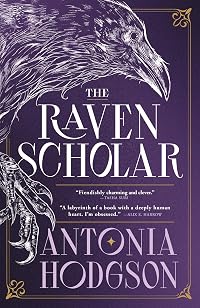
On This Page
Description
From an electrifying new voice in epic fantasy comes The Raven Scholar, a masterfully woven and playfully inventive tale of imperial intrigue, cutthroat competition, and one scholar's quest to uncover the truth.Let us fly now to the empire of Orrun, where after twenty-four years of peace, Bersun the Brusque must end his reign. In the dizzying heat of mid-summer, seven contenders compete to replace him. They are exceptional warriors, thinkers, strategists—the best of the best.
Then one of show more them is murdered. We know who did it. We saw it happen. No one else did.
It falls to Neema Kraa, the emperor's brilliant, idiosyncratic High Scholar, to find the killer before the trials end. To do so, she must untangle a web of deadly secrets that stretches back generations, all while competing against six warriors with their own dark histories and fierce ambitions. Neema believes she is alone. But we are here to help; all she has to do is let us in.
If she succeeds, she will win the throne. If she fails, death awaits her. But we won't let that happen.
We are the Raven, and we are magnificent. show less
Tags
Recommendations






Member Reviews
A big book with a big recommendation—really wonderful palace intrigue. There are eight totems; seven sets of worshipers send competitors to be the new Emperor as the old one’s term ends. But murder, intrigue, and crimes reaching out from the past to spill new blood complicate things, as does the fact that if the leading contender wins, he might bring the Eight back and end the world. Expertly blends fantasy with the mystery technique of revealing new information that reframes or at least adds a lot of nuance to each person’s acts. I can’t wait for the next volume.
This is an immersive secondary world fantasy, the kind of thing that can demand a lot of work from a reader, but Hodgson does a good job supporting that work. I appreciated how well the story was told; I think many writers of immersive fantasy in particular don't really see the narrator as a character worth thinking about, except as a supposedly transparent lens into the third-person thoughts of your protagonists. But Hodgson's narrator has personality and verve. Exactly where its perspective comes from is slowly revealed across the course of the book in a way I found interesting. The novel even seems to be some kind of in-universe document, as it contains footnotes and commentary. (Exactly where this text originates from wasn't clear show more to me, though I suppose there are two more books to go.)
Me being me, I'm of course constantly thinking about everything I read in terms of its genre: where is it positioned relative to other constituents of the field? I read a comment on Reddit that even though none of the characters were young adults, the book felt YA, and I was like, "Hm, why would that be?" I don't know that I agree that I felt YA, but I could see how someone else would feel that way. And I decided that it was that it's all a bit Harry Potter / Hunger Games, in two ways. First, there's that classic YA trope, that the entire society can be divided into x number of groups. This isn't always a YA thing, but we commonly see it in YA: the four houses in Harry Potter are the most obvious example. Here, the Empire is divided into eight different orders: the Ravens of the title are the scholars, the Foxes are the spies and assassins, and so on. (I, obviously, would be an Ox.) Has any real society ever broken down so neatly? There are exactly eight kinds of people!
The other very YA thing is that there's a "trial" of some kind. The Empire chooses its leader through a competition, where each of the eight orders fields a representative; they compete in both combat- and noncombat-based events across the course of a week. It all felt a bit "Triwizard Tournament" to me, especially the aspect that even though there's been a murder, the trials must still go ahead, and so the main character has to investigate the murder and participate in the trials, which is the kind of stuff I feel like Dumbledore is always inexplicably making Harry Potter do. Yes, someone's been murdered, but we can't postpone our games, so you must compete in them and be a detective!
I told a friend this, and she said it was weird that I specifically associated it with Harry Potter, because she says it's basically ubiquitous across contemporary fantasy. I would assume this mostly people who grew up on Harry Potter and thus absorbed it into their conception of how the genre works—though perhaps the even bigger influence here is Divergent, which features both a set of groups and a big competition. As my friend said, it "really cemented the 'classified groups' thing beyond the school story context." I was thus surprised to discover that author Antonia Hodgson is about ten years older than me; she is not part of the Harry Potter generation, surprisingly enough, and so I wouldn't think would have this in her default conception of how fantasy realms operate. But here it is, and I think it's why the redditor in question found The Raven Scholar to be on the YA end, because it's coming from a YA fantasy conception of how the universe works.
I find the the "people classify themselves" thing a little silly, but tolerable; I do find the system of trials for choosing a leader unbelievable, especially when we find out it's been a place for over a thousand years. Does any institution function so consistently for so long? Especially one this weird?Anyway, if you're able to accept all of this (and I was), it's a highly enjoyable read. Great characters, decent jokes, good twists, strong prose. Though over six hundred pages is probably honestly more than any book not by George Eliot needs to be. I'm not much of a fantasy person, but this solidly scratches my itch of what I enjoy in the genre when I do read it. show less
Me being me, I'm of course constantly thinking about everything I read in terms of its genre: where is it positioned relative to other constituents of the field? I read a comment on Reddit that even though none of the characters were young adults, the book felt YA, and I was like, "Hm, why would that be?" I don't know that I agree that I felt YA, but I could see how someone else would feel that way. And I decided that it was that it's all a bit Harry Potter / Hunger Games, in two ways. First, there's that classic YA trope, that the entire society can be divided into x number of groups. This isn't always a YA thing, but we commonly see it in YA: the four houses in Harry Potter are the most obvious example. Here, the Empire is divided into eight different orders: the Ravens of the title are the scholars, the Foxes are the spies and assassins, and so on. (I, obviously, would be an Ox.) Has any real society ever broken down so neatly? There are exactly eight kinds of people!
The other very YA thing is that there's a "trial" of some kind. The Empire chooses its leader through a competition, where each of the eight orders fields a representative; they compete in both combat- and noncombat-based events across the course of a week. It all felt a bit "Triwizard Tournament" to me, especially the aspect that even though there's been a murder, the trials must still go ahead, and so the main character has to investigate the murder and participate in the trials, which is the kind of stuff I feel like Dumbledore is always inexplicably making Harry Potter do. Yes, someone's been murdered, but we can't postpone our games, so you must compete in them and be a detective!
I told a friend this, and she said it was weird that I specifically associated it with Harry Potter, because she says it's basically ubiquitous across contemporary fantasy. I would assume this mostly people who grew up on Harry Potter and thus absorbed it into their conception of how the genre works—though perhaps the even bigger influence here is Divergent, which features both a set of groups and a big competition. As my friend said, it "really cemented the 'classified groups' thing beyond the school story context." I was thus surprised to discover that author Antonia Hodgson is about ten years older than me; she is not part of the Harry Potter generation, surprisingly enough, and so I wouldn't think would have this in her default conception of how fantasy realms operate. But here it is, and I think it's why the redditor in question found The Raven Scholar to be on the YA end, because it's coming from a YA fantasy conception of how the universe works.
I find the the "people classify themselves" thing a little silly, but tolerable; I do find the system of trials for choosing a leader unbelievable, especially when we find out it's been a place for over a thousand years. Does any institution function so consistently for so long? Especially one this weird?Anyway, if you're able to accept all of this (and I was), it's a highly enjoyable read. Great characters, decent jokes, good twists, strong prose. Though over six hundred pages is probably honestly more than any book not by George Eliot needs to be. I'm not much of a fantasy person, but this solidly scratches my itch of what I enjoy in the genre when I do read it. show less
I didn’t realize I was getting into an epic fantasy trilogy, and might not have picked this up if I had — that said, it’s excellent. Great world building, with cool animal spirit based houses competing for a crown. That’s extremely oversimplified but also a pleasing draw. The characters kept me coming back — Neema and Cain, the dragon affected family, the whole unfolding tragedy of betrayals. The visuals are also compelling and imaginative. I could see this as a tv adaptation, I very much enjoyed the inner dialogues of the Raven and the Fox. This feels like a very twisty road that I hope comes good.
This review refers to the audiobook read by Daphne Kouma.
I am so glad there was an ebook of The Raven Scholar included in the Hugo voter packet because I couldn't even make it through part one of the audiobook. Daphne Kouma was a poor match for this book: this is a book with some intense themes and violence, but she read it in a way that would be more appropriate for an upbeat children's book. Blech.
I had a much more enjoyable experience once I switched to the ebook, even though I found this a *very* slow starter; I feel that the first four chapters could have been dealt with in about half the number of pages with no loss to the story.
I didn't become really engaged by the book until about 20-25% in, but I was wholly invested after that show more and resented every interruption that took me away from reading. I was entranced by the combination of the trials, intrigue, and the supernatural. By the end of the book I had largely forgotten my frustration with its beginning and was looking up the release date for book two.
My recommendation: skip the audibook if possible, because it is a one star production of a four star book.
Audiobook received via NetGalley. show less
I am so glad there was an ebook of The Raven Scholar included in the Hugo voter packet because I couldn't even make it through part one of the audiobook. Daphne Kouma was a poor match for this book: this is a book with some intense themes and violence, but she read it in a way that would be more appropriate for an upbeat children's book. Blech.
I had a much more enjoyable experience once I switched to the ebook, even though I found this a *very* slow starter; I feel that the first four chapters could have been dealt with in about half the number of pages with no loss to the story.
I didn't become really engaged by the book until about 20-25% in, but I was wholly invested after that show more and resented every interruption that took me away from reading. I was entranced by the combination of the trials, intrigue, and the supernatural. By the end of the book I had largely forgotten my frustration with its beginning and was looking up the release date for book two.
My recommendation: skip the audibook if possible, because it is a one star production of a four star book.
Audiobook received via NetGalley. show less
The Raven Scholar does tropey semi-YA fantasy better than an of the other's I've read. By that I mean we have an appealing fish-out-of-water protagonist who has to navigate some kind of cliquey contest with a great reward and even greater consequences for failure while also dealing romantic entanglements and growing up.
In this case, our protagonist is Neema, the immensely competent Scholar from the Raven Temple. The Orrun Empire has lasted over 1500 years on the back of a tradition of aristocratic selection. Each emperor reigns for 24 years, and none may pick their successor. Instead, the chosen champions of the eight temples, each associated with a mythical guardian animal a bureaucratic task and a personality type (Ravens are studious show more scholars, Foxes are crafty spies, Hounds are loyal guards, Bears brave warriors, etc) compete in an 8 day long trial of fights and tests, and whoever gets the most points is the new emperor. The current emperor Bersun is just coming up on the end of his rule, and the new contest will start in a few days.
A commoner, she was ostracized by other Ravens despite being best in her class for years running. She achieved her current rank by scribing the Imperial Writ of Exile for Yana, the daughter of an infamous traitor who attempted a coup, since as an otherwise unremarkable junior clerk she had the best handwriting. This first service catapulted her up the ranks, as she became a friend and confidant to the Emperor. It also made her a bunch of enemies, including her BFF and lover, the Fox Cain, who thought that "just following orders" was no excuse to send an innocent girl to a horrific death with your name on a parchment stitched into her chest.
And now, 8 years later, Neema is very much looking forward to a quiet retirement once her role organizing the current Trials is over. Except the real Raven Candidate, her nemesis Gaida, is found dead, stabbed by a blade cursed to usher in the apocalypse the next time it kills a person. Neema is quickly assigned to investigate the murder, compete in the trials, and also prevent the end of the world. And the other complication is that many of the other competitors have very personal stakes. Cain is competing for the Foxes, and they haven't spoken in eight years. Tiger Ruko got his position by chosing the exile of his twin sister Yana. Hound Shal escorted Yana to her exile and death. Amazing how in a big empire, everything can hinge on a small room's worth of people.
The writing, which is compelling and quickly paced, elevates this book. I would have read it in a single sitting, but 8 PM - 4 AM and sleep is close enough. While Hodgson plays with tropes, she isn't their slave. The competitors are able professionals around 30 who have trained extensively, not teenagers infinitely over their head. The romance between Neema and Cain is marked by emotional maturity, and there's no obligatory love triangle. While the setting has some political and social silliness, the mythic aspects hang together.
The one fly in the ointment is a rather weird moment of pacing, where a completely unnecessary chapter reveals the true antagonist to the reader well before the characters find out, drawing the punch from what could have been a truly fantastic ending. It's fine, but it's weird that it made it through editing. show less
In this case, our protagonist is Neema, the immensely competent Scholar from the Raven Temple. The Orrun Empire has lasted over 1500 years on the back of a tradition of aristocratic selection. Each emperor reigns for 24 years, and none may pick their successor. Instead, the chosen champions of the eight temples, each associated with a mythical guardian animal a bureaucratic task and a personality type (Ravens are studious show more scholars, Foxes are crafty spies, Hounds are loyal guards, Bears brave warriors, etc) compete in an 8 day long trial of fights and tests, and whoever gets the most points is the new emperor. The current emperor Bersun is just coming up on the end of his rule, and the new contest will start in a few days.
A commoner, she was ostracized by other Ravens despite being best in her class for years running. She achieved her current rank by scribing the Imperial Writ of Exile for Yana, the daughter of an infamous traitor who attempted a coup, since as an otherwise unremarkable junior clerk she had the best handwriting. This first service catapulted her up the ranks, as she became a friend and confidant to the Emperor. It also made her a bunch of enemies, including her BFF and lover, the Fox Cain, who thought that "just following orders" was no excuse to send an innocent girl to a horrific death with your name on a parchment stitched into her chest.
And now, 8 years later, Neema is very much looking forward to a quiet retirement once her role organizing the current Trials is over. Except the real Raven Candidate, her nemesis Gaida, is found dead, stabbed by a blade cursed to usher in the apocalypse the next time it kills a person. Neema is quickly assigned to investigate the murder, compete in the trials, and also prevent the end of the world. And the other complication is that many of the other competitors have very personal stakes. Cain is competing for the Foxes, and they haven't spoken in eight years. Tiger Ruko got his position by chosing the exile of his twin sister Yana. Hound Shal escorted Yana to her exile and death. Amazing how in a big empire, everything can hinge on a small room's worth of people.
The writing, which is compelling and quickly paced, elevates this book. I would have read it in a single sitting, but 8 PM - 4 AM and sleep is close enough. While Hodgson plays with tropes, she isn't their slave. The competitors are able professionals around 30 who have trained extensively, not teenagers infinitely over their head. The romance between Neema and Cain is marked by emotional maturity, and there's no obligatory love triangle. While the setting has some political and social silliness, the mythic aspects hang together.
The one fly in the ointment is a rather weird moment of pacing, where a completely unnecessary chapter reveals the true antagonist to the reader well before the characters find out, drawing the punch from what could have been a truly fantastic ending. It's fine, but it's weird that it made it through editing. show less
*contains spoilers*
Neema Kraa, High Scholar to the emperor, unexpectedly finds herself at the center of a murder, political games, and a battle for the throne. Guided by the Raven, she seeks to find the parties responsible for her rival's death without stepping on too many toes, all while competing for the chance to become the new ruler of Orrun.
I found this book a bit slow in the beginning, but the world-building and lore were so interesting that I couldn't put it down. Neema is a likeable but flawed character, and just about every other character mentioned had their own intriguing backgrounds and personalities. I loved reading about her relationship with Cain, and Ruko was an interesting puzzle throughout. I actually did not at all show more anticipate the direction the story would go, which was refreshing. The plot twists were genuinely surprising, and I found myself wondering what Neema or the people around her would choose to do next. It feels like it has been a long time since I have read a book with such creative lore, and I can't wait to read the rest of the series when it comes out. show less
Neema Kraa, High Scholar to the emperor, unexpectedly finds herself at the center of a murder, political games, and a battle for the throne. Guided by the Raven, she seeks to find the parties responsible for her rival's death without stepping on too many toes, all while competing for the chance to become the new ruler of Orrun.
I found this book a bit slow in the beginning, but the world-building and lore were so interesting that I couldn't put it down. Neema is a likeable but flawed character, and just about every other character mentioned had their own intriguing backgrounds and personalities. I loved reading about her relationship with Cain, and Ruko was an interesting puzzle throughout. I actually did not at all show more anticipate the direction the story would go, which was refreshing. The plot twists were genuinely surprising, and I found myself wondering what Neema or the people around her would choose to do next. It feels like it has been a long time since I have read a book with such creative lore, and I can't wait to read the rest of the series when it comes out. show less
A really good read that kept me engaged and eager to see where the story goes next. I loved the breadth of the cast and the thoughtful inclusion of a female same-sex couple with a daughter, especially in a fantasy setting lacking modern technology. The book features many intriguing characters with conflicting motivations and some neat twists.
I’m still holding out hope that things aren’t quite as they seem for the character we start with - the opening threw me a bit, spending so much time with them only to flip perspective. The culmination came together well, though at times it felt slightly predictable, such as the token reference to the main character’s martial training to justify surviving certain trials.
Despite these minor show more points, there’s a lot of potential, and I’m keen to read more! show less
I’m still holding out hope that things aren’t quite as they seem for the character we start with - the opening threw me a bit, spending so much time with them only to flip perspective. The culmination came together well, though at times it felt slightly predictable, such as the token reference to the main character’s martial training to justify surviving certain trials.
Despite these minor show more points, there’s a lot of potential, and I’m keen to read more! show less
Members
- Recently Added By
Lists

Books We Discovered On LibraryThing
530 works; 130 members

Books Read in 2025
4,091 works; 97 members

Books Read in 2026
1,963 works; 66 members

2026 Hugo Awards -- Eligible Works -- Novels
18 works; 2 members
Author Information

6 Works 1,856 Members
Some Editions
Awards and Honors
Awards
Distinctions
Series

Common Knowledge
- Canonical title
- The Raven Scholar
- Original title
- The Raven Scholar
- Original publication date
- 2025-04-17
- People/Characters*
- Yanara 'Yana' Valit (twin-sister Ruko, Tiger); Ruko Valit (twin-brother Yana, Tiger contender for the new emperor); Yasila Valit-Majan (Tiger, mother Yana, Ruko and Nisthala); Andren Valit (Tiger, father Yana, Ruko and Nisthala, deceased); Sergeant Shal Worthy (Hounds Contender for the new emperor); Nisthala Valit (Tiger, younger sister Yana and Ruko) (show all 42); Gatt Worthy (Hound, uncle Shal); Emperor Bersun the Brusque (Bear); High Commander Hol Vabras; Fenn Fedala (Oxen, High Engineer); Abbess Rivenna Glorren (Tiger, guardian mother to Yana and Ruko, lover Andren); Neema Kraa (Raven scholar, Archivist); Cain Ballari (former lover Neema, Foxen contender for the new emperor); Benna Edge (Bear, assistent Neema); Lord Kindry Rok (Lord Eternal, High Justice); Gaida Rack (Raven contender for the new emperor, daughter Yaan, former friend Neema); Janric Tursul (assistent Gaida); Yaan Rack (Raven, High Justice, father Gaida); Tala Talaka (Oxen contender for the new emperor, co-mother Suru, partner Sunur); Katsan Brundt (Bear contender for the new emperor); Shimmer Arbell (sister lady Harmony, painter); Lady Harmony Arbell-Ranor (sister Shimmer); Sunur (Co-mother Suru, Oxen, partner Tala); Suru (daughter Tala and Sunur); Havoc Ranor (son Lady Harmony and Lord Clarion, Monkey contender for the new emperor); Lord Clarion Ranor (Monkey, husband Lady Harmony, father Havoc); Jadu Rell (Servant of the Dragon, Ruler of Helia); Empress Yasthala (the last Raven emperor of Orrun); Eyart Just (husband Yasthala, deceased); Navril (servant to Gaida); Ishmahir 'Ish' Fort (Fox, Abbot of Anat-russir monastery); Visitor Pyke (dragon of Helia, friend of Yasila on Helia); Mordir (Bear warrior and poet); High Scholar Donalia Craw; Grace Eliat (imperial designer); Riff Ankalla (Monkey tribe, the three Ankalla brothers, choir); Princess Marana (mother Yasila); Empress Haven; Lady Kara Kandraga (mistress emperor Bersun); Gedrun (Bear, younger brother emperor Bersun); Facet (jeweler); Sol (bird, solitair Raven, friend Meena)
- Important places*
- Armas, Orrun (fictional); Helia, Island of the Dragons (fictional)
- Epigraph
- Brother, Sister—listen to me,
The Eight will Return in blood and fire.
You will taste them in the water,
You will hear them in the wind,
You will glimpse them in the lightning storm.
They will come to you in ... (show all)dreams.
They will call to you.
Do not let them in, do not let them in.
They are coming.
“The Bear Warrior's Lament,” anon
… and the skies wept poison on to the ruined earth…
Dolrun tomb inscription, trans. Neema Kraa - First words
- Once they made sacrifices here, to appease the Eight. This was many thousands of years ago, but the rock remembers.
- Last words
- (Click to show. Warning: May contain spoilers.)This moment was wide as an empire and deep as the sea. This moment was golden.
- Publisher's editor
- Sayers, Nick [UK, acquired); Powell, Molly [UK editor]; Evans, Nivia [US, acquired]; Chong, Angelica [US editor]
- Blurbers
- Harrow, Alix E.; Leckie, Ann; Suri, Tasha; Clark, C. L.; Jacobs, Bethany; Gratton, Tessa (show all 8); Summers, Georgia; Robin, Emery
- Original language
- English
*Some information comes from Common Knowledge in other languages. Click "Edit" for more information.
Classifications
Statistics
- Members
- 1,135
- Popularity
- 22,260
- Reviews
- 24
- Rating
- (4.30)
- Languages
- English, Spanish
- Media
- Paper, Audiobook, Ebook
- ISBNs
- 10
- ASINs
- 5