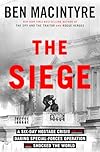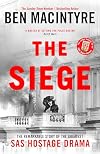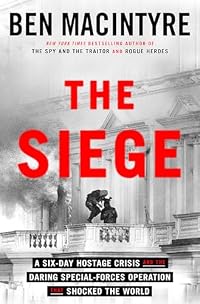
The Siege: A Six-Day Hostage Crisis and the Daring Special-Forces Operation That Shocked the World
by Ben Macintyre
On This Page
Description
A thrilling tick-tock recounting one of the most harrowing hostage situations and daring rescue attempts of our time—from the true-life espionage master and New York Times bestselling author of Operation Mincemeat and The Spy and the Traitor.“[Ben Macintyre is] John le Carré’s nonfiction counterpart.”—The New York Times
As the American hostage crisis in Iran boiled into its seventh month in the spring of 1980, six heavily armed gunman barged into the Iranian embassy in London, show more taking twenty-six hostages. What followed over the next six days was an increasingly tense standoff, one that threatened at any moment to spill into a bloodbath.
Policeman Trevor Lock was supposed to have gone to the theater that night. Instead, he found himself overpowered and whisked into the embassy. The terrorists never noticed the gun hidden in his jacket. The drama that ensued would force him to find reserves of courage he didn’t know he had. The gunmen themselves were hardly one-dimensional—all Arabs, some highly educated, who hoped to force Britain to take their side in their independence battle against Supreme Leader Ayatollah Khomeini. Behind the scenes lurked the brutal Iraqi dictator Saddam Hussein, who had bankrolled the whole affair as a salvo against Iran.
As police negotiators pressed the gunmen, rival protestors clashed violently outside the embassy, and as MI6 and the CIA scrambled for intelligence, Britain’s special forces strike team, the SAS, laid plans for a dangerous rescue mission. Inside, Lock and his fellow hostages used all the cunning they possessed to outwit and outflank their captors. Finally, on the sixth day, after the terrorists executed the embassy press attaché and dumped his body on the front doorstep, the SAS raid began, sparking a deadly high-stakes climax.
A story of ordinary men and women under immense pressure, The Siege takes readers minute-by-thrilling-minute through an event that would echo across the next two decades and provide a direct historical link to the tragedy on 9/11. Drawing on exclusive interviews and a wealth of never-before-seen files, Macintyre brilliantly reconstructs a week in which every day minted a new hero and every second spelled the potential for doom. show less
Tags
Recommendations





Member Reviews
Six Days on the Edge
A review of the Random House large-print paperback (September 10, 2024) released simultaneously with the hardcover/ebook/audiobook.
I was curious about Ben Macintyre's book about the 1980 Iranian Embassy in show more London crisis as I had actually read one of the very first books about it back in the day Siege : Six Days at the Iranian Embassy (1980) due to its blurb and Introduction by John Le Carré. That was apparently one of the fastest books ever published, coming only a few weeks after the actual event. I re-read and reviewed it recently as Black Ops in the Open.
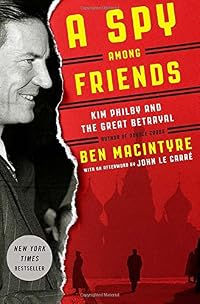
Knowing the high quality of Macintyre's research and writing from some of his espionage histories such as A Spy Among Friends: Kim Philby and the Great Betrayal (2014) and The Spy and the Traitor: The Greatest Espionage Story of the Cold War (2018), I expected another tour-de-force and was not disappointed. Of course Macintyre had access to a huge amount of material that was unknown to the Observer reporters back in 1980, most especially the inside story from many of the SAS squadron members who were now able to speak freely about the events 44 years after the fact.
There was also the inside story from the point of view of many of the 26 hostages and their observations of how police negotiation tactics wore down the morale of the hostage takers. There were the further revelations about how the six gunmen had been recruited by Saddam Hussein's Iraqi Intelligence service and trained by Hussein's then protected terrorist Abu Nidal. All of it being an advance cold-war strike against Hussein's enemy the new Iranian government of Khomeini, which later erupted into the Iraq-Iran War (1980-88). Those six were pawns in the game, thinking they could do anything to relieve the situation for Arab-Iranians under the brutal Khomeini regime.
The youngest and most innocent of the gunmen survived the SAS assault, likely by being protected by the hostages who had grown sympathetic to him through the process of so-called Stockholm Syndrome. That survivor served 28 years of a life sentence before being paroled and now lives under a protected identity in the UK, while subject to a death sentence if ever returned to Iran.
It all makes for a fascinating inside story which reads like the best of fiction due to Macintyre's dramatic writing skills. I read the large-print version which was more easily accessible in the Toronto library when there were more holds on the regular print size. show less
A review of the Random House large-print paperback (September 10, 2024) released simultaneously with the hardcover/ebook/audiobook.
Just before 21:00, someone turned on a large television, and the men settled down to watch themselves for the first time. The news opened with a figure in black clambering across a balcony to plant explosives. At that moment someone with bouffant hair obscured the screen.
“Oi, fucking sit down at the front,” shouted John McAleese, who wanted a clear view of his moment of anonymous fame.
The person with big hair obediently ducked out of the way.
No one ever spoke to Mrs. Thatcher that way. But who dares, wins.
I was curious about Ben Macintyre's book about the 1980 Iranian Embassy in show more London crisis as I had actually read one of the very first books about it back in the day Siege : Six Days at the Iranian Embassy (1980) due to its blurb and Introduction by John Le Carré. That was apparently one of the fastest books ever published, coming only a few weeks after the actual event. I re-read and reviewed it recently as Black Ops in the Open.
Knowing the high quality of Macintyre's research and writing from some of his espionage histories such as A Spy Among Friends: Kim Philby and the Great Betrayal (2014) and The Spy and the Traitor: The Greatest Espionage Story of the Cold War (2018), I expected another tour-de-force and was not disappointed. Of course Macintyre had access to a huge amount of material that was unknown to the Observer reporters back in 1980, most especially the inside story from many of the SAS squadron members who were now able to speak freely about the events 44 years after the fact.
There was also the inside story from the point of view of many of the 26 hostages and their observations of how police negotiation tactics wore down the morale of the hostage takers. There were the further revelations about how the six gunmen had been recruited by Saddam Hussein's Iraqi Intelligence service and trained by Hussein's then protected terrorist Abu Nidal. All of it being an advance cold-war strike against Hussein's enemy the new Iranian government of Khomeini, which later erupted into the Iraq-Iran War (1980-88). Those six were pawns in the game, thinking they could do anything to relieve the situation for Arab-Iranians under the brutal Khomeini regime.
The youngest and most innocent of the gunmen survived the SAS assault, likely by being protected by the hostages who had grown sympathetic to him through the process of so-called Stockholm Syndrome. That survivor served 28 years of a life sentence before being paroled and now lives under a protected identity in the UK, while subject to a death sentence if ever returned to Iran.
It all makes for a fascinating inside story which reads like the best of fiction due to Macintyre's dramatic writing skills. I read the large-print version which was more easily accessible in the Toronto library when there were more holds on the regular print size. show less
The back-cover blurb of this book dubs Ben Macintyre the non-fiction equivalent of John le Carré. I agree wholeheartedly with this blurb. Macintyre has woven together an utterly gripping account of an event I knew nothing about before reading this book. Despite my unfamiliarity with the subject, I found this easy to read from a structural point of view. The actual subject matter gets pretty grim, especially when the actual siege happens. A chapter at the end describes what happened to all of the hostages and the key players involved in the rescue (as well as some peripheral characters). Very well done and highly recommended.
An in-depth account of an event I was only vaguely aware of. The author has reconstructed a terrific account of the event, one of the first breaking news events shown on live television, based on never-published accounts of the hostages and those involved in the rescue. Recommended.
Ratings
Members
- Recently Added By
Lists

Kindle Non-Fiction
221 works; 1 member
Author Information

30+ Works 14,184 Members
Awards and Honors
Awards
Distinctions
Notable Lists
Classifications
- Genres
- History, General Nonfiction, Nonfiction, Biography & Memoir
- DDC/MDS
- 356.167 — Social sciences Public administration & military science Foot forces and warfare Organization Special infantry troops Rangers, Commandos, Etc.
- LCC
- UA659 .S67 .M335 — Military Science Armies: Organization, distribution, military situation Armies: Organization, distribution, military situation By region or country
- BISAC
Statistics
- Members
- 319
- Popularity
- 99,419
- Reviews
- 4
- Rating
- (4.23)
- Languages
- English
- Media
- Paper, Audiobook, Ebook
- ISBNs
- 15
- ASINs
- 5