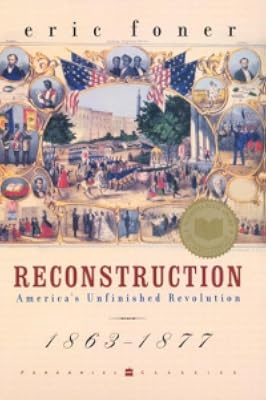
A Short History of Reconstruction
by Eric Foner
On This Page
Description
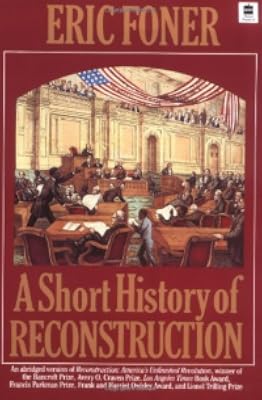
In this updated edition of the abridged Reconstruction, Eric Foner redefines how the post-Civil War period was viewed. Reconstruction chronicles the way in which Americans-black and white-responded to the unprecedented changes unleashed by the war and the end of slavery. It addresses the quest of emancipated slaves searching for economic autonomy and equal citizenship, and describes the remodeling of Southern society, the evolution of racial attitudes and patterns of race relations, and the show more emergence of a national state possessing vastly expanded authority and committed, for a time, to the principle of equal rights for all Americans. This treatment remains the standard work on the wrenching post-Civil War period-an era whose legacy still reverberates in the United States today. show lessTags
Recommendations






Member Reviews
clear-cut, well-written, absolutely fucking appalling.
here's the thing: my public school teachers politely glossed over that whole RECONSTRUCTION thing, subtitled "In Which White Politicians Decide To Continue The System Of Slavery, Albeit Informally". i suspect my teachers were not allowed to teach us about Reconstruction, in the same way they were not allowed to teach about the Holocaust, or the Vietnam War, or the US-run internment camps for Japanese citizens, or the various atrocities committed against the Native population, or ... anything that might cast the US in a less-than-shining light.
we missed out on a lot of history in history class, is what i'm saying.
so. for the past two hundred years or so, the South has deliberately show more worked to keep a nasty, racist culture in place. (the North has been deliberately complacent.)
this is not okay.
(understatement.)
this is not a few individuals being jerks.
this is a system of control.
it is not acceptable.
(understatement.)
here is the story of the beginning, or rather one beginning, or rather the story of the choice to continue when there was a damn good opportunity to stop. the system had been dismantled and it was put back together again because people (white people. rich white people) decided there was more money to be made more fun in beating, raping, lynching, shooting, terrorizing, violence extraordinare and as ordinary as the sun rising
-- than in complying with, you know, a standard moral code.
this is not a handful of people. this is an entire country, most especially the persons in power, who decide that it's better for some to be enslaved and others raised above their deserts, than for everyone to be equal and free.
this is wrong.
(understatement.)
(note: i was born and raised a Southerner. since you'll ask, my family came to America a few decades after formal slavery was abolished ... but i am white. i have always profited from a culture of white supremacy. owning human slaves is a symptom, not the sickness itself.) show less
here's the thing: my public school teachers politely glossed over that whole RECONSTRUCTION thing, subtitled "In Which White Politicians Decide To Continue The System Of Slavery, Albeit Informally". i suspect my teachers were not allowed to teach us about Reconstruction, in the same way they were not allowed to teach about the Holocaust, or the Vietnam War, or the US-run internment camps for Japanese citizens, or the various atrocities committed against the Native population, or ... anything that might cast the US in a less-than-shining light.
we missed out on a lot of history in history class, is what i'm saying.
so. for the past two hundred years or so, the South has deliberately show more worked to keep a nasty, racist culture in place. (the North has been deliberately complacent.)
this is not okay.
(understatement.)
this is not a few individuals being jerks.
this is a system of control.
it is not acceptable.
(understatement.)
here is the story of the beginning, or rather one beginning, or rather the story of the choice to continue when there was a damn good opportunity to stop. the system had been dismantled and it was put back together again because people (white people. rich white people) decided there was more money to be made more fun in beating, raping, lynching, shooting, terrorizing, violence extraordinare and as ordinary as the sun rising
-- than in complying with, you know, a standard moral code.
this is not a handful of people. this is an entire country, most especially the persons in power, who decide that it's better for some to be enslaved and others raised above their deserts, than for everyone to be equal and free.
this is wrong.
(understatement.)
(note: i was born and raised a Southerner. since you'll ask, my family came to America a few decades after formal slavery was abolished ... but i am white. i have always profited from a culture of white supremacy. owning human slaves is a symptom, not the sickness itself.) show less
Good survey of a hugely important but frequently overlooked period in US history. Reconstruction was complex, often morally ambiguous, and is still controversial. Although relatively brief, this is serious history, not a novelistic treatment by any means. Foner gives you the basics - after reading this, you can decide whether to dig into one of the longer histories of the period. I haven't yet taken that step, but I can understand now why it might be worthwhile.
Post Civil War South
Ratings
Members
- Recently Added By
Author Information

66+ Works 10,384 Members
Eric Foner is the preeminent historian of his generation. His books have won the top awards in the profession, and he has been president of both major history organizations, the American Historical Association and the Organization of American Historians. He is the author of Give Me Liberty!, which displays all of his trademark strengths as a show more scholar, teacher, and writer. A specialist on the Civil War/Reconstruction period, he regularly teaches the nineteenth-century survey at Columbia University, where he is DeWitt Clinton Professor of History. In 2011, Foner's The Fiery Trial: Abraham Lincoln and American Slavery won the Pulitzer Prize in History, the Bancroft Prize, and the Lincoln Prize. His Gateway to Freedom: The Hidden History of the Underground Railroad is a 2015 New York Times bestseller. (Bowker Author Biography) show less
Common Knowledge
- Original publication date
- 1990
- Important places
- American South
- Original language
- English
Classifications
- Genres
- History, Nonfiction, General Nonfiction
- DDC/MDS
- 973.8 — History & geography History of North America United States The Gilded Age, Reconstruction, Spanish American War (1865-1901)
- LCC
- E668 .F662 — History of the United States United States Late nineteenth century, 1865-1900 Johnson's administration, April 15, 1865-1869 Reconstruction, 1865-1877
- BISAC
Statistics
- Members
- 686
- Popularity
- 41,869
- Reviews
- 3
- Rating
- (4.02)
- Languages
- English
- Media
- Paper, Ebook
- ISBNs
- 10
- ASINs
- 5