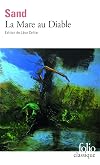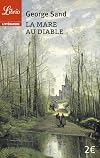
The Devil’s Pool
by George Sand
On This Page
Description
Don't let the name fool you—French author George Sand was not only a woman, she was a woman who was decades ahead of her time when it came to her disregard of social mores and standards of behavior. Her trailblazing take on life is on full display in The Devil's Pool, an unconventional romance of sorts in which Sand explores the stifling patriarchal traditions that often served virtually to imprison rural French women in the nineteenth century..
Tags
Recommendations




































Member Reviews
A short book set in the French region of Berry in the 1840s, where the young widower Germain sets out on a trip to find a new wife but realises that the ideal person for him may have been much closer to home all along. I think that George Sand's novella—with its insistence on the validity of the emotional lives of the peasantry and its well-observed child characters and social details—likely read as much more progressive and even subversive in the France of the July Monarchy period than it does today. Today, the authorial voice which bookends the novella reads as patronising: Sand's peasants, honest people of the soil, may feel more intensely and purely than their social betters, but Sand tells us that they cannot think. Hrm.
The Devil’s Pool by George Sand is a short simple novel about a young French farmer who has been widowed and left with three young children to raise. He lives with his in-laws who encourage him to remarry to provide a mother for his children.
His father-in-law has lined up a widow that he thinks would make a good wife and mother and the fact that she has both a dowry and some land is an added bonus. The young man is sent out to meet this widow and see if they can come to an agreement. He is asked to take a young neighbour with him as she is to work as a shepherdess at a farm along the way. Of course, this young farmer and the shepherdess find they have much in common and a mutual attraction. Along the way they must travel by the show more Devil’s Pool which brings clarity to the decision the young farmer must make.
I found this story charming and engaging with it’s exploration of the age-old question of whether one should chose to follow their heart or their brain. The author was inspired by the print called The Dance of Death by Hans Holbein and she wanted to show that farmers have a deep connection to the land and nature that is far more joyful and inspiring than the hardship and struggle that is usually used to describe their lives. show less
His father-in-law has lined up a widow that he thinks would make a good wife and mother and the fact that she has both a dowry and some land is an added bonus. The young man is sent out to meet this widow and see if they can come to an agreement. He is asked to take a young neighbour with him as she is to work as a shepherdess at a farm along the way. Of course, this young farmer and the shepherdess find they have much in common and a mutual attraction. Along the way they must travel by the show more Devil’s Pool which brings clarity to the decision the young farmer must make.
I found this story charming and engaging with it’s exploration of the age-old question of whether one should chose to follow their heart or their brain. The author was inspired by the print called The Dance of Death by Hans Holbein and she wanted to show that farmers have a deep connection to the land and nature that is far more joyful and inspiring than the hardship and struggle that is usually used to describe their lives. show less
A bit hard to get into; the first chapter seems disconnected from the rest of the book. The middle part is about the love story between Marie and Germain and is much easier to follow and enjoy. But then the last part (the appendix?) is almost a distanced observation of their wedding and the long held wedding traditions that lasts for days. It was nice to learn about their traditions that have long disappeared, but it felt disjointed.
Decided to try this French novella off the 1001 books to read before you die list. It was just ok. It's a simple story about a widowed farmer who finds love with a poor girl in his village. Sand begins by describing a Holbein painting of peasant and farming life and transitions into this tale of the working/lower classes.
I didn't find it particularly memorable. Likely I'd need to understand more about how it fits into French literature as a whole to get more out of it.
Original publication date: 1846
Author’s nationality: French
Original language: French
Length: 109 pages
Rating: 2.5 stars
Format/where I acquired the book: purchased used paperback
Why I read this: off the shelf, 1001 books
I didn't find it particularly memorable. Likely I'd need to understand more about how it fits into French literature as a whole to get more out of it.
Original publication date: 1846
Author’s nationality: French
Original language: French
Length: 109 pages
Rating: 2.5 stars
Format/where I acquired the book: purchased used paperback
Why I read this: off the shelf, 1001 books
This book has been stopping up the works around here. I read it, I digested it, I had thoughts about it, but for some reason I haven't felt quite prepared or qualified or informed enough to just comment on it and get on with life.
I think it's because I have this image of George Sand, this just ass-kicking supergenius female from the intimidating past, leaning over my shoulder, saying, "Don't you GET IT you moron? It wasn't just about cabbages and true love. It was about so! much! more!" The truth is, unfortunately, that unless the imaginary spectre of George Sand wants to clue me in, I'm not sure what else is here besides the cabbages. And the true love.
Well, there's the prologue. The prologue, which addresses the reader directly, is show more about how noble and wise the peasants of rural France are (were) and how their lack of intellect or ability to understand their circumstances doesn't interfere with their feeling of important feelings, and experiencing of deep emotion. Isn't that nice? Those sweet, precious peasants and their silly dumb heads.
Sand takes the prologue to rhapsodize about them and how cute they are, with their toil and whatnot, and then tells a pretty story about them falling (without consciousness) in love with each other. Finally, she takes a few more pages (a lot more pages) to just unapologetically savor the peasants' cute rituals. Marriage rituals.
The truth is, I really liked the book, up until the plot quit and the "I miss the cute peasants I used to look down on in my youth" themes came to the fore. I expected something raunchy, loud, scathing, or at least edgy. This is not that. It's a sweet love story, flavored with a lot of local color. So George Sand was a surprise, for this postfeminist. I'm not sure I'd love to read another of her books, but I'm glad I finally found out what she was really writing, under all that scandal and wild living. show less
I think it's because I have this image of George Sand, this just ass-kicking supergenius female from the intimidating past, leaning over my shoulder, saying, "Don't you GET IT you moron? It wasn't just about cabbages and true love. It was about so! much! more!" The truth is, unfortunately, that unless the imaginary spectre of George Sand wants to clue me in, I'm not sure what else is here besides the cabbages. And the true love.
Well, there's the prologue. The prologue, which addresses the reader directly, is show more about how noble and wise the peasants of rural France are (were) and how their lack of intellect or ability to understand their circumstances doesn't interfere with their feeling of important feelings, and experiencing of deep emotion. Isn't that nice? Those sweet, precious peasants and their silly dumb heads.
Sand takes the prologue to rhapsodize about them and how cute they are, with their toil and whatnot, and then tells a pretty story about them falling (without consciousness) in love with each other. Finally, she takes a few more pages (a lot more pages) to just unapologetically savor the peasants' cute rituals. Marriage rituals.
The truth is, I really liked the book, up until the plot quit and the "I miss the cute peasants I used to look down on in my youth" themes came to the fore. I expected something raunchy, loud, scathing, or at least edgy. This is not that. It's a sweet love story, flavored with a lot of local color. So George Sand was a surprise, for this postfeminist. I'm not sure I'd love to read another of her books, but I'm glad I finally found out what she was really writing, under all that scandal and wild living. show less
Part of the 1001 list to read before you die. I enjoyed this story about a widowed man falling in love with a young girl instead of the woman he is supposed to be set up to marry. The story flowed easily and I liked all the characters. Ending was great because it was happy and I was expecting something sad or gloomy.
On l'appelait la mare au Diable, car ses brumes, le soir, égaraient les voyageurs. Perdus à leur tour, Germain, Marie et le Petit Pierre sont forcés d'y passer la nuit. Le laboureur et la jeune fille ont le coeur triste. Germain va chercher une épouse pour s'occuper de ses enfants orphelins de leur mère. A quoi bon se marier, pense-t-il, quand l'amour n'y est pas. Et Marie a quitté sa mère, ce matin, en larmes, pour se louer comme bergère à la ferme des Ormeaux, si loin. Seul, Petit Pierre, le fils de Germain, est heureux et confiant. De lui dépendra le sort de ceux qu'il aime tant. Dédié à Chopin, ce bref roman champêtre a un charme inégalé. George Sand a vu le beau dans le simple. Elle chante, quelquefois en patois, show more les joies de l'amour, de l'enfance et du travail de la terre. Beaucoup d'amour et un peu d'idéalisme sont ses secrets show less
Members
- Recently Added By
Lists

1001 Books You Must Read Before You Die
1,448 works; 1,134 members

Female Author
1,234 works; 64 members

Books Read in 2020
4,379 works; 123 members

Harold Bloom - The Western Canon: C. The Democratic Age
336 works; 15 members

Trinity College Booklist (1951): Class Nine, Foreign Literatures
161 works; 3 members

French Fiction of the 18th and 19th Centuries in English Translation
169 works; 3 members
Author Information

456+ Works 6,454 Members
George Sand began life as Aurore Dupin, the daughter of a count and a dressmaker. Educated both on her aristocratic grandmother's estate and in a Parisian convent, at 18 she married Casimer Dudevant, a provincial gentleman whose rough temperament was the opposite of her own, and from whom she obtained a separation several years later. At 31 she show more moved to Paris, where she changed her name and plunged into the bohemian world of French romanticism. Frequently dressed in men's clothing, she participated actively in literary debates, cultural events, and even the revolution of 1848. Sand was friend and correspondent with many of the major artists and writers of her age, including Balzac, Flaubert, and Liszt. Her love affairs with the poet Musset and the composer Chopin were the stuff of legend, chronicled in her own Story of My Life. Sand's immensely popular novels ranged from sentimental stories of wronged women, to utopian socialist fictions, such as her masterpiece in Consuelo, 1842, to explorations of pastoral themes written when she retired, late in life, to her estate in Berry. Though frequently dismissed as overblown or too sentimental, Sand's fiction has recently undergone a revaluation, emerging as an influential body of women's writing. As both a writer and an intellectual personality, Sand is a central figure in nineteenth-century French cultural life. George Sand died in 1876 (Bowker Author Biography) show less
Some Editions
Awards and Honors
Series
Belongs to Publisher Series
Clube de Literatura Clássica (CLC) (18.1 [October 2021])
GF Flammarion (35)
Work Relationships
Common Knowledge
- Canonical title
- The Devil’s Pool
- Original title
- La Mare au Diable
- Alternate titles*
- Der Teufelssumpf
- Original publication date
- 1846 (in French as “La Mare au Diable”) (in French as “La Mare au Diable”)
- Related movies*
- La mare au diable (1923 | IMDb)
- First words
- A la sueur de ton visaige
Tu gagnerois ta pauvre vie,
Après long travail et usaige,
Voicy la mort qui te convie.
The quatrain in old French written below one of Holbein’s pictures is profoundly ... (show all)sad in its simplicity. - Last words
- (Click to show. Warning: May contain spoilers.)In the distance could be heard the songs of the youths from the adjoining parishes, just starting for home, and repeating, in voices somewhat the worse for wear, the merry refrains of the preceding night.
- Original language
- French
- Disambiguation notice
- The original French title was “La Mare au Diable”.
*Some information comes from Common Knowledge in other languages. Click "Edit" for more information.
Classifications
Statistics
- Members
- 895
- Popularity
- 30,165
- Reviews
- 21
- Rating
- (3.12)
- Languages
- 11 — Catalan, Chinese, English, Finnish, French, German, Italian, Norwegian, Slovenian, Spanish, Turkish
- Media
- Paper, Audiobook, Ebook
- ISBNs
- 145
- ASINs
- 51