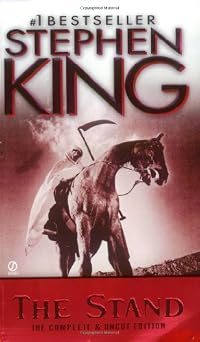
The Stand: Expanded Edition: For the First Time Complete and Uncut (Signet)
by Stephen King
On This Page
Description
It's 1985 and a deadly 'superflu' practically wipes out the population of the U.S. Gradually survivors trail across a wasteland of horror and death to congregate in two zones, one the embodiment of good, the other the embodiment of evil.Tags
Recommendations




Member Reviews
I first read The Stand in `95. I was fifteen. I have never read the original version, which is over three hundred pages shorter, and I don't intend to. If you trek over to Amazon, reviewers the world over scream their distaste for this uncut version, mainly because they think the added material has no purpose. Even King warns readers in the foreword that this version is heavier in the character development department and high in filler. But this is the version he wants people to remember. To me, the original version doesn't exist.
I will say that this book drones on and on in the middle. The first part of the book is 382 pages long. The middle part, Book Two, comes in at 592 pages. Book Three is only 230 pages long. Could the middle be show more trimmed? Sure thing. Does it need to be? It depends on how you like your character development. When I read King, I don't read his books like other authors' works. I know I am in for information overload, so I take my time, sit back, and relax. If you've read other King books and felt he was wordy, The Stand might just make your head cave in. This book is thick, and for good reason. It's the end of the world, baby, and King wants you know every single detail.
The most disturbing part of this book for me was the sympathy I had for the bad guys, if you can really call them that. Lloyd Henreid and the Trashcan Man are dynamic villains with far more to say about the world than any of the protagonists. Then again, I always have rooted for the broken of us.
This book is not for everyone, but it is one of King's best.
E. show less
I will say that this book drones on and on in the middle. The first part of the book is 382 pages long. The middle part, Book Two, comes in at 592 pages. Book Three is only 230 pages long. Could the middle be show more trimmed? Sure thing. Does it need to be? It depends on how you like your character development. When I read King, I don't read his books like other authors' works. I know I am in for information overload, so I take my time, sit back, and relax. If you've read other King books and felt he was wordy, The Stand might just make your head cave in. This book is thick, and for good reason. It's the end of the world, baby, and King wants you know every single detail.
The most disturbing part of this book for me was the sympathy I had for the bad guys, if you can really call them that. Lloyd Henreid and the Trashcan Man are dynamic villains with far more to say about the world than any of the protagonists. Then again, I always have rooted for the broken of us.
This book is not for everyone, but it is one of King's best.
E. show less
As with most crazy-long books, The Stand was a bit slow to start off. A lot of establishing characters and backgrounds, but once it got going, it never stopped. King is obviously an awesome writer, and this is my favorite book that I've read by him so far. He's not afraid to sacrifice lovable characters (yes, you will probably cry while reading this), and he's not afraid to let things get completely hopeless. These things make for one awesome read. Add all the weird paranormal stuff to it, and you have probably one of the best books ever written.
I usually don't like to read descriptions of books before I read them -- a vague idea of what's going to happen is fine with me. And I don't know how I managed to live 23 years without hearing show more the plot line, but I did it, so I had absolutely no idea what this book was about nor why it was so good. I was shocked (in a good way) to learn that not only is this about a plague that kills 99% of the population, but there's a paranormal element to it and a sort of devil-dude is trying to gain followers to wipe out the decent people that are left. (Side note: Can King think of an awesome plot, or what?!)
The page length will probably scare some people off, but I actually enjoy longer books. You get to know the characters so much better, and that is definitely true of this book. I felt like I was with these characters; their problems were my problems, and I found myself worrying about the same things as them and rooting for them all the way. There is also a lot of room for growth and change, which definitely happens. My advice: don't let the length scare you. It'll take you some time to read, but it's worth it.
I did think that the good guys should have recognized some of the practically-converted-devil-followers fairly quickly. Yes, they're busy trying to put the world back together and survive and stuff, but with all this weird telepathic/psychic stuff going on, you think at least one of them would have picked up on it, and, being in survival mode, done something to prevent these people from wreaking havoc. Yes, it's a novel and crazy stuff happens, but I thought it could have been more intelligently done. While I liked the good guys, I didn't find them particularly smart, which bothered me a little.
Overall, I think this is a brilliant book. Strip away the world and most of society, and you can get a good look at true human nature. King gives an insightful view into what an apocalyptic world would look like: the chaos, the re-establishing of order, and how people come together (or tear each other to pieces). Some people can't make it, and the people who are the most successful often aren't the ones that would be successful in the society we live in today. It's about family, friends, survival, and of course, the destructive force we humans have on ourselves and on our world. I never recommend a book for everyone, because we all have different tastes and there will never be one book that's a perfect fit for every single person, but this is one that everyone should at least try hard to read. I highly recommend it. show less
I usually don't like to read descriptions of books before I read them -- a vague idea of what's going to happen is fine with me. And I don't know how I managed to live 23 years without hearing show more the plot line, but I did it, so I had absolutely no idea what this book was about nor why it was so good. I was shocked (in a good way) to learn that not only is this about a plague that kills 99% of the population, but there's a paranormal element to it and a sort of devil-dude is trying to gain followers to wipe out the decent people that are left. (Side note: Can King think of an awesome plot, or what?!)
The page length will probably scare some people off, but I actually enjoy longer books. You get to know the characters so much better, and that is definitely true of this book. I felt like I was with these characters; their problems were my problems, and I found myself worrying about the same things as them and rooting for them all the way. There is also a lot of room for growth and change, which definitely happens. My advice: don't let the length scare you. It'll take you some time to read, but it's worth it.
I did think that the good guys should have recognized some of the practically-converted-devil-followers fairly quickly. Yes, they're busy trying to put the world back together and survive and stuff, but with all this weird telepathic/psychic stuff going on, you think at least one of them would have picked up on it, and, being in survival mode, done something to prevent these people from wreaking havoc. Yes, it's a novel and crazy stuff happens, but I thought it could have been more intelligently done. While I liked the good guys, I didn't find them particularly smart, which bothered me a little.
Overall, I think this is a brilliant book. Strip away the world and most of society, and you can get a good look at true human nature. King gives an insightful view into what an apocalyptic world would look like: the chaos, the re-establishing of order, and how people come together (or tear each other to pieces). Some people can't make it, and the people who are the most successful often aren't the ones that would be successful in the society we live in today. It's about family, friends, survival, and of course, the destructive force we humans have on ourselves and on our world. I never recommend a book for everyone, because we all have different tastes and there will never be one book that's a perfect fit for every single person, but this is one that everyone should at least try hard to read. I highly recommend it. show less
I understand why this book is so long. It's not just a story. It's an apocalyptic epic of the struggle between good and evil. Like Lord of the Rings, and that took three long books to tell that story.
The variety of characters Stephen King creates is impressive. There are so many different players, from so many walks of life, appropriate for an apocalyptic story as this. I've seen warnings of overelaborate character development, but the character development doesn't drag -- it's simply *deep*. His characters come to life on the page. And the menace of the plague spreads as we learn about the characters, so the plot develops at the same time. It's actually kind of creepy how gradually the disease has developed, as part of the story. Yet, show more in the story, it's developing like wild fire. Neat trick.
Although it was updated to the 1990s, the updating was minimal. It's still clearly written in the late 70s. The story feels like the 70s, from references to music, the dialogue used, attitudes, etc. But I suppose it would have meant rewriting rather than updating to really make it feel like the 1990s.
And the villain - the Dark Man - creepy doesn't even begin to describe him. King managed to balance developing his character with a lack of description that resulted in maximum creepiness.
ALERT! SPOILERS AHEAD! It's interesting that those who are drawn to the Dark Man are not evil people by definition. I would call them weak. A lot of them are just afraid. Others are looking for something they thought they've found in him. The Dark Man knows this. He gathers weak people he can seduce into believing what he's selling. He's searching for people who've given up on second chances, salvation, goodness. Cynicism, despair, hate, these are what feed the Dark Man. And he's hungry.
Well-written, great characters, building up with lots of tension and creepiness.
Except the climax ...wasn't.
I was actually disappointed with what was supposed to be the big climax scene. It was supposed to be The Stand. The battle between good and evil.
Instead, it was a brief conflict, and the heroes weren't even the active parties in the villain's destruction. They came to the West, to Las Vegas, to make their Stand. They knew they'd probably die in the process, and one of them was killed right away. The odd thing was that the villain, Flagg, was already losing it. Not really losing his power, but his ability to See, his focus, and his minions were leaving him, defecting, abandoning him. As a result, his overall badassery was diminishing already.
In the end, what vanquishes Flagg is only partly due to Larry and Ralph, the only two left. After being caged, about to be brutally killed before Flagg's people, the most they can do is try to instigate someone to rebel. To their surprise, it works, and Whitney the Cook defies Flagg to tell them what they're doing is wrong. Flagg is unruffled, since he Saw that this would happen, but he indulges himself in a little payback and produces this little ball of electricity to torture Whitney a bit.
This sets up his demise, but doesn't cause it. It's really the Trashcan Man, one of his own people, who ends it for all of them. His arrival at the camp with a hot nuclear missile essentially ended everything -- Trash was nearly dead himself from radiation poisoning already, and they'd soon be toast too. So in reality, his return is what killed them. Which Flagg couldn't foresee because he hadn't ever been able to See into the minds of those who weren't quite right in the head, like Tom and like Trash. Just driving up in his little cart, with a missile in the back, and it's over.
But Flagg loses track of his little powerball, the ball of electricity, and it's drawn to the missile, which sealed the end of all of them. Even that end was anticlimactic for me. The reader doesn't get much here. Larry sees it coming, and he's glad. He sees the end coming and it comes in a silent, white light.
And it's over.
In a matter of a couple of pages, and then in one line, it was over. I expected more. The story's called The Stand, after all. But I don't see how it was a stand at all. Instead, the heroes go into enemy territory, are captured, and one of the bad guy's minions brings in a weapon that explodes because the bad guy lost track of one of his toys.
When Stu sees the explosion, it's from miles away and that's how we see the climactic moment: from miles away. Not really satisfying. Stu's not involved in the moment. He has survived it, and what follows is a gratifying resolution in their eventual arrival home. But I was left a bit dissatisfied, like it had been an incomplete meal.
And yet, it was worth it. The story itself is like no other. The characters are memorable, and many fulfilled their destinies in style. King ends the story with a twist that adds an extra touch of creepy that is all his own.
There's a reason why he's the King. show less
The variety of characters Stephen King creates is impressive. There are so many different players, from so many walks of life, appropriate for an apocalyptic story as this. I've seen warnings of overelaborate character development, but the character development doesn't drag -- it's simply *deep*. His characters come to life on the page. And the menace of the plague spreads as we learn about the characters, so the plot develops at the same time. It's actually kind of creepy how gradually the disease has developed, as part of the story. Yet, show more in the story, it's developing like wild fire. Neat trick.
Although it was updated to the 1990s, the updating was minimal. It's still clearly written in the late 70s. The story feels like the 70s, from references to music, the dialogue used, attitudes, etc. But I suppose it would have meant rewriting rather than updating to really make it feel like the 1990s.
And the villain - the Dark Man - creepy doesn't even begin to describe him. King managed to balance developing his character with a lack of description that resulted in maximum creepiness.
ALERT! SPOILERS AHEAD! It's interesting that those who are drawn to the Dark Man are not evil people by definition. I would call them weak. A lot of them are just afraid. Others are looking for something they thought they've found in him. The Dark Man knows this. He gathers weak people he can seduce into believing what he's selling. He's searching for people who've given up on second chances, salvation, goodness. Cynicism, despair, hate, these are what feed the Dark Man. And he's hungry.
Well-written, great characters, building up with lots of tension and creepiness.
Except the climax ...wasn't.
I was actually disappointed with what was supposed to be the big climax scene. It was supposed to be The Stand. The battle between good and evil.
Instead, it was a brief conflict, and the heroes weren't even the active parties in the villain's destruction. They came to the West, to Las Vegas, to make their Stand. They knew they'd probably die in the process, and one of them was killed right away. The odd thing was that the villain, Flagg, was already losing it. Not really losing his power, but his ability to See, his focus, and his minions were leaving him, defecting, abandoning him. As a result, his overall badassery was diminishing already.
In the end, what vanquishes Flagg is only partly due to Larry and Ralph, the only two left. After being caged, about to be brutally killed before Flagg's people, the most they can do is try to instigate someone to rebel. To their surprise, it works, and Whitney the Cook defies Flagg to tell them what they're doing is wrong. Flagg is unruffled, since he Saw that this would happen, but he indulges himself in a little payback and produces this little ball of electricity to torture Whitney a bit.
This sets up his demise, but doesn't cause it. It's really the Trashcan Man, one of his own people, who ends it for all of them. His arrival at the camp with a hot nuclear missile essentially ended everything -- Trash was nearly dead himself from radiation poisoning already, and they'd soon be toast too. So in reality, his return is what killed them. Which Flagg couldn't foresee because he hadn't ever been able to See into the minds of those who weren't quite right in the head, like Tom and like Trash. Just driving up in his little cart, with a missile in the back, and it's over.
But Flagg loses track of his little powerball, the ball of electricity, and it's drawn to the missile, which sealed the end of all of them. Even that end was anticlimactic for me. The reader doesn't get much here. Larry sees it coming, and he's glad. He sees the end coming and it comes in a silent, white light.
And it's over.
In a matter of a couple of pages, and then in one line, it was over. I expected more. The story's called The Stand, after all. But I don't see how it was a stand at all. Instead, the heroes go into enemy territory, are captured, and one of the bad guy's minions brings in a weapon that explodes because the bad guy lost track of one of his toys.
When Stu sees the explosion, it's from miles away and that's how we see the climactic moment: from miles away. Not really satisfying. Stu's not involved in the moment. He has survived it, and what follows is a gratifying resolution in their eventual arrival home. But I was left a bit dissatisfied, like it had been an incomplete meal.
And yet, it was worth it. The story itself is like no other. The characters are memorable, and many fulfilled their destinies in style. King ends the story with a twist that adds an extra touch of creepy that is all his own.
There's a reason why he's the King. show less
The Stand is probably one of the creepiest books I've ever read, largely because it feels like it's something that can happen at any time.
After an accident at a secret government lab, a superflu with 99.7% communicability start spreading across the United States, then across the rest of the planet. Although almost the entire population is wiped out, there's still survivors, and they start to have dreams. Dreams of The Dark Man, or the Devil's Imp, and Mother Abigail, the Voice of God, and they beckon to the survivors to choose with their hearts whose side to join.
Guided by the righteous and the wicked, the survivors start to live again, forming new societies, and building from the ground up. And whether they wholly realize it or not, show more they're all caught up in the middle of a war as well, that seems to hinge upon the actions of a select few on each side.
All in all, it's an excellent book, and despite feeling creeped out, I enjoyed it immensely. I just hope we never see our own version of Captain Trip's though. show less
After an accident at a secret government lab, a superflu with 99.7% communicability start spreading across the United States, then across the rest of the planet. Although almost the entire population is wiped out, there's still survivors, and they start to have dreams. Dreams of The Dark Man, or the Devil's Imp, and Mother Abigail, the Voice of God, and they beckon to the survivors to choose with their hearts whose side to join.
Guided by the righteous and the wicked, the survivors start to live again, forming new societies, and building from the ground up. And whether they wholly realize it or not, show more they're all caught up in the middle of a war as well, that seems to hinge upon the actions of a select few on each side.
All in all, it's an excellent book, and despite feeling creeped out, I enjoyed it immensely. I just hope we never see our own version of Captain Trip's though. show less
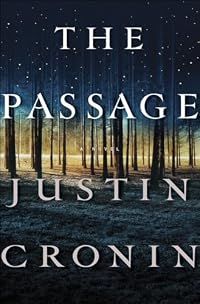
When I read The Passage, it seemed to be clearly derivative of what I had heard about The Stand. I wanted to read it and compare the two to find out.
In case you missed my review of The Passage, one of my main objections to that book was the central role played by vampire-zombie-bat-thingies (VZBT) in spreading a virus that destroys most of mankind. King resorts to no such creatures to wreak havoc on the world: good old people are sufficient to destroy themselves.
As you will see, I believe that The Stand - also a post-apocalyptic horror/fantasy novel - is a much better book. I think Stephen King is a better writer, and the characterizations are richer. King was dealing with all these BIG THEMES and ARCHETYPES. I saw Cronin as maybe show more trying to update some of the general thrust of The Stand and also put it into a format "modern" audiences would like - i.e., VZBTs. But I think Cronin got too bogged down by his Bat-Thingies, even as King got too caught up in trying to document every single aspect of the cultural era. King's story is not entirely devoid of the paranormal, but it really could stand on its own without that aspect, whereas Cronin's VZBTs are essential to the plot.
The novel is divided into three parts, or books. The first is titled "Captain Trips" and takes place over nineteen days (and almost 400 pages), with the escape and spread of a deadly mutation of an ordinary flu virus secretly created by the Army as a possible biological weapon. The resulting epidemic of what came to be known as “Captain Trips” leads directly to the death of an estimated 99.4% of the world's human population. Much of this section traces the (accidental) escape of the virus and spread through one man, Charlie Campion. (Not always accidental however; after the effect of the virus on the United States became clear, the Army decided to “share,” exporting it stealthily and purposefully to Europe, the U.S.S.R., and Red China.)
While the chain by which the devastation occurred is interesting, we probably didn’t have to know so many details about so many people who were a part of the viral transmission and died more or less immediately. And I was quite disappointed that King ended his digression on “the Captain Trips Chain Letter” with the phrase: “And so on.” That seemed a bit too inept.
In Part II, “On the Border,” the survivors begin cross-country odysseys driven and directed by shared dreams, some of which feature an old black woman in a cornfield in Nebraska, and some of which feature “The Dark Man” who is waiting for them in Las Vegas. Pilgrims include: the first human discovered to be immune, Stuart Redman (The Hero – smart, macho, quiet); Glen Bateman (a philosophy-spouting sociologist) [enabling King - through this character - to expound on the social implications and complications of the plague]; Larry Underwood (a would-be rock star) [allowing King an excuse to insert any number of rock lyrics into the text]; Nick Andros (a deaf-mute whose condition expresses multitudes); and a number of others including some very insipid and inauthentic-sounding women. They take to the highways, “jammed with broken heroes on a last chance power drive… Chrome wheeled, fuel injected and steppin out over the line … “
And they meet, and aggregate, and form two separate inchoate polities, depending on which dream filled their heads at night.
Two important characteristics of the post-flu world stood out for me. With so many professionals dead, those with skills like medicine, engineering and technology are highly sought-after by both sides. And secondly, it doesn’t take long for the old patterns of social organization to reassert themselves. As the resident sociologist observes: "Show me a man or woman alone and I’ll show you a saint. Give me two and they’ll fall in love. Give me three and they’ll invent the charming thing we call ‘society.’ Give me four and they’ll build a pyramid. Give me five and they’ll make one an outcast. Give me six and they’ll reinvent prejudice. Give me seven and in seven years they’ll reinvent warfare. Man may have been made in the image of God, but human society was made in the image of His opposite number, and is always trying to get back home.”
While there are no VZBTs, King does add paranormal forces to the story, much in the manner of classical Greek epics, in which the tragedies and joys of man were but the outcome of games of the gods. Indeed, so it is in The Stand. In The Stand, however, the gods vying for the souls of men are not members of the Greek pantheon but rather those two prime movers of more recent Western Civilization, God and Satan.
To this end, The Stand has many allusions to Job (in which God and Satan take bets, metaphorically speaking, on how much misery can be dumped on Job before he disavows God).
But unlike The Bible, in The Stand, God and Satan appear through their earthly representatives – God through a 108-year-old black woman named Mother Abagail, and Satan in the form of the villain Randall Flagg. Mother Abagail tells one of the survivors her interpretation of the chaos being visited on earth: "She believes we are all a part of a chess game between God and Satan; that Satan’s chief agent in this game is the Adversary whose name she says in Randall Flagg…”
[Here, one is reminded of “The Seventh Seal,” the Swedish drama about a knight who returns from the Crusades to find that his home country of Sweden is being ravaged by the plague. To his dismay, Death has come for him as well. He challenges Death to a chess match. Death agrees to the terms: if the knight wins, he shall go free.]
Appropriately, Randall Flagg – the personification of evil, sets up his headquarters in Las Vegas, and those who feel his pull are drawn to that city, while more godly types dream of Mother Abagail and how to find her and her growing entourage. (They start out in Nebraska but move on to Boulder, Colorado.) [Personally, I think King should have chosen West Virginia for Mother Abagail, as in: "Almost Heaven... West Virginia... Take me home, country roads..."] Somewhat disturbingly, while Mother Abagail can die, Flagg never can. As one of the characters explains,
"He’s in the wolves… the crows, the rattlesnake, the shadow of the owl at midnight and the scorpion at high noon. He roosts upside down with the bats. He’s blind like them.”
Flagg, King said in an interview, "...is like the archetype of everything that I know about real evil … he is somebody who is empty and who has to be filled with other people's hates, fears, resentments, laughs. Flagg, Koresh, Jim Jones, Hitler — they're all basically the same guy."
What attracts people to Flagg? One of the characters – a lifelong “loser” - suggests: "…when there are enough outsiders together in one place, a mystic osmosis takes place and you’re inside. Inside where it’s warm. Just a little thing, being inside where it’s warm, but really such a big thing. About the most important thing in the world.”
And what of God? God for the most part only speaks through Mother Abagail, and His dictates do not always seem benevolent. Furthermore, He always requires a sacrifice: “His hands are bloody with it.” And as the hero, Stu Redman, says, “That’s the same God murdered his own boy, or so I heard.”
Mother Abagail’s group tries to recreate democracy, and it's messy and chaotic. Randall Flagg comes up with a more effective polity run by tyranny and fear. Appropriately, slackers are punished by public crucifixions.
The groups confront one another in Part III, “The Stand.” Both sides recognize that the other is a threat to its survival. Both understand there may be more death before the outcome of the chess game is decided. And both groups know that the future of the world depends on babies being born to the groups – babies that will be immune from the virus.
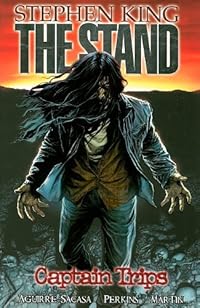
I won’t tell you how the story ends up – you’ll have to brave the book for yourself. Or you can try the movie or the graphic novel version, both of which are shorter than the book.
Discussion: There are some questions that never get answered by the book. How is it that everyone is having the same dreams? (The sociologist character theorizes that this psychic sense was dormant while we had telephones and televisions, but became active again in the absence of these technological substitutes for information sharing. Pretty quick evolutionary turnaround, I'd say.) And why can one of the [living] characters talk to one of the dead characters? (Of all the dead, only one comes back to talk?) And why do God and Satan’s representatives have some powers and not others? King doesn't give us the answers, but Mr. King, if you're reading this, PLEASE DON'T ADD ANOTHER 500 PAGES TO PROVIDE THEM!!! I'LL USE MY IMAGINATION!!!
Evaluation: And so was it worth it? Yes, I thought so. I don't consider it a "great" book, but it does give you a lot to think about. One can't help but be fascinated by survival situations when all pre-disaster preoccupations no longer have any meaning. What turns out to matter? What would matter to you? Besides, the book is a fantastic doorstop. Did I like it? Yes, I did. ...which is not to say I wouldn't have cut about 800 pages out, but that's just me.... show less
In case you missed my review of The Passage, one of my main objections to that book was the central role played by vampire-zombie-bat-thingies (VZBT) in spreading a virus that destroys most of mankind. King resorts to no such creatures to wreak havoc on the world: good old people are sufficient to destroy themselves.
As you will see, I believe that The Stand - also a post-apocalyptic horror/fantasy novel - is a much better book. I think Stephen King is a better writer, and the characterizations are richer. King was dealing with all these BIG THEMES and ARCHETYPES. I saw Cronin as maybe show more trying to update some of the general thrust of The Stand and also put it into a format "modern" audiences would like - i.e., VZBTs. But I think Cronin got too bogged down by his Bat-Thingies, even as King got too caught up in trying to document every single aspect of the cultural era. King's story is not entirely devoid of the paranormal, but it really could stand on its own without that aspect, whereas Cronin's VZBTs are essential to the plot.
The novel is divided into three parts, or books. The first is titled "Captain Trips" and takes place over nineteen days (and almost 400 pages), with the escape and spread of a deadly mutation of an ordinary flu virus secretly created by the Army as a possible biological weapon. The resulting epidemic of what came to be known as “Captain Trips” leads directly to the death of an estimated 99.4% of the world's human population. Much of this section traces the (accidental) escape of the virus and spread through one man, Charlie Campion. (Not always accidental however; after the effect of the virus on the United States became clear, the Army decided to “share,” exporting it stealthily and purposefully to Europe, the U.S.S.R., and Red China.)
While the chain by which the devastation occurred is interesting, we probably didn’t have to know so many details about so many people who were a part of the viral transmission and died more or less immediately. And I was quite disappointed that King ended his digression on “the Captain Trips Chain Letter” with the phrase: “And so on.” That seemed a bit too inept.
In Part II, “On the Border,” the survivors begin cross-country odysseys driven and directed by shared dreams, some of which feature an old black woman in a cornfield in Nebraska, and some of which feature “The Dark Man” who is waiting for them in Las Vegas. Pilgrims include: the first human discovered to be immune, Stuart Redman (The Hero – smart, macho, quiet); Glen Bateman (a philosophy-spouting sociologist) [enabling King - through this character - to expound on the social implications and complications of the plague]; Larry Underwood (a would-be rock star) [allowing King an excuse to insert any number of rock lyrics into the text]; Nick Andros (a deaf-mute whose condition expresses multitudes); and a number of others including some very insipid and inauthentic-sounding women. They take to the highways, “jammed with broken heroes on a last chance power drive… Chrome wheeled, fuel injected and steppin out over the line … “
And they meet, and aggregate, and form two separate inchoate polities, depending on which dream filled their heads at night.
Two important characteristics of the post-flu world stood out for me. With so many professionals dead, those with skills like medicine, engineering and technology are highly sought-after by both sides. And secondly, it doesn’t take long for the old patterns of social organization to reassert themselves. As the resident sociologist observes: "Show me a man or woman alone and I’ll show you a saint. Give me two and they’ll fall in love. Give me three and they’ll invent the charming thing we call ‘society.’ Give me four and they’ll build a pyramid. Give me five and they’ll make one an outcast. Give me six and they’ll reinvent prejudice. Give me seven and in seven years they’ll reinvent warfare. Man may have been made in the image of God, but human society was made in the image of His opposite number, and is always trying to get back home.”
While there are no VZBTs, King does add paranormal forces to the story, much in the manner of classical Greek epics, in which the tragedies and joys of man were but the outcome of games of the gods. Indeed, so it is in The Stand. In The Stand, however, the gods vying for the souls of men are not members of the Greek pantheon but rather those two prime movers of more recent Western Civilization, God and Satan.
To this end, The Stand has many allusions to Job (in which God and Satan take bets, metaphorically speaking, on how much misery can be dumped on Job before he disavows God).
But unlike The Bible, in The Stand, God and Satan appear through their earthly representatives – God through a 108-year-old black woman named Mother Abagail, and Satan in the form of the villain Randall Flagg. Mother Abagail tells one of the survivors her interpretation of the chaos being visited on earth: "She believes we are all a part of a chess game between God and Satan; that Satan’s chief agent in this game is the Adversary whose name she says in Randall Flagg…”
[Here, one is reminded of “The Seventh Seal,” the Swedish drama about a knight who returns from the Crusades to find that his home country of Sweden is being ravaged by the plague. To his dismay, Death has come for him as well. He challenges Death to a chess match. Death agrees to the terms: if the knight wins, he shall go free.]
Appropriately, Randall Flagg – the personification of evil, sets up his headquarters in Las Vegas, and those who feel his pull are drawn to that city, while more godly types dream of Mother Abagail and how to find her and her growing entourage. (They start out in Nebraska but move on to Boulder, Colorado.) [Personally, I think King should have chosen West Virginia for Mother Abagail, as in: "Almost Heaven... West Virginia... Take me home, country roads..."] Somewhat disturbingly, while Mother Abagail can die, Flagg never can. As one of the characters explains,
"He’s in the wolves… the crows, the rattlesnake, the shadow of the owl at midnight and the scorpion at high noon. He roosts upside down with the bats. He’s blind like them.”
Flagg, King said in an interview, "...is like the archetype of everything that I know about real evil … he is somebody who is empty and who has to be filled with other people's hates, fears, resentments, laughs. Flagg, Koresh, Jim Jones, Hitler — they're all basically the same guy."
What attracts people to Flagg? One of the characters – a lifelong “loser” - suggests: "…when there are enough outsiders together in one place, a mystic osmosis takes place and you’re inside. Inside where it’s warm. Just a little thing, being inside where it’s warm, but really such a big thing. About the most important thing in the world.”
And what of God? God for the most part only speaks through Mother Abagail, and His dictates do not always seem benevolent. Furthermore, He always requires a sacrifice: “His hands are bloody with it.” And as the hero, Stu Redman, says, “That’s the same God murdered his own boy, or so I heard.”
Mother Abagail’s group tries to recreate democracy, and it's messy and chaotic. Randall Flagg comes up with a more effective polity run by tyranny and fear. Appropriately, slackers are punished by public crucifixions.
The groups confront one another in Part III, “The Stand.” Both sides recognize that the other is a threat to its survival. Both understand there may be more death before the outcome of the chess game is decided. And both groups know that the future of the world depends on babies being born to the groups – babies that will be immune from the virus.
I won’t tell you how the story ends up – you’ll have to brave the book for yourself. Or you can try the movie or the graphic novel version, both of which are shorter than the book.
Discussion: There are some questions that never get answered by the book. How is it that everyone is having the same dreams? (The sociologist character theorizes that this psychic sense was dormant while we had telephones and televisions, but became active again in the absence of these technological substitutes for information sharing. Pretty quick evolutionary turnaround, I'd say.) And why can one of the [living] characters talk to one of the dead characters? (Of all the dead, only one comes back to talk?) And why do God and Satan’s representatives have some powers and not others? King doesn't give us the answers, but Mr. King, if you're reading this, PLEASE DON'T ADD ANOTHER 500 PAGES TO PROVIDE THEM!!! I'LL USE MY IMAGINATION!!!
Evaluation: And so was it worth it? Yes, I thought so. I don't consider it a "great" book, but it does give you a lot to think about. One can't help but be fascinated by survival situations when all pre-disaster preoccupations no longer have any meaning. What turns out to matter? What would matter to you? Besides, the book is a fantastic doorstop. Did I like it? Yes, I did. ...which is not to say I wouldn't have cut about 800 pages out, but that's just me.... show less
I can't stress to you fellow "good-readers" how much I loved this book. This is the 6th King book I've read and it is far and away the best. I know that it's pretty much the norm to consider this King's finest effort..BUT there's a reason for that. Now, granted, I haven't read anywhere near his full catalogue but I have this feeling that I may not like anything nearly as much - that's a depressing thought considering how big of a fan I'm becoming. So you can see why I'm a little worried.
King basically crafts a scenario where a US biological weapons facility has an accident, unleashing a plague that kills off 99.4% of the world's population. Out of the remaining survivors, two very different societies form. One in Las Vegas led by what show more is basically evil incarnate and one in Boulder, Colorado led by a 108 year old woman (who lies on the side of all that is good..and God). As the novel progresses, characters change (for the good as well as the bad), both societies have their problems as an inevitable clash is in the works.
I was so nervous about starting this monster. 1,135 pages with such small print had me worried I would be reading this for months OR that something would cause me to hate it halfway through; becoming discouraged and throwing it aside. I initially bought this in May and deciding it was now or never, cracked the book at the beginning of September. After the first few chapters, I felt like an idiot for waiting so long.
I haven't had a novel cause me to invest in characters so fully since I had read "The Road" about 3 years ago. Can you be on the edge of your seat reading a book? I guess so. To steal a phrase, the book was "un-put-downable". I'm not sure if it's in my nature, but I always try to pick out the good stuff in any form of entertainment. I'm not very critical - it's probably why I have a lot of stuff rated between 4-5 stars. That being said, if I could rate this above 5 stars, I would.
Without a doubt, to date, Randall Flagg is by far my favorite literary villain. How could he not be? King crafts him as a man without reason. He wants nothing more than to watch the world burn. Sure, he wants power but he wants death and destruction more. He's the kind of man who would promise you the world for assistance and then throw you away when you've used up your purpose. He was terrifying and I'm happy that King apparently uses him again and again in additional work.
Near the end of the novel, something occurs that had me on the verge of tears. To date, I've never been that emotionally caught up in a novel. I'm not sure how that relates to the stuff I'm reading or my ability to identify with characters but it really did a number on me. Laws, yes, it did!
I read through this review like 10 times before I posted it and it more or less sounds like I'm rambling on and on without structure. That's okay - I feel like I accomplished what I sent out to do. show less
King basically crafts a scenario where a US biological weapons facility has an accident, unleashing a plague that kills off 99.4% of the world's population. Out of the remaining survivors, two very different societies form. One in Las Vegas led by what show more is basically evil incarnate and one in Boulder, Colorado led by a 108 year old woman (who lies on the side of all that is good..and God). As the novel progresses, characters change (for the good as well as the bad), both societies have their problems as an inevitable clash is in the works.
I was so nervous about starting this monster. 1,135 pages with such small print had me worried I would be reading this for months OR that something would cause me to hate it halfway through; becoming discouraged and throwing it aside. I initially bought this in May and deciding it was now or never, cracked the book at the beginning of September. After the first few chapters, I felt like an idiot for waiting so long.
I haven't had a novel cause me to invest in characters so fully since I had read "The Road" about 3 years ago. Can you be on the edge of your seat reading a book? I guess so. To steal a phrase, the book was "un-put-downable". I'm not sure if it's in my nature, but I always try to pick out the good stuff in any form of entertainment. I'm not very critical - it's probably why I have a lot of stuff rated between 4-5 stars. That being said, if I could rate this above 5 stars, I would.
Without a doubt, to date, Randall Flagg is by far my favorite literary villain. How could he not be? King crafts him as a man without reason. He wants nothing more than to watch the world burn. Sure, he wants power but he wants death and destruction more. He's the kind of man who would promise you the world for assistance and then throw you away when you've used up your purpose. He was terrifying and I'm happy that King apparently uses him again and again in additional work.
Near the end of the novel, something occurs that had me on the verge of tears. To date, I've never been that emotionally caught up in a novel. I'm not sure how that relates to the stuff I'm reading or my ability to identify with characters but it really did a number on me. Laws, yes, it did!
I read through this review like 10 times before I posted it and it more or less sounds like I'm rambling on and on without structure. That's okay - I feel like I accomplished what I sent out to do. show less
I adore Post-Apocalyptic stories. I love scaring myself with them, wondering what it would be like if the modern amenities that we take for granted were suddenly stripped away. I wonder about survival strategies. Would we be able to rally together and work for our own mutual benefit, or would the evil angels of our nature come forward leading us to squander the scraps of what was left, the strong preying upon the weak? Could you hold on to hope, or would shock and depression take hold?
That's what The Stand is all about, really; that sort of speculation. It's a long Christian parable about good versus evil with and ensemble cast that go through a lot over the course of the book. It really is a Lord of the Rings in a contemporary American show more setting. I found the character development enjoyable and believable. There is a noticeable lag in the action as the book progresses, the result of a infamous bout of writer's block on Kings part, but he brings it back in the third act nicely.
If there is one thing that irks me about this Expanded Edition is how they tried to update the time frame to the early nineties. I kept trying to edit it back to the seventies as I read. It just flows better that way, from the kind of music Larry Underwood makes to the television shows and other cultural clues. Throwing in references to Bart Simpson and AIDS made the time shift seem false and forced. show less
That's what The Stand is all about, really; that sort of speculation. It's a long Christian parable about good versus evil with and ensemble cast that go through a lot over the course of the book. It really is a Lord of the Rings in a contemporary American show more setting. I found the character development enjoyable and believable. There is a noticeable lag in the action as the book progresses, the result of a infamous bout of writer's block on Kings part, but he brings it back in the third act nicely.
If there is one thing that irks me about this Expanded Edition is how they tried to update the time frame to the early nineties. I kept trying to edit it back to the seventies as I read. It just flows better that way, from the kind of music Larry Underwood makes to the television shows and other cultural clues. Throwing in references to Bart Simpson and AIDS made the time shift seem false and forced. show less
Members
- Recently Added By
Lists

Best Science Fiction Novels
816 works; 430 members

Best Horror Books
281 works; 85 members

Best Post-Apocalyptic Stories
143 works; 88 members

BBC Big Read
191 works; 46 members

Top-Rated Books on LibraryThing
272 works; 117 members
Top 5 Books by Stephen King
27 works; 18 members

PBS The Great American Read
100 works; 21 members

Best Books About Plagues and Epidemics
99 works; 17 members
Stephen King Bibliography
77 works; 3 members

It's the end of the world as we know it!
90 works; 23 members

Recommend the 20 best books you've read in the last five years
2,168 works; 601 members

Books I've Read More Than Once
602 works; 49 members
1970s Horror
28 works; 8 members

Ozarks Area
1 work; 2 members

The West
2 works; 2 members

Unbound Worlds 100 Best SF Books
100 works; 8 members
Apocalypse Horror: Top 5
5 works; 1 member
Page Turners
185 works; 11 members

To Read - Horror
137 works; 14 members
Powell's 50 Books for 50 Years
50 works; 4 members

Best Survival Stories
97 works; 15 members

Speculative Fiction to Read
706 works; 32 members
LibraryThingers' 1001 Books You Must Read Before You Die
442 works; 30 members

Great American Novels
158 works; 42 members

Top Five Books of 2018
802 works; 265 members

Top Five Books of 2019
387 works; 108 members

mstrust's scary list
34 works; 1 member
Best Books of the 20th Century
193 works; 5 members

Fake Top 100 Fiction
81 works; 4 members

Plan to Read Books
75 works; 1 member
Viral Outbreaks and Pandemics
82 works; 8 members
Books We'd Want on a Desert Island
203 works; 131 members

2023 Update: The Best Twenty Books You've Read in the Past Five Years
40 works; 3 members

The Atlantic's The Great American Novel
136 works; 12 members

Books Read in 2000
113 works; 4 members

Books Read in 2020
4,379 works; 123 members
fantasy
1 work; 1 member
The Re-Reads
12 works; 1 member
Books We Love to Reread
688 works; 296 members
Horror Read
10 works; 2 members

The Top Ten: Writers Pick Their Favorite Books
240 works; 31 members
Favourite Books
1,817 works; 316 members

Unread books
1,063 works; 87 members

Dark Tower Books
47 works; 2 members
Books Set in New York City
127 works; 21 members

Christianity
19 works; 3 members
Favorite Long Books
330 works; 42 members
Books to Reread Someday
53 works; 7 members

Books Read in 2019
4,052 works; 110 members
The American Experience
173 works; 18 members
American Lit for Eng 11 Research Project
368 works; 6 members
Five star books
1,755 works; 108 members
Overdue Podcast
803 works; 9 members
Top Five Books of 2017
757 works; 230 members

BBC Top Books
78 works; 3 members
Allie's List of Books I Want To Read
93 works; 1 member

Survey of Science Fiction and Fantasy
101 works; 13 members
Author Information

966+ Works 867,771 Members
Stephen King was born in Portland, Maine, on September 21, 1947. After graduating with a Bachelor's degree in English from the University of Maine at Orono in 1970, he became a teacher. His spare time was spent writing short stories and novels. King's first novel would never have been published if not for his wife. She removed the first few show more chapters from the garbage after King had thrown them away in frustration. Three months later, he received a $2,500 advance from Doubleday Publishing for the book that went on to sell a modest 13,000 hardcover copies. That book, Carrie, was about a girl with telekinetic powers who is tormented by bullies at school. She uses her power, in turn, to torment and eventually destroy her mean-spirited classmates. When United Artists released the film version in 1976, it was a critical and commercial success. The paperback version of the book, released after the movie, went on to sell more than two-and-a-half million copies. Many of King's other horror novels have been adapted into movies, including The Shining, Firestarter, Pet Semetary, Cujo, Misery, The Stand, and The Tommyknockers. Under the pseudonym Richard Bachman, King has written the books The Running Man, The Regulators, Thinner, The Long Walk, Roadwork, Rage, and It. He is number 2 on the Hollywood Reporter's '25 Most Powerful Authors' 2016 list. King is one of the world's most successful writers, with more than 100 million copies of his works in print. Many of his books have been translated into foreign languages, and he writes new books at a rate of about one per year. In 2003, he received the National Book Foundation Medal for Distinguished Contribution to American Letters. In 2012 his title, The Wind Through the Keyhole made The New York Times Best Seller List. King's title's Mr. Mercedes and Revival made The New York Times Best Seller List in 2014. He won the Edgar Allan Poe Award in 2015 for Best Novel with Mr. Mercedes. King's title Finders Keepers made the New York Times bestseller list in 2015. Sleeping Beauties is his latest 2017 New York Times bestseller. (Bowker Author Biography) Stephen King is the author of more than thirty books, all of them worldwide bestsellers. Among his most recent are "Hearts in Atlantis", "The Girl Who Loved Tom Gordon", "Bag of Bones", & "The Green Mile". "On Writing" is his first book of nonfiction since "Danse Macabre", published in 1981. He served as a judge for Prize Stories: The Best of 1999, The O. Henry Awards. He lives in Bangor, Maine with his wife, novelist Tabitha King. King's book, The Bazaar of Bad Dreams: Stories, made the 2015 New York Times bestseller list. (Publisher Provided) show less
Common Knowledge
- Original publication date
- 1990
Classifications
Statistics
- Members
- 4,981
- Popularity
- 2,787
- Reviews
- 72
- Rating
- (4.48)
- Languages
- English
- Media
- Paper
- ISBNs
- 1
- ASINs
- 1