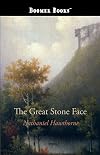
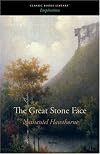
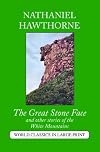
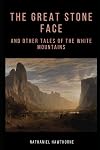
The Great Stone Face and Other Tales of the White Mountains
by Nathaniel Hawthorne
On This Page
Description
This collection of tales is an engaging compendium of Hawthorne's short stories, including many set in and around the writer's native New England. The title story is a charming fable-like tale that takes as its focus a long-famous geological feature in the New Hampshire mountains (the face-like granite protrusion collapsed in 2003)..
Tags
Recommendations



















Member Reviews
A simple, pleasant set of four stories. Hawthorne's style is definitely out of fashion now, verbose and rather sentimental, but although these now seem quite dated, I found they worked well for these stories. They're simple, almost humble stories, all based loosely on some real thing or event. I don't think I'd want to read a lot of his work, as it feels simplistic and the style now grates a bit, but these were fine.
The Ambitious Guest - (Kinda cool irony, but not much of a story. Guy wants to be something before he dies and then he dies.)
The Great Carbuncle - (Too obviously moralistic. The greedy people pay, the good people leave it behind.)
The Great Stone Face - (Interesting and kind of cool. One day a great man will come and he will have the face of the mountain.)
The Great Carbuncle - (Too obviously moralistic. The greedy people pay, the good people leave it behind.)
The Great Stone Face - (Interesting and kind of cool. One day a great man will come and he will have the face of the mountain.)
Ratings
Members
- Recently Added By
Author Information

881+ Works 79,418 Members
Nathaniel Hawthorne was born on July 4, 1804 in Salem, Massachusetts. When he was four years old, his father died. Years later, with financial help from his maternal relatives who recognized his literary talent, Hawthorne was able to enroll in Bowdoin College. Among his classmates were the important literary and political figures Horatio Bridge, show more Henry Wadsworth Longfellow, and Franklin Pierce. These friends supplied Hawthorne with employment during the early years after graduation while Hawthorne was still establishing himself as a legitimate author. Hawthorne's first novel, Fanshawe, which he self-published in 1828, wasn't quite the success that he had hoped it would be. Not willing to give up, he began writing stories for Twice-Told Tales. These stories established Hawthorne as a leading writer. In 1842, Hawthorne moved to Concord, Massachusetts, where he wrote a number of tales, including "Rappaccini's Daughter" and "Young Goodman Brown," that were later published as Mosses from an Old Manse. The overall theme of Hawthorne's novels was a deep concern with ethical problems of sin, punishment, and atonement. No one novel demonstrated that more vividly than The Scarlet Letter. This tale about the adulterous Puritan Hester Prynne is regarded as Hawthorne's best work and is a classic of American literature. Other famous novels written by Hawthorne include The House of Seven Gables and The Blithedale Romance. In 1852, Hawthorne wrote a campaign biography of his college friend Franklin Pierce. After Pierce was elected as President of the United States, he rewarded Hawthorne with the Consulship at Liverpool, England. Hawthorne died in his sleep on May 19, 1864, while on a trip with Franklin Pierce. (Bowker Author Biography) show less
Series
Belongs to Publisher Series
Work Relationships
Classifications
- Genres
- Fiction and Literature, General Fiction
- DDC/MDS
- 813.33 — Literature & rhetoric American literature in English American fiction in English Middle 19th Century 1830-1861 Hawthorne, Nathaniel 1804–64
- LCC
- PS1852 .H6 — Language and Literature American literature American literature Individual authors 19th century
- BISAC
Statistics
- Members
- 71
- Popularity
- 432,814
- Reviews
- 2
- Rating
- (4.00)
- Languages
- English, German, Turkish
- Media
- Paper, Audiobook, Ebook
- ISBNs
- 27
- ASINs
- 9